
-
Paper Information
- Next Paper
- Previous Paper
- Paper Submission
-
Journal Information
- About This Journal
- Editorial Board
- Current Issue
- Archive
- Author Guidelines
- Contact Us
International Journal of Mechanics and Applications
p-ISSN: 2165-9281 e-ISSN: 2165-9303
2013; 3(5A): 8-12
doi:10.5923/s.mechanics.201308.02
Laser Emission Monochromatism Breaking Caused by Friction
 Abstract
 Reference
 Full-Text PDF
 Full-text HTML
D. N. Lubimov1, N. K. Vershinin1, K. N. Dolgopolov1, L. S. Pinchuk2
1Engineering Center, Lubimov & Co, Ltd, Shahty, Rostov-on-Don Region, 346500, Russia, Jonov St., 106a
2V.A. Belyi Metal-Polymer Research Institute, National Academy of Sciences, Gomel, 246050, Belarus, 32a Kirov St
Correspondence to: D. N. Lubimov, Engineering Center, Lubimov & Co, Ltd, Shahty, Rostov-on-Don Region, 346500, Russia, Jonov St., 106a.
| Email: |  |
Copyright © 2012 Scientific & Academic Publishing. All Rights Reserved.
The experiment based on optical Doppler effect is described. Its results prove the appearance at friction of physical effects describable by the relativity theory. Under fixed experimental conditions, a shift to long-wave region of electromagnetic spectrum was detected of laser monochromatic radiation passing through friction contact. It has been found experimentally that the spectrum of laser emission transmitted across the contact zone of a PTFE-steel pair shifts to the «red zone» during the friction pair operation. This effect disappeared when the friction machine was switched off. Analysis of results achieved allows to assume the change of the tribosystem proper time as a result of relativistic effects, this allows to relate tribojoints to physical relativistic objects.
Keywords: Tribojoint, Laser Emission, Red Shift, Doppler Effect, Relativity
Cite this paper: D. N. Lubimov, N. K. Vershinin, K. N. Dolgopolov, L. S. Pinchuk, Laser Emission Monochromatism Breaking Caused by Friction, International Journal of Mechanics and Applications, Vol. 3 No. A, 2013, pp. 8-12. doi: 10.5923/s.mechanics.201308.02.
Article Outline
1. Introduction
- In the middle of the last century, while studying the laws of dislocation motion D. Kuhlmann-Wilsdorf had obtained an unexpected result, viz., the equations used to calculate stresses by moving dislocations contain relativistic corrections[1]. The relativistic corrections introduced by D. Kuhlmann-Wilsdorf differ from equations of Lorentz transform in the following. Lorentz relates the speed of a moving object to the light speed whereas D. Kuhlmann-Wilsdorf relates the travel rate of a dislocation to the propagation velocity of a sound wave in metal. The theoretical analysis reported elsewhere[2] shows physical equivalency of these equations. Hence, the Lorentz and D. Kuhlmann-Wilsdorf systems of equations have similar outcome. This means that dislocation streams possess effects predicted by the relativistic mechanics: increased mass of dislocations, their size variation, and retardation of local time in the dislocation region.These effects become the more perceptible, the greater the speed ratio of dislocation and sound propagation. This variable (the expression «relativistic correction» will be used below) may be substantial in the processes of frictional interaction.The speed of individual dislocations may be about 1 cm/min because dislocation streams become thermo stimulated by friction; the surface layers of the tribojoint lose their elastic properties dozens of times. This reduces many times the travel velocity of sound waves through the material area activated by friction[2, 3, 4]. The complex of internal microprocesses initiated by friction can make the value of the relativistic correction quite appreciable. This means that within the substance layer, adjacent to the friction surface, effects may happen unusual for the classical mechanics and tribology but associated with the theory of relativity. These effects can make an unexpected contribution in the microdynamics of friction processes.A tribosurface is a very complicated system for constructing a theoretical model of any microprocesses. In the field of tribology, therefore, experiments are of main importance; on their basis, essential relations between frictional phenomena are being revealed. In physics, there are not many methods for experimental investigation of the effects predicted using the theory of relativity; almost all of them are for observations in astrophysics and nuclear physics. Among these the optical shift caused by the Doppler effect is probably the only method that could be used for studying the relativistic effects in friction[5].The Doppler effect causes shifting of the emitted light spectrum to the short wave («blue») region when the light source and the observer are approaching, while the light of a retreating source, on the contrary, shifts to the long wave («red») part of the spectrum. Thanks to the «red shifting» the American astronomer E. Hubble had discovered the effect of recession of galaxies, which had served as a tentative proof of Universe′s expansion and corroborated the idea of the «Big Bang Theory» of the Universe. An approach or recession of light sources leads to changes in the time required for the observer to receive a signal: in the case of light source recession the signal is delayed; with approach, the signal arrives earlier. This situation may occur when owing to relativistic effects the local time of a physical system is delayed, which is identical to source receding that causes a long wave Doppler shift.The aim of the work is to detect experimentally a Doppler shift in the spectrum of laser emission passing across the contact zone of a polymer-metal pair in friction. Experimental check of the hypothesis of relativistic proper time dilation in dynamic contact of solids.The novelty of the work consists in revelation of fundamental regularities in friction nature in order to explain the effects of tribosystems self-organizing, as well as in finding new ways of friction entropy reduction. These phenomena which theory is based on non-equilibrium thermodynamic principles, have not direct experimental confirmation in tribology. Disclosing of friction relativistic mechanisms will enable go over to a new level in developing smart tribosystems and in methodology of control tribotechnical parameters and lifetime of tribosystems.
2. Material and Methods
- As regards to the methodology and construction of the device for frictional temporal characteristics examination, this work has not analogies. Patents (Russian and international) were applied of measuring device construction [6].The experiments were run using the tribometer Falex of test geometry shaft-bearing. The shaft was made from polytetrafluorethylene (PTFE). This allowed to use a small-sized electric motor, to reduce the vibration level resulting from friction. The bearing was made from a hardened tool steel containing a high quantity of chromium; the friction surface had roughness of 1.25 μm and hardness of 50 HRC. A groove was cut in the friction surface for the light guide. The groove depth was such that the light guide surface – though being extremely close to the frictional contact – did not touch the moving parts of the friction assembly.A general view and diagram of the experimental device are shown in Figure 1. A laser (type TD-GP-04B, GL-303, power 200 mW, laser beam diameter 5 µm, laser beam intensity divergence angle 0,8 mrad, distance 100 m) is attached to one end of the light guide, the other end of it – running through the frictional contact – faces a glass prism; the latter refracts the incident laser beam. The refracted beam through a condenser falls onto an opaque screen having a measuring scale. The friction assembly, the optical table with the prism and the condenser with the screen are fixed on firm bases to prevent effects of mechanical vibrations on the image recordings. Before reaching the screen, the laser beam expands optically, which allows – by the laser spot boundaries – to control unaccounted small vibrations whose presence makes the boundaries smeared. The edge of a laser spot-image was sharp during the experiment, which allows to state with certainty the absence of mechanical vibrations that could distort the results of optical measurements.
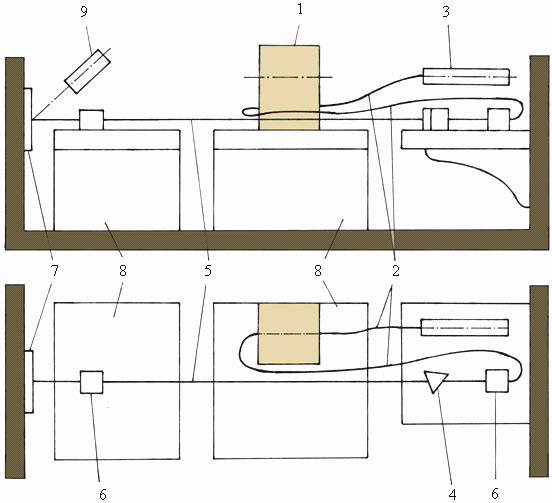 | Figure 1. Schematic diagram of the experimental device: 1 – friction machine; 2 – light guide; 3 – laser; 4 – prism; 5 – laser ray; 6 – condenser; 7 – screen; 8 – bases; 9 – photo-video camera |
3. Results
- A slight shift of the laser beam toward the «red zone» of the visible spectrum was observed after the initial 15 minutes of friction (e.g. Figure 2). The amount of long-wave shifting becomes stable during the first hour of friction and remains unchanged to the end of testing. After the friction was stopped, the laser spot returned to the starting point.The computer estimation of the position of the light spot boundaries on the screen enabled to measure the amount of long-wave shift to the laser spot initiated by friction forces which was about 0.1-0.2 nm.
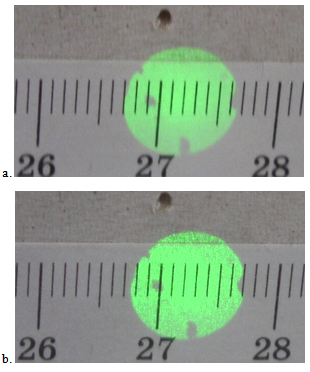 | Figure 2. A shift in laser spot edge on the condenser screen scale: a – before testing; b – after 4.5 h-testing |
4. Discussion
- The experiments ensured recording of changes in the position of the refracted laser beam on the screen caused by frictional forces. According to the Cauchy law of dispersion (known in the field of optics) the refracted index of a substance depends on both the optical properties of the medium – in which the light becomes refracted – and the wave length of the electromagnetic radiation passing through this medium[7].As the positions of the refracting prism and light guides were not changed in the course of the experiment, one may presume that the shift in the refracting laser beam results from a change in its wave length. This change in the spectral composition of the monochromatic laser emission took place under the influence of processes initiated by frictional forces acting between the polymeric shaft and steel bearing. This is unambiguously supported by disappearance of the spectrum shift after the tribometer was stopped.The spectral composition of a laser emission may vary for two reasons: the Doppler shift and effects of nonlinear optics in the light-guide material caused by frictional forces. In substances of a nonlinear relation between the vectors of electric field and magnetic field of light flux, the wave length of the reflected and refracted beams is equal to the wave length of the original emission[8]. Should the linear relation between the electromagnetic field characteristics is broken then the electromagnetic radiation in such a medium propagates witch a change in its spectral composition caused by effects of nonlinear optics[9]. Nonlinear optical effects can result in a variation of the refraction degree of the beam and accordingly its optical shift. Similar effects include:a) self-focusing or self-defocusing caused by deviation of the beam from its original course owing to non-uniform illumination in the beam cross-section;b) generation of short harmonics of frequencies 2ω, 3ω…, where ω is the frequency of an incident monochromatic light wave;c) light scattering on ultrasonic waves leading to changes in the emission spectral composition.Nonlinear optical effects of self-focusing and generation of multiple harmonics may not be immediately taken into consideration when the reasons affecting an optical shift are discussed. These effects lead to different external developments – in comparison with the recorded ones – first of all to variations in the quantity and size of optical spots which do not correspond to the laser spot appearance in Figure 2. Besides, the nature and mechanisms of these nonlinear optical effects do not allow to connect them with the action of frictional forces upon a medium.A light wave may scatter over ultrasonic oscillations because friction can excite surface elastic waves within the acoustic range of frequencies[10]. Acoustic waves are regions of compression and evacuation propagating in a medium and creating – in a light guide – optical non uniformities on which the initial light emission can scatter. The scattered light field, however, changes with time following the law: ~
 , where ω and Ω are the frequencies of light and elastic waves, respectively. This means that the scattered light spectrum consists of a doublet of lines, viz. satellites arranged symmetrically about the base line; they were termed Mandelshtam–Brillouin components. Such arrangement must probably lead to symmetrical «broadening» of the spot on the screen and not to a shift on the wave length scale. The scatter mechanisms of laser emission on a sonic wave generated by friction cannot lead to an optical shift similar to Figure 2. A most probable reason for the shift is the Doppler effect[7, 9].In the theoretical physics there are two reasons which lead to Doppler shifts. One of them results from a change in the distance between the source and detector of a sound of a light signal. The other reason – as explained by the theory of relativity – relates the optical Doppler effect to the difference between extrinsic, or universal, time – which is usually associated with the observer’s time – and intrinsic (local) time of a physical system[11], i.e. in our case the area of friction contact. For a uniform and isotropic space the interval of the extrinsic (universal) time, during which a light wave propagates from the source to the receiver, is independent of the wave direction; as a result, the number of oscillations (frequency, wave length) happening in a unit of the universal time is the same in all points of the light beam. However, in the Lorentz transform different amounts of intrinsic time – which are the greater, the farther is the observer from the force field source – correspond to one and the same interval of the universal time. From the observer’s point of view a stated interval of the universal time contains a fewer number of oscillations of the electric vector of a light wave, which is identical to the long-wave spectral shift. That is, if in some force field a signal of wave length λ1 travels from a point of potential U1 to a point of potential U2 the signal’s wave length reduces to
 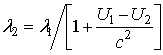 , where c is the light speed. According to the forecasts made by A. Einstein a long-wave Doppler shift in a light beam directed vertically upwards to the Earth surface had been recorded. At a height of 10 m the magnitude of «red shift» Δλ/λ was 10-15 to accuracy of 1%[12]. In the case of red shift initiated by frictional forces this magnitude is 10-4, which is 1011 times as much as the gravitational Doppler shift. Such a considerable difference can be explained by multiply large magnitudes of energy of electromagnetic fields in comparison with a weak gravitational interaction.In line with the salient points of the theory of relativity, time delay is connected to distorted four dimensional space-time continuum whose size, in the end, is set by the potentials U1 and U2. The values of these potentials created by electromagnetic forces generated by friction must exceed dozens of billions of times the «gravitational» potentials U1–U2. This logical reasoning gives a clue to an explanation of large Doppler shifts.The following expression is for calculating the Doppler effect:
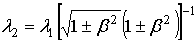 | (1) |
 ; the sign «minus» corresponds to the moving off the source from the receiver; the sign «plus» to their approach;
  is the speed of source’s relative motion; с is the speed of wave propagation in a medium.Assuming
  , we neglect higher degrees in parameter β when expanding the product in (1), and have the following:
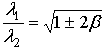 | (2) |
5. Conclusions
- 1. The main conclusion resulting from the analysis of the research results is the recognition of a high probability that the effects predicted by the theory of relativity show themselves in friction and influence it. This conclusion is in agreement with those made elsewhere[14] by the Nobel Prize winner L.D. Landau («recording of relativistic effects… may be connected not only with the high speed (comparable with the light speed) of macroscopic motion…, equations undergo considerable changes also in the case if this speed is not high, but the speeds of microscopic motion of particles making up a body are high»), and in work[1] by D. Kuhlhmann-Wilsdorf who substantiated theoretically the relativistic mechanisms of motion for fast dislocations.The experimentally revealed «Doppler red shift» in a laser beam traveling across a friction zone allows to classify tribojoints as physical relativistic objects.2. Since the triborelativistic effects mentioned have been detected at mild load-and-speed operating regimes of a friction pair, one may presume that the manifestation of laws of the theory of relativity is rather general in nature.3. In view of the said above, a triboassembly, in accord with the technology of Nobel Prize Winners A. Geim and K. Novoselov[15], may be related to the «new scientific paradigm, namely, relativistic physics of a solid body, where quantum relativistic events, a part of which haven’t been realized even in the high-energy physics, can now be investigated at common laboratory conditions». A friction assembly being a unique natural phenomenon (in the opinion of Russian tribologist, prof. D.N. Garkunov) is such an object which can be used to study most fundamental laws of Nature.
ACKNOWLEDGEMENTS
- The authors would like to thank the LIK Co, Ltd for providing the funds for this work and Mrs. V. Moiseenko for the help in manuscript preparing.