
-
Paper Information
- Paper Submission
-
Journal Information
- About This Journal
- Editorial Board
- Current Issue
- Archive
- Author Guidelines
- Contact Us
Research in Zoology
2012; 2(2): 1-6
doi: 10.5923/j.zoology.20120202.01
A Note on Annual Bidirectional Movement of Butterflies at South-Eastern Plains of India
 Abstract
 Reference
 Full-Text PDF
 Full-Text HTML
T. Ramesh 1, K. Jahir Hussain 2, K. K. Satpathy 2, M. Selvanayagam 1
1Loyola Institute of Frontier Energy (LIFE), Loyola College, Chennai, 600034, India
2Environmental and Safety Division, Indira Gandhi Centre for Atomic Research, Kalpakkam, 603102, India
Correspondence to: K. Jahir Hussain , Environmental and Safety Division, Indira Gandhi Centre for Atomic Research, Kalpakkam, 603102, India.
| Email: |  |
Copyright © 2012 Scientific & Academic Publishing. All Rights Reserved.
North-South bidirectional migration of butterflies was seen at coastal areas of Kalpakkam in the months of October and July respectively. A 10 meter wide imaginary strip was chosen to assess the swarm density. The migration was huge during October (2009) and relatively less in July (2010). Migratory swarm was comprised of three species viz., Catopsilia pyranthe, Catopsilia pomona and Papilio demoleus. Totally 34,556 individuals were observed. In the swarm, C. pyranthe and P. demoleus constituted 86% of the total count. The activity of migratory swarms increased during the peak day hours (12.00 to 13.30 hr), but the movement was varied between seasons. The daily migratory activity appears to be shaped by temperature. However the existence of an endogenous control cannot be overruled. We believe that this migration is not only the rain avoidance movement but also to avoid competition at the site of emergence and to utilize the availability of larval host plant resources at the destination site.
Keywords: Butterfly Migration, Seasonal Movement, Catopsilia Pyranthe, Papilio Demoleus, Catopsilia Pomona, Kalpakkam
Article Outline
1. Introduction
- The habit of migration is found in all families of the Rhopalocera (butterflies). This behavior is frequent in the Pieridae, Danaidae and the Nymphalidae and less common in Lycaenidae and Hesperiidae. Generally to and fro movement of the butterfly population between two areas at different seasons of the year is regular[1]. As ethological and ecological aspects are involved, migratory behavior is difficult to define and it differs from one insect group to another. There are many theories have been proposed to describe migration. Johnson[2] states that migration is a special category of mass dispersive movements. In Rainey’s[3] opinion, migration is simply a “seasonal displacement of populations”. According to Williams[4], migration is a continued movement in a more or less definite direction in which both movement and direction are under the control of the animal concerned. Schneider[5] opines that, migration seems always to be related to the well known escape movement, a phase of the active life releasing the insect from sites which previously had been attractive for it or its parents. These movements are related with periodism in climate and growth of the vegetation and may replace diapauses[6]. In Southern India, butterflies’ migration has been documented since the beginning of 20th century[7,8]. Moreover, occasional butterfly migration that take place in central India and Northern Western Ghats[9-17] and Southern Western Ghats have also been well documented[7,8,18-22]. Till now there is no theoretical explanations have been developed to address the reasons behind the migration (except Danainae migration[22]), its exact path and destinations. Relatively much has been studied in the Western Ghats, but there is a paucity of information on butterfly migration at coastal plains of Tamil Nadu. During our regular butterfly monitoring, we had an unique opportunity to study a seasonal bidirectional movement at Kalpakkam (Tamil Nadu, India). In this paper, we report the composition and seasonality of buttery swarm, and the reasons behind the migration and the influence of climatic factors on migration.
2. Materials and Methods
2.1. Study Area
- DAE (Department of Atomic Energy) campus at Kalpakkam (12º 33.7’N and 80º 10.5’ E ~2500 acres) is located 60 km South of the city, Chennai (Tamil Nadu, India). It encompasses seashore and a vast plain area of the Bay of Bengal. The coastal system forms the complex natural site, where intense interactions occur among land, sea and atmosphere. It spreads through the biologically diverse and productive habitat of native flora, and fauna and aesthetically blended with introduced vegetation. The main natural vegetation observed at DAE campus is dry-evergreen and scrub comprising of members predominantly belonging to the families Poaceae, Fabaceae, Cyperaceae, Asteraceae, Euphorbiaceae, Verbenaceae, Solanaceae, Rubiaceae, Convolvulaceae and Amaranthaceae[23].
2.2. Field Observation
- The butterfly migration at Kalpakkam was observed during October 15, 16 and 19 (2009), and July 10, 14 and 15 (2010). The migratory band was at least few hundred meters wide, but for accurate quantification of swarm a 10 meter wide imaginary strip was chosen[22] at the swarms way and the numbers of butterflies passing through this strip over a 15 minutes duration were counted without collecting them. 20 such observations were taken between 10.00 to 15.00 hr.
3. Result
3.1. Species Composition
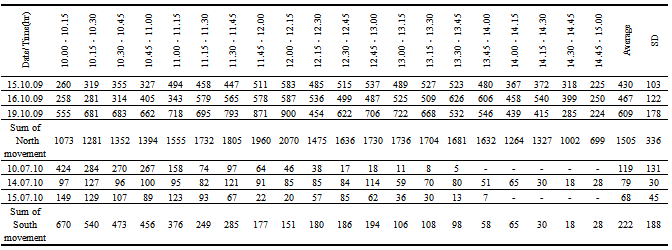
- A large bidirectional migratory flights of butterflies viz., Catopsilia pyranthe, Papilio demoleus and Catopsilia pomona at Kalpakkam during October (2009) and July (2010) was observed. Overall 34,556 individuals were observed during sampling days. In which the Catopsilia pyranthe comprised 57.6% of total individuals, followed by Papilio demoleus (28.3%) and Catopsilia pomona (14%). During October, totally 30,108 individuals were observed and density of Catopsilia pyranthe was remarkable (19,098 individuals). The second dominant species was Papilio demoleus (9,261 individuals) and finally 1,749 individuals of Catopsilia pomona were observed. But in July (2010) the total numbers were very less compared to October and the dominant species was Catopsilia pomona (Table 1). In addition, considerable numbers of Tirumala septentrionis, Euploea core, meager numbers of Graphium sarpedon and Graphium nomius wandered along with swarm during July.
3.2. Directional Movement and Periodicity of Migrant Swarms
- In this bidirectional movement, 30,108 individuals flew towards North direction during October and it comprised 87% of the total count. In July, totally 4,448 individuals flew towards the Southward direction. Interestingly, movements towards North direction were 6.7 times more than that of Southerly direction. The peak activity of migratory swarms was found between 11.00 to 13.30 hr during October and highest number was observed at 12.00 noon (2,070 individuals). The lowest was observed at 15.00 hr (699 individuals). However, during July, peak activity was observed at early counts and the numbers declined rapidly as the day progresses (Table 2).
3.3. Daily Pattern
- The total numbers of butterflies observed at every one hour interval between 10.00 to 15.00 hr is represented as percentage of the total numbers sighted in a day. Figure 1 (a, b) shows the pattern of flight activity through six days between October (15, 16 and 19) and July (10, 14 and 15). It was observed that the daily pattern of activity changes as the migratory seasons progresses. The curve of daily density pattern was more or less like bell-shaped, and this trend indicated that butterflies activity tends to concentrate within a narrow time intervals around noon in October. In the case of July, peak activity was observed during the morning hours and drastically decreased in the noon, completely absent at 15.00 hr. A minor variation among different days which was observed could be attributed to several factors such as wind direction, wind speed and cloud cover.
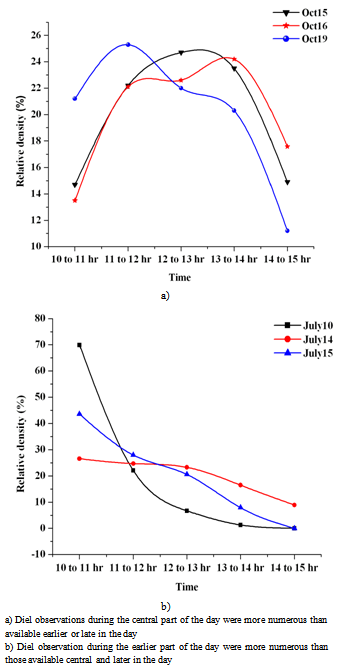 | Figure 1. Migratory activity during sampling days in the month of October and July |
3.4. Correlation between Swarm Density and Abiotic Factors
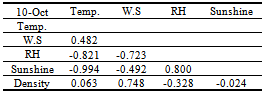
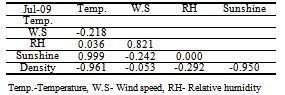
- Generally the swarm movement was found to be synchronized with local micro climate. Mainly it was governed by following factors namely temperature, wind speed, relative humidity and sunshine. The correlation analysis between weather parameter and swarm density was calculated and correlation co-efficient values are given in Table 3&4. Data on these parameters for particular time intervals were collected from the meteorological station at IGCAR (Indira Gandhi Centre for Atomic Research), Kalpakkam. The butterfly swarm was negatively correlated with mean atmospheric temperature during July (r=0.961), whereas wind speed was positively correlated with mean butterfly density during October (r = 0.748).
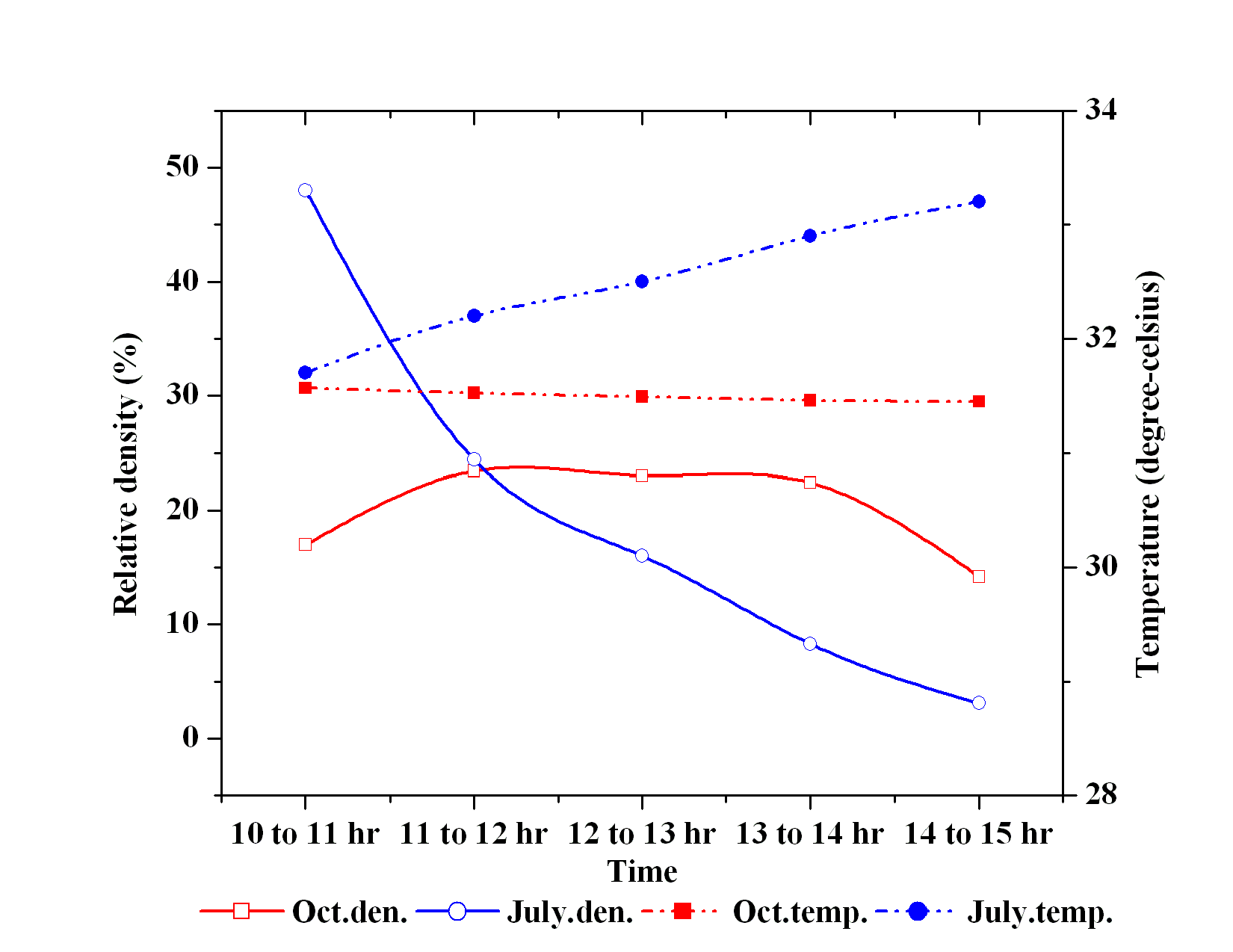 | Figure 2. Pooled diel incidence of migratory swarm and temperature during different seasons |
|

|
|
|
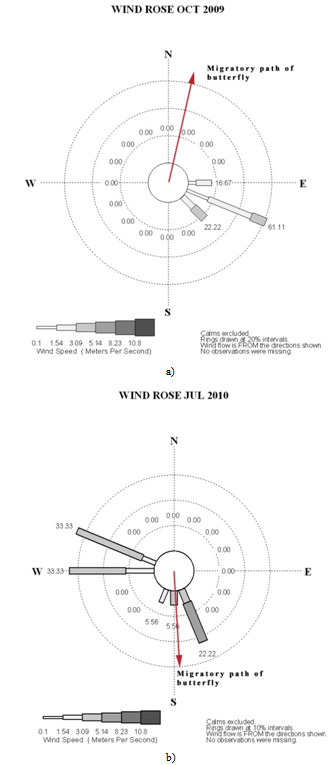 | Figure 3. a,b: Direction of wind flow and orientation of butterfly swarm during October and July (Data of three days in each season were presented) |
4. Discussion
- Totally 1,255 species of butterflies have been recorded in India[24], out of which 52 species are reported to be migratory in nature[14]. Migratory butterflies belong to the genera, Catopsilia, Junonia, Vanessa, Euploea, Paranatica, Danaus, Papilio, Cynthia, Pieris, Appias and Lampides. Eventhough much has been reported on this interesting phenomenon of butterfly migration still very little is understood about this subject. In Southern India the butterfly migration has been documented since the turn of the 19th centaury[7]. In addition, the interesting migration of butterflies between mountains and plains were reported by Williams[14], Larsen[19], Mathew and Binoy[21], and Kunte[22]. The earlier reports indicated that, the migratory tendency among butterflies was predominately evolved during the months of March-July and October-November, to avoid unfavorable climatic conditions, especially North-East Monsoons (NEM) and South- West Monsoons (SWM). To the best of our knowledge there is no published record of Catopsilia migration in the coastal plains of Tamil Nadu, which is well known for their migratory behavior. The first and authentic migratory record of Catopsilia species came from Patton, who observed Northerly migrating Catopsilia at Madras (now Chennai) during November 1918, which was reported by Williams[25]. After 90 years we report the same species (Catopsilia pomona and Catopsilia pyranthe) which were migrating towards North during October (2009). Similarly Papilio demoleus along with above mentioned species was found migrating towards South during the month of August at Kodaikanal hills[14], which corroborates with our observation during July (2010).In temperate region, the migration depends or closely related to the temperature changes, in the tropics the climatic relations are more uncertain, but in Southern India they are definitely related to the changes of the monsoons[1]. During the present investigation the migratory tendency started just before onset of monsoons such as NEM (October) and SWM (July). Earlier studies[26-28] also suggest that temperature and precipitation are two vital factors which influence butterfly population directly. Moreover, wind speed and wind direction also influence the swarm movement. Larsen[19] opined that, the direction of the flight cannot have been much modified by wind direction, though strong cross wind would lead to a considerable drift. During present observation during October, the swarm flew across the wind, whereas during July the swarm not only flew across the wind but also flew against it. The wind opposing movement during July could be the reasons for reduced migration (density) of butterflies. It is also known from literature that the butterflies are quite frequently flying in one direction being in large numbers than the opposite flights[1]. One has to keep in mind that the larval host plant availability/phenology during different seasons is also the vital factor governing the abundance pattern of different species of butterflies. From previous study it is clear that the adult activity especially oviposition of Catopsilias and Papillio demoleus were closely associated with wet seasons between June– November, which was mainly attuned with their larval host plant resource. Moreover, the unique summer rains (especially in plains of Tamil Nadu) initiate the reproductive activity in Catopsilias and subsequent emergence of next generation of butterflies just before the SWM (July- September), which triggers this interesting dispersal phenomenon. Hence the first summer rain plays a crucial role in deciding the time of migration. Interestingly the summer rains differ from region to region, thus causing a slight variation in commencement of July migration. The considerable availability of larval host plant prior (July-September) to NEM and subsequent major rainfall during this monsoon makes NEM, the most abundant period for Catopsilias and Papillio demoleus, which is evident in our observation during October.Butterflies being poikilothermic organisms, the daily variations of solar radiation, temperature, wind and humidity may have profound effects on when a butterfly should be active and what it should be doing at any given time. The periodicity of the butterfly movement was found to be very high during mid days between 12.00 to 13.00 hr at Southern Western Ghats[20,21]. In the present study we observed peak migration between 12.00 to 13.00 hr during October and at 09.30 hr during July. The activity varied from seasons to seasons. The inconsistency of the daily flight activity between the seasons indicates that the onset of migration is not only governed by a major factor like temperature but also likely to be under the influence of internal rhythm.
5. Conclusions
- It’s concluded that the North-South bidirectional migration of Catopsilias and Papilio demoleus at coastal areas of Tamil Nadu varies between seasons. We believe that the probable reason for this unique movement is to avoid competition in ancestral ground and to utilize the copious availability of host plant resources at the destination site; however, the excessive rain avoidance theory cannot be overruled, because the origin of migration is unclear. This investigation constitutes the base for a long term study, to clarify the origin and destination of migrants and the driving mechanism.
Acknowledgments
- Authors are grateful to Dr. Baldev Raj, former Director, IGCAR for his continuous encouragement and support. Authors are also thankful to P. Kumaran, M.K. Velayutham, and K.N. Balaji of EnSD, IGCAR for their help during field work.