
-
Paper Information
- Paper Submission
-
Journal Information
- About This Journal
- Editorial Board
- Current Issue
- Archive
- Author Guidelines
- Contact Us
International Journal of Textile Science
p-ISSN: 2325-0119 e-ISSN: 2325-0100
2026; 15(1): 10-17
doi:10.5923/j.textile.20261501.02
Received: Jul. 12, 2026; Accepted: Aug. 6, 2026; Published: Aug. 13, 2026

Restoration of Tubo Female Costume from Xiatatu Tomb No.1 Based on Style3D Technology
 Abstract
 Reference
 Full-Text PDF
 Full-text HTML
Zhiyu Hui
New Media Art College, Xi'an Polytechnic University, Xi'an City, Shaanxi Province, P.R. China
Correspondence to: Zhiyu Hui, New Media Art College, Xi'an Polytechnic University, Xi'an City, Shaanxi Province, P.R. China.
| Email: |  |
Copyright © 2026 The Author(s). Published by Scientific & Academic Publishing.
This work is licensed under the Creative Commons Attribution International License (CC BY).
http://creativecommons.org/licenses/by/4.0/

The painted side panels of the coffin board from Tomb No.1 at Xiatatu in Guolimu Township provide visual materials for understanding the culture of the Tubo period. Costume restoration is an important approach to studying the historical and cultural aspects of clothing. This study examines the female costume depicted on the coffin board through iconographic analysis and employs Style3D technology to achieve a digital restoration of the female attire. The results demonstrate that using digital restoration techniques for costume research is feasible. The application of Style3D technology enhances both the accuracy and efficiency of the research, offering new possibilities for the innovative development of traditional art forms. The findings of this study can provide new perspectives for archaeological research on clothing and hold significant value for cultural heritage preservation and the study of traditional arts. Furthermore, they may serve as a reference for contemporary fashion design and material exploration.
Keywords: Tubo period, Painted coffin board painting, Female costume, Style3D technology
Cite this paper: Zhiyu Hui, Restoration of Tubo Female Costume from Xiatatu Tomb No.1 Based on Style3D Technology, International Journal of Textile Science, Vol. 15 No. 1, 2026, pp. 10-17. doi: 10.5923/j.textile.20261501.02.
Article Outline
1. Introduction
- The painted wooden coffin boards from Tomb No.1 at Xiatatu were severely damaged upon excavation, yet some sections of the paintings have been preserved and have drawn significant scholarly attention. Currently, certain parts of these coffin board paintings remain relatively well preserved, particularly side panel A of the coffin board from Tomb No.1, which features exquisite motifs and rich scenes, whereas the images on side panel B are largely indistinct. Moreover, the female figures on side panel A are clearer and more complete than those on side panel B, providing more historical and cultural information. The styles, colors, and patterns of the female costumes are relatively distinct, facilitating a deeper understanding of women's costume culture during the Tubo period. Additionally, the scenes and figures on side panel A contain more information regarding social status, ritual customs, and other aspects, all of which serve as important clues for studying the art of female costume in the Tubo period. In contrast, side panel B offers limited information due to its blurred imagery and is therefore not a focus of this study.At the International Conference on Tibetan Archaeology and Art held in August 2002, Xu Xinguo of the Qinghai Provincial Institute of Cultural Relics and Archaeology first presented materials from the painted coffin boards of Tomb No.1 at Xiatatu to conference participants, sparking widespread interest [1]. In 2006, the third issue of Chinese National Geography magazine published tracings and photographs of the coffin board paintings made by Liu Chuncheng of the Qinghai Provincial Institute of Cultural Relics and Archaeology, bringing these artifacts to the attention of a broader audience [2]. Luo Shiping, in his article "Heavenly Banquet: An Interpretation of the Tubo Coffin Board Paintings from Guolimu, Haixi Prefecture, Qinghai," conducted a more in-depth examination of the imagery and themes of the coffin board paintings [3]. These studies and publications reflect the progress and current state of academic research on the painted coffin boards from Tomb No.1 at Xiatatu. This research team plans to build upon existing scholarly findings regarding these coffin board paintings to conduct an in-depth analysis of female costume styles, color applications, and pattern designs from the Tubo period. By employing Style3D digital technology and three-dimensional dynamic presentation techniques, this study aims to reconstruct the original appearance of Tubo-period female attire, thereby providing a more intuitive and accurate reference for the study and preservation of the art of female costume from this period.
2. Historical Background
- The region where Tomb No.1 at Xiatatu is located was initially a territory of the Tuyuhun during the early Tang Dynasty and was later conquered by the Tubo, becoming a vassal state under Tubo rule [4]. Therefore, the female images depicted on the coffin boards may also reflect a fusion of Tuyuhun and Tubo cultures. The historical background of the female figures on side panel A of the coffin board from Tomb No.1 at Xiatatu is closely associated with the culture, religion, and social structure of the Tubo period.
2.1. Funeral Rituals and Social Status
- According to relevant archaeological materials, the female images on side panel A of the coffin board from Tomb No.1 at Xiatatu are closely associated with funeral rituals. This may be related to the Bon funerary practices prevalent during that period. Bon is an ancient religion of the Qinghai-Tibet Plateau, whose funeral ceremonies often included rituals such as shamanic music and dance [5]. These female figures hold a prominent position on the coffin board, adorned in elaborate garments with decorative fabrics featuring linked patterns on the lapels and cuffs. This suggests that they likely belonged to the aristocratic class, were related to the deceased, and played significant roles in Bon funeral ceremonies [6].
2.2. Costume Culture and Social Change
- The elegance and refinement of the female costumes depicted on the coffin board reflect the clothing culture and aesthetic trends of the society at that time. Details of these female garments, such as triangular-lapel long robes and front-fastening straight-collar long robes, reveal cultural exchanges along the Qinghai Route of the Silk Road, demonstrating the impact of such cross-cultural interactions [7]. The attire worn by the Tuyuhun or Tubo figures on the coffin board shares numerous similarities with the clothing of Sogdian nobles depicted in stone sarcophagi unearthed in Shanxi and Shaanxi, as well as with the Sogdian, West Asian Persian, and Kucha figures found in the murals of the Dunhuang Thousand Buddha Caves and the Kizil Caves [8].
2.3. Cultural Exchange and Influence
- The female costumes on the painted wooden coffin boards exhibit the influence of Central Asian Sogdian culture. Sogdian culture has a long history and distinctive characteristics. As prominent merchants along the Silk Road, the Sogdians were known as the "Phoenicians of the Silk Road" [9]. They not only played a crucial role in material trade but also served as intermediaries in cultural exchange, facilitating economic and cultural interactions between the East and West. The female costumes depicted on the painted wooden coffin boards, particularly the triangular-lapel belted long robe, were highly popular among the Tubo and Tuyuhun peoples on the Qinghai-Tibet Plateau. This garment style bears similarities to Sogdian attire and may have been transmitted to the Qinghai-Tibet Plateau region via the Silk Road [10].The historical background of the female images on side panel A of the coffin board from Tomb No.1 at Xiatatu is multidimensional, encompassing aspects such as religious beliefs, social structure, and cultural exchange, providing important contextual information for this study of Tubo-period society.
3. Characteristics of Female Images
- The coffin board of Tomb No.1 at Xiatatu consists of two panels, Panel A and Panel B. This study focuses on the female attire of the Tubo period depicted on Panel A. Panel A is located on the left side of the painted coffin, presenting a composition that is higher on the right and lower on the left. Its imagery is widely recognized and has become a focal point of academic research. Panel A depicts scenes such as ox hunting and other hunting activities, featuring over 40 figures, including 10 horses, 3 deer, 3 yaks, 1 dog, and 1 camel [11].To the right of the felt tent, several women are arranged in a row, but due to partial blurring of the imagery, only four female figures are clearly discernible. These women have their faces painted with ocher pigment. The three women on the left wear round-necked tight-fitting robes underneath, with front-fastening straight-collar long robes as outer garments. The woman on the far right wears a triangular-lapel left-fastening long robe, with the collar and cuffs adorned with colorful patterned brocade edges decorated with linked pearl motifs. The hairstyles of these women resemble those of the women inside the felt tent, with hair hanging naturally without braiding, falling at the back of the head and alongside the ears. These details provide valuable information for our digital restoration efforts and contribute to a deeper understanding of the costume culture and social status of women during the Tubo period.
3.1. Headdress and Hairstyle
- In the banquet scene of Xiatatu M1-A, four Tubo women are depicted (Figure 1). Their hairstyle is characterized by hair that is partially combed up and partially left loose, with the hair brushed forward from the back. A small bun is arranged at the forehead, and pearls or gemstones adorn the forehead or temples. A circular linked-pearl hair ornament is placed at the center of the forehead, or a headscarf is used to add fullness to the hairstyle. This hairstyle and headdress not only reflect the aesthetic preferences of Tubo women but may also be associated with religious or social customs of the period. For instance, linked-pearl hair ornaments held significance in cultural exchanges along the Silk Road, with similar adornments appearing in Sogdian art [12].
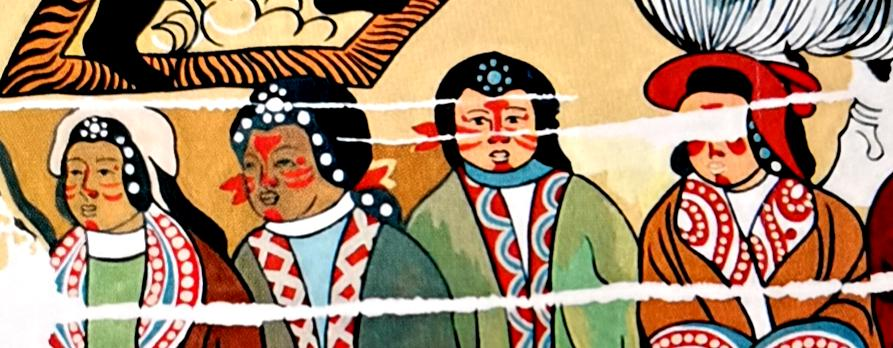 | Figure 1. Female Headdress in the Banquet Scene of Xiatatu M1-A(Source: "Who Are the Figures Painted on the Coffin Board?" Chinese National Geography, Vol. 3, 2006, p.91) |
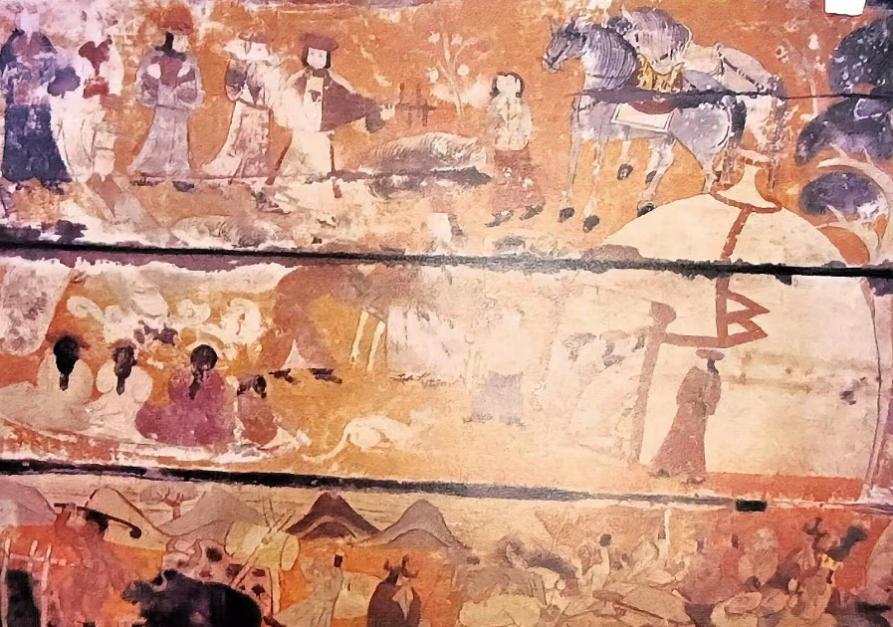 | Figure 2. Detail of Side Panel—Millennium-Old Memories of the Silk Road (Qinghai Route): Ancient Painted Coffin Board Paintings Along the Route |
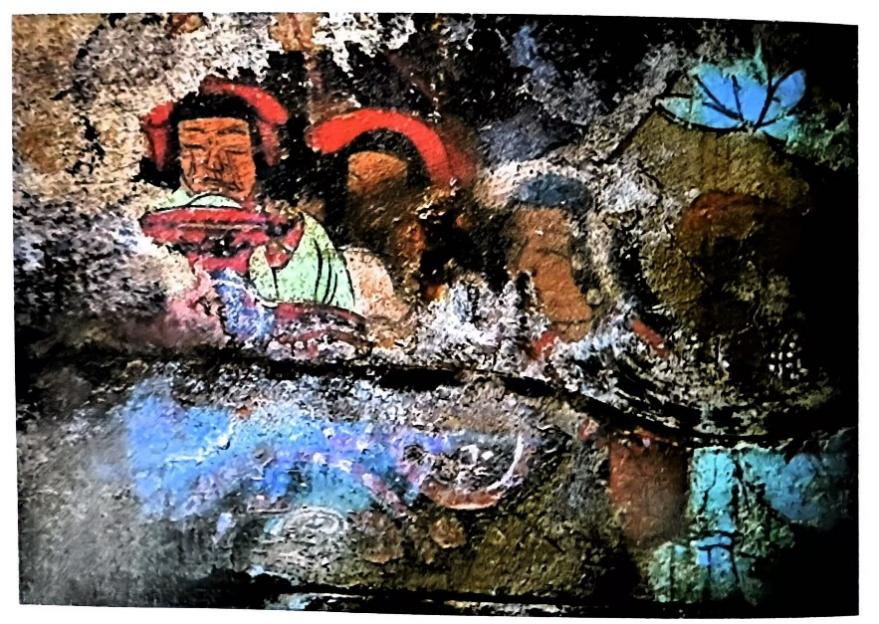 | Figure 3. Detail of Side Panel—Millennium-Old Memories of the Silk Road (Qinghai Route): Ancient Painted Coffin Board Paintings Along the Route |
3.2. Costume and Color
- As shown in Figure 4, on the painted wooden coffin board unearthed from the Xiatatu tombs in Guolimu Township, Qinghai, the three women on the left wear front-fastening straight-collar long robes that reach the ankle or floor. The overall silhouette is smooth, reflecting the women's dignity and elegance. The design of these garments not only emphasizes practicality but also reflects the aesthetic concepts of the time. The sleeves are mostly wide or straight, with cuffs that may be slightly tapered, facilitating movement while offering decorative appeal. The woman on the far right wears a triangular-lapel left-fastening long robe, with the collar and cuffs adorned with colorful patterned brocade edges decorated with linked-pearl motifs.
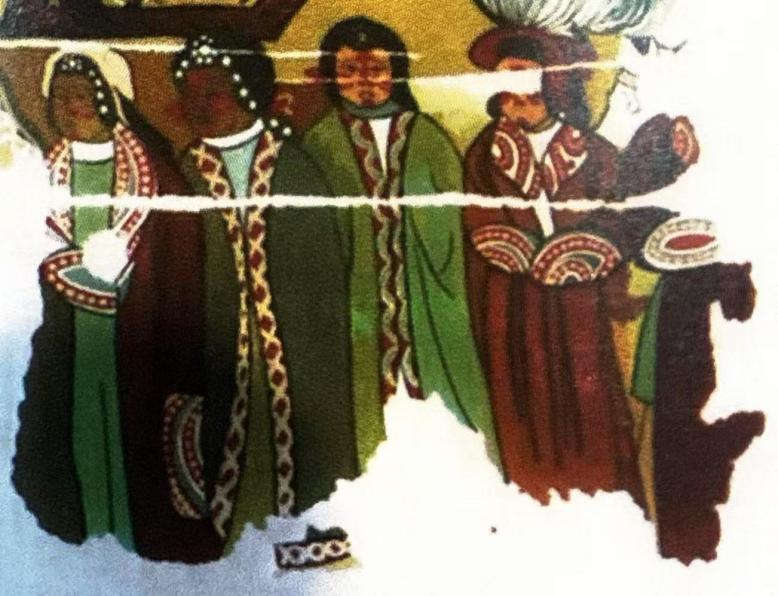 | Figure 4. Detail of Side Panel-Millennium-Old Memories of the Silk Road (Qinghai Route): Ancient Painted Coffin Board Paintings Along the Route (Source: Chinese National Geography, Issue 3, 2006, p. 94) |
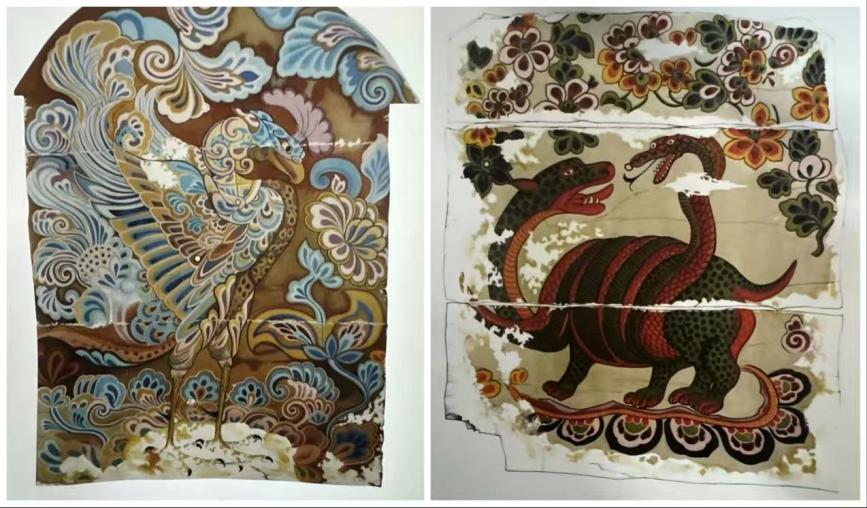 | Figure 5. Left: Panel One; Right: Panel Two—Partial Views of Painted Wooden Coffin Boards, Haixi Prefecture Ethnic Museum |
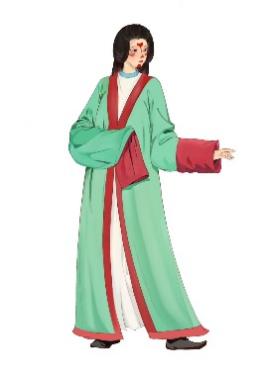 | Figure 6. Planar Rendering of the Front-Fastening Straight-Collar Long Robe |
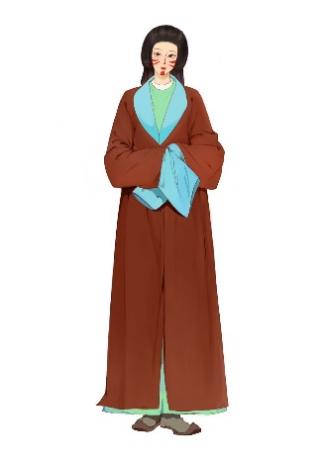 | Figure 7. Planar Rendering of the Triangular-Lapel Left-Fastening Long Robe |
4. Definition of Female Costume Patterns
- Through our research on the fragmentary silk tapestry with pearl roundel patterns and the fragmentary silk tapestry with hanging curtain patterns from the Tang Dynasty preserved in the Shōsō-in Repository in Nara, Japan, it can be observed that the patterns on the costumes of the Tibetan female figures on the right side panel A of the Xiata Tomb No. 1 exhibit typical characteristics of pearl roundel patterns (Figure 8).
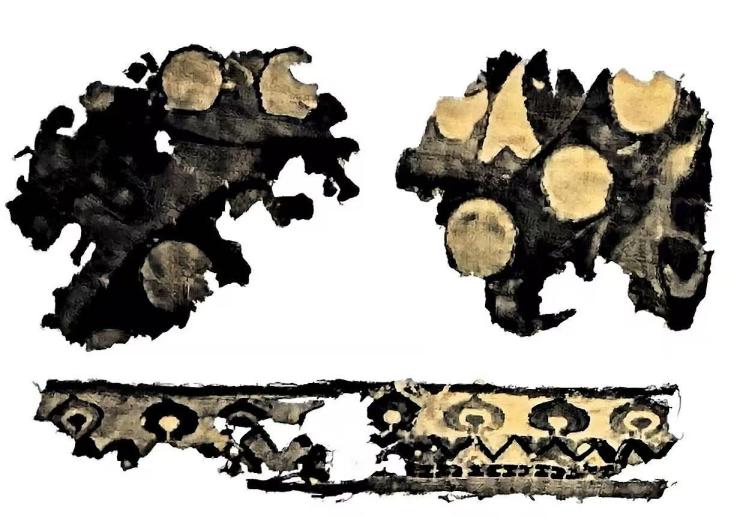 | Figure 8. Linked-Pearl Pattern Kesi Fragments and Valance Curtain Kesi Fragments (Source: 7,000 Years of Chinese Silk Technology and Art, p. 109; Currently preserved at the Shōsō-in, Nara, Japan) |
5. Three-Dimensional Restoration Process
- Digital technology has become one of the key means for preserving historical and cultural heritage sites [18]. Through advanced techniques such as high-precision scanning, photogrammetry, and three-dimensional modeling, cultural heritage can be comprehensively and accurately documented. These records encompass not only the appearance of cultural heritage but also detailed information such as materials, structure, and texture, forming valuable digital archives. These archives provide a solid data foundation for the preservation of cultural heritage, enabling long-term storage of information and effectively mitigating damage caused by natural disasters, human activities, and other factors.Among the various digital technologies, Style3D stands out due to its proprietary underlying algorithms for simulating the physical properties of clothing [19]. This technology enables high-precision digital restoration based on actual fabrics, allowing virtual garments to move flexibly within digital space while exhibiting realistic texture and dynamic beauty. This capability makes it particularly suitable for accurately restoring the styles, fabrics, textures, and decorative details of Tubo-period female attire, providing valuable references for researchers of historical clothing. Therefore, Style3D technology was selected as the supporting technology for restoring the Tubo female attire depicted on the painted wooden coffin boards, in order to better preserve and represent the unique charm of this historical cultural heritage.Based on the detailed dimensional data of the Tubo female robes depicted on the aforementioned coffin boards, and following the restoration study of patterns, styles, and construction, CAD software ET was used for three-dimensional garment modeling, proceeding sequentially through modeling and pattern making. Concurrently, Style3D technology was employed for virtual stitching, fabric simulation, and dynamic simulation, ultimately achieving a comprehensive three-dimensional digital restoration of the female robe system.In the three-dimensional virtual display of clothing, the body measurements of the virtual model play a crucial role in the restoration outcome. Therefore, based on the actual dimensions of the garment, a height of 165 cm was selected as the base data for the virtual model, upon which the human body model was constructed. Additionally, reference was made to the small size specifications for women in the national standard GB/T 1335.2-2008 Standard Sizing Systems for Clothing—Women.
5.1. Pattern Making
- Given that ancient Chinese clothing predominantly employed two-dimensional cutting techniques, this study conducted virtual two-dimensional digital cutting and pattern making using the garment CAD software ET. Subsequently, the two-dimensional garment patterns of the female robe (Figure 9) were imported into the Style3D platform for virtual stitching, fabric simulation, and dynamic simulation, aiming to achieve a more accurate digital restoration. As a modern three-dimensional garment design tool, ET presents certain technical challenges when handling loose-fitting ancient robes. Due to the large dimensions of the pattern pieces for ancient robes, the overlapping of fabric allowances makes it difficult for subsequently added fabrics to precisely adhere to the key points of the three-dimensional human model. This often results in disorganized three-dimensional stitching and structural confusion among the pattern pieces. To address this issue, larger pattern pieces were subdivided into multiple smaller pieces for individual pattern making during the production process. These pieces were then progressively reassembled during the virtual stitching stage, thereby enhancing restoration accuracy and operational convenience.
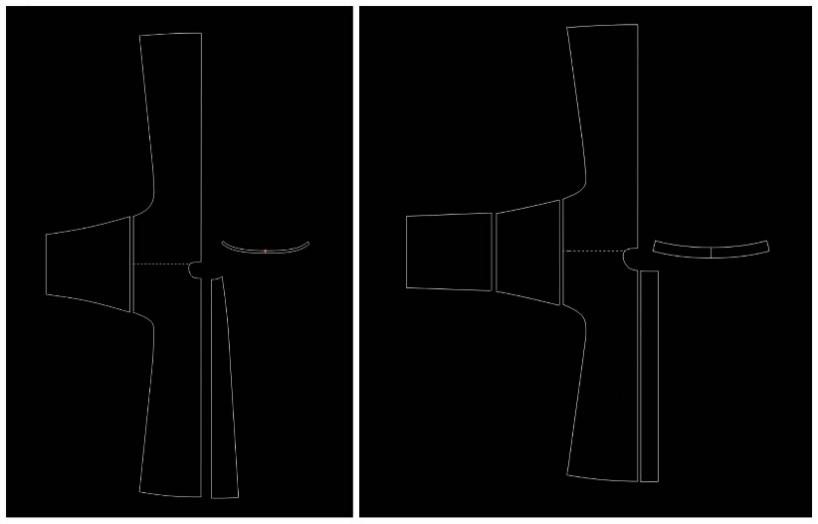 | Figure 9. Two-Dimensional Garment Patterns |
5.2. Virtual Stitching
- In the "Arrangement Points" mode, each pattern piece was precisely positioned onto the corresponding area of the human model. Subsequently, tools such as "Segment Sewing" and "M:N Free Sewing" were employed to perform virtual stitching of the three-dimensional pattern pieces (Figure 10). During the stitching process, the actual sewing methods of the garment pieces were strictly followed, while the spatial relationship between overlapping and underlying pieces was carefully considered to avoid overlapping or crossed stitching, thereby ensuring a smooth and accurate stitching process. Ultimately, the virtual try-on effect was achieved through this series of meticulous operations (Figure 11).
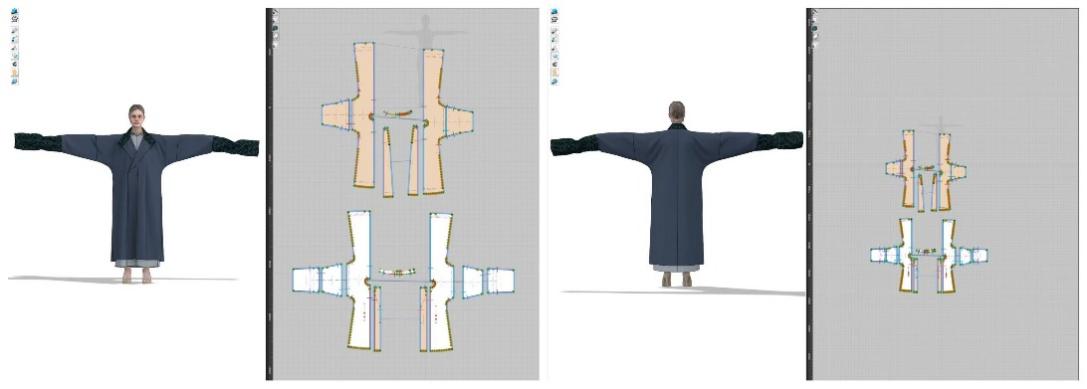 | Figure 10. Virtual Stitching of Three-Dimensional Pattern Pieces |
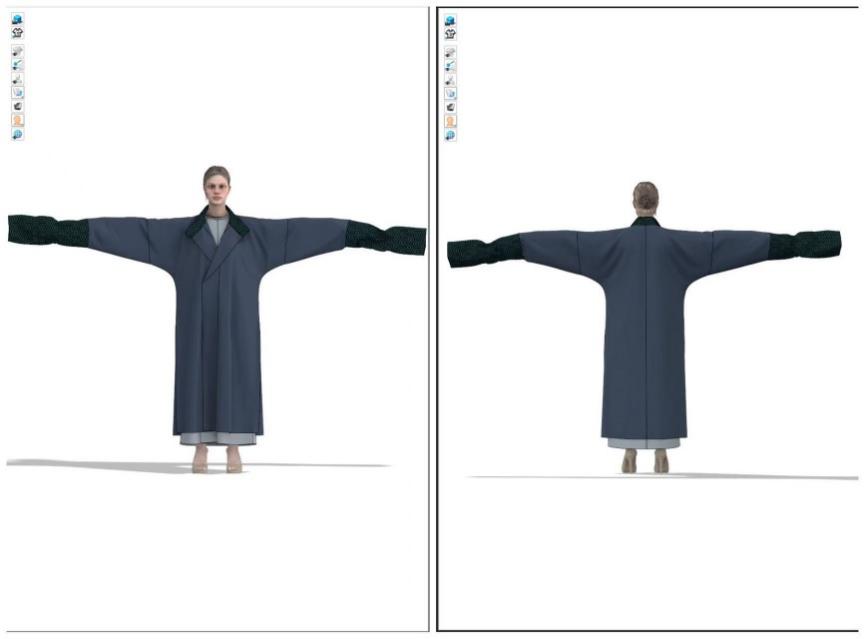 | Figure 11. Virtual Try-On Effect |
5.3. Dynamic Simulation
- In the final stage, the assembled three-dimensional robe model was compared with the original costume depicted on side panel A of the coffin board from Tomb No.1 at Xiatatu. Local morphological optimizations were performed to achieve a closer correspondence between the reconstructed model and the pictorial representation. As the hat model was developed using an independent UV layout, this component was separately selected for color calibration and material appearance optimization, resulting in a complete digital reconstruction of the female costume system.
6. Conclusions
- As a historical and cultural heritage of the Tubo period, the coffin board paintings on side panel A of Tomb No.1 at Xiatatu embody the cultural characteristics of that era. The protection of such valuable cultural heritage remains a globally shared concern. In this study, we focused on the female costumes depicted on the painted wooden coffin boards, conducting research on their colors, patterns, and structures, and employed Style3D technology to restore these garments. The following conclusions were drawn:(1) The female costumes depicted on the painted wooden coffin boards represent the typical triangular-lapel long robe style of female attire during the Tubo period.(2) The female costumes predominantly feature a vivid red as the primary color tone, while skillfully incorporating diverse colors such as blue, green, and white. The patterns on the garments are primarily linked-pearl motifs, with collars and cuffs adorned with colorful patterned brocade edges. These characteristics not only reflect the aesthetic preferences of women at that time but also indicate the social status of women during the Tubo period.(3) This study confirms that employing Style3D technology for the restoration of historical costumes is entirely feasible. The application of this technology opens new avenues for the digital preservation and research of historical and cultural heritage.(4) From the perspective of cultural relic preservation, the digitization of historical costumes not only contributes to the protection of these precious cultural heritages but also enables a broader public to access and appreciate humanity's cultural heritage through digital means.In summary, the above conclusions supplement the research on female costumes of the Tubo period. However, further investigation is needed regarding the styles and patterns of female costumes depicted on painted wooden coffin boards from other periods, as well as the differences in female attire across various historical periods.
Declarations
- Ethics approval and consent to participateNot applicable. This study is a historical costume reconstruction based on archaeological data and does not involve human or animal subjects, thus no ethical approval is required.Consent for publicationNot applicable. This manuscript contains no individual person’s data, so consent for publication is not required.Data availabilityThe datasets generated and analyzed during the current study (including Style3D model files, archaeological records, and reconstruction materials) are available from the corresponding author on reasonable request.Competing interestsThe author declares that there are no competing interests.FundingThis research received no specific grant from any funding agency in the public, commercial, or not-for-profit sectors.