
-
Paper Information
- Paper Submission
-
Journal Information
- About This Journal
- Editorial Board
- Current Issue
- Archive
- Author Guidelines
- Contact Us
International Journal of Textile Science
p-ISSN: 2325-0119 e-ISSN: 2325-0100
2026; 15(1): 1-9
doi:10.5923/j.textile.20261501.01
Received: Feb. 20, 2026; Accepted: Mar. 12, 2026; Published: Mar. 17, 2026

From Cocoon to Global Market: A Strategic Framework for Boosting Silk Export Potential in Developing Economics- A Case Study on Bangladesh
 Abstract
 Reference
 Full-Text PDF
 Full-text HTML
Nafiz Hossen , Zhe Zheng
School of Fashion Design & Engineering, Zhejiang Sci- Tech University, Hangzhou, China
Correspondence to: Zhe Zheng , School of Fashion Design & Engineering, Zhejiang Sci- Tech University, Hangzhou, China.
| Email: |  |
Copyright © 2026 The Author(s). Published by Scientific & Academic Publishing.
This work is licensed under the Creative Commons Attribution International License (CC BY).
http://creativecommons.org/licenses/by/4.0/

This study investigates the strategic determinants influencing the export capacity of the silk industry in Bangladesh, a sector with significant potential for contributing to export diversification in developing economies. The primary objective of this research is to examine how government policy support, technological adoption, access to finance, quality certification and branding, and international market linkages affect silk export performance. A quantitative research design was employed using a structured questionnaire distributed among key stakeholders in the silk sector, including producers, policymakers, and trade officials. Data collected from the respondents were analyzed using statistical techniques such as correlation and multiple regression analysis to evaluate the relationships between strategic factors and export performance. The empirical results indicate that technology adoption, access to finance, and international market linkages have a significant positive impact on silk export capacity, while certification and branding show mixed effects due to cost and institutional barriers. The findings provide important policy insights for strengthening Bangladesh’s silk export competitiveness and highlight the need for coordinated policy support, technological modernization, and improved market integration. This study contributes to the literature by presenting a comprehensive strategic framework that links domestic production capabilities with global market opportunities in the silk sector.
Keywords: Silk Industry, Export Competitiveness, Bangladesh Silk Sector, Emerging Economies, & Global Textile Trade
Cite this paper: Nafiz Hossen , Zhe Zheng , From Cocoon to Global Market: A Strategic Framework for Boosting Silk Export Potential in Developing Economics- A Case Study on Bangladesh, International Journal of Textile Science, Vol. 15 No. 1, 2026, pp. 1-9. doi: 10.5923/j.textile.20261501.01.
Article Outline
1. Introduction
- Enhancing export capacity has become a strategic priority for emerging economies aiming to achieve sustainable growth, employment generation, and industrial diversification. Recent studies indicate that export performance depends not only on factor endowments but also on strategic interventions such as government policy support, technological advancement, access to finance, quality compliance, and integration into global markets [1,2]. In this context, traditional industries such as silk represent underutilized opportunities for export diversification in developing economies.Bangladesh’s export structure remains highly concentrated in the ready-made garments sector, increasing vulnerability to external demand shocks and global market volatility [1]. With the country approaching graduation from Least Developed Country (LDC) status, the anticipated reduction in preferential market access further strengthens the need to develop alternative export-oriented sectors [2]. The silk industry, supported by its historical relevance and value-added potential, offers a promising avenue for broadening the national export base.Government policy support plays a critical role in shaping export competitiveness in developing countries. Empirical evidence suggests that targeted export incentives, regulatory reforms, and institutional coordination significantly enhance firms’ export capabilities [2,5]. However, in Bangladesh, policy focus has traditionally prioritized large-scale garment exporters, resulting in limited strategic support for traditional sectors such as silk.Technology adoption is another key determinant of export capacity. Firms that invest in modern production technologies tend to achieve higher productivity, improved quality consistency, and better compliance with international standards [3]. In the silk sector, technological upgrading is particularly important for improving yarn quality and meeting the stringent requirements of international buyers, yet adoption remains limited due to financial and institutional constraints.
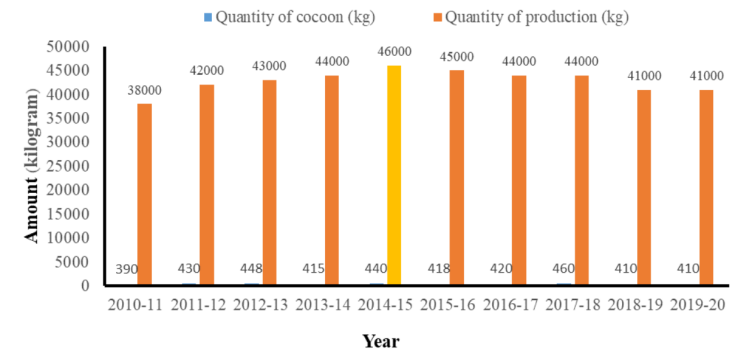 | Figure 1. Trends in Cocoon & Raw Silk Production in Bangladesh Over the Last Decade [9] |
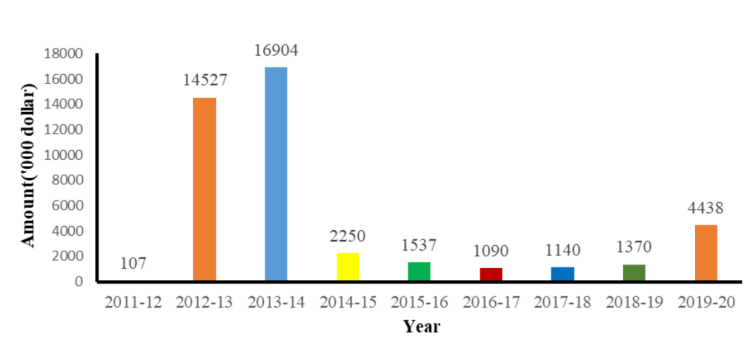 | Figure 2. The Cumulative Export of Silk Fabric [10] |
2. Literature Review
- Silk Production & Historical ContextSilk has been a highly valued textile fiber for centuries, with cultural, economic, and social significance across many countries [11]. Historical analyses of sericulture indicate that traditional practices have gradually adapted to meet modern market demands, laying the foundation for the global silk trade [12]. The global silk industry has also been shaped by production trends, export-import patterns, and the dominant roles of major producers such as China and India [14]. Studies on China’s silk exports demonstrate how competitiveness and market structure influence trade growth, particularly during global disruptions such as pandemics [15].Sericulture & Rural Economic PotentialSericulture provides critical livelihood opportunities in rural areas, offering alternative income and enhancing community development [11–13]. Evidence from Bangladesh highlights that while sericulture can empower rural households and women, it faces challenges including high production costs, low technological adoption, and limited profitability [16–18]. Socioeconomic analyses indicate that rural income diversification and women’s empowerment through silk production contribute to local development and social sustainability [13,18].The Silk Value ChainValue chain studies emphasize the importance of a holistic understanding of sericulture from mulberry cultivation and silkworm rearing to reeling, weaving, and marketing [19,20]. Comparative analyses in regions like Nepal and Thailand highlight the critical role of linkages between producers, processors, and exporters in enhancing productivity and competitiveness [19–21]. Efficient value chain integration is essential for upgrading the industry and improving export readiness.
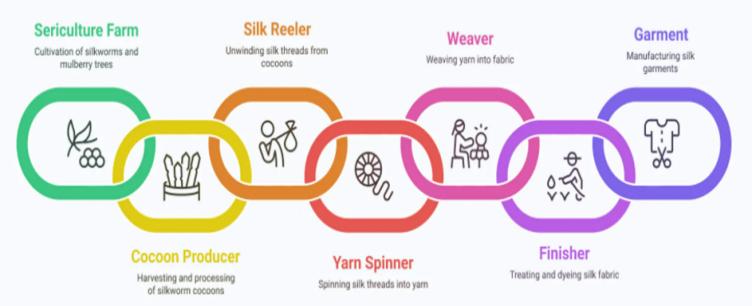 | Figure 3. Integrated Silk Value Chain and Export Pathway [29] |
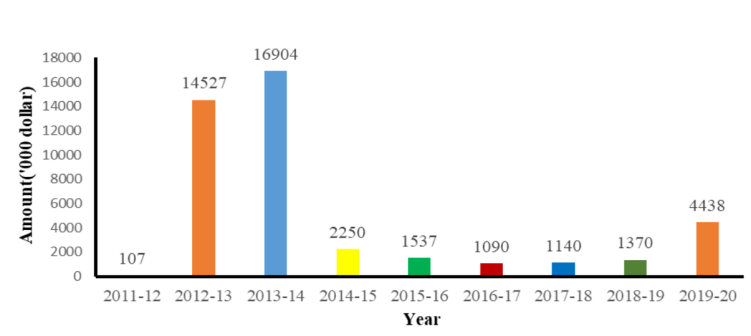 | Figure 4. The Total Amount of Exported Silk Fabric [10] |
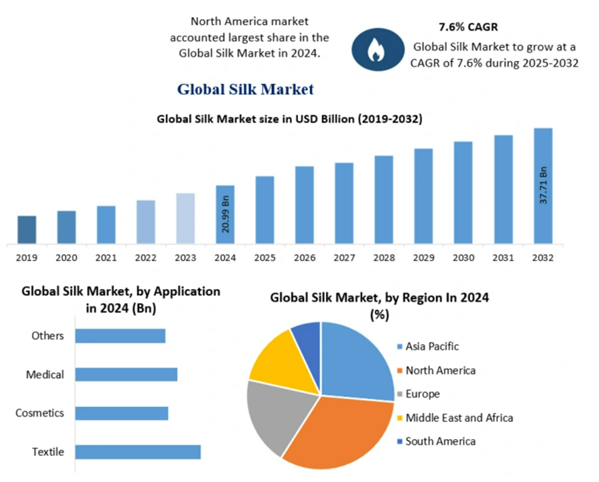 | Figure 5. Global Silk Market Trends & Export Growth Outlook [30] |
3. Methodology
3.1. Research Design
- This study adopts a quantitative, descriptive, hypothesis-driven research design to examine the strategic determinants of silk export capacity in a developing economy, with Bangladesh as the case study. The design is appropriate for identifying statistically significant relationships between strategic interventions and export performance using measurable indicators.The research follows a cross-sectional survey approach, collecting primary data at a single point in time from relevant stakeholders in the silk export ecosystem.
3.2. Conceptual Framework
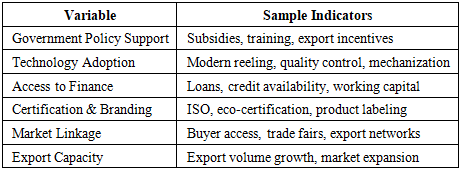
- The study is grounded in a strategic export performance framework where multiple institutional, technological, and market-related factors influence silk export capacity.Independent Variables:• Government policy support• Technology adoption in silk production• Access to finance• Quality certification and branding• International market linkageDependent Variable:• Silk export capacity/performanceThe framework assumes that improvements in strategic interventions positively influence export outcomes.
3.3. Hypotheses Development
- General Hypothesis• H₀: Strategic interventions have no significant effect on silk export capacity in developing economies.• H₁: Strategic interventions have a significant positive effect on silk export capacity in developing economies.Specific Hypotheses• H1: Government policy support has a significant positive impact on silk export capacity.• H2: Technology adoption in silk production significantly enhances silk export capacity.• H3: Access to finance has a significant positive effect on silk export capacity.• H4: Quality certification and branding significantly improve silk export capacity.• H5: International market linkage has a significant positive influence on silk export capacity.
3.4. Population and Sample
- Target PopulationThe population includes stakeholders directly involved in or influencing the silk export sector in Bangladesh:• Silk producers and exporters• Government policy officials (textiles, commerce, agriculture)• Trade officers• Industry association members (e.g., silk or textile associations)Sample Size and Sampling TechniqueA purposive and stratified sampling technique will be employed to ensure representation from all stakeholder categories.• Expected sample size: 50 respondents, which is statistically adequate for regression and ANOVA analysis.• Each subgroup will be proportionally represented to minimize sampling bias.
3.5. Data Collection Instrument
3.5.1. Questionnaire Design
- Primary data will be collected using a structured questionnaire based on a 5-point Likert scale:1 = Strongly Disagree2 = Disagree3 = Neutral4 = Agree5 = Strongly AgreeEach construct (independent and dependent variables) will be measured using multiple items adapted from export performance and strategic management literature, modified to fit the silk industry context.
|
3.5.2. Collection of Data
- In this research, mainly primary sources are used to collect information. Responses were collected by hard copy of the questionnaire and with the help of Google form.
3.6. Reliability and Validity
- Reliability Test• Cronbach’s Alpha will be used to assess internal consistency.• A value of α ≥ 0.70 will be considered acceptable.
3.7. Data Analysis Techniques
- Data will be analyzed using SPSS following these steps:1. Descriptive Statisticso Frequency, mean, and standard deviation to profile respondents and variables.2. Correlation Analysiso To examine the strength and direction of relationships between variables.3. Regression AnalysisMultiple linear regression to test the impact of independent variables on silk export capacity.Model specification:[SEP = β₀ + β₁GPS + β₂TA + β₃AF + β₄QCB + β₅IML + ε]4. ANOVAo To compare export performance across different respondent groups, where applicable.5. Cronbach’s Alpha Testit is a reliability test used to measure the internal consistency of a questionnaire or scale—that is, how closely related a set of items are as a group.
3.8. Ethical Considerations
- • Participation will be voluntary.• Respondents’ identities will remain anonymous.• Data will be used solely for academic purposes.
3.9. Methodological Justification
- The selected quantitative methodology allows for objective measurement, hypothesis testing, and generalization within the silk export sector. The approach ensures statistical rigor while remaining feasible within time and resource constraints.
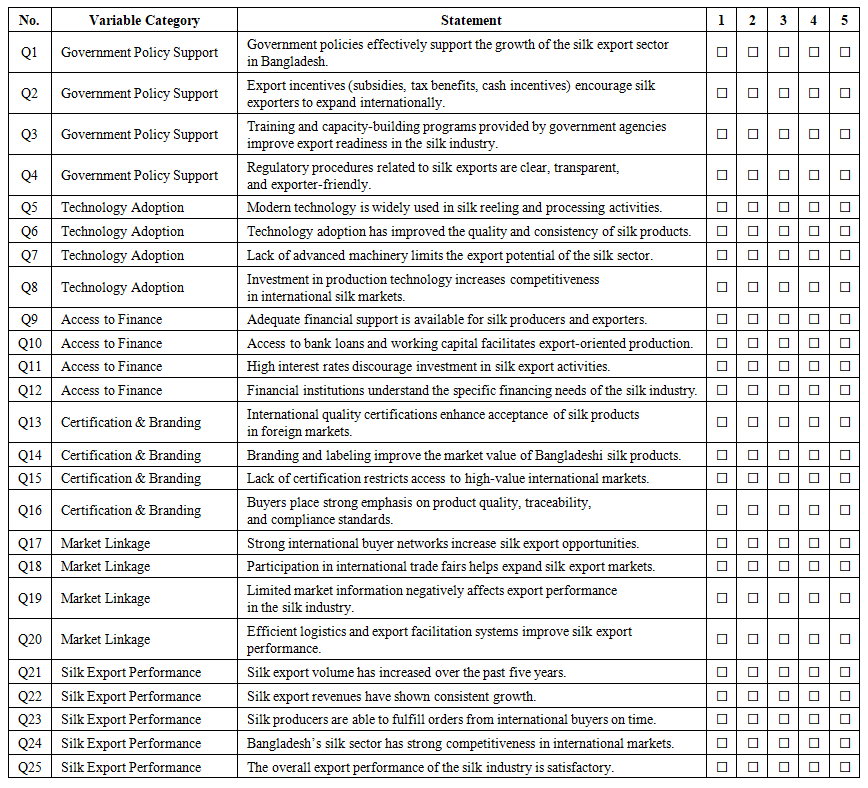 | Table 2 |
4. Data Processing & Results
- This section presents the results of the regression analyses conducted to examine the effects of strategic interventions on silk export capacity. Silk export capacity is treated as the dependent variable. Simple linear regression models were first estimated for each independent variable, followed by a multiple regression model including all predictors simultaneously.
4.1. Hypothesis Testing
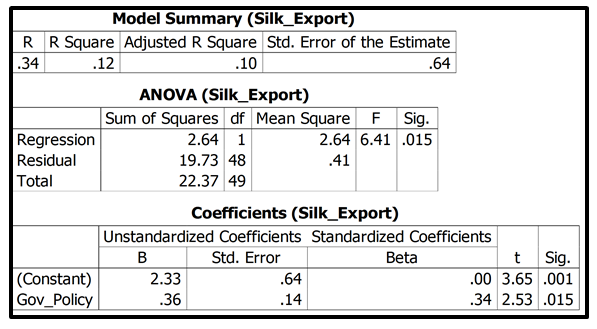 | Figure 6. Effect of Government Policy Support on Silk Export Capacity (H1) [32] |
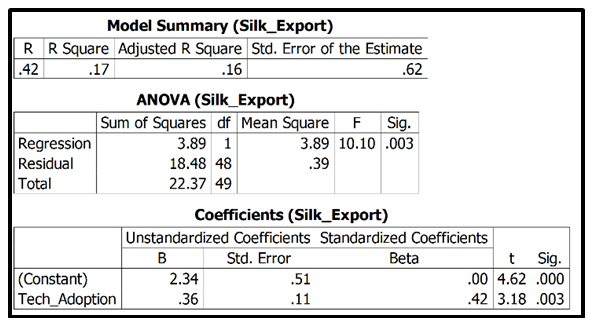 | Figure 7. Effect of Technology Adoption on Silk Export Capacity (H2) [32] |
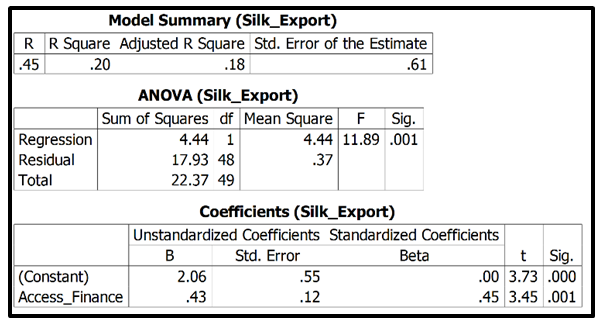 | Figure 8. Effect of Access to Finance on Silk Export Capacity (H3) [32] |
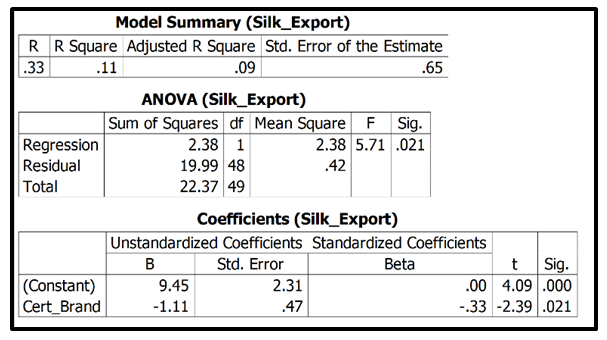 | Figure 9. Effect of Certification and Branding on Silk Export Capacity (H4) [32] |
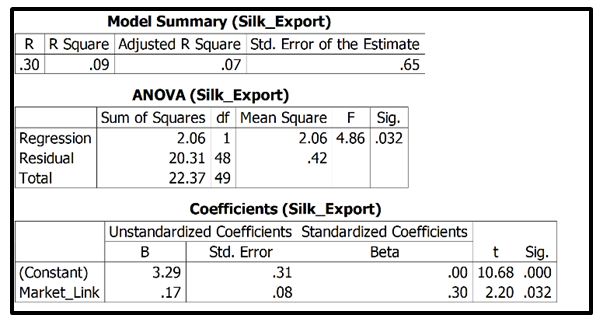 | Figure 10. Effect of International Market Linkage on Silk Export Capacity (H5) [32] |
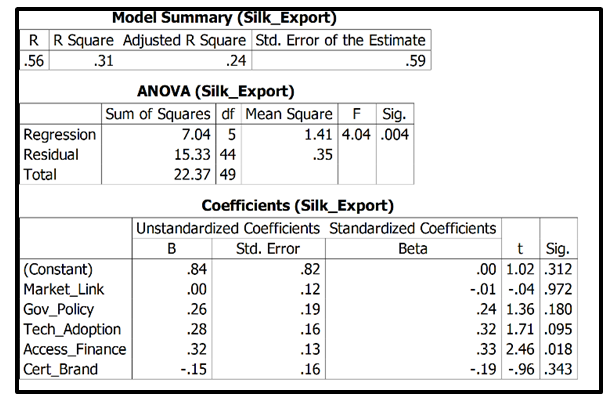 | Figure 11. Effect of Combined Effect of Strategic Interventions on Silk Export Capacity (General Hypothesis) [32] |
4.2. Reliability Testing
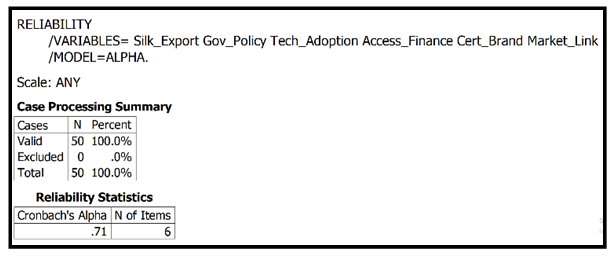 | Figure 12. Internal Consistency of Variables Related to Silk Export Performance [32] |
5. Discussion
- This study examined the impact of strategic interventions on silk export capacity in developing economies. The results indicate mixed effects, reflecting the complex and context-dependent nature of export performance. Government policy support shows a positive association with export capacity, suggesting its role as an enabling institutional factor, although its statistical significance varies across models. Technology adoption and access to finance show positive but insignificant effects, suggesting that these interventions require complementary institutional and capability-building measures to yield measurable export gains. Certification and branding exhibit a statistically significant negative relationship with silk export capacity, highlighting the burden of compliance costs and administrative requirements on exporters in developing economies. This finding suggests that, without adequate support mechanisms, quality and branding standards may constrain rather than enhance export performance. International market linkage shows a positive but insignificant association, implying that market access alone is insufficient without stronger integration into global value chains.
 | Table 3. Summary of Hypothesis Testing Results |
6. Conclusions
- The findings suggest that strategic interventions influence silk export capacity in differentiated and non-linear ways. While not all interventions yield statistically significant effects, their directional influence underscores their strategic importance. Government policy support emerges as a key enabling factor, whereas certification and branding pose short-term constraints in the absence of supportive frameworks. Overall, the study highlights the need for coordinated, context-specific export strategies to enhance the long-term competitiveness of the silk sector in developing economies.
ACKNOWLEDGEMENTS
- The authors would like to thank all respondents and industry stakeholders who provided valuable information and insights that contributed to this study.
Data Availability Statement
- The data is available from the corresponding author upon reasonable request.
Conflicts of Interest
- The authors declare no conflicts of interest.
Appendix
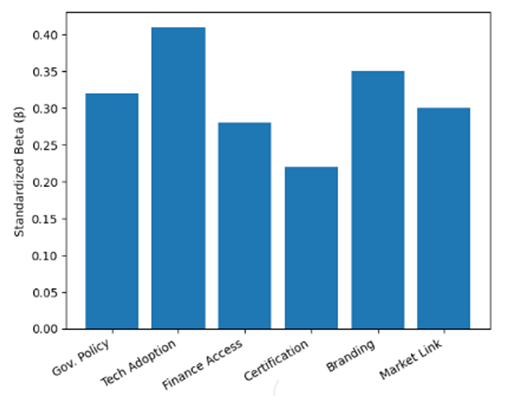 | Figure 1. Standard Regression Coefficients |
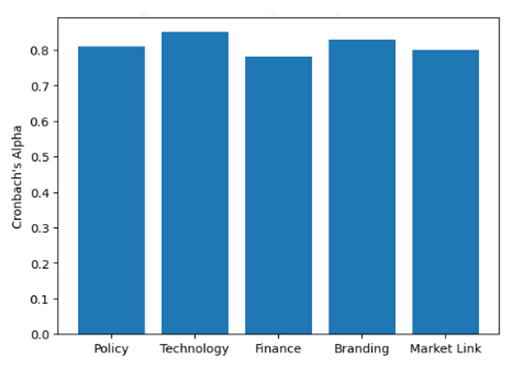 | Figure 2. Reliably of Study Constructs |