
-
Paper Information
- Paper Submission
-
Journal Information
- About This Journal
- Editorial Board
- Current Issue
- Archive
- Author Guidelines
- Contact Us
International Journal of Sports Science
p-ISSN: 2169-8759 e-ISSN: 2169-8791
2026; 16(1): 13-18
doi:10.5923/j.sports.20261601.03
Received: Oct. 6; Accepted: Oct. 20, 2026; Published: Oct. 26, 2026

Attitudes and Opinions of Teachers and Students on Technology Use in Teaching and Learning Physical Education in Public Teacher Training Colleges
 Abstract
 Reference
 Full-Text PDF
 Full-text HTML
George Macharia1, Richaard Ndambiri2, Edwin Boit2
1Physical and Health Education, Kenya School of TVET, Nairobi, Kenya
2Physical Education, Exercise and Sport Science, Kenyatta University, Kenya
Correspondence to: George Macharia, Physical and Health Education, Kenya School of TVET, Nairobi, Kenya.
| Email: |  |
Copyright © 2026 The Author(s). Published by Scientific & Academic Publishing.
This work is licensed under the Creative Commons Attribution International License (CC BY).
http://creativecommons.org/licenses/by/4.0/

Integration of Information Communication Technology (ICT) has significant potential to enhance sports skills in physical activities, particularly in the context of Physical Education (PE). This study aimed at evaluating the attitudes and opinions of PE teachers and students regarding the use of ICTs in teaching and learning PE in Public Teacher Training Colleges (PTTCs) situated in the Western region of Kenya. The findings from this study provide critical insights into the current status of ICT integration in teaching and learning of PE, guiding future efforts to enhance ICT infrastructure, teacher training, and educational strategies in PTTCs. The study adopted a cross-sectional analytical research design. The study targeted a population of 1798 students and 13 PE teachers from four PTTCs in the Western region of Kenya. Stratified and census sampling methods were used to arrive at the sample size for this study. Data were analyzed using the Statistical Package for the Social Sciences (SPSS) version 29 software. Descriptive and inferential statistics were used to summarize coded data. Pearson correlation, simple linear regression were used to test data at a significance level of P≤ 0.05. The results revealed that there is a significant correlation between attitudes and opinions regarding the use of ICTs and effective teaching and learning of PE. In conclusion, the teacher and students have positive attitude towards ICT integration in teaching and learning of PE. The study therefore recommended that there should be increased government funding to support ICT integration in teaching and learning and an establishment of partnerships between PTTCs and technology companies to facilitate access to modern ICTs and resources. In addition, the study has made recommendations for policy, practice and further research.
Keywords: Technology Adoption, Teacher and Student Attitudes, Perceived Usefulness, Skill Performance
Cite this paper: George Macharia, Richaard Ndambiri, Edwin Boit, Attitudes and Opinions of Teachers and Students on Technology Use in Teaching and Learning Physical Education in Public Teacher Training Colleges, International Journal of Sports Science, Vol. 16 No. 1, 2026, pp. 13-18. doi: 10.5923/j.sports.20261601.03.
Article Outline
1. Introduction
- ICT enhances effectiveness in teaching Physical Education (PE) as students can revisit procedures by viewing and getting constructive criticism to address misguided beliefs and inaccurate learning [1]. Information Communication Technologies (ICTs) such as digital cameras, television, and computers are utilized to convey and demonstrate PE skills such as fine motor skills for example tracing and stirring and fundamental movement skills for example throwing, running and catching and therefore improving pedagogy and skill performance [2]. The efficacy of teaching and learning is assessed based on ICT proficiency to make learning enjoyable, easy, and effective; evaluate student performance; engage the learners' visual, auditory, and kinaesthetic learning pathways; improve the capacity to recall; enhance instruction and student performance [3]. Teachers’ and students’ opinions and attitudes concerning ICT devices, as well as the value teachers and students place on them is a determinant for ICT integration [4]. Perceived usefulness and perceived ease of use of ICTs, significantly predict attitudes and opinions toward ICT integration. Students and teachers who feel that ICT may help them study and teach will be more likely to use it. Teachers and students are often prone to have negative attitudes toward ICT integration when it is perceived as difficult to use [5]. Teachers who are sceptical about ICT's benefits are hesitant to incorporate them into their classes [6]. Students who understand the potential benefits of integrating ICT in learning are inspired to properly use ICT in learning [7]. Attitude towards adopting technology to boost efficiency in teaching is the key determinant of whether ICT would be employed in teaching and learning PE [8]. In Kenya’s PTTCs, there are few studies assessing the attitudes and opinions of PE teachers regarding the integration of ICT in PE learning. Therefore, this study was necessary to address the gap. When a teacher feels that adopting ICT in class will improve his or her effectiveness during teaching and believes that using ICT devices would be simple then the results would be a positive attitude toward ICT use [9]. Wanyonyi and Mugo assessed the perception of teachers towards integrating ICT into biology instruction in secondary schools within the southern region of Eritrea. The findings revealed that a significant portion of Biology educators exhibit positive attitudes towards incorporating ICT into the classroom [10]. Odoyo and Omulando assessed attitudes and opinions of teachers about using ICT in teaching English in Nairobi County and found that majority of instructors in high schools have positive opinions and attitudes about the incorporation of ICT in teaching. [11]. There has been limited research undertaken on the attitudes and opinions of students and PE teachers in Kenya the regarding the integration of ICT resources in PE classes in PTTCs. As a result, this study attempted to bridge the gap.
2. Conceptual Framework
- Attitudes and opinions of PE teachers and students towards use of ICTs influence the effectiveness of use of ICTs in teaching and learning of Physical Education. Effective ICT-assisted physical education instruction can make learning engaging, dynamic, an uncomplicated. It can simplify the assessment and evaluation of individual progress. It can allow students to revisit procedures by observing recordings and receiving corrective feedback that addresses misconceptions and gaps in learning. It can ensure that visual, auditory, and kinaesthetic learning channels are engaged, strengthening learners; capacity for retention. It can also improve pedagogy and skill execution.
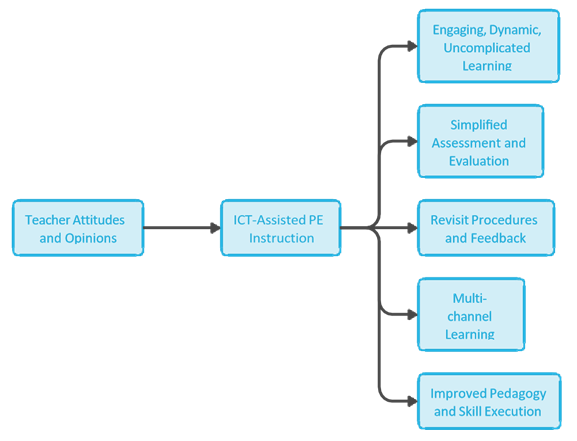 | Figure 1. Effective teaching and learning using ICTs |
3. Material and Method
3.1. Research Design
- This study utilized a cross-sectional analytical research design, which proved effective in describing the present situation and analysing the relationship between dependent and independent variables [12]. The purpose of this design was to measure the association between specific exposures and outcomes within a defined population. The cross-sectional analytical research design is advantageous due to its cost- effectiveness and its ability to randomize data sources, ensuring diverse and representative insights [13].
3.2. Study Population
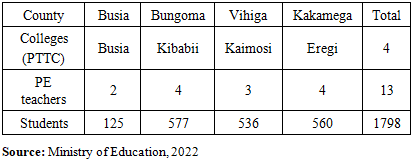
- The study targeted 1798 PE students and 13 PE teachers from the four PTTCs in Western region of Kenya. The table 1 shows the distribution of participants based on their college of affiliation.
|
3.3. Sampling Technique
- A census sampling method was used to include all PE teachers from three PTTC, excluding Kaimosi PTTC which was used for pre-testing. To determine the sample size for students, Cochran's (1997) formula was applied. Thus, no= (Z2pq)/e2 where no is the sample size, p is the proportion of the population (0.5), Z is the confidence level, q is 1–p and e is the margin of error (5%). The sample size was further modified using the Cochran Formula for calculating sample size (1937) [14]. Where, n=n/1+ (no-1)/N. In this context, n represents the adjusted sample size, while N denotes the population. Simple random sampling was used to select students from the three PTTCs. There was equal representation. Sample size was calculated using the Cochran's (1997) formula, where no = (Z2pq)/e2, then no = (1.9622 x 0.5 x 0.5)/ (0.05)2= 385 students. Modifying using the Cochran Formula (1937), where n=n/1+ (no-1)/N, therefore n= 385/ (1+385/1798) = 318 students. Therefore, the sample for the study constituted 318/3 = 106 students from Busia, Eregi and Kibabii PTTCs. In addition, the study included 10 PE teachers from the PTTCs.
3.4. Data Collection Instruments
- The questionnaire consisted of two sections. The first section focused on collecting demographic information about the participants. The second section was adopted from the framework on ICT integration in teacher training institutions provided by the Organisation for Economic Cooperation and Development (OECD, 2023). The questionnaire was validated by lecturers from the Physical Education, Exercise and Sports Science department of Kenyatta University and found to be an appropriate tool for measuring the study objective. The questionnaire helped in capturing the data on the challenges associated with integrating ICT. The researcher conducted interviews with informants, specifically PE teachers, to collect information on the attitudes and opinions regarding the use of ICTs in teaching and learning of PE.PE Teachers were observed in the classroom to provide firsthand information on their attitudes and opinions regarding the use of ICTs in teaching and learning of PE.
3.5. Data Analysis
- Quantitative data were analysed using descriptive statistics, including totals and frequencies, Data was presented in tables. Data from the questionnaires was coded and analysed using SPSS version 29. Descriptive statistics, including, means and standard deviations were used for analysing quantitative data, while inferential statistics was used to test hypothesis at a significance level of (p = 0.05). Pearson correlation was used to examine the relationships, bivariate regression analysis was employed to determine the predictive power of attitudes and opinions of PE teachers and students regarding the use of ICTs on the effectiveness of ICT use in teaching and learning of PE.
4. Results
4.1. Attitudes and Opinions of PE Teachers and Students Regarding the Use of ICT Resources in Teaching and Learning PE in PTTCs
- The respondents were asked to indicate their level of agreement or disagreement with the statements relating to attitude and opinions regarding the use of ICT resources in teaching and learning and their responses were rated on a five-point Likert scale.
|
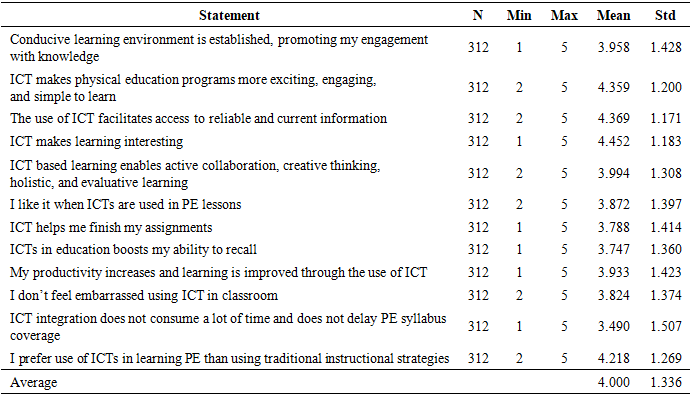
 = 3.958, SD = 1.428). The respondents also strongly agreed that ICT makes physical education programs more exciting, engaging and simple to learn (
 = 4.359, SD = 1.200), with respondents emphasizing the use of ICT facilitates access to reliable and current information (
 = 4.369, SD = 1.171). Similarly, they strongly agreed that ICT makes learning interesting (
 = 4.452, SD =1.183) and ICT based learning enables active collaboration, creative thinking, holistic, and evaluative learning (
 = 3.994, SD =1.308). The respondents indicated that they like when ICTs are used in PE lessons (
 = 3.872, SD =1.397). The mean score of 3.788 suggest a high level of agreement among respondents regarding ICT helping the respondents finish their assignments. Additionally, majority of respondents agree that ICTs in education boosts their ability to recall (
 = 3.747, SD =1.360). Similarly, the mean of (
 = 3.933, SD =1.423) indicates that the respondents agreed that productivity increases and learning is improved through the use of ICT. The respondents strongly agreed that they don’t feel embarrassed using ICT in the classroom (
 = 3.824, SD =1.3824). Respondents moderately agreed that ICT integration does not consume a lot of time and does not delay PE syllabus coverage (
 = 3.490, SD =1.507). The mean of (
 = 4.218, SD =1.269) indicates strong agreement among the respondents that they prefer use of ICTs in learning PE than using traditional instructional strategies. The overall average across all the statements was 4.008, with a standard deviation of 1.336, indicating that respondents have a positive attitude towards the use of ICTs. This shows that respondents generally have a positive attitude towards the use of ICTs in teaching and learning PE in PTTCs. The positive attitude and opinions create a favorable environment for ICT integration.
4.2. Correlation between Attitudes and Opinions of PE Teachers and Students Regarding the Use of ICT Resources and the Effectiveness of Teaching and Learning
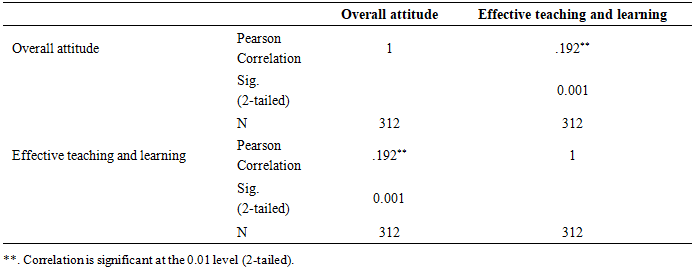
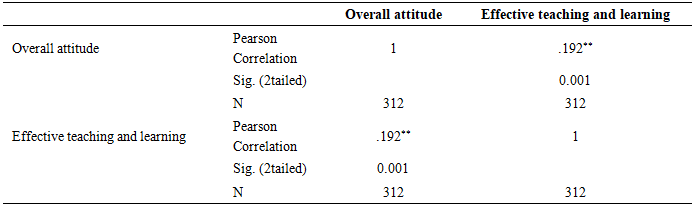
- The interpretation of correlation coefficients follows the classification as suggested by Cohen (2013): Weak correlation: 0.10 ≤ r <0.30; Moderate correlation: 0.30 ≤ r < 0.50; Strong correlation: r ≥ 0.50. The research study focused on obtaining the correlation between attitudes and opinions of PE teachers and students regarding the use of ICT resources and effectiveness of teaching and learning.
|
4.3. Regression Analysis of Attitudes and Opinions of PE Teachers and Students Regarding the Use of ICT Resources and the Effectiveness of Teaching and Learning
- A bivariate regression analysis was conducted to establish the relationship between attitudes and opinions regarding the use of ICT resources and the effectiveness of teaching and learning.
|
 Effectiveness of teaching and learning = 1.764 + 0.245 attitudes and opinions regarding the use of ICT resources + ε.
5. Discussion
- The respondents hold high positive attitudes toward the integration of ICT in PE. This suggests that most PE teachers and students in PTTCs in the Western region view ICT integration as beneficial and necessary for teaching PE. This observation concurs with Jena, who reported that in India, students‟ engagement and comprehension improved when using ICT tools, as these resources simplified complex concepts and made learning more accessible [15]. This attitude-behaviour disconnect aligns with broader research that highlights logistical and structural challenges as significant obstacles to ICT adoption. For instance, while many teachers recognize the value of ICT, the lack of adequate resources, outdated infrastructure, and insufficient funding hinder their ability to effectively integrate these technologies into teaching practices. Similarly, students’ enthusiasm for ICT is often curtailed by technical challenges, such as unreliable internet connectivity and a lack of appropriate devices, which limit their ability to engage fully with ICT-based learning. Teachers’ and students’ attitudes played a significant role in ICT integration but were often undermined by external factors such as resource constraints and institutional inefficiencies. To bridge this gap, there is a need for strategic interventions that address these structural barriers. Providing adequate ICT infrastructure, offering targeted training programs, and fostering supportive institutional policies could help convert positive attitudes into actionable behaviour, ensuring the long-term adoption and effective utilization of ICT in teaching and learning PE.Despite the generally positive attitudes, results of ANOVA (F (1,310) = 11.847, p < 0.05), show that there was significant statistical relationship between attitudes and opinions of students and teachers on ICTs integration in PE and effectiveness teaching and learning PE using ICTs. Therefore, the null hypothesis that there is no significant correlation between the attitudes and opinions of students and teachers regarding the use of ICT resources and the effectiveness of teaching and learning PE in PTTCs in the Western region of Kenya was rejected. This implies there is correlation between the attitudes and opinions of students and teachers regarding the use of ICT resources and the effectiveness of teaching and learning PE in PTTCs in the Western region of Kenya.
6. Conclusions
- PE teachers and students in PTTCs in Western region of Kenya have a positive attitude towards ICT Integration PE. However, despite these encouraging attitudes, they have not yet led to widespread and effective use of ICTs in the classroom. This gap underscores the need for targeted efforts to turn positive attitudes into practical actions, such as investing in teacher training and ensuring sufficient infrastructure. The Ministry of Education should establish a framework for the continuous monitoring and evaluation of ICT usage in PTTCs. This should include periodic assessments to identify areas requiring improvement, refine integration strategies, and ensure that ICT tools are being effectively utilized to enhance PE teaching and learning. Performance benchmarks and feedback mechanisms should be implemented to measure progress and inform policy adjustments. The Ministry of Education should update and strengthen existing ICT policies to explicitly address the integration of ICT in PE.