
-
Paper Information
- Paper Submission
-
Journal Information
- About This Journal
- Editorial Board
- Current Issue
- Archive
- Author Guidelines
- Contact Us
International Journal of Sports Science
p-ISSN: 2169-8759 e-ISSN: 2169-8791
2026; 16(1): 7-12
doi:10.5923/j.sports.20261601.02
Received: Apr. 17, 2026; Accepted: May 3, 2026; Published: May 11, 2026

Establishing Preliminary Normative Neuromuscular Profiles in Collegiate Baseball Pitchers
 Abstract
 Reference
 Full-Text PDF
 Full-text HTML
Michael Cohen, Patrick Horvath, Deric Grohowski
Health and Human Performance, King’s College, Wilkes-Barre, United States
Correspondence to: Michael Cohen, Health and Human Performance, King’s College, Wilkes-Barre, United States.
| Email: |  |
Copyright © 2026 The Author(s). Published by Scientific & Academic Publishing.
This work is licensed under the Creative Commons Attribution International License (CC BY).
http://creativecommons.org/licenses/by/4.0/

The establishment of normative physiological and functional benchmarks specific to collegiate baseball pitchers is essential for advancing evidence-based performance profiling and injury prevention. Despite extensive biomechanical analysis in pitching research, few studies have provided integrated normative datasets describing both neuromuscular and functional characteristics of this unique athletic population. The present study developed a comprehensive normative profile through the combined use of Tensiomyography (TMG), Handgrip Dynamometry, and Functional Movement Screening (FMS). Seven male collegiate pitchers completed assessments across three time points during the competitive season. TMG quantified contractile parameters—delay time (Td), contraction time (Tc), and maximal displacement (Dm)—across major upper-limb muscles; this method has demonstrated strong validity and high test–retest reliability for evaluating skeletal muscle contractile properties across athletic and clinical populations [1-3]. Dynamometry measured isometric grip strength, and FMS assessed shoulder mobility. Significant dominant-side adaptations were identified, including faster contraction and relaxation times in the anterior and posterior deltoid, biceps brachii, and middle trapezius (p < .05), alongside reduced Dm in the posterior deltoid, indicating greater stiffness. Grip strength and FMS scores showed minor asymmetries favoring the dominant side. These results establish the first normative dataset integrating muscle contractile dynamics, upper-limb strength, and functional mobility in collegiate pitchers. The findings provide a foundational reference for longitudinal monitoring, performance optimization, and early detection of maladaptive asymmetries within baseball and other sports with related or comparable physical dynamics.
Keywords: Neuromuscular, Functional Movement, Tensiomyography, Collegiate Pitchers, Hand Grip Dynamometry
Cite this paper: Michael Cohen, Patrick Horvath, Deric Grohowski, Establishing Preliminary Normative Neuromuscular Profiles in Collegiate Baseball Pitchers, International Journal of Sports Science, Vol. 16 No. 1, 2026, pp. 7-12. doi: 10.5923/j.sports.20261601.02.
Article Outline
1. Introduction
- Normative data describing neuromuscular and functional movement characteristics are critical for contextualizing individual athlete performance, monitoring adaptations to training, and advancing evidence-based approaches within sport science. In baseball pitching, where performance relies on the precise coordination of force production, transfer, and dissipation across multiple kinetic segments, the quantification of physiological and functional baselines remains limited. While various studies have examined biomechanical and kinematic aspects of pitching, relatively few have established comprehensive normative datasets that integrate direct measures of muscle contractile behavior, limb strength, and movement competency within a single athletic cohort. [4]TMG provides a non-invasive and highly reliable method for evaluating skeletal muscle contractile properties through the measurement of radial displacement following an electrical stimulus. Parameters such as contraction time (Tc), delay time (Td), relaxation time (Tr), and maximal displacement (Dm) have been shown to reflect underlying muscle fiber composition, stiffness, and neuromuscular responsiveness. [5] These quantitative indices enable the objective characterization of muscular function and have been utilized across various sports to identify inter-limb differences and track adaptation to training or competition. [6-8]Complementing this physiological assessment, handgrip dynamometry offers a simple yet robust measure of upper-limb isometric strength. Grip force has been correlated with overall upper extremity performance and general muscular condition, making it an appropriate adjunct metric for profiling strength characteristics in throwing athletes. [9] Its inclusion allows for direct comparison with established normative reference ranges within athletic and non-athletic populations. [10]To contextualize muscle-level findings within broader movement patterns, FMS will be implemented to assess mobility, stability, and control across essential movement tasks. The FMS composite and subtest scores will provide a qualitative dimension to the dataset, enabling analysis of neuromuscular properties related to integrated movement performance in baseball pitchers. [11]
2. Methods
- ParticipantsA total of seven male collegiate baseball pitchers from King’s College in Wilkes-Barre, Pennsylvania (age range: 18–25 years) volunteered to participate in this study. All participants were active members of the intercollegiate baseball team and engaged in regular strength training and throwing programs during the competitive season. Participants were included if they were injury-free at the time of testing and had no history of upper-limb surgery or muscular disorders. Individuals with implanted electronic devices (e.g., pacemakers) were excluded due to contraindications for electrical stimulation. Written informed consent was obtained prior to participation. The study was reviewed and approved by the King’s College Institutional Review Board (IRB) under expedited review procedures.Study DesignThis study employed a longitudinal observational design to establish normative data for neuromuscular and functional characteristics of collegiate pitchers. Data were collected once during the spring pre-competitive season. Assessments were conducted in the Exercise Science Laboratory within the Kowalski Center for Health Sciences at King’s College. The testing session consisted of three components administered in a standardized order to minimize fatigue which could influence data sets: (1) TMG, (2) Handgrip Dynamometry, and (3) FMS shoulder mobility.InstrumentationTensiomyography (TMG)A TMG Science for Body Evolution device (TMG-BMC Ltd., Ljubljana, Slovenia) was used to assess contractile properties of the biceps brachii, pectoralis major, anterior deltoid, posterior deltoid, and middle trapezius on both dominant and non-dominant sides. The TMG system applies brief electrical stimuli (0–100 mA, pulse duration 1 ms) via self-adhesive electrodes to elicit muscle twitches, while a digital displacement sensor records radial muscle belly displacement. Parameters analyzed included:• Delay Time (Td, ms): time from stimulus to 10% of maximal displacement• Contraction Time (Tc, ms): time from 10% to 90% of maximal displacement• Maximal Displacement (Dm, mm): peak radial muscle belly displacement• Relaxation Time (Tr, ms): Time from 90% to 50% (or 10%, depending on convention) of maximal displacement during the relaxation phase.These variables provide quantitative indices of muscle stiffness, contractility, and tone. Three valid trials were obtained per muscle, and the mean value was used for analysis. Stimulation intensity was increased incrementally until maximal displacement was achieved, avoiding participant discomfort.
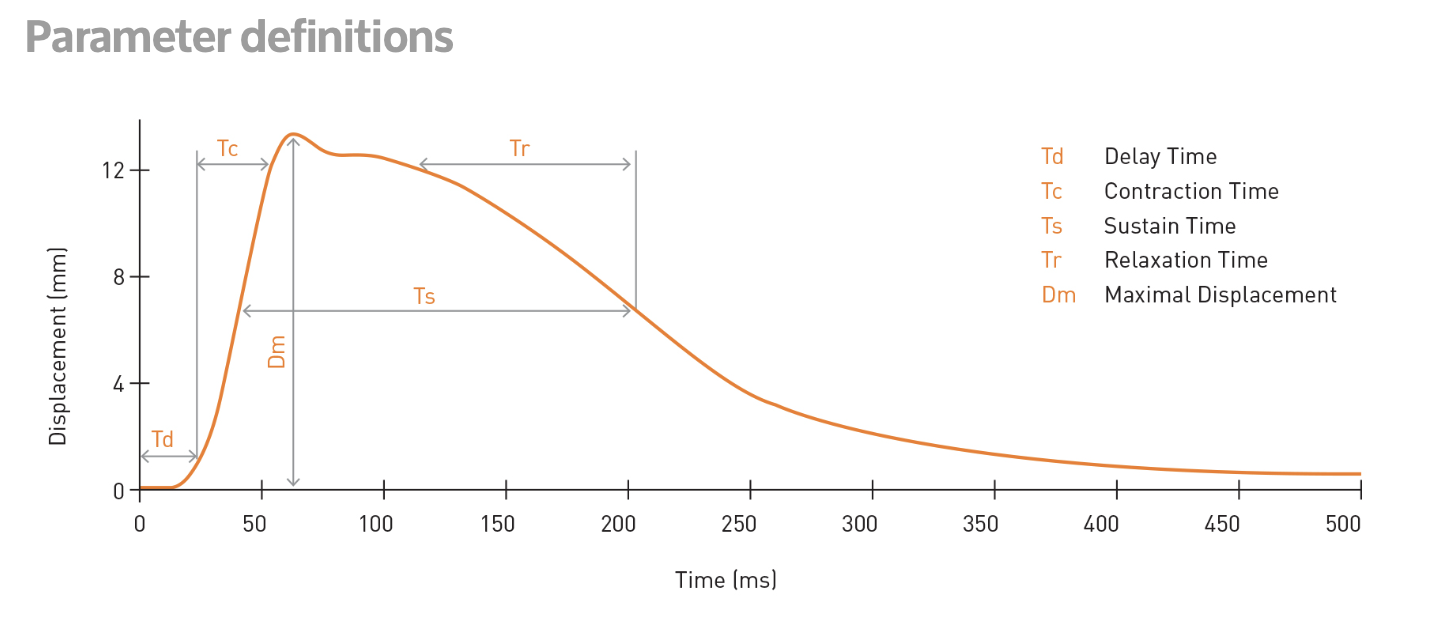 | Image 1. TMG Reference Graph |
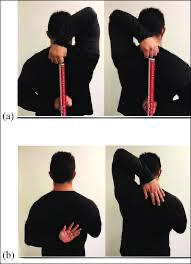 | Image 2. Demonstrated FMS Shoulder Mobility Test, sourced from https://www.researchgate.net/figure/The-different-movement-screens-utilized-a-FMS- shoulder-mobility-reciprocal-pattern-of_fig1_329433377 |
3. Results
- Seven pitchers (six right-handed, one left-handed) completed all the testing. TMG data demonstrated significant side-dependent differences in contraction and relaxation times for select muscles (Figure 1–4, Table 1). The anterior (p = 0.034) and posterior deltoid (p = 0.016) showed faster contraction times on the dominant side. Relaxation times were significantly shorter in the biceps brachii (p = 0.012), anterior deltoid (p = 0.005), and middle trapezius (p = 0.008). Maximal displacement differed significantly for the posterior deltoid (p = 0.048), indicating greater stiffness on the dominant side. Delay times showed no significant side differences (p > 0.05). FMS shoulder mobility scores were slightly lower on the dominant side (2.33 ± 0.52 vs. 3.00 ± 0.00, p = 0.051).
|
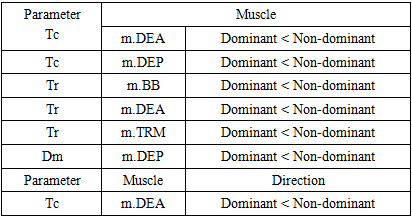
3.1. Figures and Tables
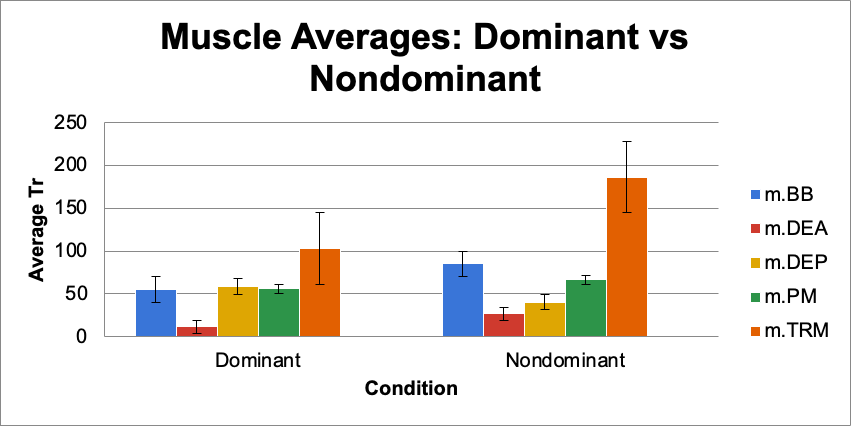 | Figure 1. Average Muscle Relaxation Time (Tr) by Side (Dominant versus Non-Dominant |
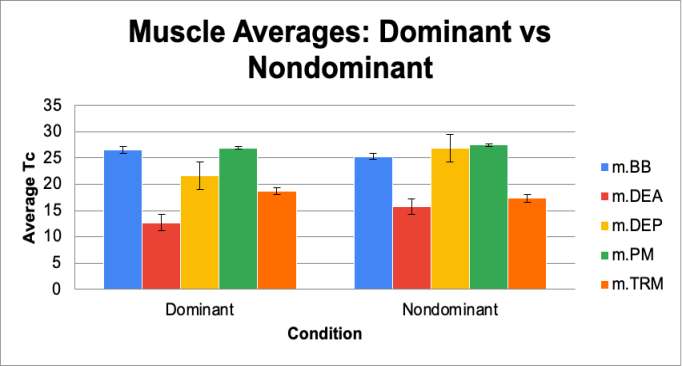 | Figure 2. Average Muscle Contraction Time (Tc) by Side (Dominant vs. Non-Dominant) |
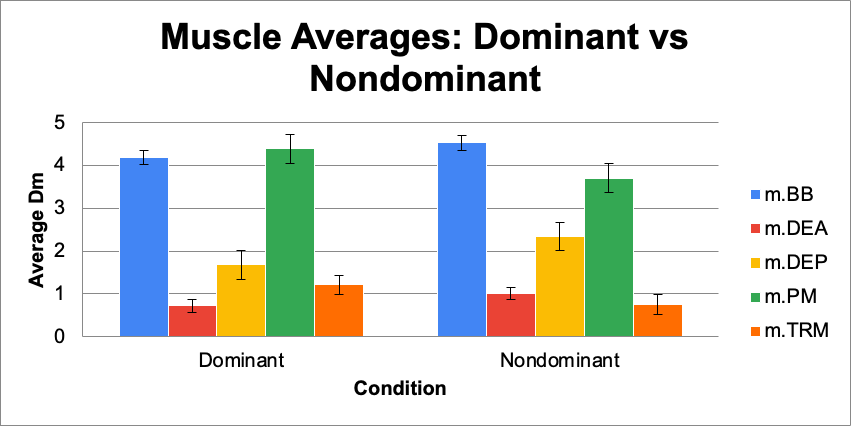 | Figure 3. Average Maximal Displacement (Dm) by Side (Dominant vs. Non-Dominant) |
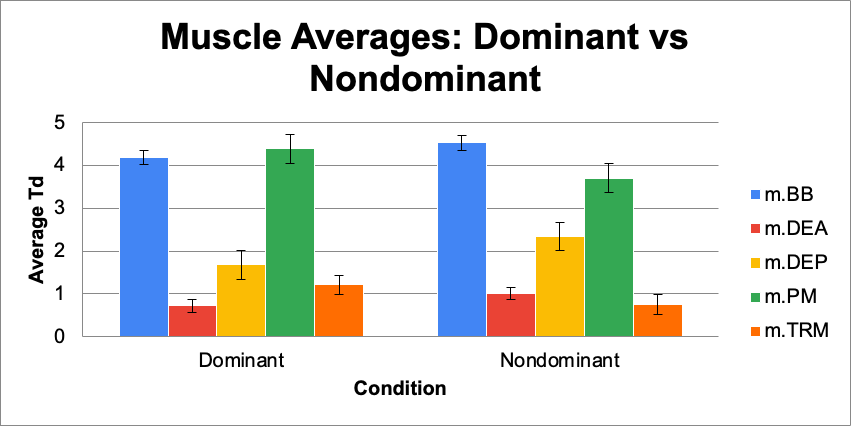 | Figure 4. Average Delay Time (Td) by Side (Dominant vs. Non-Dominant) |
4. Discussion
- This study successfully established a novel normative framework for characterizing the neuromuscular and functional profiles of collegiate baseball pitchers. Through the integration of TMG, Handgrip Dynamometry, and FMS, this investigation provides the first multidimensional reference dataset combining muscle-level contractile properties, strength symmetry, and functional movement competency within this athletic population. The significance of this contribution lies in its ability to contextualize individual and team-level performance data against objective benchmarks—an advancement that can inform athlete monitoring, rehabilitation, and training interventions.The observed dominant-side adaptations across the deltoid, biceps brachii, and trapezius muscles demonstrate enhanced neuromuscular efficiency through shortened contraction (Tc) and relaxation (Tr) times. These adaptations likely reflect sport-specific demands, including repeated high-velocity arm acceleration and deceleration inherent to pitching. Such findings align with previous electromyographic and kinematic analyses of throwing athletes, supporting the interpretation that repeated mechanical loading promotes selective recruitment of fast-twitch fibers and improved excitation–contraction coupling on the dominant side. [13]However, the reduced maximal displacement (Dm) in the dominant posterior deltoid suggests increased stiffness—an adaptation that may enhance joint stability but also restrict shoulder range of motion. This duality underscores the delicate balance between performance optimization and injury susceptibility. The inclusion of Dm as a quantitative stiffness index highlights the diagnostic potential of TMG in identifying maladaptive responses that may not yet manifest as symptomatic dysfunction.Handgrip dynamometry results revealed symmetry between limbs, suggesting that distal strength is maintained despite proximal muscular adaptations. This reinforces the idea that grip force, while reflective of general upper-limb conditioning, is less affected by unilateral throwing patterns than shoulder musculature. FMS shoulder mobility scores, though not significantly different, trended lower on the dominant side, consistent with the adaptive internal rotation deficits frequently observed in pitchers. Together, these findings demonstrate that functional mobility reductions accompany the neuromuscular adaptations identified via TMG, emphasizing the value of multimodal assessment for capturing both physiological and movement-level outcomes.The novelty of the established normative dataset will deepen understanding of variables affecting health and performance, as well as potential injury risk. Prior research has primarily examined these variables in isolation—muscle contractility, strength, or functional movement—without an integrative perspective. [14] By merging these domains, the present study delivers a comprehensive, objective reference for future comparative analyses and athlete management within baseball performance science.LimitationsSeveral limitations warrant consideration.First, the small sample size (n = 7) limits external validity and prevents generalization across broader baseball populations. Expanding the dataset to include athletes of varying competitive levels, positions, and throwing mechanics will strengthen its normative utility.Second, the study’s muscle selection focused on upper-limb and scapular stabilizers, omitting key contributors to the kinetic chain such as the rotator cuff complex, latissimus dorsi, external obliques, and lower-limb musculature. Including these regions in future TMG analyses would enhance understanding of force transmission and whole-body coordination during pitching.Third, the one-session design may not fully capture short-term fluctuations due to fatigue, recovery, or in-season workload. Increasing assessment frequency and correlating TMG measures with pitching volume, velocity, and perceived exertion could provide deeper insight into temporal adaptations.Finally, despite standardized testing conditions, minor sources of variability—such as electrode placement, muscle temperature, or hydration status—may influence TMG readings. Continued methodological refinement and replication across research groups will improve validity, reliability and generalization of results.Future DirectionsBuilding upon the present findings, future research should explore multiregional TMG mapping of both upper and lower limbs to delineate the complete kinetic chain underpinning pitching mechanics. Integrating complementary technologies such as surface electromyography (sEMG), ultrasound elastography, and motion capture would allow for the correlation of contractile metrics with biomechanical and performance outcomes.Additionally, extending normative comparisons to injured or rehabilitating pitchers could validate the use of TMG-derived benchmarks as diagnostic or return-to-play indicators. Investigating the relationship between contractile asymmetry and key performance metrics—pitch velocity, accuracy, and fatigue resilience—may further establish the applied relevance of this dataset for coaches and sports medicine professionals.As well, such data may be utilized in a temporal manner to perform longitudinal studies that track compensatory patterns and musculoskeletal adaptation from the inception of a collegiate sports career until the end (Freshman to Senior). From an applied standpoint, integrating these assessments into pre-season and in-season monitoring programs offers a proactive strategy for managing athlete workload, detecting early signs of neuromuscular fatigue, and tailoring corrective strength or mobility interventions.
5. Conclusions
- The present study developed and validated a novel normative dataset describing the neuromuscular and functional movement characteristics of collegiate baseball pitchers. Significant dominant-side adaptations in contractile properties—paired with subtle mobility asymmetries—highlight the complex balance between performance-driven specialization and potential injury risk in overhead athletes.The integration of TMG, Handgrip Dynamometry, and FMS represents a methodological advancement in athlete profiling, offering a multidimensional lens through which to evaluate readiness, adaptation, and movement efficiency. These normative values provide a crucial reference point for both research and applied sport settings, enabling individualized benchmarking and longitudinal tracking across competitive seasons.Future research expanding muscle inclusion, participant diversity, and multimodal integration will further refine this framework and strengthen its application in performance optimization and injury prevention across baseball and related throwing sports.
ACKNOWLEDGEMENT
- N/A
DISCLOSURE
- N/A