
-
Paper Information
- Paper Submission
-
Journal Information
- About This Journal
- Editorial Board
- Current Issue
- Archive
- Author Guidelines
- Contact Us
Resources and Environment
p-ISSN: 2163-2618 e-ISSN: 2163-2634
2016; 6(2): 28-40
doi:10.5923/j.re.20160602.02

Construction of Roadway, Sanitary Latrine Ring and Septic Tank Using Textile Sludge
 Abstract
 Reference
 Full-Text PDF
 Full-text HTML
Arun Kanti Guha , Md. Rasel , Mohammad Tanvir Ahmed , Shuchismita Dey , ABM Foisal
Department of Textile Engineering, Southeast University, Tejgaon, Dhaka, Bangladesh
Correspondence to: Arun Kanti Guha , Department of Textile Engineering, Southeast University, Tejgaon, Dhaka, Bangladesh.
| Email: |  |
Copyright © 2016 Scientific & Academic Publishing. All Rights Reserved.
This work is licensed under the Creative Commons Attribution International License (CC BY).
http://creativecommons.org/licenses/by/4.0/

Textile effluent, after treatment produces sludge, contains high concentrations of organic and inorganic chemicals and characterized by high pH, Chemical Oxygen Demand (COD), Biological Oxygen Demand (BOD), Total Dissolved Solids (TDS), Total Suspended Solids (TSS), low Dissolved Oxygen (DO) and strong color. Now it is a burning question, how this sludge will be properly managed? There are different options for sludge management such as, wetland filling, brick preparation, incineration, composting and biogas generation. Biogas generation by anaerobic digestion is sustainable, cost effective and eco-friendly method in Bangladesh. We have analyzed both the raw and residual sludge at BCSIR, Dhaka, to check the pollution reduction level after biogas generation from Textile sludge. We found that 55-96% pollution was reduced in various parameters. The residual sludge generated after biogas generation should be managed properly utilizing eco-friendly and sustainable technique (s). This paper describes some eco-friendly and sustainable methods of residual sludge management. In this work, we have constructed lab-scale pavement by using both the raw and residual sludge as substituent of sand in sub-grade. Sludge can be co-processed with cement. We have constructed lab-scale blocks by co-processing of sludge with cement at different proportions. Sanitary latrine ring and septic tanks can be constructed with co-processed sludge in cement in upcoming project. Utilization of both the residual and raw sludge after biogas generation in roadway construction was determined to be a viable, eco-friendly and sustainable solution regarding sludge disposal problem.
Keywords: Textile Sludge, Biogas, Roadway, Sanitary Latrine Ring, Septic Tank
Cite this paper: Arun Kanti Guha , Md. Rasel , Mohammad Tanvir Ahmed , Shuchismita Dey , ABM Foisal , Construction of Roadway, Sanitary Latrine Ring and Septic Tank Using Textile Sludge, Resources and Environment, Vol. 6 No. 2, 2016, pp. 28-40. doi: 10.5923/j.re.20160602.02.
Article Outline
1. Introduction
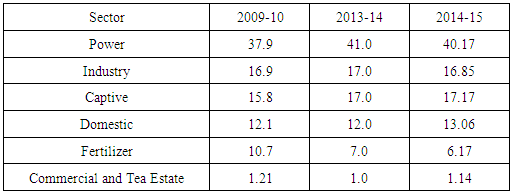
- With respect to both the volume and composition, the wastewater produced by the textile industry is the most polluting among other industries. Textile effluent contains high concentrations of organic and inorganic chemicals and characterized by high pH, Chemical Oxygen Demand (COD), Biological Oxygen Demand (BOD), Total Dissolved Solids (TDS), Total Suspended Solids (TSS), low Dissolved Oxygen (DO) and strong color [1]. Textile effluent needs proper treatment before discharging to water bodies. After effluent treatment an inevitable semi solid part is separated from treated effluent which is called sludge. A large quantity of sludge is generated from Textile sector in Bangladesh. Now it is a burning question, how this sludge will be properly managed? The ready-made garment industries are backbone of economy of Bangladesh. The export oriented Ready-Made Garment (RMG) sector has made crucial contribution to the Bangladesh economy. The RMG sector drastically introduced dynamism in the report as well as in the domestic economy. Despite many difficulties faced by the sector over the past years, it continued to show robust performance, competitive strength, and social commitment. The contribution of this sector to Bangladesh economy is well-known, well appreciated and well respected [2]. Shirts, Trousers, Jackets, T-Shirts and Sweater were exported from 2000-2001 to 2014-15 from RMG sector of Bangladesh [3]. The Ready-Made Garments (RMG) sector of Bangladesh earned 81.68% of total export of the country in 2014-15 fiscal year [4]. The GDP share of RMG of Bangladesh was 14.07% in 2013-14 [5]. There are other supporting industries like Knitting, Weaving, Dyeing, Printing etc. Among these supporting industries some are wet processing units. These wet processing industries are using a large quantity of water and generating effluents every day. After effluent treatment sludge is produced.In Textile processing initially fibre is cultivated (natural) or manufactured (manmade). After that yarn is produced. After that optionally yarn dyeing is done. Then fabric is manufactured from yarn by knitting or weaving. After that fabric is dyed under knit or woven processing steps. After dyeing dyed fabric is sent to garment industries for garment manufacturing. After garment manufacturing optionally garment dyeing is done. Among these steps wastewater generates from yarn dyeing, weaving preparation, knit & woven processing and garment washing and dyeing steps. Textile industries use 1500 billion litre ground water every year in Bangladesh [6]. As a result Textile sector of Bangladesh has been discharging 2million m3 effluent/day [6]. This wastewater needs to treat in effluent treatment plant (ETP) before discharging. After effluent treatment 2.81 million metric ton sludge is produced every year in Bangladesh from this sector [6]. Textile sludge is consists of a cluster of organic and inorganic complex with high concentrations of heavy metals such as Fe, Cu, Cd, Zn, Cr etc. because a variety of dyes & chemicals are used in different wet processing steps. It is an inevitable part obtained after effluent treatment. It needs appropriate, eco-friendly and sustainable management so that huge sludge can be converted to a resource instead of waste.There are several options available in Textile sludge management. It can be used to prepare brick, the sludge can be co-processed with cement, it can be incinerated to produce electricity, sludge can be utilized for sanitary land filling, it can be used for composting [6] and it can be used for biogas generation [7]. All methods have both the advantages and disadvantages.If bricks are prepared by using sludge then it may create hazardous effect when it will be used in building construction. Similarly when sludge will be co-processed with cement it may be harmful for all kinds of building construction because of presence of toxic matters and high concentrations of heavy metals. Open incineration is dangerous because of emission of dioxin. Closed incineration may be done. But considering our country situation electricity production by incineration of sludge would not be viable because of lack of available technology and expertise. Our country is flood affected zone. For this reason sanitary land filling in wetland area will not be suitable. On the other hand we have limitation of enough available wetland for sanitary land filling. Composting on crop producing plants will be harmful for migration of heavy metals to human body through food chain. Biogas generation from Textile sludge would be sustainable and eco-friendly as per condition of renewable energy resources of Bangladesh. Textile sludge is hazardous. So after generation of biogas safe disposal of residue and no toxic emission must be ensured. Anaerobic technology will be conducive for safe generation of biogas because it is done at closed condition. In most of the cases biogas was generated from cow dung and other organic wastes such as vegetable waste. Some of the literature survey results have been summarized as follows.(a) In 1996, Rahman et al. [8], reported a study on biogas technology in Bangladesh. Authors reported biogas quantity from various wastes such as cattle dung, poultry manure, municipal solid wastes rural solid wastes etc.(b) In another report, Islam et al. [9], reported about generation of biogas from anaerobic digestion of vegetable waste. Authors reported various factors of biogas generation from vegetable waste.(c) Rajendran et al., reported a review on household biogas digesters [10].(d) Optimization and fabrication of a portable biogas reactor was reported by Yousufet. al. [11].(e) Imu and co-workers [12] a method for biogas generation from municipal wastes in Dhaka City.(f) According to Opwis et al. [13], Biogas can be generated from Textile Wastewater. (f) Raj et al. [14] reported that biogas can be generated from Textile cotton waste. (h) According to Asia, I. O. [15], treatment of Textile sludge using anaerobic technology is effective for Textile pollution control.Biogas generation from Textile sludge is a brilliant solution in Textile sector which will be outstanding contribution in energy sector of Bangladesh. Natural gas is the most important fuel for Bangladesh – both in terms of energy and diversity of use. Bangladesh Oil, Gas and Mineral Resources Corporation (Petrobangla) is entrusted with the responsibilities of the gas and coal sectors of Bangladesh. Subsidiaries under Petrobangla are responsible for exploration, production, transmission, distribution and marketing of natural gas to the end users.
|
2. Materials and Methods
2.1. Sludge Collection
- Textile bio sludge was collected from Delta Knit Composite located at Kashimpur Gazipur. The type of Effluent Treatment Plant (ETP) of the industry is biological and capacity of the ETP is 120 m3/h.
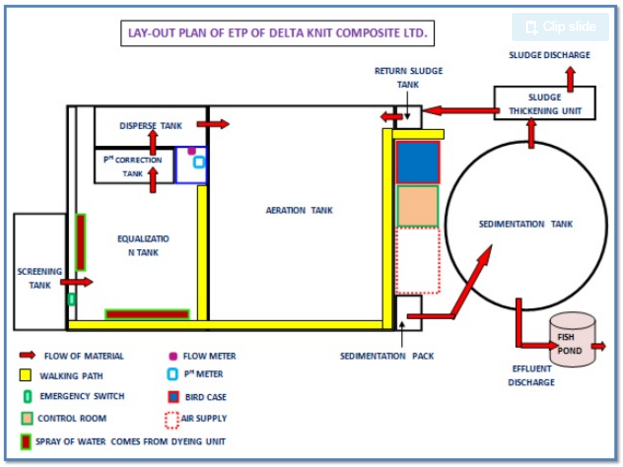 | Figure 1. Lay Out of Delta ETP (Source: Factory) |
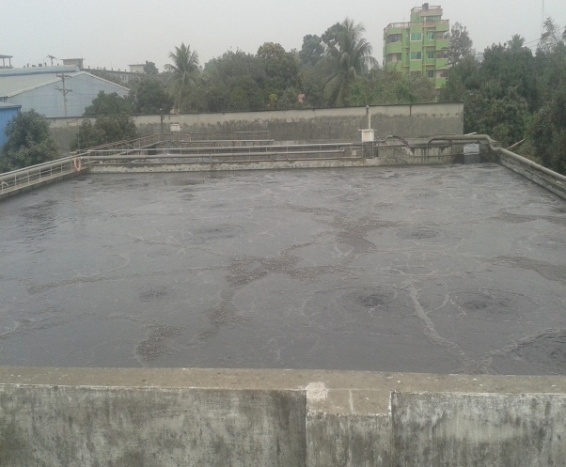 | Figure 2. Delta ETP |
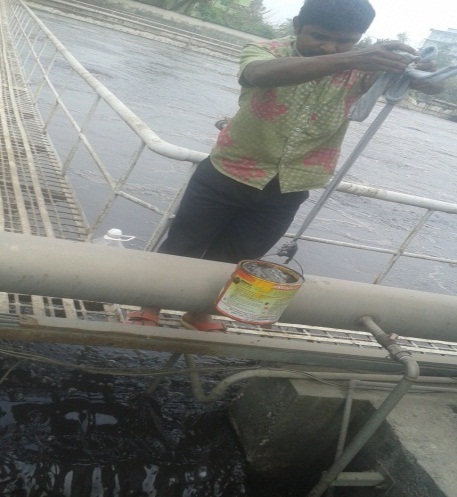 | Figure 3. Sludge Collection from Delta ETP |
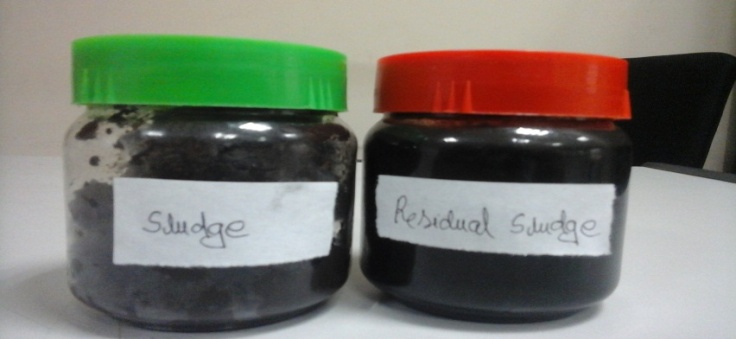 | Figure 4. Images of Raw and Residual Sludge |
2.2. Construction of Lab-Scale Biogas Plant
- A lab scale biogas plant was constructed in the Chemistry lab of Southeast University of Bangladesh with technical support from BCSIR, Dhaka. The plant was constructed by connecting a conical flask with two glass bottles (Figure 6). The conical flask is called digester (2.5 L). The middle glass bottle (10 L) is designated as gas collector. The third bottle is (10 L) is called water collector. The digester was connected to gas collector by a plastic pipe by means of three ways gas valve. The generated gas flowed to the gas collector through the gas valve and same volume of water was displaced to the water collector because of pressure of produced gas. The gas collector was connected to the water collector so that displaced water was easily transferred to the water collector. There was another connection between gas collector and gas out let pipe. During the production of biogas this connection was closed but it was opened when the collected biogas was separated out to the gas balloon for flammability and other tests.
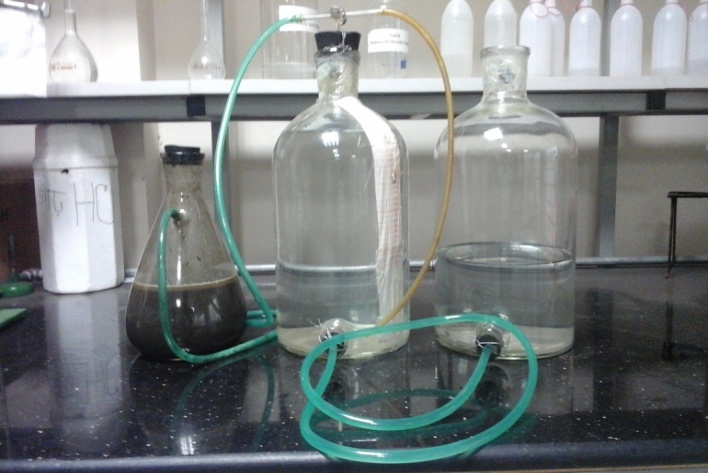 | Figure 5. Lab-Scale Biogas Plant |
2.3. Biogas Generation from Textile Sludge
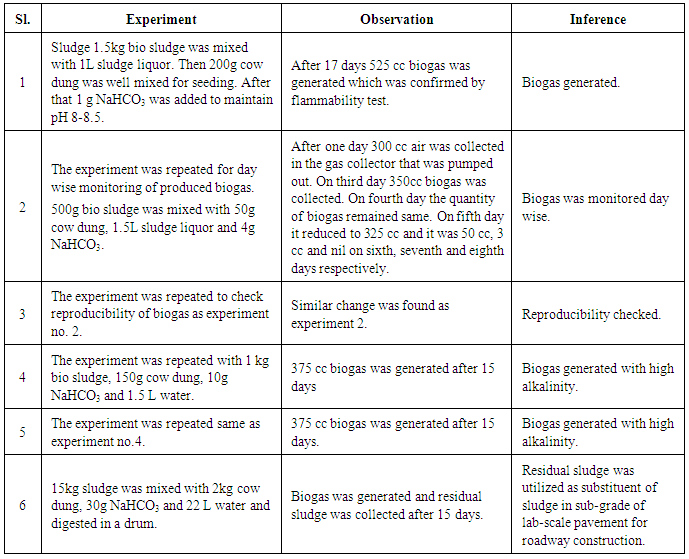
- Biogas generated several times using constructed lab-scale biogas plant in the Chemistry lab of permanent campus of Southeast University. The gas generated as per following table. Experiment 1 to 5 were done in lab-scale biogas plant and experiment 6 was done in a drum digester because relatively bulk quantity of sludge was used. All experiments were done at room temperature (25.0°C).
|
2.4. Utilization of Raw and Residual Textile Sludge in Lab Scale Pavement Construction as Sub-Grade Materials
- A large quantity of residual sludge remains after biogas generation from raw Textile sludge. In a lab-scale experiment we found that weight of the digester tank with all used materials (sludge, cow dung, sodium carbonate and sludge liquor) for biogas generation was increased after 10 days anaerobic digestion. Initially the weight of digester tank including all materials was 3.419Kg and final weight was 3.432Kg. The weight of the residual sludge was increased because of some byproducts due to chemical reactions in four steps mentioned in process and mechanism of biogas generation. This residual sludge needs proper management otherwise the purpose of sludge management by anaerobic digestion will be in vain. As per our literature survey we did not find any method of residual sludge management obtained after biogas generation from Textile sludge. We did some experiments to solve this problem. We constructed lab-scale pavement for roadway construction in wooden boxes by using both the raw and residual sludge as substituent of sand at sub-grade. The hard surface of a road, driveway is called pavement [20]. Both the raw and residual Textile sludge can be used in roadway construction as substituent of sand in sub-grade. We have prepared a construction plan which was approved by a civil engineer.
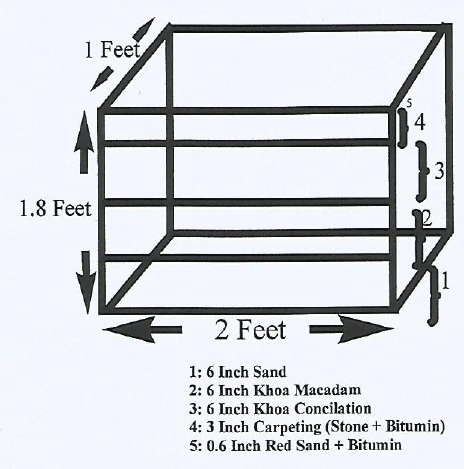 | Figure 6. Approved Plan for Lab-Scale Pavement Using 100% Sand |
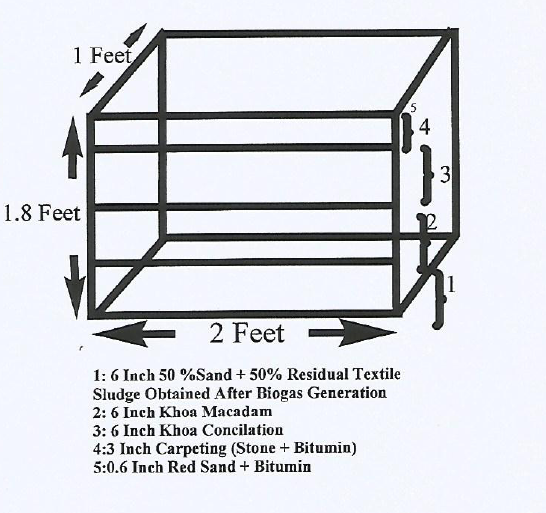 | Figure 7. Approved Plan for Lab-Scale Pavement Using 50% Sand + 50% Residual Sludge Obtained After Biogas Generation |
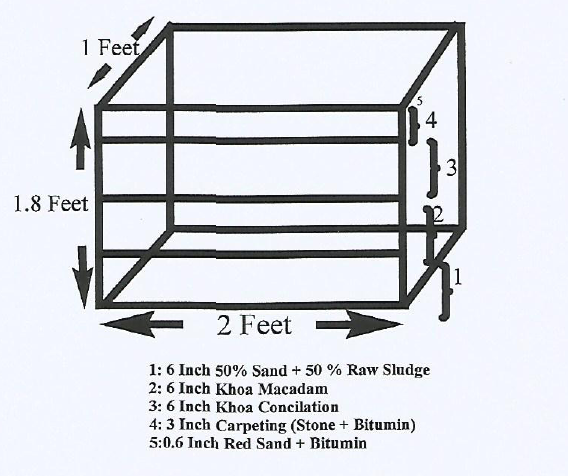 | Figure 8. Approved Plan for Lab-Scale Pavement Using 50% Sand + 50% Textile Raw Sludge Obtained After Biogas Generation |
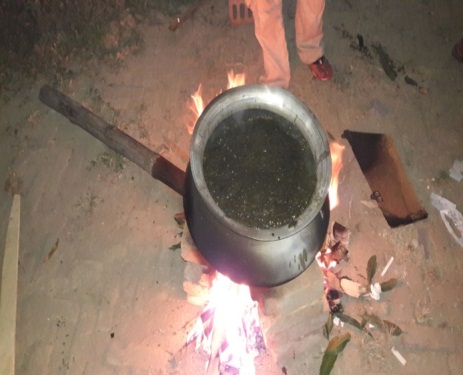 | Figure 9(a). Drying of Residual Sludge by Heating |
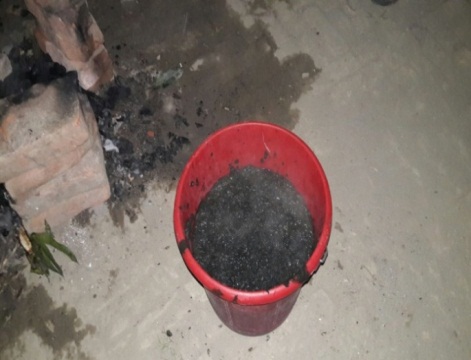 | Figure 9(b). Dried Residual Sludge |
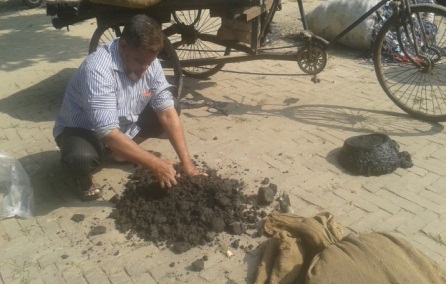 | Figure 10(a). Mixing of Sludge with Sand |
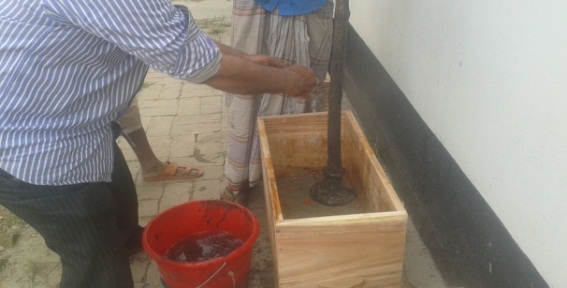 | Figure 10(b). Making Sub-grade with Sand and Sludge in Wooden Box |
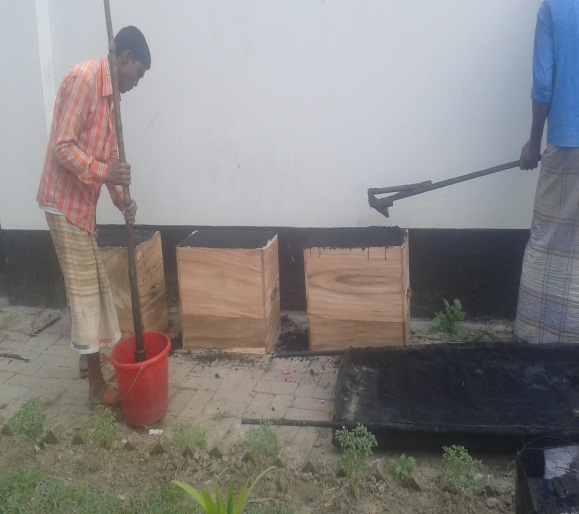 | Figure 11. Carpeting of Pavement Block |
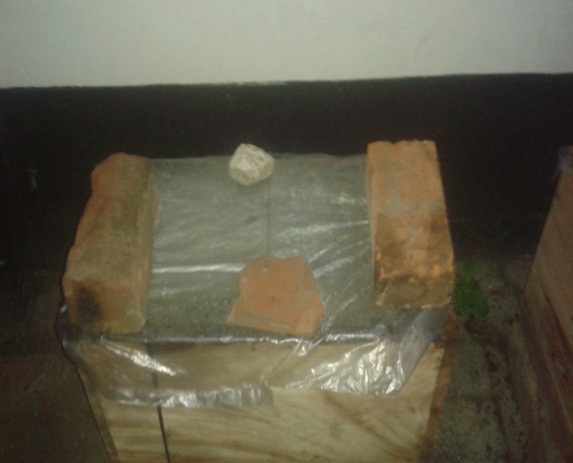 | Figure 12. Constructed Lab-Scale Pavement |
2.5. Construction of Blocks Using Textile Sludge as Substituent of Cement
- Sludge can be used as substituent of cement. There are some reports available in literature [21-23]. Roccaro, P. et al. [21] reported that sludge could be used in building materials. Authors interpreted that concrete is the most used construction material in the industrialized countries. However, the concrete production needs natural resources (waterand aggregates) and cement whose production is costly due to the energy required. Indeed, cement manufacturing is recognized to be a major source of carbon dioxide (CO2). In order to reduce the use of natural materials (Directive 2008/98/EC del 19/11/2008), the CO2 production(Decision n. 406/2009/CE del 23/04/2009) and the amount of wastes to be disposed in the landfill(Directive 1999/31/CE), several studies have been carried out to investigate the possibility of using dissimilar wastes for partial replacement of aggregates and/or cement in the concrete production. Also the use of sludge produced from the treatment of surface water or waste water has been considered. Although obtained results are promising, other research is needed to guarantee the standardized production of concrete based on wastes having the required mechanical, physical and chemical characteristics. Sludge from different water and wastewater treatment plants (e.g. chemical precipitation, biological treatment) and with different organic content and humidity (i.e. raw sludge, digested sludge, digested + dewatered sludge) was employed as partial or total replacement of water (from 10% to 100%) in the production of concrete. The mechanical characterization (i.e. specific mass, consistency, compressive strength, tensile strength, modulus of elasticity) and environmental compatibility (toxicity characteristics leaching procedures – TCLP) of specimens produced at varying curing time has shown that the sludge produced from the water treatment plant can be effectively used as partial or total replacement of water in concrete production, while those coming from wastewater treatment plants often reduce the mechanical characteristics of the concrete.According to Dhinesh, A. [22], A common effluent treatment waste sludge being largest industry in India faces problem of sludge disposal. In this study an attempt is made to reuse common effluent treatment waste water sludge in solid blocks. Common effluent treatment waste water sludge is used to replace base material by weight up to15%. Blocks are casted by adding sludge after drying at 3000°C to 6000°C for 8, 16 and 24 hrs. Common effluent treatment waste water sludge can be added up to 15% as it gives compressive strength above 8.33 N/mm2 and water absorption ratio is obtained as less than 0.50%. Thus reuse of common effluent treatment waste water sludge in solid block is better option so that problem of ultimate disposal of common effluent treatment waste water sludge can be solved up to greater extent.In a report Rajamanickam, R. and Nagan, S. [23] explained co-processing of Textile dyeing industry ETP sludge in cement industry. Authors mentioned that cement production consumes large amounts of both raw materials and fuel and produces substantial CO2 emissions. The use of alternative fuels and raw materials in cement manufacturing can reduce the amount of fossil fuels and virgin raw materials needed, and thus reduce the overall environmental impact of the operations. These alternative materials may be either by-products from other industrial processes, or waste streams such as municipal solid waste, sewage sludge, ETP sludge, discarded tires and plastics. In the State of Tamil Nadu in India, large number of textile dyeing units are in operation in Tiruppur, Erode, Namakkal and Karur districts. These units generate huge quantity of sludge from the treatment of trade effluent, which is categorized as hazardous waste needs to be disposed properly. M/s. Ultra Tech Cement Limited, Reddipalayam, Ariyalur District carried out a trial run of co-processing of textile dyeing industry ETP sludge in their cement plant. The trial study reveals that there is no significant variation in the quality of stack emission, ambient air quality, clinker composition, and the physical strength of cement. There is no leaching of heavy metals from the clinker. This also conserves the raw material (lime stone) consumption. Thus co-processing of textile dyeing industry ETP sludge in the cement industry is a sustainable development concept based on the principles of making one industry’s waste another’s raw material.In this work, we have constructed three blocks using brick sieve, cement, sand, Textile raw sludge and water. We used different proportions of sludge with cement as follows,(a) 50%cement + 50 % sludge,(b) 60%cement + 40 % sludge and(c) 70 % cement+ 30 % sludge.After curing we found strong blocks in all cases. It needs more studies with all necessary tests.We can construct sanitary latrine ring with both the residual and raw textile sludge. So that health condition will be protected of rural people because the price of sanitary latrine will be reduced for Textile sludge using in ring construction. Then cost of sanitary latrine will be affordable to rural people of Bangladesh.
3. Results and Discussion
3.1. Concentration Dilution after Biogas Generation
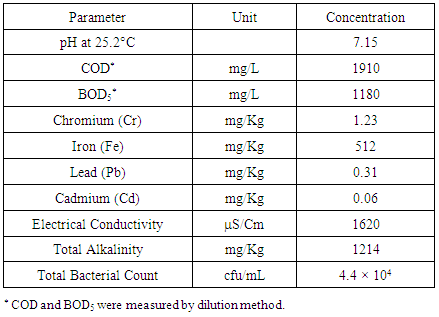
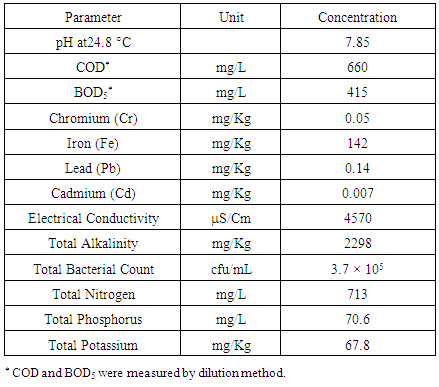
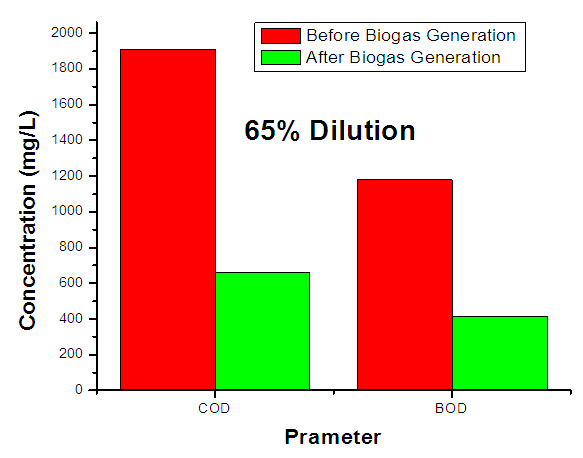
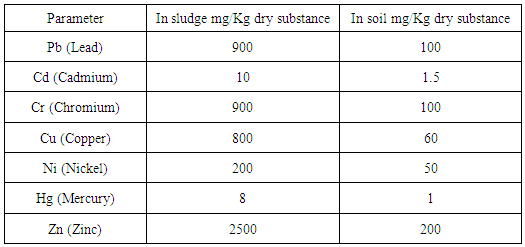
- Concentrations of organic contents and heavy metals were diluted after biogas generation from Textile sludge. Both the sludge samples before and after biogas generation were analyzed at BCSIR, Dhaka, Bangladesh following standard test procedures. We found that concentration level was diluted after biogas generation from raw Textile sludge.
|
|
|
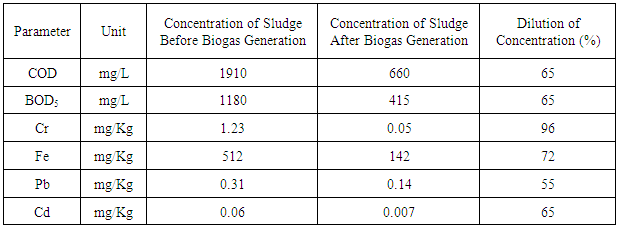
 | Figure 13. Dilution of Concentration after Biogas Generation from Textile Sludge |
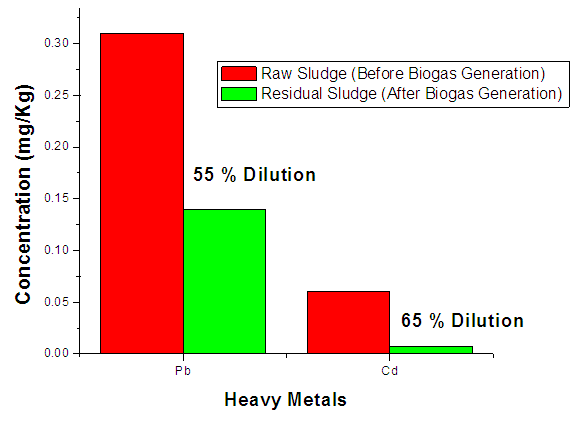 | Figure 14. Dilution of Concentration after Biogas Generation from Textile Sludge |
|
3.2. Monitoring of Day Wise Biogas Production
- The amount of generated biogas depends on the quantity of initial sludge digestion. In this work we got 525 cc biogas from 1.5 kg of Textile bio sludge whereas 350 cc biogas obtained from 500 g of Textile bio sludge. Daily biogas was monitored when initial amount of bio sludge was 500 g at room temperature (25°C). After three days of digestion we got 350 cc biogas which was reduced to 325 cc on fifth day of experiment. The quantity of biogas was 55 cc on sixth day and it was 3 cc on seventh day. The quantity turned to nil on eighth day of biogas generation. The maximum biogas obtained on third day of generation (Figure 19) [25]. Due to unavailability of day wise biogas production data from Textile sludge our result cannot be compared. But day wise data was found for biogas production from Kitchen waste [11]. According to the paper [11], about 200 cc biogas was generated on third day of experiment from kitchen waste at room temperature (25°C). The quantity of generated biogas was decreased on fourth day of experiment and it was gradually decreased and became nil on tenth day of experiment. This trend is similar to our experimental result. It is usual that biodegradable organic matter could be used as sole feedstock in anaerobic digestion but the digestion process trends to fail without addition of external nutrients for appropriate anaerobic bacteria culture [11].
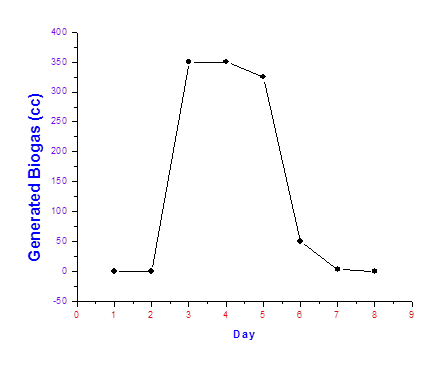 | Figure 15. Day Wise Biogas Generation |
3.3. Pavement Construction
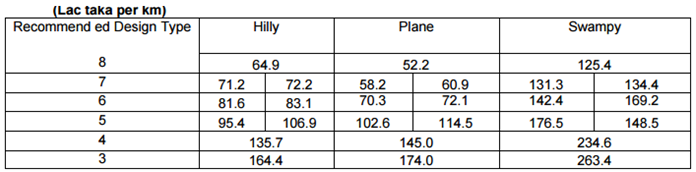
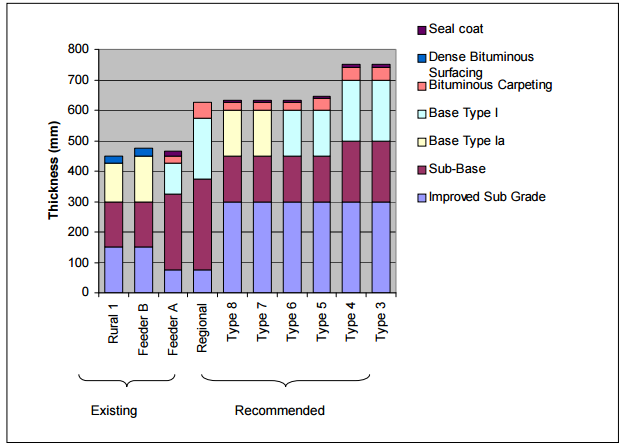
- Utilization of both the residual and raw sludge in roadway construction will be a viable, eco-friendly and sustainable solution regarding sludge disposal problem. In this work, we have constructed lab-scale pavement by using both the raw and residual sludge. Use of raw and residual sludge after biogas generation will be suitable in roadway construction as sub-grade material. According to information provided by Roads and Highways Department of Govt. of The People’s Republic of Bangladesh, available road length data are as follows [26],National Highway: 3,812.78 Km,Regional Highway: 4246.97 Km,Zilla Road: 13,242.33 Km andTotal Road Length: 21,302.08 Km.Construction cost of roads depends on design and area where the road will be constructed.The estimated costs are compiled below [27].Roadway construction needs huge sand in its sub-grade. If we can replace 50% sand by Textile raw or residual sludge obtained after biogas generation, it will be cost effective, eco-friendly and sustainable method.
|
 | Figure 16. Pavement Thicknesses |
4. Recommendations
- 1. Considering energy situation of Bangladesh biogas generation from Textile sludge is a sustainable, eco-friendly and cost effective sludge management option.2. After biogas generation the residual sludge can be utilized in pavement as substituent of sand as sub-grade material in roadway construction.3. Raw sludge is also suitable to use as alternative of sand in roadway construction.4. Replacement of sand by raw or residual sludge is cost effective, eco-friendly and sustainable in roadway construction.5. Raw sludge is suitable to co-process with cement in building construction. It can be used to construct sanitary latrine ring or septic tank. Raw sludge contains heavy metals and some hazardous materials. It would be wise decision to use it in sanitary latrine ring or septic tank construction because in that case sludge will remain as co-processed with cement in constructed ring or septic tank as bounded condition under the earth surface. The idea of keeping sludge under the earth surface somehow is better than keeping it on the earth surface. The residual sludge obtainable after biogas generation is safe in this process because concentration level is diluted up to 96% after biogas generation.
5. Conclusions
- A sustainable, eco-friendly and cost effective method of Textile sludge management is biogas generation. After biogas generation huge residual sludge remains. This residual sludge is useable in roadway construction as a sub-grade material. As a result, double benefits will be gained. Even raw sludge is also suitable to use as sub-grade material. Raw sludge is suitable for co-processing with cement. So it is suitable to construct sanitary latrine ring and septic tank. Ultimately both the raw and residual sludge could be used in roadway, sanitary latrine ring and septic tank constructions.
ACKNOWLEDGEMENTS
- We are grateful to the authority of Southeast University for providing a research grant (2015-16) through Institute of Research and Training (IRT) of this University. Special thanks to Prof. Anwar Hossain (Vice Chancellor), Prof. Dr. Humayun Kabir Chowdhury (Pro Vice Chancellor), Maj Gen Kazi Fakhruddin Ahmed, psc (Retd) (Registrar), Prof. Syed Fakhrul Hassan (Dean, Acting, School of Science and Engineering) and Prof. Dr. AFM Mafizul Islam (Director, IRT), Southeast University for their moral support during this work. Thanks are also due to Mr. Rezaul Karim, Chairman and Wing Commander A H M Mostafa Morshed (Retd), Chief Coordinator, Southeast University Trust for their kind support to carry out this research work.