Sh. G. Zairov, A. J. Makhmudova, M. S. Islamov, T. R. Alimov
Republican Specialized Scientific-Practical Medical Center of Hematology, Tashkent, Uzbekistan
Copyright © 2026 The Author(s). Published by Scientific & Academic Publishing.
This work is licensed under the Creative Commons Attribution International License (CC BY).
http://creativecommons.org/licenses/by/4.0/

Abstract
The aim of this study was to determine the incidence rate and regional characteristics of chronic myeloid leukemia in Uzbekistan over a 20-year period (2003–2023). Materials & methods. The study population consisted of a cohort of patients with CML who underwent examination and treatment at the Republican Specialized Scientific-Practical Medical Centre of Hematology between 2003 and 2023. A total of 1,583 cases were included in the retrospective analysis. Results. The consistently high incidence rate of CML in the Bukhara region is noteworthy. This figure exceeded the national average by a factor of 2.1 in 2009-2013, 2.7 in 2014-2018, and 2.0 in 2019-2023. This fact – as well as the reasons behind the low incidence rates that persist to this day in the Fergana and Jizzakh regions, among others – requires further study. Conclusion. Thus, a long-term population-based study on the incidence of Ph/BCR::ABL1-positive CML in Uzbekistan was conducted for the first time. An upward trend in the number of newly registered cases was observed; over the past five years, the nationwide incidence rate reached 0.41 per 100,000 population.
Keywords:
CML, Ph/BCR::ABL1-positive, Primary incidence, Positive trend, Newly registered
Cite this paper: Sh. G. Zairov, A. J. Makhmudova, M. S. Islamov, T. R. Alimov, Chronic Myeloid Leukemia: Incidence of Primary in the Republic of Uzbekistan, Research In Cancer and Tumor, Vol. 13 No. 1, 2026, pp. 10-18. doi: 10.5923/j.rct.20261301.03.
1. Introduction
CML is a clonal myeloproliferative disorder that develops as a result of the malignant transformation of early hematopoietic progenitors. According to a population-based study conducted in six regions of the Russian Federation, the incidence rate, standardized to the WHO standard population, is 0.7 per 100,000 adults [1-2]. The incidence rate of CML is 1.03–1.51 cases per 100,000 population in Lithuania, 0.76 cases per 100,000 population in the UK, and 1.96 cases per 100 000 people in Finland [3-4]. A high incidence of CML is also observed in the USA, where the annual cumulative rate consistently stands at 1.7–1.8 per 100,000 population [5-7]. It has been suggested that the incidence of CML is lower in some Asian countries, although there are no actual statistics for Asian countries based on accurate, modern diagnostic methods [6]. It is interesting to note that the countries with the highest incidence and mortality rates for CML are primarily coastal or island nations, such as Ethiopia, Brunei, Honduras, the Seychelles, Denmark, and Costa Rica [7]. The causes of this phenomenon require further study.Over the past few decades, the Republic of Uzbekistan has achieved significant practical results: basic patient access to first-line targeted therapy has been secured through state and international programs, leading to a dramatic reduction in mortality from CML [8-9]. However, to date, there has been virtually no systemic analysis of these processes at the international level.Given the significant increase in life expectancy and improved quality of life associated with CML, along with the growing need for high-cost tyrosine kinase inhibitor (TKI) therapies, systems for patient tracking and lifelong monitoring have become critically important.The aim of the study is to determine the incidence and regional characteristics of primary CML cases in Uzbekistan over a 20-year period (2003–2023).
2. Material and Methods
The study focuses on a cohort of patients with chronic myeloid leukemia who underwent examination and treatment at the Republican Specialized Scientific-Practical Medical Centre of Hematology between 2003 and 2023. A total of 1,583 cases were included in the retrospective archival analysis. The study employed a combination of socio-hygienic, clinical-laboratory, and statistical research methods. Epidemiological analysis was conducted using descriptive epidemiology techniques to calculate crude (per 100,000 population) and standardized incidence rates of CML, accounting for the population's age and sex structure.
3. Results
The incidence rate of newly diagnosed CML in the Republic of Uzbekistan was calculated based on State Committee on Statistics data regarding population size for the period 2003–2023. An analysis of the incidence trends of CML across the Republic of Uzbekistan reveals an extremely low rate during the first six years of observation (2003–2008), with only isolated cases of CML recorded during that period (Fig. 1).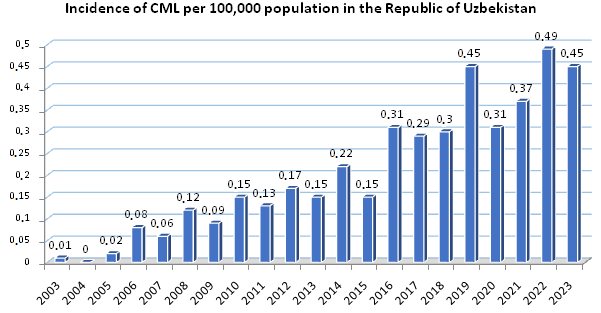 | Figure 1. A sample line graph using colors which contrast well both on screen and on a black-and-white hard copy |
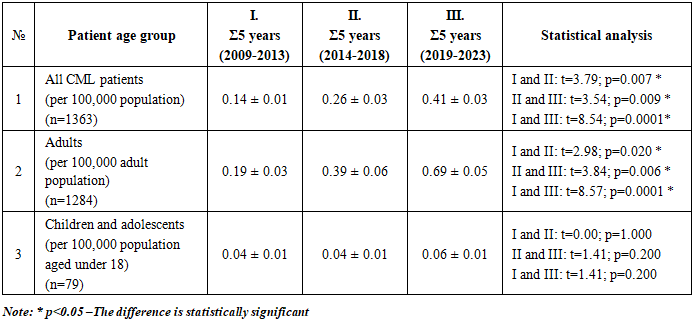
At the same time, in certain regions of the republic (the Andijan and Syrdarya regions and the Republic of Karakalpakstan), the CML detection rate was close to zero. As hematologists became increasingly aware of new trends in the diagnosis and treatment of CML, the number of patients with the disease – and consequently, the annual incidence rates – began to rise.Since 2007, a qualitative PCR method for detecting the BCR::ABL1 chimeric gene – formed as a result of t(9;22) – has been implemented in the clinical laboratory practice of the Republican Specialized Scientific-Practical Medical Center of Hematology (RSSPMCH) of the Ministry of Health of the Republic of Uzbekistan; a quantitative PCR method for assessing the level of t(9;22) expression was introduced in 2011.Since 2012, the Center of Hematology (RSSPMCH) has conducted conventional cytogenetic analysis (СCA) of metaphase chromosomes from the leukemic cells of CML patients to detect the Ph-chromosome, and since 2022, it has also performed interphase fluorescence in situ hybridization (FISH). The implementation of all key genetic tests required to confirm a CML diagnosis has significantly improved the detection of this hematologic malignancy and expanded public access to these diagnostic procedures in Uzbekistan.When assessing morbidity over an extended period, it is standard practice to evaluate the long-term average level. Data from a five-year period are typically used to determine these long-term average morbidity rates, as the calculation smooths out annual fluctuations caused by various factors [5].As part of the study, we analyzed the average 5-year incidence rate of CML in the Republic of Uzbekistan for the periods 2009-2013, 2014-2018, and 2019-2023 (Table 1).The analysis showed that the average 5-year incidence rate of CML – overall, without regard to age-was 0.14 per 100,000 population for the period 2009-2013.During the subsequent 5-year period (2014–2018), the average incidence rate increased by 46.2% (or 1.9-fold), reaching 0.26 per 100,000 population (p <0.05).Finally, during the 2019-2023 period, this indicator reached a value of 0.41 per 100,000 population, which is 65.8% (or 2.9 times) higher than the figure for 2009-2013 (p<0.05) and 36.6% (or 1.6 times) higher than the figure for 2014-2018 (p<0.05) (Table 1).Since adult CML patients constituted the vast majority of the total patient population, a similar pattern was observed for this category of patients as well.The average 5-year incidence rate of CML in adults for the period 2009-2013 was 0.19 per 100,000 population.During the subsequent 5-year period (2014–2018), the average incidence rate increased by 51.3% (or twofold), reaching 0.39 per 100,000 population (p < 0.05).During the 2019-2023 period, this indicator reached a value of 0.69 per 100,000 population, which is 72.5% (or 3.6 times) higher than the figure for 2009–2013 (p<0.05) and 43.5% (or 1.8 times) higher than the figure for 2014–2018 (p<0.05) (Table 1).However, a completely different picture was observed regarding the average 5-year incidence rate of CML in patients under the age of 18.Over the periods 2009–2013 and 2014–2018, the average incidence rate remained unchanged at 0.04 per 100,000 population.During the 2019–2023 period, this indicator reached a value of 0.06 per 100,000 population, which was 33.3% (or 1.5 times) higher than the figure for the preceding two five-year periods; however, statistical analysis revealed no significant difference between these values (0.04 and 0.06; p > 0.05), precluding any conclusions regarding a specific trend in the dynamics (Table 1).Table 1. Estimation of the average five-year incidence rate (per 100,000 population) of CML in adults and children for the period 2009–2023
 |
| |
|
The comparative dynamics of the average 5-year incidence rate of CML in adults and patients under the age of 18 are presented in Figure 2.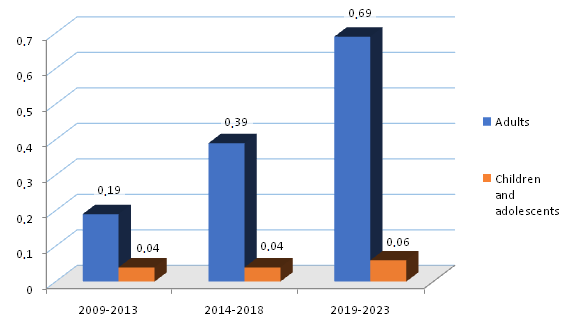 | Figure 2. Average 5-year incidence rate of CML among adult patients and patients under 18 years of age, based on initial presentation data at the Republican Specialized Scientific-Practical Medical Center of Hematology (Ministry of Health of the Republic of Uzbekistan) for the period 2009–2023 |
An analysis of regional trends in the primary incidence of CML reveals extremely low rates during the initial six-year observation period (2003–2008) across all administrative-territorial units of the Republic of Uzbekistan, with only isolated cases recorded. Notably, in certain regions of the country (Andijan, Syrdarya and Navoi regions, and the Republic of Karakalpakstan), the CML detection rate was zero or close to zero.Since 2008, a steady trend of improved diagnosis regarding the detection of CML patients has been observed in the majority of the administrative-territorial units of the Republic of Uzbekistan, a development reflected in the primary incidence rates.The trends in the incidence of newly diagnosed CML in the Andijan, Bukhara, Jizzakh, Kashkadarya, Navoi, and Namangan regions from 2003 to 2023 are shown in Figure 3. Trends in the incidence of newly diagnosed CML in the Samarkand, Surkhandarya, Syrdarya, Tashkent, Fergana, and Khorezm regions from 2003 to 2023 are shown in Figure 4. Trends in the incidence of newly diagnosed CML from 2003 to 2023 in the Republic of Karakalpakstan are shown in Figure 5, and in the city of Tashkent – in Figure 6.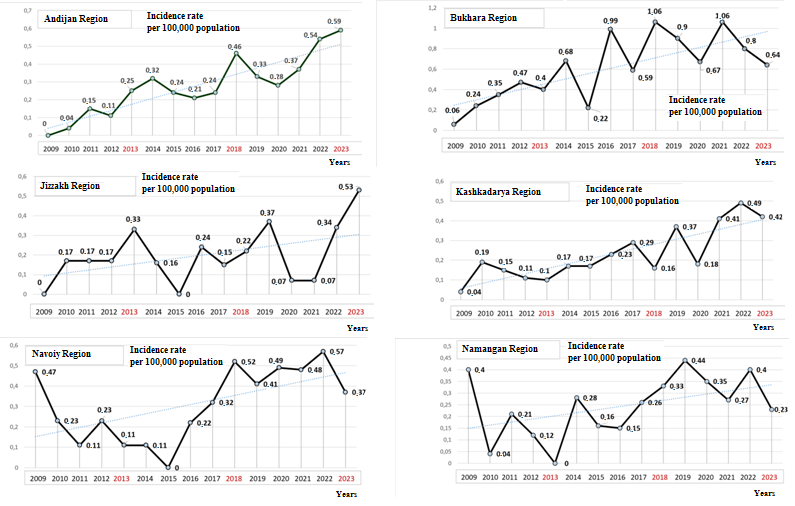 | Figure 3. Trends in the incidence of newly diagnosed diseases among the population in the Andijan, Bukhara, Jizzakh, Kashkadarya, Navoi, and Namangan regions from 2009 to 2023 |
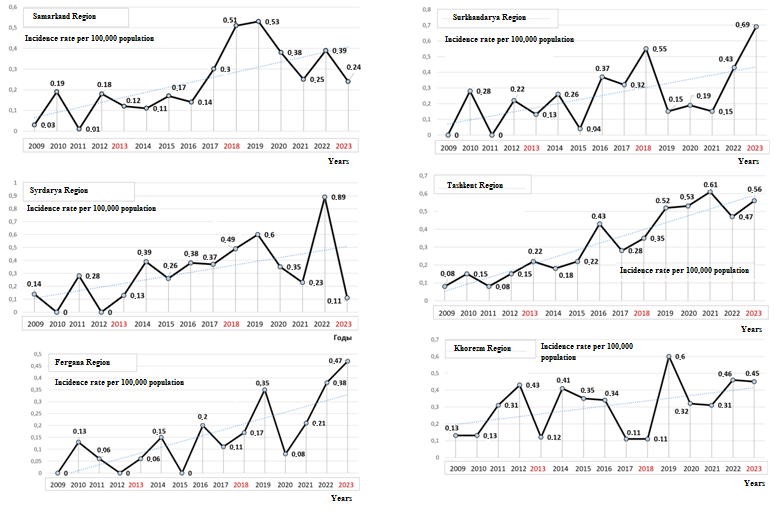 | Figure 4. Trends in the incidence of newly diagnosed diseases among the population in the Samarkand, Surkhandarya, Syrdarya, Tashkent, Fergana, and Khorezm regions from 2009 to 2023 |
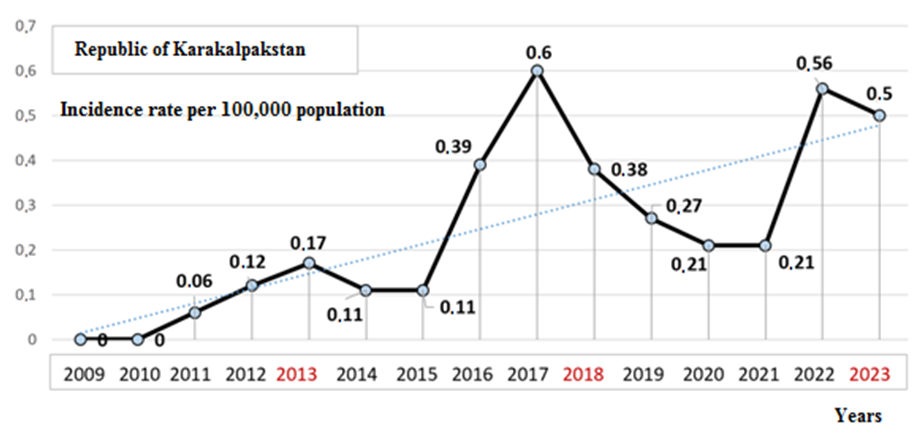 | Figure 5. Trends in the incidence of newly diagnosed diseases among the population of the Republic of Karakalpakstan from 2009 to 2023 |
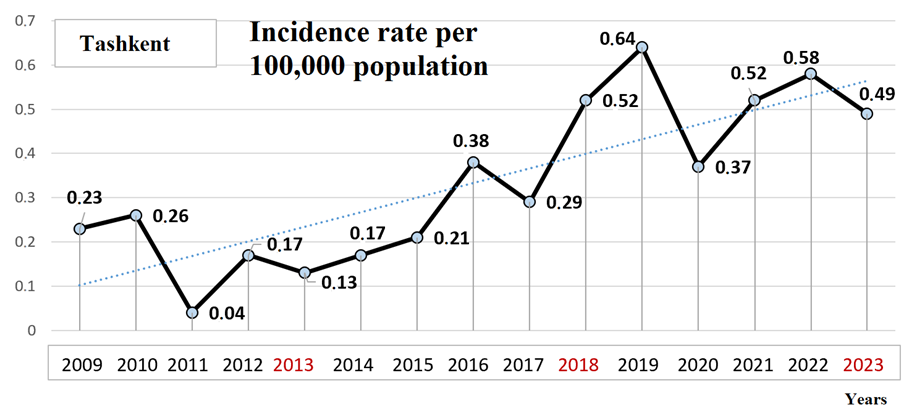 | Figure 6. Trends in the incidence of newly diagnosed diseases among the population of Tashkent from 2009 to 2023 |
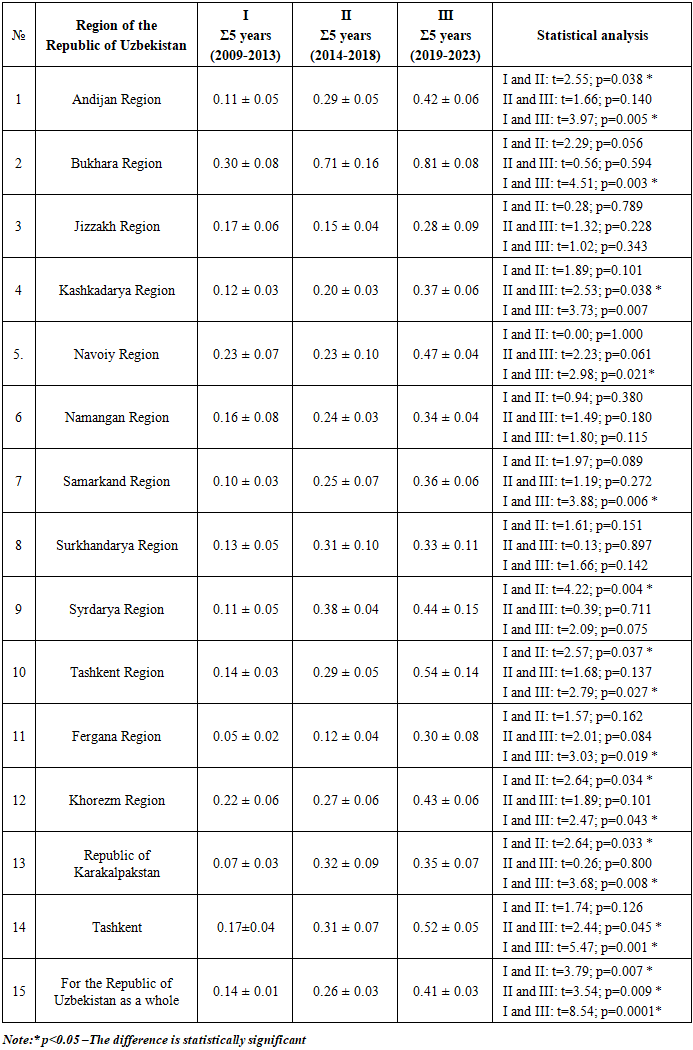
An analysis of the long-term dynamics of morbidity makes it possible to assess directional trends, identify changes and examine their causes, and investigate periodic fluctuations in morbidity across specific territories and within various population groups.Long-term trends in population morbidity are determined by causal factors that operate continuously, appear periodically, or manifest sporadically [10]. Factors acting continuously determine a linear trend in morbidity dynamics. An analysis of the long-term dynamics of the primary incidence of CML across the administrative-territorial units of the Republic of Uzbekistan reveals a linear trend – indicated by the trend line on the graphs – pointing to an overall increase in newly diagnosed cases. The study demonstrated that the most consistent positive linear trend in morbidity was observed in the Tashkent Region and the city of Tashkent – regions of the Republic of Uzbekistan with the highest level of access to high-quality onco-hematological medical care (Figs. 4, 6).Periodic factors determine the frequency and intensity of cyclical changes, whereas episodic factors can trigger outbreaks or lead to a significant decline in morbidity rates. The figures demonstrate that such factors alter morbidity dynamics across the vast majority of the administrative-territorial units of the Republic of Uzbekistan, causing sharp fluctuations – both upward and downward – in the country's overall morbidity levels (Figs. 3, 4, and 5).A comparative regional assessment of the average five-year incidence rate of CML in the administrative-territorial units of the Republic of Uzbekistan for the periods 2009-2013, 2014-2018, and 2019-2023 is presented in Table 2.Table 2. Estimation of the average five-year incidence rate (per 100,000 population) of CML in adults and children for the period 2009–2023
 |
| |
|
Analysis showed that during the 2009-2013 period, the highest average 5-year incidence rate of CML was observed in the Bukhara (0.30 per 100,000 regional population), Navoi (0.23 per 100,000 regional population), and Khorezm (0.22 per 100,000 regional population) regions, while the lowest average 5-year incidence rate of CML was observed in the Samarkand (0.10 per 100,000 regional population) and Fergana (0.05 per 100,000 regional population) regions and the Republic of Karakalpakstan (0.07 per 100,000 regional population) (Fig. 7).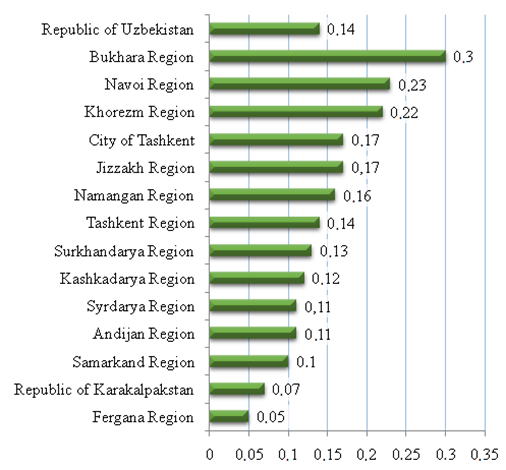 | Figure 7. Ranking of regions by the average five-year (2009–2013) incidence rate of CML per 100,000 of the regional population |
During the 2014–2018 period, the highest average 5-year incidence rate of CML was again observed in the Bukhara region (0.30 per 100,000 of the regional population). A relatively high average 5-year CML incidence rate was also recorded in the Syrdarya region (0.39 per 100,000 of the regional population). The lowest CML incidence rates were found in the Jizzakh (0.15 per 100,000 of the regional population) and Fergana (0.12 per 100,000 of the regional population) regions (Fig. 8).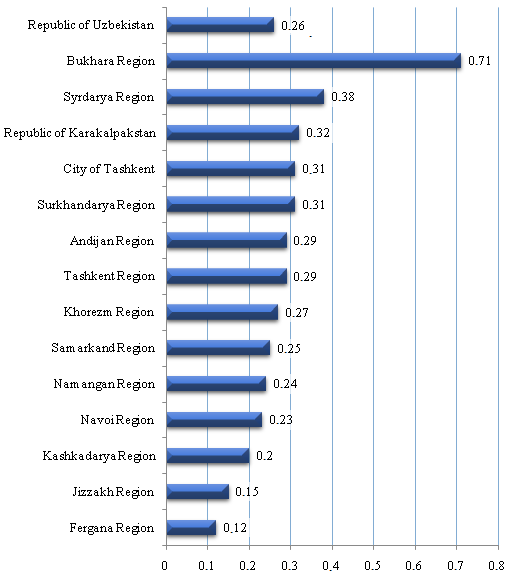 | Figure 8. Ranking of regions by the average five-year (2014–2018) incidence rate of CML per 100,000 of the regional population |
During the 2019-2023 period, the highest average 5-year incidence rate of CML was again observed in the Bukhara region (0.81 per 100,000 of the regional population). Relatively high average 5-year CML incidence rates were also recorded in the Tashkent region (0.54 per 100,000 of the regional population) and the city of Tashkent (0.52 per 100,000 of the regional population). The lowest CML incidence rates were again observed in the Jizzakh (0.28 per 100,000 population) and Fergana (0.30 per 100,000 population) regions (Fig. 9).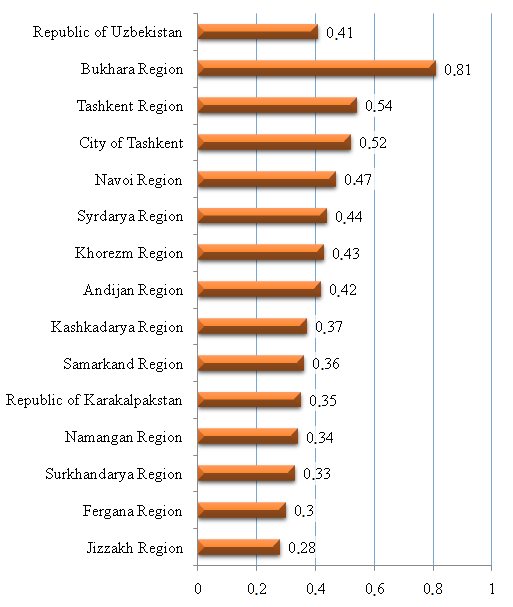 | Figure 9. Ranking of regions by the average five-year (2019–2023) incidence rate of CML per 100,000 of the regional population |
The consistently high incidence rate of CML in the Bukhara region is noteworthy. This figure exceeded the national average by a factor of 2.1 in 2009-2013, 2.7 in 2014-2018, and 2.0 in 2019-2023. This fact – as well as the reasons behind the low incidence rates that persist to this day in the Fergana and Jizzakh regions, among others – requires further study.
4. Conclusions
Thus, a long-term population-based study on the incidence of Ph/BCR::ABL1-positive CML in Uzbekistan was conducted for the first time. An upward trend in the number of newly registered cases was observed; over the past five years, the nationwide incidence rate reached 0.41 per 100,000 population.This level may not account for all new cases of CML, as it reflects only the incidence based on patient presentations at the Republican Specialized Scientific-Practical Medical Center of Hematology (RSSPMCH) of the Ministry of Health of the Republic of Uzbekistan; nevertheless, it aligns closely with data found in the literature. Regional variations in incidence were also identified, which may be attributable to factors such as the accessibility of high-quality medical care and the ethnic composition of the population.
Conflict of Interests’ Statement
The authors declare no conflict of interest. This study does not include the involvement of any budgetary, grant or other funds. The article is published for the first time and is part of a scientific work.
ACKNOWLEDGEMENTS
The authors express their gratitude to the management of the multidisciplinary clinic of Republican Specialized Scientific-Practical Medical Centre of Hematology for the material provided for our study.
References
| [1] | Afanasyev B.V., Abdullaev A.O., Al-Radi L.S., et al. Clinical guidelines: "Chronic Myeloid Leukemia." Developers: All-Russian National Union "Association of Oncologists of Russia," Non-profit Partnership for the Promotion of Hematology and Bone Marrow Transplantation Development "National Hematological Society." – 2020. – 87 p. |
| [2] | Ginter E.K. Cytogenetic Methods for Diagnosing Chromosomal Disorders: A Methodological Guide for Physicians / E.K. Ginter, T.V. Zolotukhina, V.G. Antonenko, N.V. Shilova, T.G. Tsvetkova, L.Yu. Zhuleva. – Moscow: RMAPO-MGNTs, 2009. – 82 p. |
| [3] | Zeltser A.N., Burnasheva E.V., Shatokhin Yu.V. Molecular-genetic characterization of chronic myeloid leukemia. Journal of Fundamental Medicine and Biology, 2016. (1), 4-14. |
| [4] | Kuzmina E.A., Chelysheva E.Yu., Biderman B.V., Turkina A.G. The role of somatic mutations in various genes and the problem of resistance to tyrosine kinase inhibitors in patients with chronic myeloid leukemia (literature review). Clinical Oncohematology. 2025; 18(1): 10–20. doi: 10.21320/2500-2139-2025-18-1-10-20. |
| [5] | Turkina A.G., Zaritskey A.Yu., Shuvaev V.A., et al. Clinical guidelines for the diagnosis and treatment of chronic myeloid leukemia. Clinical Oncohematology. 2017; 10(3): 294-316. doi: 10.21320/2500-2139-2017-10-3-294-316. |
| [6] | Apperley JF, Milojkovic D, Cross NCP, et al. 2025 European LeukemiaNet recommendations for the management of chronic myeloid leukemia. Leukemia 2025; 39(8): 1797-1813. doi: 10.1038/s41375-025-02664-w |
| [7] | Au WY, Caguioa PB, Chuah C, et al. Chronic myeloid leukemia in Asia. Int J Hematol. 2009; 89(1): 14-23. doi: 10.1007/s12185-008-0230-0. |
| [8] | Baccarani M, Castagnetti F, Gugliotta G, et al. The proportion of different BCR-ABL1 transcript types in chronic myeloid leukemia. An international overview. Leukemia 2019; 33(5): 1173-1183. doi: 10.1038/s41375-018-0341-4. |
| [9] | Baccarani M, Deininger MW, Rosti G, et al. European LeukemiaNet recommendations for the management of chronic myeloid leukemia: 2013. Blood. 2013; 122(6): 872–84. doi: 10.1182/blood-2013-05-501569. |
| [10] | Baccarani M, Pileri S, Steegmann JL, et al. Chronic myeloid leukemia: ESMO clinical practice guidelines for diagnosis, treatment and follow-up. Ann Oncol. 2012; 23(Suppl 7): vii72–7. doi: 10.1093/annonc/mds228. |


 Abstract
 Reference
 Full-Text PDF
 Full-text HTML