
-
Paper Information
- Paper Submission
-
Journal Information
- About This Journal
- Editorial Board
- Current Issue
- Archive
- Author Guidelines
- Contact Us
International Journal of Plant Research
p-ISSN: 2163-2596 e-ISSN: 2163-260X
2026; 14(1): 14-21
doi:10.5923/j.plant.20261401.03
Received: Jun. 16, 2026; Accepted: Jul. 12, 2026; Published: Jul. 23, 2026

Effects of Rice Straw Biochar Application Rates on Growth, Yield and Iron Toxicity Tolerance of Two Rice Varieties
 Abstract
 Reference
 Full-Text PDF
 Full-text HTML
Daniel Mulbah Kokulo1, 2, Moses Ahmed Daramy1
1Department of Crop Science, Njala University, Sierra Leone
2Crops Program, Central Agricultural Research Institute (CARI), P.M.B. 3929, Suakoko, Bong County, Liberia
Correspondence to: Daniel Mulbah Kokulo, Department of Crop Science, Njala University, Sierra Leone.
| Email: |  |
Copyright © 2026 The Author(s). Published by Scientific & Academic Publishing.
This work is licensed under the Creative Commons Attribution International License (CC BY).
http://creativecommons.org/licenses/by/4.0/

Iron toxicity is a major constraint to lowland rice production in acidic soils. This study evaluated the effects of rice straw biochar application (0-5%) on soil chemical properties, rice growth, yield, and Fe accumulation in two rice varieties (NERICA L-19 and NUCOS-1) under iron-toxic soil conditions. Biochar application significantly improved soil fertility indicators by increasing soil pH, exchangeable K, and ECEC, while reducing available Fe concentration. Soil pH increased from 4.58 to 5.63 in NERICA L-19, and from 4.80 to 5.49 in NUCOS-1, whereas available Fe declined by 24% and 56%, respectively, under 5% biochar application. Rice variety and biochar rate significantly influenced plant growth and grain yield, statistically significant at (p<0.01). Furthermore, NERICA L-19 produced significantly higher grain yield (27.98 g plant⁻¹) than NUCOS-1 (25.27 g plant⁻¹), representing a 10.7% increase and indicating greater tolerance to iron toxicity. In addition, biochar application improved grain yield, with the highest yield recorded at 3% biochar (29.32 g plant⁻¹), representing an 18.1% increase compared with the control (24.82 g plant⁻¹). However, the higher application rates (5%) did not provide additional yield benefits. In addition, biochar also significantly reduced Fe accumulation in plant tissues, with root Fe decreasing by 43% in NERICA L-19 and 53% in NUCOS-1, while grain Fe concentration declined by 61% and 67%, respectively. These results demonstrate that rice straw biochar effectively mitigates iron toxicity by improving soil chemical properties, reducing Fe availability and uptake, and enhancing rice productivity. The study therefore recommends that application of 3-4% biochar combined with tolerant varieties such as NERICA L-19 represents a promising strategy for sustainable management of iron-toxic lowland rice soils.
Keywords: Biochar, NERICA L-19, NUCOS-1, Iron-toxic soils, Sierra Leone
Cite this paper: Daniel Mulbah Kokulo, Moses Ahmed Daramy, Effects of Rice Straw Biochar Application Rates on Growth, Yield and Iron Toxicity Tolerance of Two Rice Varieties, International Journal of Plant Research, Vol. 14 No. 1, 2026, pp. 14-21. doi: 10.5923/j.plant.20261401.03.
Article Outline
1. Introduction
- Rice is one of the most rapidly increasing food commodities in terms of both production and consumption in Sub-Saharan Africa [SSA], [1]. However, the average rice yield in SSA is only around 2.1 t ha-1 [2]. In Sierra Leone, rice is the staple food where the country cannot produce enough to meet local demand affecting food security. As a result, the nation imports approximately 361,000 metric tons of rice, valued at around $160 million, which accounts for about 30% of the national demand [3].The low yield is as a result of iron toxicity, serving as one of the major problems in the West Africa lowlands, limiting rice production [4]. A study by [5] revealed that iron toxicity threatens 19% of the total African rice growing area, nearly 55% of rice fields in Guinea, Ivory Coast, and Ghana, with 10% of these regions abandoned due to severe toxicity.Iron toxicity is a major constraint to lowland rice production in many tropical and subtropical regions. It occurs when insoluble ferric iron (Fe³⁺) is reduced to soluble ferrous iron (Fe²⁺) under anaerobic and acidic soil conditions [6]. Excessive uptake of ferrous iron damages plant tissues, disrupts cellular homeostasis, and inhibits rice growth and development [7]; [8]. Depending on the severity of the stress and the crop growth stage, iron toxicity can reduce rice yields by 10-90% and may even cause complete crop failure, particularly when it occurs during the early vegetative stage [9]; [10]; [11]; [12].Conventional management practices, such as liming and drainage improvement, are often expensive and impractical for smallholder farmers. As a result, there is increasing interest in sustainable and cost-effective soil amendments for managing iron toxicity. Biochar, a carbon-rich material produced through the pyrolysis of organic biomass under limited oxygen conditions, has emerged as a promising option [13]. Numerous studies have shown that biochar improves soil fertility by enhancing nutrient retention, increasing cation exchange capacity, buffering soil pH, and improving soil structure and microbial activity [14]; [15]; [16].The effectiveness of biochar depends largely on the feedstock used during its production because feedstock characteristics determine the physicochemical properties of the resulting biochar [17]. Rice straw (RS) is considered a promising feedstock due to its abundance and its potential to alleviate iron toxicity in lowland rice systems [18]; [19]. Rice straw is particularly rich in potassium and silica [20], two nutrients that have been reported to reduce the adverse effects of iron toxicity on rice growth and performance [21]; [22]. In addition, the application of both fresh rice straw [23]; [24] and decomposed rice straw [25], has been shown to mitigate iron toxicity in lowland rice fields.Converting rice straw into biochar offers several advantages over the direct application of raw straw. Pyrolysis reduces the volume and weight of the biomass, increases its long-term stability in soil, lowers contaminant levels, and concentrates essential nutrients [26]; [16]; [27]. The process also concentrates potassium and silica, producing a stable, silica-rich rice straw biochar (RSBC). The high potassium content of RSBC can increase soil pH and potassium availability, while its silica-rich composition may enhance rice tolerance to iron toxicity [28]. These characteristics make RSBC a promising soil amendment for mitigating iron toxicity and improving the productivity of lowland rice systems [21]; [22].
1.1. Study Objective
- Against this background, this study examined the effects of rice straw biochar application rates on growth, yield and iron toxicity tolerance of two rice varieties. Based on this objective, we tested the following hypotheses.
1.2. Hypotheses
- 1. Different rates of biochar application significantly influence the soil pH, CEC, and K content.2. Different rates of biochar application significantly influence the growth and yield parameters of the tested rice varieties under iron toxicity conditions.3. Different rates of biochar reduce Fe concentration in plant tissues of the two rice varieties.
2. Methodology
2.1. Study Area
- The study was conducted in a greenhouse at the School of Agriculture and Food Sciences, Njala Campus, Njala University, located in Moyamba District, Southern Sierra Leone. Njala is approximately 47 km from Bo City and 255 km from Freetown, the capital. The area has a tropical climate characterized by a rainy season from May to October and a dry season from November to April, with mean annual temperatures ranging from 28°C to 33°C and annual rainfall of about 2,500 mm [29]. These climatic conditions support rice and cash crop production, with rice being the dominant food crop cultivated mainly under rain-fed upland and inland valley swamp systems. The location of the study area is presented in Figure 1.
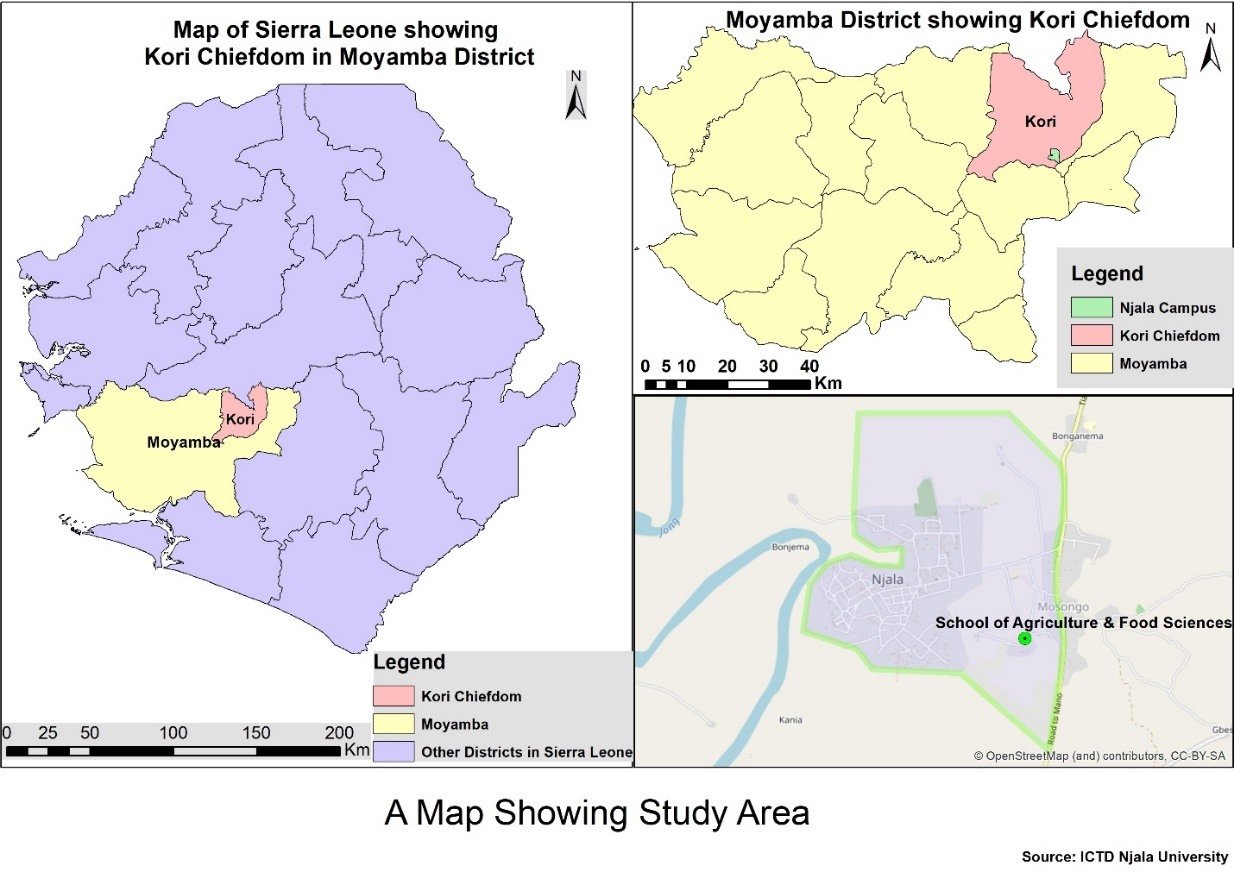 | Figure 1. Map of the study area |
2.2. The Collection and Preparation of Planting Materials and Soil Samples
- Two rice varieties, NERICA L-19 and NUCOS 1, were obtained from the Central Agricultural Research Institute (CARI), Liberia, and the School of Agriculture and Food Sciences, Njala University, Sierra Leone. Soil samples were collected randomly from the 0-20 cm depth of a well-characterized iron-toxic inland valley swamp at the Njala Agricultural Research Center, Sierra Leone Agricultural Research Institute (SLARI). The collected soil samples were air-dried for two weeks, during which large soil clods were crushed and plant debris was removed. The processed soil was then stored in plastic containers, and representative subsamples were collected for physicochemical analysis.
2.3. Biochar Preparation
- We collected dry rice straw randomly from local rice farmers in Njala Monkonday town, Sierra Leone. The collected straw was sun-dried for two days to reduce moisture content before carbonization. The dried rice straw was then converted into biochar using an aluminum zinc process drum under limited oxygen conditions. After cooling, the produced biochar was gently crushed and passed through a 2 mm mesh sieve to obtain a uniform fine material. The processed biochar was stored in airtight plastic containers until use in the experiment, while representative subsamples were collected for laboratory analysis of its physicochemical properties.
2.4. Experimental Design and Crop Management
- The experiment was conducted using a Completely Randomized Design (CRD) with a factorial arrangement comprising six rice straw biochar (RSBC) application rates (0%, 1%, 2%, 3%, 4%, and 5%) and two rice varieties (NERICA L-19 and NUCOS-1). The experiment was conducted during the month of May, which falls within the early rainy season in southern Sierra Leone. Ambient air temperatures during this period typically range from approximately 24-31 °C, with high relative humidity (generally above 80%). The greenhouse received natural daylight, and no supplemental lighting was provided. Light intensity was not monitored during the experimental period.Each treatment combination was replicated three times. Five kilograms of air-dried soil were weighed into perforated plastic containers, and RSBC was incorporated at the designated rates. The soil and biochar mixtures were thoroughly homogenized to ensure uniform distribution of the amendment. The amended soils were then moistened to field capacity and allowed to equilibrate for seven days before rice transplanting.Twenty-eight-day-old seedlings of NERICA L-19 and NUCOS-1, previously raised in a nursery, were carefully uprooted, washed to remove adhering soil, and trimmed to obtain uniform height before transplanting. Two seedlings were transplanted into each pot. Basal N:P:K fertilizer was applied at 40:40:40 kg ha⁻¹ three days after transplanting, followed by a top dressing of 20 kg ha⁻¹ nitrogen as urea at the panicle initiation stage.Soil moisture was maintained through daily watering during the first four weeks after transplanting and subsequently at one-day intervals until harvest. In addition, weeds were manually removed as they emerged. The physicochemical properties of the rice straw biochar (RSBC), including pH, moisture content, water-holding capacity, total carbon, total nitrogen, available phosphorus, potassium, calcium, magnesium, silicon, and cation exchange capacity (CEC), were analyzed before application. Soil samples collected before planting and after harvest, were also analyzed to determine changes in soil properties.Furthermore, moisture content was determined using an infrared moisture analyzer at 150°C. Soil pH was measured in a 1:1 soil-to-water suspension using a calibrated pH meter after equilibration for 30 minutes. The CEC was determined using the ammonium acetate (NH₄OAc) extraction method. Exchangeable cations (Na, K, Ca, and Mg) were extracted with 1 N ammonium acetate solution and quantified using a flame photometer [30]. Total nitrogen was determined using the Kjeldahl digestion and distillation method, while available phosphorus was measured using the Bray I extraction method [31], and quantified spectrophotometrically. All analyses were conducted in triplicate to ensure accuracy and reliability.
2.5. Data Collection and Analysis
- Data were collected to evaluate the effects of rice straw biochar application on growth, yield, biomass production, and iron accumulation in NERICA L-19 and NUCOS-1 rice varieties. Growth parameters, including plant height, number of leaves, and tiller number, were measured at 1 and 2 months after transplanting (MAT) and at harvest. Plant height was measured from the soil surface to the tip of the uppermost fully expanded leaf during vegetative growth and to the tip of the panicle at harvest.At harvest, yield-related traits were assessed, including 1000-grain weight and grain yield. For 1000-grain weight determination, grains were randomly selected, dried to approximately 12% moisture content, counted, and weighed. Grain yield was determined by harvesting three plants per pot, and the average grain weight per plant was calculated. Aboveground biomass (shoots, stems, and leaves) and roots were collected separately, oven-dried at 60°C for 72 hours to constant weight, and weighed to determine dry biomass.Finally, plant samples, including aboveground tissues and grains, were collected at harvest to determine iron concentration. The collected data were analyzed using two-way analysis of variance (ANOVA) in GENSTAT, and treatment means were separated using the least significant difference (LSD) test at the 5% significance level.
3. Results and Discussion
3.1. The Effects of the Different Rates of Biochar Application on Soil pH, CEC, and K Content
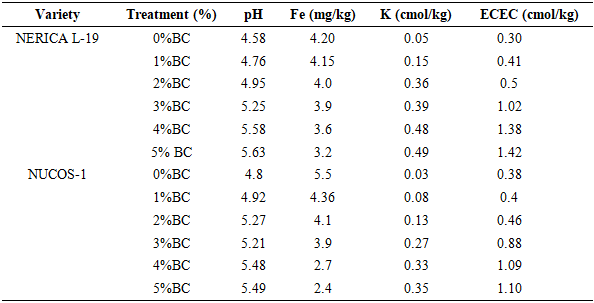
- Table 3.1 shows the effects of biochar application rates on soil pH, CEC, K, and available Fe for the two rice varieties (NERICA L-19 and NUCOS-1). Increasing biochar rates improved soil chemical properties by increasing pH, exchangeable K, and ECEC, while reducing available Fe concentration.Soil pH increased progressively with biochar application. In NERICA L-19, pH increased from 4.58 (0% BC) to 5.63 (5% BC), while in NUCOS-1 it increased from 4.80 to 5.49. This improvement reflects the liming effect of biochar, which is associated with its alkaline properties and release of basic cations (Ca²⁺, Mg²⁺, K⁺, and Na⁺), that neutralize soil acidity [13]; [32]. Increased pH likely reduced Fe availability by promoting Fe precipitation and enhancing Fe adsorption by biochar surfaces, thereby mitigating iron toxicity [33]; [13].Available Fe declined with increasing biochar rates. In NERICA L-19, Fe decreased from 4.2 to 3.2 mg/kg, while in NUCOS-1 it declined from 5.5 to 2.4 mg/kg under 0-5% biochar application. This reduction is beneficial for rice production in iron-toxic soils, where excessive Fe availability can limit plant growth.Exchangeable K increased substantially with biochar application, rising from 0.05 to 0.49 cmol/kg in NERICA L-19 and from 0.03 to 0.35 cmol/kg in NUCOS-1. This increase reflects biochar’s role as a source of exchangeable nutrients, particularly potassium, which is commonly retained in biochar ash [15]. Similarly, ECEC increased from 0.30 to 1.42 cmol/kg in NERICA L-19 and from 0.38 to 1.10 cmol/kg in NUCOS-1, indicating improved nutrient retention capacity due to biochar’s high surface area and functional groups [34].Although both varieties showed similar responses, NERICA L-19 exhibited greater increases in K and ECEC, whereas NUCOS-1 showed a stronger reduction in Fe concentration. These differences suggest varietal variation in soil–plant interactions, although biochar application was the primary factor influencing soil improvement. The highest biochar rates (4-5%) produced the greatest improvements, highlighting their potential for ameliorating acidic, iron-toxic soils and enhancing rice production. These results support Hypothesis 1, confirming that biochar application significantly influences soil pH, CEC, and K availability.
|
3.2. The Effect of the Different Rates of Biochar Application on the Growth and Yield Parameters of the Tested Rice Varieties Under Iron Toxicity Conditions
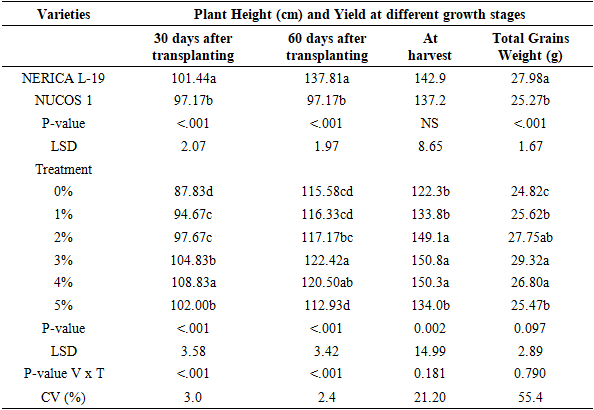
- Table 3.2 shows that both rice variety and biochar application significantly influenced plant height, and grain yield under iron-toxic soil conditions. NERICA L-19 consistently produced taller plants (137.81cm) than NUCOS-1 (97.17), at 30 and 60 days after transplanting, and achieved a significantly higher grain yield (27.98), than NUCOS-1 (25.27), statistically significant at 1% level indicating greater tolerance to iron toxicity. This superior performance is likely due to its greater ability to tolerate excess Fe while maintaining nutrient uptake, photosynthesis, and biomass production under stress [10].Biochar application significantly improved plant growth compared with the control, with the greatest response observed at 3-4% application rates. These improvements can be attributed to the ability of rice straw biochar to alleviate Fe toxicity by increasing soil pH and cation exchange capacity, reducing soluble Fe²⁺ concentrations, and improving the availability of essential nutrients such as K [13]; [35].Although the 4% biochar treatment produced the tallest plants during early growth, the 3% treatment achieved the highest grain yield, suggesting that moderate biochar rates provided the most favorable balance between vegetative growth and reproductive development. In contrast, the 5% biochar treatment did not further improve growth or yield and performed similarly to the control for several traits. Excessive biochar application may increase soil alkalinity and nutrient adsorption, reducing the availability of some nutrients and creating nutritional imbalances that limit crop performance. Similar optimum responses at moderate biochar rates have been reported in previous studies [36]; [37].Overall, these findings support the hypothesis that biochar mitigates iron toxicity and enhances rice growth and productivity, with 3-4% biochar representing the optimum application range under the conditions of this study.
|
3.3. Different Rates of Biochar Affect the Iron (Fe) Concentration in the Plant Tissues of the Two Rice Varieties
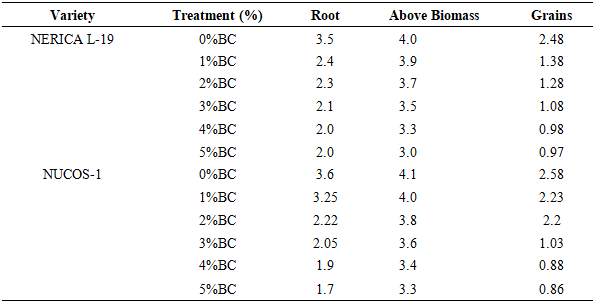
- Table 3.3 shows that biochar application (0-5%) reduced Fe concentration in the roots, above-ground biomass, and grains of both NERICA L-19 and NUCOS-1. Root Fe concentration declined steadily with increasing biochar rates, decreasing from 3.5 to 2.0 in NERICA L-19 (43%) and from 3.6 to 1.7 in NUCOS-1 (53%). This reduction indicates that biochar lowered Fe availability by increasing soil pH and adsorbing soluble Fe, thereby reducing Fe uptake [33]; [13].A similar trend was observed in the above-ground biomass, where Fe concentration decreased from 4.0 to 3.0 in NERICA L-19 and from 4.1 to 3.3 in NUCOS-1. Reduced Fe translocation from roots to shoots likely alleviated oxidative stress and leaf bronzing associated with Fe toxicity [9].Grain Fe concentration also declined markedly with increasing biochar rates, falling from 2.48 to 0.97 in NERICA L-19 (61%) and from 2.58 to 0.86 in NUCOS-1 (67%). The sharp decline, particularly between 2% and 3% biochar in NUCOS-1, suggests that moderate biochar application effectively limited Fe movement to the grain while improving soil chemical conditions.Although both varieties exhibited similar responses, NUCOS-1 showed slightly greater reductions in root and grain Fe at higher biochar rates, indicating possible varietal differences in Fe uptake. Overall, biochar was the primary factor controlling Fe dynamics, with application rates of 3-5% providing the greatest reduction in tissue Fe concentration. These findings agree with previous studies showing that biochar increases soil pH and immobilizes Fe in acidic soils, thereby reducing Fe toxicity [13]; [32]. The results therefore support Hypothesis 3 that biochar application reduces Fe accumulation in rice tissues and can serve as an effective amendment for managing iron-toxic lowland rice soils.
|
4. Conclusions and Policy Recommendations
4.1. Conclusions
- The study demonstrated that rice straw biochar is an effective amendment for improving soil quality and mitigating iron toxicity in lowland rice production systems. Biochar application significantly increased soil pH, exchangeable K, and ECEC, while reducing available Fe concentration, indicating improved soil fertility and reduced Fe toxicity. The greatest improvements in soil chemical properties were observed at the higher biochar rates (4-5%).Rice growth and yield responded positively to biochar application. NERICA L-19 outperformed NUCOS-1 in plant height and grain yield, indicating greater tolerance to iron-toxic conditions. Although increasing biochar rates enhanced plant growth, the highest grain yield was achieved at the 3% biochar rate, suggesting that moderate biochar application provides the most favorable balance between soil improvement and crop performance.Biochar also significantly reduced Fe accumulation in roots, shoots, and grains of both rice varieties, confirming its effectiveness in limiting Fe uptake and translocation within the plant. The reductions in tissue Fe concentration were most pronounced at 3-5% biochar application rates, reflecting the role of biochar in increasing soil pH and immobilizing soluble Fe.Overall, the results confirm that biochar application can effectively ameliorate acidic, iron-toxic soils, improve nutrient availability, reduce Fe toxicity, and enhance rice productivity. Under the conditions of this study, NERICA L-19 combined with a biochar application rate of approximately 3-4% emerged as the most effective strategy for improving rice performance in iron-toxic lowland soils. These findings highlight the potential of rice straw biochar as a sustainable and locally available soil management option for increasing rice productivity and food security in iron-affected rice-growing areas.There are several limitations despite these promising results. First, the study was conducted under controlled greenhouse conditions using a single iron-toxic soil source and a limited number of rice varieties. Therefore, the responses observed may differ under farmers’ field conditions due to variations in soil properties, climate, water management, and biochar quality. Second, the experiment also evaluated short-term biochar effects and did not assess long-term changes in soil fertility, residual effects, or the economic feasibility of biochar application at farm scale. Further multi-location field trials are needed to validate the optimum biochar rates, evaluate long-term soil and crop responses, and determine the practical adoption potential of biochar-based management for iron-toxic lowland rice systems.
4.2. Policy Recommendations
- Based on the study findings, the following policy recommendations are made: 1. Promote rice straw biochar as a sustainable soil amendment. Agricultural extension services should encourage the production and use of rice straw biochar in iron-toxic lowland rice areas to increase soil pH, improve nutrient retention, and reduce Fe toxicity, thereby enhancing soil fertility and rice productivity.2. Support local biochar production and utilization. Policies should encourage community- and farmer-based biochar production using rice straw and other agricultural residues. This will reduce residue burning, recycle farm waste into valuable soil amendments, and contribute to climate-smart agriculture.3. Promote the use of rice straw biochar at an optimum application rate of 3-4% in iron-toxic lowland rice fields. Agricultural extension services should recommend this rate as it provided the greatest improvement in grain yield and plant growth while avoiding the diminishing returns observed at higher application rates. 4. Scale up the dissemination of iron-toxicity-tolerant rice varieties such as NERICA L-19. Seed multiplication and distribution programs should prioritize tolerant varieties in areas affected by iron toxicity, as they demonstrated superior growth and yield under stress conditions.5. Encourage on-farm production of rice straw biochar. Policies should support farmer groups and cooperatives to convert rice straw into biochar rather than burning or discarding it. This approach transforms agricultural waste into a valuable soil amendment, lowers production costs, and promotes environmentally sustainable residue management.
Declaration of Competing Interest
- The authors declare that they have no known competing financial interests or personal relationships that could have appeared to influence the work reported in this paper.
Funding
- The authors declare that no funds, grants, or other support were received during the preparation of this manuscript.
Data Access
- Data will be available on request from the corresponding author.