
-
Paper Information
- Paper Submission
-
Journal Information
- About This Journal
- Editorial Board
- Current Issue
- Archive
- Author Guidelines
- Contact Us
International Journal of Plant Research
p-ISSN: 2163-2596 e-ISSN: 2163-260X
2026; 14(1): 8-13
doi:10.5923/j.plant.20261401.02
Received: Jun. 25, 2026; Accepted: Jul. 19, 2026; Published: Jul. 22, 2026

Spiritual Blessing (Biofield) Energy Treatment on Radish (Raphanus sativus) Morphology and Productivity: An Innovative Approach to Agriculture
 Abstract
 Reference
 Full-Text PDF
 Full-text HTML
Mahendra Kumar Trivedi 1, Nikhil Rajendra Phutankar 2, Vivek Dattaram Kadam 2, Tejas Bapu Gaikwad 2, Sambhu Mondal 3, Snehasis Jana 3
1Trivedi Global, Inc., Research and Development, Henderson, Nevada, USA
2Shree Angarsiddha Shikshan Prasarak Mandal’s College of Agriculture, Dept. of Horticulture, Sangulwadi, Mohitewadi, Maharashtra, India
3Trivedi Science Research Laboratory Pvt. Ltd., Research and Development, Thane (W), Maharashtra, India
Correspondence to: Snehasis Jana , Trivedi Science Research Laboratory Pvt. Ltd., Research and Development, Thane (W), Maharashtra, India.
| Email: |  |
Copyright © 2026 The Author(s). Published by Scientific & Academic Publishing.
This work is licensed under the Creative Commons Attribution International License (CC BY).
http://creativecommons.org/licenses/by/4.0/

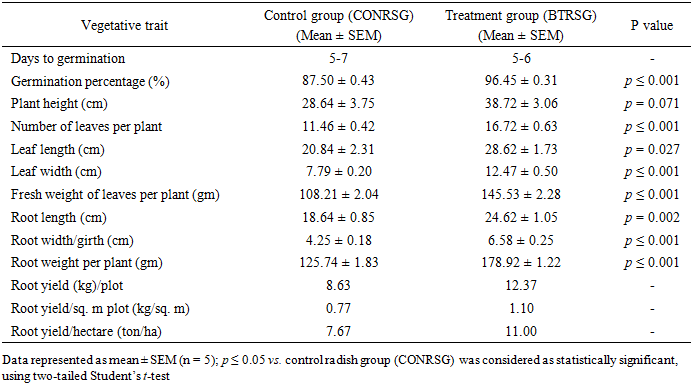
Objective: The study objective was to evaluate the impact of spiritual blessing (biofield) energy treatment (SBET) on morphological characteristics and overall productivity of radish (Raphanus sativus L.). Methods: The study utilized a Randomized Complete Block Design (RCBD) where uniform, high-quality radish seeds and plots were divided into two main groups: an untreated radish control group (CONRSG) and a biofield energy-treated radish group (BTRSG). The treatment group received a unique biofield energy blessing from a recognized practitioner (the Trivedi Effect®), while the control group received no treatment. Both groups were maintained under identical environmental, soil, and watering conditions. Key parameters, including germination rate, plant height, leaf area, root length, root fresh weight, and overall yield, were measured and statistically analyzed over a standard cultivation cycle. All the data between two independent cohorts were evaluated using a two-tailed Student’s t-test using SigmaPlot (version 14.0), with statistical significance defined as p < 0.05. Results: Results showed that various morphological and phenological traits such as numbers of leaves per plant, leaf length, leaf width, fresh weight of leaves per plant, root length, root width/girth, and root weight per plant were significantly increased by 45.90% (p ≤ 0.001), 37.33% (p = 0.027), 60.08% (p ≤ 0.001), 34.49% (p ≤ 0.001), 32.08% (p = 0.002), 54.82% (p ≤ 0.001), and 42.29% (p ≤ 0.001), respectively, in the BTRSG compared to the CONRSG. Further, root yield (tons per hectare) were rose by 43.42% in the BTRSG compared to the CONRSG. Conclusion: The findings suggest that the application of SBET can positively modulate the vegetative growth, morphology, and yield potential of Raphanus sativus.
Keywords: Radish, Spiritual blessing, Prayer, Biofield treatment, Plant morphology, Phenology, Crop yield, Raphanus sativus
Cite this paper: Mahendra Kumar Trivedi , Nikhil Rajendra Phutankar , Vivek Dattaram Kadam , Tejas Bapu Gaikwad , Sambhu Mondal , Snehasis Jana , Spiritual Blessing (Biofield) Energy Treatment on Radish (Raphanus sativus) Morphology and Productivity: An Innovative Approach to Agriculture, International Journal of Plant Research, Vol. 14 No. 1, 2026, pp. 8-13. doi: 10.5923/j.plant.20261401.02.
Article Outline
1. Introduction
- Radish (Raphanus sativus L.) is an important root vegetable utilized worldwide. All plant parts of radish (leaves, stem, seeds, roots and pods) are utilized for consumption. Over last few decades, radish root is gaining interest of researchers for the conformity of its human health benefits, due to the presence of compounds such as glucosinolates, isothiocyanates, phenols, flavonoids, anthocyanins and other bioactive substances which holds medicinal and therapeutic properties [1-3]. Radish root contains a good amount of various bioactive compounds such as vitamins (vit. B6, vit. C and folate) and minerals (calcium, magnesium, copper, manganese, and potassium) [4]. Physical seed pre-treatments including magnetic field induction, electric fields, and specialized irradiation techniques have gained substantial scientific traction as alternative mechanisms to alter plant physiology. These non-invasive external stimuli have demonstrated a profound capacity to alter seed vitality indices, notably accelerating germination energy, seedling uniformity, and subsequent vegetative growth without altering the foundational genomic architecture of the organism. For example, historical frameworks tracking electromagnetic or electrical adjustments in root crops have recorded distinct spikes in germination velocity and total phenotypic biomass accumulation [5]. Parallel to electromagnetic or mechanical physical therapies, the concept of biofield energy modalities has steadily entered the discourse of complementary biophysical methodologies. Formally recognized and categorized under Complementary and Alternative Medicine (CAM) by institutions like the National Centre for Complementary and Integrative Health (NCCIH), the biofield was scientifically framed as an elusive yet measurable complex of endogenous and exogenous electromagnetic and subtle fields that envelop living biological systems. Within the realm of quantitative research, non-contact biofield-based practices and directed focus strategies have been shown to influence the behavioural, architectural, and structural properties of both organic compounds and cellular matrices [6]. Consequently, this study was designed to systematically evaluate the precise impact of biofield energy treatment on the morphological variations, developmental timelines, and ultimate yield outcomes of Raphanus sativus. Applying these physical and energetic field principles directly to vegetable crops has shown profound potential, particularly regarding the crop model radish (Raphanus sativus). The definitive impact of external physical field manipulations on this specific species was meticulously demonstrated by Konefał-Janocha et al. 2018 [7]. Their research revealed that exposing seeds to specific stationary magnetic fields significantly enhances the rate of germination, the vigor index, and early vegetative root-shoot lengths compared to untreated control groups. These foundational studies establish that external electromagnetic and physical fields can alter early germination indices and physiological kinetics, there remains a critical research gap regarding how subtle, specialized biofield energy treatments affect the full lifecycle, structural morphology, and final harvest productivity of Raphanus sativus.Prior investigations have highlighted the potential of electromagnetic and bio-energetic treatments to optimize agricultural outcomes. Specifically, the exogenous application of a high-intensity electromagnetic field (EMF) to oil radish seeds (Raphanus sativus L. var. oleifera Metzg.) was shown to enhance germination efficiency and subsequent crop productivity [8]. Beyond direct seed stimulation, treatments applied to the cultivation medium have also yielded significant benefits; soil exposure to biofield energy substantially enhanced its physicochemical and microbial properties, thereby improving electrical conductance, fostering beneficial microbiota, and optimizing mineral availability to boost overall crop yield [9]. Furthermore, supporting evidence indicates that electric, magnetic, and biofilm-based interventions positively modulate the vegetative growth, total yield, and yield-attributing traits of radish (Raphanus sativus L.) [10]. To address this knowledge gap, the present study comprehensively evaluates the effect of a novel spiritual blessing (biofield) energy treatment (SBET) on both the physical growth characteristics and overall crop yield of radish plants.
2. Materials and Methods
- Experimental site detailsThis study was established in Bhandarwadi, Sindhudurg, Maharashtra, India (15°37’–16°40’ N, 73°19’–74°13’ E; 26 m above mean sea level.) within the tropical Konkan agro-climatic zone. Characterized by mean maximum pre-monsoon temperatures of 39–42°C, the site exhibits pronounced interannual rainfall variability. These erratic precipitation patterns induce severe soil moisture deficits, thereby exacerbating crop vulnerability to drought stress and potentially compromising core physiological mechanisms across critical phenological stages.Seed details and study designRadish (Raphanus sativus L. cv. 'Desi Golden/Pusa Chatki') seeds with genetic purity of 98% (Lot No. NURGF099; Label: 13647) were procured from Namdeo Umaji Agritech (India) Pvt. Ltd. The stock was allocated into two experimental cohorts: the control radish seed group (CONRSG) and the biofield energy-treated radish seed group (BTRSG), with the latter subjected to a spiritual blessing energy treatment (SBET). Agronomic and environmental parameters, including irrigation, fertilization, and pest management, were maintained uniformly across both cohorts for the duration of the study.Field layoutThe field experiment was laid out in a Randomized Complete Block Design (RCBD) comprising two treatment groups replicated three times: an untreated control (CONRSG) and a biofield energy treatment (BTRSG). In the CONRSG group, no treatment was applied to either the seeds or the soil; conversely, both the seed stock and the designated plot soil in the BTRSG group were subjected to a biofield energy treatment prior to sowing. There were six plots with an individual plot size of 2.5 m × 1.5 m. Spacing was maintained at 0.5 × 0.5 m, and a half-meter distance was maintained between replications and 50 cm between plots, with a total area of the experimental site of 30.0 m2 and an individual plot size of 3.75 m2. Prior to planting, the experimental site was cleared, and standard basal fertilizer was applied directly to each plot at a rate of 50, 100, and 50 kg NPK ha-1 and thoroughly incorporated into the soil.Spiritual blessing (prayer) energy treatment strategySpiritual blessing (prayers/biofield) energy treatment (SBET) was provided by Mr. Mahendra Kumar Trivedi in the BTRSG (both radish seeds and soil), while the CONRSG (seeds and soil) did not receive any treatment with maintaining the following criteria/conditions – ü Blessing exposure time: approximately 4 minutes.ü Mode of blessing: in physical presence without touching the seeds and farming land.ü Distance maintain during blessing: approximately 0.5 meter.ü Practitioner’s experience: more than 17 years.ü Environmental conditions during blessing: temperature (28 ± 2°C) and relative humidity (65 ± 5%).ü Frequency of blessing: singleSoil featuresTo establish baseline characteristics, composite soil samples were collected from the top 30 cm of each plot using a five-point sampling design. The samples were air-dried, passed through a 2-mm sieve for homogenization, and maintained at 4°C prior to analysis. Soil particle size distribution (texture) was evaluated following established protocols [11]. Potentiometric pH was determined in a 1:2 (w/v) soil-to-distilled water suspension using a calibrated pH meter.Seed plantation and farming managementFollowing direct sowing, experimental plots received manual irrigation for a 7-day establishment period before transitioning to a surface drip irrigation system. This system featured pressure-compensating emitters spaced 0.5 m apart with a discharge rate of 3 L h⁻¹. Baseline fertilization was applied at a rate of 50:100:50 kg ha⁻¹ of nitrogen (N), phosphorus (P), and potassium (K), respectively. The basal application included the entire specified doses of P [as single superphosphate (SSP)] and K [as muriate of potash (MOP)], combined with 50% of the total N [as urea]. The remaining 50% of N was side-dressed at 21 days after sowing (DAS). To ensure uniform crop protection across all treatments, insect pests were managed via a foliar application of a commercial insecticide mixture (50% chlorpyrifos + 5% cypermethrin; Hamla 550, Gharda Chemicals Ltd., Mumbai, India) at a concentration of 2 mL L⁻¹.Growth parameters of radishFor growth parameters, five plants were randomly selected from each plot to measure the important radish plant characters after 45 days after sowing (DAS). The qualitative attributes of the plant were plant height, leaf length, leaf blade width, leaf blade colour, leaf blade lobing, density of hairs in leaf blade, root shape and root colour, root flesh colour and smell. The quantitative traits were viz. plant length (cm), number of leaves per plant, leaf blade length and width (cm), fresh weight of leaves per plant, root length (cm), root width (cm); yield (t/ha), etc.Yield parameters of radishThe radish plant roots were harvested at the stage of physiological maturity. The size of the plant roots was determined in centimetre, and their mass was noted with the weighing balance. With respect to yield, parameters were recorded at five randomly selected plants from each plot. The yield of radish (kg per net plot) was then converted to a tonne per hectare (t/ha) basis using a multiple factor. Statistical analysisQuantitative data are expressed as mean ± standard error of the mean (SEM). Intergroup differences between the two independent cohorts were evaluated using a two-tailed Student’s t-test. All statistical analyses were performed using SigmaPlot (version 14.0), with statistical significance defined as p < 0.05.
3. Results
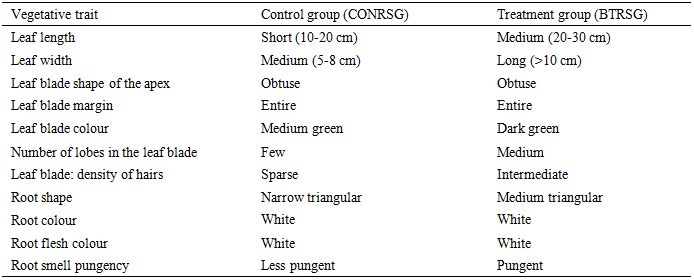
- Soil propertiesThe soil was characterized the as a strongly acidic (pH 5.01) sandy loam with restricted nutrient mobility and limited cation exchange capacity (CEC). Post-harvest results demonstrated that SBET application significantly neutralized the soil, raising the pH to 5.86. This neutralization concurrently increased exchangeable cations (Ca2+, Mg2+, and Na+) and total K in the BTRSG cohort compared to the CONRSG. Consequently, these data implied that the blessing intervention modified ion exchange dynamics and mineral solubility, presenting a strategic mechanism to mitigate constraints inherent to acidic soil profiles.Morphology of radish plantsWe documented the morphological characteristics of radish (Raphanus sativus) through systematic observations at defined intervals. The study tracked the complete phenological progression, from initial germination and the seedling phase through vegetative growth, floral initiation, plant root development, and the final harvest stage (Figure 1).
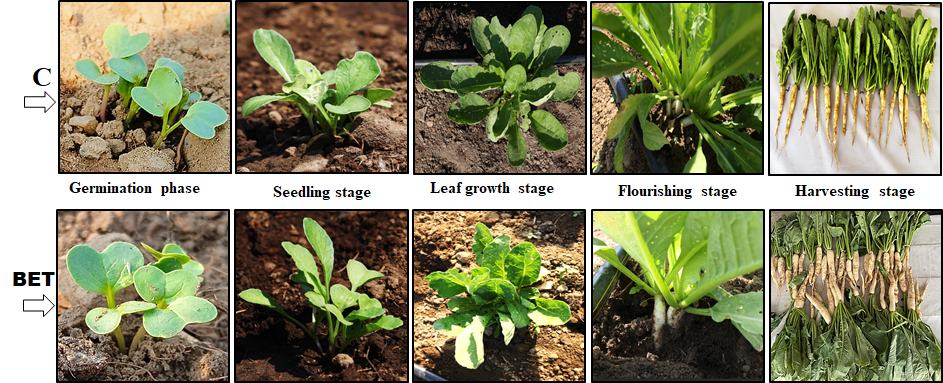 | Figure 1. Sample images illustrate the changes at different stages of the vegetative growth characteristics of the radish. C: Control group; BET: Blessing/biofield energy treatment group |
|
|
4. Discussion
- Modern global agriculture faces the compounding challenges of a changing climate, rapid soil degradation, and an urgent demand to enhance crop productivity for a burgeoning human population. For decades, agroecosystems have relied heavily on synthetic chemical fertilizers and intensive genetic modifications to augment yield and manipulate plant structural traits. Emerging paradigms at the intersection of biology and quantum physics suggest that living organisms are not merely biochemical machines, but complex systems governed by energetic fields that regulate developmental homeodynamics [12]. The conceptual framework behind these energy-based interventions rests on the understanding of the biological field, or "biofield." This paradigm views living matter as an integrated network of energy and information that actively interacts with external physical forces to regulate cellular processes. The living systems generate and respond to low-level electromagnetic and physical fields as fundamental components of physiological regulation. To understand the operational mechanisms of these treatments, physics models indicate that biological systems experience long-range, coherent information flow linked to the quantum vacuum [13-15].The phenotypic, physiological, and agronomic advancements observed in the Biofield Treated Radish Seed Growth (BTRSG) group relative to the Control Radish Seed Growth (CONRSG) group demonstrate a profound optimization of both the vegetative and subterranean reproductive growth phases. The treatment triggered an immediate physiological acceleration, established by a highly significant increase in the rate of seed germination. Early-stage germination efficacy serves as a critical determinant of eventual agricultural yield, as accelerated metabolic activation triggers rapid cellular elongation and reserve mobilization [16]. This expansion of leaf dimensions directly implies a maximized total leaf surface area, which serves as the primary engine for photon interception and carbon assimilation. The concurrent surge in leaf fresh weight confirms that these structural adaptations were well-supported by active cellular hydration and biomass accumulation and thus enhancements in radish morpho-physiology and fresh weight accumulation via exogenous sustainable inputs [17].The structural scaling of the root system was essential for a root crop like radish (Raphanus sativus), where the hypocotyl and taproot function as both the primary nutritional sink and the economic yield component [18]. There was a significant surge in root width/girth represents substantial lateral cambial activity and secondary xylem development, which accommodate the increased influx of leaf-derived sucrose. Ultimately, these single-plant morphological metrics successfully translated into macroscopic field success, driving a 43.42% rise in total root yield (tons per hectare) in the BTRSG compared to CONRSG.
5. Conclusions
- Based on the experimental data, the BTRSG treatment demonstrates a highly significant, comprehensive enhancement in plant growth, physiological development, and overall agronomic yield compared to the control (CONRSG). This innovative, non-chemical, and eco-friendly approach holds promising potential for sustainable agriculture and merits further molecular and genetic investigation to understand the underlying biophysical mechanisms. In summary, the SBET intervention in the BTRSG proves to be a statistically robust and highly effective strategy for optimizing both morphological development and economic output of radish.
Abbreviations
- SBET: spiritual blessing energy treatment; CONRSG: control radish group; BTRSG: biofield energy-treated radish group; SSP: single super phosphate; MOP: muriate of potash
ACKNOWLEDGEMENTS
- The authors are grateful to Divine Connection Foundation for the assistance and support during the work.
Conflict of Interests
- Author MKT was employed by Trivedi Global, Inc. NRP, VDK, and TBG were employed by Shree Angarsiddha Shikshan Prasarak Mandal’s College of Agriculture, Sangulwadi, Mohitewadi, Maharashtra, India. Authors SM and SJ were employed by Trivedi Science Research Laboratory Pvt. Ltd.
Funding
- The authors declare that no funds, grants, or other support were received during the preparation of this manuscript.