
-
Paper Information
- Paper Submission
-
Journal Information
- About This Journal
- Editorial Board
- Current Issue
- Archive
- Author Guidelines
- Contact Us
International Journal of Plant Research
p-ISSN: 2163-2596 e-ISSN: 2163-260X
2026; 14(1): 1-7
doi:10.5923/j.plant.20261401.01
Received: Feb. 12, 2026; Accepted: Mar. 2, 2026; Published: Mar. 7, 2026

Impact of Blessing/Biofield Energy Treatment (BET) on the Vegetative Growth, Phenology, and Yield of Eggplant (Solanum melongena L.)
 Abstract
 Reference
 Full-Text PDF
 Full-text HTML
Dahryn Trivedi1, Mahendra Kumar Trivedi1, Alice Branton1, Nikhil Rajendra Phutankar2, Vivek Dattaram Kadam2, Tejas Bapu Gaikwad2, Sambhu Mondal3, Snehasis Jana3
1Trivedi Global, Inc., Research and Development, Henderson, Nevada, USA
2Shree Angarsiddha Shikshan Prasarak Mandal’s College of Agriculture, Dept. of Horticulture, Sangulwadi, Mohitewadi, Maharashtra, India
3Trivedi Science Research Laboratory Pvt. Ltd., Research and Development, Thane (W), Maharashtra, India
Correspondence to: Snehasis Jana, Trivedi Science Research Laboratory Pvt. Ltd., Research and Development, Thane (W), Maharashtra, India.
| Email: |  |
Copyright © 2026 The Author(s). Published by Scientific & Academic Publishing.
This work is licensed under the Creative Commons Attribution International License (CC BY).
http://creativecommons.org/licenses/by/4.0/

Background: Eggplant is a key vegetable crop in many countries. However, its production often suffers because soils lack enough nutrients. To meet rising food demand and take advantage of eggplant’s health benefits, it is important to improve soil nutrients and boost the crop’s quality, yield, and cost-effectiveness. Objective: The objective of this study was to improve vegetative growth, phenological development, yield, and soil fertility using the blessing (biofield) energy treatment (BET) - Trivedi Effect®. Methods: Soil physical features were measured using the hand feel method. Mineral components were determined using standard methods. Plant morphological, phenological, and yield-related parameters were measured by experienced scientists. Results: The BET-Trivedi Effect® significantly (p ≤ 0.001) impacted the number of days to 50% flowering, plant height, branch number, leaf number, fresh fruit weight, fruit size, and fruit yield. The eggplant yields (ton) were significantly increased by 44.44% per hectare in the treatment group compared to the control. Conclusion: Blessing (biofield) energy treatment (BET)-Trivedi Effect® significantly improved morphological, phenological, and yield-related parameters compared to the control group. This alternative approach can effectively support eggplant growers in maximizing both yield and quality outcomes in the near future.
Keywords: Biofield energy treatment, Eggplant, Soil analysis, Yield, Brinjal
Cite this paper: Dahryn Trivedi, Mahendra Kumar Trivedi, Alice Branton, Nikhil Rajendra Phutankar, Vivek Dattaram Kadam, Tejas Bapu Gaikwad, Sambhu Mondal, Snehasis Jana, Impact of Blessing/Biofield Energy Treatment (BET) on the Vegetative Growth, Phenology, and Yield of Eggplant (Solanum melongena L.), International Journal of Plant Research, Vol. 14 No. 1, 2026, pp. 1-7. doi: 10.5923/j.plant.20261401.01.
Article Outline
1. Introduction
- Brinjal, also known as eggplant (Solanum melongena L.), thrives in warm climates and is predominantly grown in the tropical and sub-tropical regions of the country. Although naturally a perennial, it is typically cultivated as an annual to harvest its young, tender fruits, which are enjoyed as a vegetable. Additionally, brinjal varieties are often selected to match local consumer preferences for color, shape, and taste, making it a region-specific crop [1]. Eggplant is considered a valuable crop because of its exceptional nutritional content and antioxidant activity. Climate change and a fast-growing global population are creating major challenges for agriculture [2]. In addition, declining soil fertility has further restricted brinjal production [3]. With a growing population, there is a pressing need to boost both the yield and productivity of this crop. Due to strong local preferences for color, shape, and taste, specific genotypes are adapted to particular regions. As a result, a single cultivar cannot meet the diverse requirements of all areas and consumers. Therefore, it is essential to enhance locally preferred cultivars for higher yield and improved adaptation, or to develop new hybrid combinations [4]. There were numerous factors that governed the maximum yields and development. Nitrogen is considered one of the major nutrients required by plants for their growth, development, and yield. Studies have shown that applying nitrogen fertilizer positively affects plant growth and yield components. Increasing nitrogen fertilizer rates has been reported to enhance various vegetative growth and yield parameters [5]. Water is rapidly becoming an economically scarce resource in many regions of the world. Auila et al. conducted studies on the effects of irrigation water efficiency and quantity on key characteristics of eggplant and other vegetables [6].In addition to conventional farming techniques, an alternative approach has been identified that can enhance eggplant vegetative growth, development, and yield. The authors’ previously published reports describe the remarkable agricultural results of the Trivedi Effect®, including improved growth and fruit yield in cashew [7], bottle gourd, and okra [8], as well as increased growth, germination rate, plant hormone levels, and antioxidant capacity in cotton [9] and mustard [10]. Blessing (Biofield) energy treatment (BET), including the Trivedi Effect®, is a type of complementary and alternative medicine (CAM) [11]. The Trivedi Effect® describes a phenomenon in which a spiritual energy practitioner can harness and transmit a unique form of intelligent, universal energy to both living and non-living organisms [12]. Hence, the present study was undertaken with a view to providing deep insight into the impact of BET on the differences in the eggplant growth, flowering, and yields of eggplants with respect to the control.
2. Materials and Methods
2.1. Experimental Site and Environmental Conditions
- The research took place on farmland in the Konkan region at Bhandarwadi, Sindhudurg, Maharashtra, India, from February to June 2025. The site lied between 15° 37’ and 16° 40’ north latitude and 73° 19’ and 74° 13’ east longitude, at an elevation of 26 meters above sea level. The area was hot summers and cool winters. Temperature reaches 40°C in April and May, and drops to between 8°C and 25°C from December to February. Rainfall was unpredictable, often leading to dry spells and soil moisture shortages during crop growth.
2.2. Test Item Information
- Eggplant seeds (label number: 442, lot number: NUBBL099, genetic purity: 98%) of the desi black round variety were obtained from Namdeo Umaji Agritech (India) Pvt. Ltd. The seeds were split into two groups; one group served as the untreated/control, while the other was labelled as treated and subjected to receive Blessing (biofield) energy treatment (BET)/ (The Trivedi Effect®). Then, the seeds were cultivated in the selected farmland for analysis of morphological, growth, and yield parameters analysis.
2.3. Study Design and Plots Specification
- In this study, a Randomized Complete Block Design (RCBD) was utilized with two groups: an untreated control group (CONEGPG) and a Blessing energy treatment group (BTEGPG), each replicated three times. The experimental area was divided into two equal sections, one designated as the control plot and the other as the treatment plot. Each block contained both a control and a biofield-treated plot, and three blocks were established within the experimental area. Plots within each block were assigned at random according to RCBD protocol. In total, six plots were created, each measuring 3.5 m × 2.5 m. The spacing between plants was maintained at 0.5 m × 0.5 m, with a half-meter distance between replications and 50 cm between plots. The total experimental area was 60.0 m², with each plot covering 8.75 m². The site was cleaned before the experiment, and standard fertilizer levels (50:100:50 kg NPK ha⁻¹) were incorporated into the soil prior to seed planting.
2.4. Blessing (Biofield) Energy Treatment (BET)/Spiritual Energy Treatment (SET) Strategy
- The control group of seeds and plots, labelled as the untreated/control eggplant group (CONEGPG), did not receive any treatment. The treated eggplant group (BTEGPG) received an in-person spiritual blessing/ (BET) for approximately four minutes from a renowned spiritual biofield energy healing practitioner, Mrs. Dahryn Trivedi, who has over 12 years of experience, performed the day before the farming process. The BET was administered through the practitioner’s inherent energy transmission process, delivered to the treated seeds and land without physical contact. This blessing involved the practitioner performing prayers and the laying on of hands from a distance of about 1.5 feet, at a temperature of 28 ± 2°C and relative humidity of 65 ± 5%. During this process, the healer channelled a powerful, inherently intelligent divine energy from the Universe and transmitted it to the treated seeds and land.
2.5. Soil Analysis
- The study area had sandy loam soil, which was light, well-drained, and low in fertility. Before the experiment began, topsoil samples (to a depth of 30 cm) were collected from random locations within each plot using a five-point sampling method for each plot. The samples were mixed, and 1 kg was taken from each plot, air-dried, sieved through a 2-mm mesh, and stored at 4°C. The physical and chemical properties were then measured. The soil's texture was identified by hand feeling [13]. Soil organic carbon (SOC) was measured using the Walkley and Black dichromate wet oxidation method [14]. Total nitrogen (N) was determined by Micro-Kjeldahl digestion [15]. Available phosphorus (P) was measured by Bray-1 extraction and molybdenum blue colorimetry [16]. Exchangeable Ca, Mg, and Na were extracted with 1 M ammonium acetate [17]. Potassium (K) was measured with a flame photometer [18], and Ca, Mg, and Na were measured by the EDTA titration method [19]. Soil pH was measured in a 1:2 soil-water mixture using a digital pH meter.
2.6. Plantation of Seeds and Its Management
- Seeds were sown directly. Plots were manually kept at adequate moisture for the first 10 days, after which drip irrigation with self-compensating emitters spaced 0.5 m apart and a discharge rate of 3 L h-1 was used. Each plot received 50:100:50 kg NPK ha-1 of urea, single super phosphate (SSP), and muriate of potash (MOP) in both the control and treatment groups. All SSP, MOP, and 50 percent of the urea were applied as a basal dose during land preparation, with the remaining urea applied 21 days after sowing. Hamla 550 insecticide (Gharda Chemicals Limited, India) was sprayed at 2 mL/L on days 21 and 49 after sowing. For growth and yield measurements, five plants were randomly selected from each plot 80 days after sowing.
2.7. Morphological Features
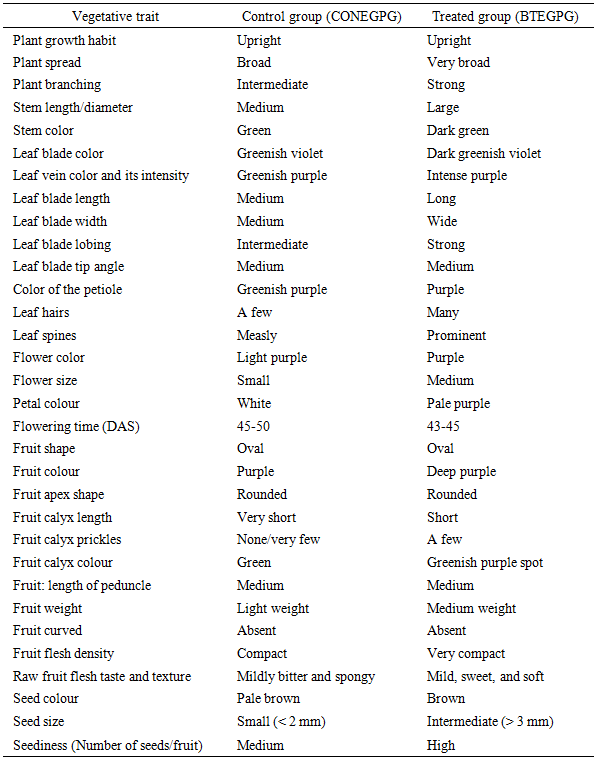
- We evaluated qualitative traits such as plant habit, branching, spreading, stem and leaf colour, leaf blade length and width, lobing, hairs, tip angle, flower colour and size, fruit colour, shape, apex, seed colour, size, and seediness. The quantitative traits, including plant height, number of branches per plant, stem diameter, number of leaves per plant, leaf length and width, days to 50% flowering, fruit length, and fruit diameter were also recorded.
2.8. Phenological and Yield Traits
- Eggplant fruits were harvested at physiological maturity. Their size was measured in centimeters, and their weight was recorded using a weighing balance. The yield per net plot in kilograms was converted to tonnes per hectare using a conversion factor.
2.9. Statistical Analysis
- Data are shown as Mean ± SEM. We used Student’s t-test in SigmaPlot (v14.0) to compare two independent groups. Results were considered statistically significant at p < 0.05.
3. Results
3.1. Soil Analysis
- The study soil was sandy loamy. Water-holding capacity (WHC) was marginally higher in the BTEGPG than in the CONEGPG. It was observed that levels of exchangeable cations, such as calcium, magnesium, and sodium were slightly increased in the BTEGPG compared to the CONEGPG. However, the total chloride level was higher in the BTEGPG than in the CONEGPG (Data not shown).
3.2. Morphological Characteristics of Eggplant
- Various observations on the growth and yield of eggplant were recorded at periodic intervals. Figure 1 shows the different stages of the growth cycle of the eggplant: germination and seedling, leaf growth, flowering, pod/fruit formation, and harvesting stages.
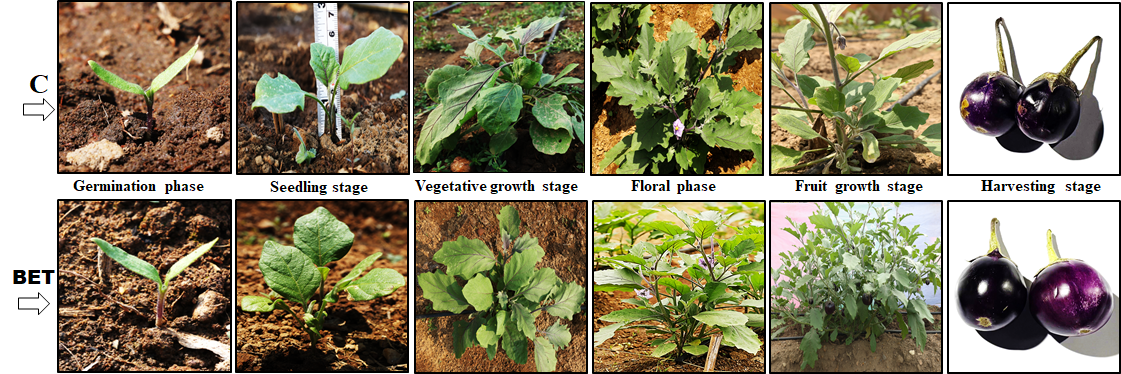 | Figure 1. Sample images illustrate changes in vegetative growth characteristics of eggplant at different stages. C: Control group; BET: Blessing/biofield energy treatment group |
|
3.3. Crop Phenology and Yield Traits
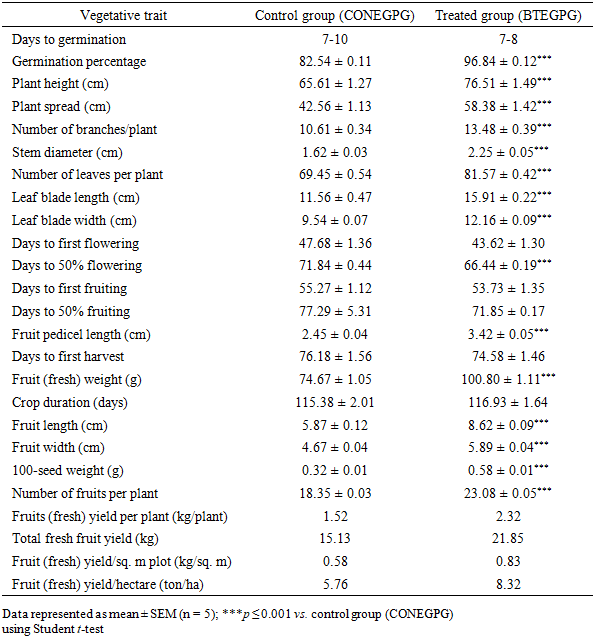
- Quantitative assessments of phenology and yield traits of eggplant following biofield energy treatment (BET) is shown in Table 2. Higher germination percentages with less time were obtained in the BTEGPG compared to the CONEGPG. The plant height significantly (p ≤ 0.001) increased by 16.61% at the harvesting stage was recorded in BTEGPG compared to the control, CONEGPG. A significant (p ≤ 0.001) number of branches (13.48) per plant was observed in BTEGPG compared to CONEGPG (10.61). Stem diameter of BTEGPG was significantly (p ≤ 0.001) increased by 38.89% compared to the control, CONEGPG. The number of leaves per plant was significantly higher in BTEGPG than CONEGPG. The days to first flowering were recorded in BTEGPG (43.62 days), followed by CONEGPG (47.68 days). The BTEGPG took significantly (p ≤ 0.001) less time to reach 50% flowering than the CONEGPG. The number of fruits per plant was significantly (p ≤ 0.001) higher in the BTEGPG compared to the CONEGPG. At the maturity stage fruit length was significantly (p ≤ 0.001) increased by 46.85% in the BTEGPG compared to CONEGPG. The fruit weight was significantly (p ≤ 0.001) increased by 34.99% in the BTEGPG compared to CONEGPG. The yield of the BET-eggplant (BTEGPG) ton per hectare was increased by 44.44% compared to the CONEGPG (Table 2).
|
4. Discussion
- The eggplant has several clinical benefits for the management of various diseases such as bronchitis, arthritis, asthma, hypercholesterolemia, and diabetes due to its phenolic and alkaloid contents [20]. The delphinidin (an anthocyanin) and chlorogenic acid (a phenolic acid) are the main phenolic compounds in the skin and pulp of eggplant [21]. From phenological parameters, the control group showed delayed 50% flowering than the BET-eggplant group, which shows early flowering. This early flowering in the BTEGPG might be due to biofield energy that helps nutrients absorption and that ultimately leads to more growth and development. Some study reported that the application of higher fertilizer leads to delayed reproductive growth of eggplant [22]; however, in this study same amount of fertilizers was applied in both the groups. Therefore, the study findings clearly indicated that the impact of spiritual blessing (biofield) energy improved reproductive growth and development and the early appearance of flowers in 50% plants. Similarly, delayed days to first and 50% fruiting were observed in the control group (CONEGPG), while early fruiting occurred in the biofield treatment group (BTEGPG). One study reported delayed fruiting due to the application of more fertilizers [23], however, in this experiment same fertilizers were applied in both groups. The soil usually has high bulk density, is acidic, and contains low levels of organic matter, total nitrogen, and exchangeable cations such as calcium, magnesium, and sodium. These low nutrient levels are not enough for healthy plant growth. Before planting, both the control group (CONEGPG) and treatment group (BTEGPG) soil had an acidic pH of 5.01. This level of acidity can reduce the soil’s cation exchange capacity, making it less fertile and reducing the number of available plant nutrient cations. However, in BTEGPG soil pH (5.9) was slightly improved, which can higher the CEC of soil and indicating more fertile soil, which ultimately leads to more exchangeable plant nutrients cations. The soil properties not only influence the plant growth, but also the growth of soil microorganisms, which are beneficial to plant growth. Soil structure, texture, bulk density, and organic matter content are the controls on soil water holding capacity; therefore, any way if we can improve these soil properties, in turn, it improves water holding capacity (WHC) of the soil [24]. In this experiment, the BTEGPG group showed increased WHC, which might be due to the biofield energy transfer to the soil as the land was blessed along with the seeds.Several biofield treatments, including Pranic Agriculture [25], meditation [26], and chi energy [27], involve skilled healers working with plants’ energy fields. When these healing energies are applied to plants, they can improve growth and increase yield. For example, Lee and Wu (2019) [28] found that biofield treatment of lettuce and bok choy resulted in greater vegetative growth and higher levels of chlorophyll and carotenoids compared to untreated plants. This shows that energy field interactions can strongly affect plant health and vitality. In this study, rapid germination in BTEGPG may result from a soft seed coat and the seed’s strong ability to adapt to soil conditions, while slow germination in CONEGPG may be caused by its harder seed coat [29]. The BET group had more branches per plant, which may have been linked to greater plant height and better photosynthetic ability in BTEGPG. This may also be related to how soil nutrients are released over time and to the supply of nitrogen that matches the plant’s growth stages. Fruit length, width, weight, and number of fruits per plant were significantly (p ≤ 0.001) increased in the BTEGPG, which might be more availability of growth resources than in CONEGPG. The results were corroborated with [30], who reported that the uptake of the higher amount of inorganic fertilizer increased the fruit length. The highest total fresh fruit yield was recorded when BET was applied in the BTEGPG. In contrast, the control plot (CONEGPG) had the lowest yield. The use of BET may have promoted cell elongation, leading to greater vegetative and reproductive growth in eggplant, thereby explaining the increase in total fresh fruit yield. This result is consistent with [31] [32], who found that higher levels of inorganic fertilizers significantly increased eggplant’s total fresh fruit yield.
5. Conclusions
- This study shows that eggplant grew better and produced higher yields when the blessing energy treatment (BET)-Trivedi Effect® was applied to both seeds and land. The group treated with the BET-Trivedi Effect® had the highest marketable fresh fruit yield compared to the control group. These results suggest that using BET on both seeds and land may help to improve eggplant production. This alternative treatment method could help farmers increase both yield and quality of vegetable crops. Therefore, the BET-Trivedi Effect® could be a cost-effective option for eggplant farming in the near future.
Abbreviations
- NPK: nitrogen phosphorus potassium; CAM: complementary and alternative medicine; BET: biofield energy treatment; CONEGPG: control eggplant group; BTEGPG: biofield energy-treated eggplant group; SSP: single super phosphate; MOP: muriate of potash; DAS, days after sowing; CEC, cation exchange capacity.
ACKNOWLEDGEMENTS
- The authors are grateful to Divine Connection Foundation for the assistance and support during the work.
Conflict of Interests
- Authors DT, MKT, and AB were employed by Trivedi Global, Inc. NRP, VDK, and TBG were employed by Shree Angarsiddha Shikshan Prasarak Mandal’s College of Agriculture, Sangulwadi, Mohitewadi, Maharashtra, India. Authors SM and SJ were employed by Trivedi Science Research Laboratory Pvt. Ltd. The authors do not have any commercial interests on the objectivity of the research.
Funding
- The authors declare that no funds, grants, or other support were received during the preparation of this manuscript.