
-
Paper Information
- Paper Submission
-
Journal Information
- About This Journal
- Editorial Board
- Current Issue
- Archive
- Author Guidelines
- Contact Us
International Journal of Plant Research
p-ISSN: 2163-2596 e-ISSN: 2163-260X
2013; 3(3): 17-22
doi:10.5923/j.plant.20130303.01
Screening of Stored Maize (Zea mays L.) Varieties Grain for Tolerance Against Maize Weevil, Sitophilus zeamais (Motsch.)
 Abstract
 Reference
 Full-Text PDF
 Full-text HTML
Simbarashe Muzemu1, James Chitamba2, Sipiwe Goto1
1Department of Horticulture, Faculty of Natural Resources Management and Agriculture, Midlands State University, P. Bag 9055, Gweru, Zimbabwe
2Department of Agronomy, Faculty of Natural Resources Management and Agriculture, Midlands State University, P. Bag 9055, Gweru, Zimbabwe
Correspondence to: Simbarashe Muzemu, Department of Horticulture, Faculty of Natural Resources Management and Agriculture, Midlands State University, P. Bag 9055, Gweru, Zimbabwe.
| Email: |  |
Copyright © 2012 Scientific & Academic Publishing. All Rights Reserved.
Insect pests cause major damage to stored maize grain thereby reducing its weight, quality and germination vigour. Five open pollinated maize varieties (ZM401, ZM309, ZM521, ZM421 and Hickory King) and one hybrid maize variety (SC709) were evaluated for tolerance and their effects on progeny development against the maize weevil, Sitophilus zeamais (Motsch.). The experiment was laid in a randomised complete block design, with 6 treatments replicated 5 times. 100g maize grain was infested with 100 three week old unsexed pure culture adult weevils in 750 ml jars. After 14 days oviposition period, adult weevils were sieved out and parent weevil mortality determined. After a further 45 days, number of weevils emerged, percentage grain weight loss and number of damaged kernels were determined. Percentage kernel germination was determined through a germination test after 45 days of weevil attack. There were significant differences (p<0.05) in number of parent weevil mortality, number of weevils emerged, grain weight loss, kernel damaged and germination percentage among varieties. ZM421 and ZM521 varieties showed potential to S. zeamais progeny suppression and tolerance as evidenced by high parent weevil mortality, low weevil emergence, less grain weight loss, low grain damage and high germination percentage.
Keywords: Stored Maize Grain, Sitophilus Zeamais, Maize Varieties, Progeny Suppression
Cite this paper: Simbarashe Muzemu, James Chitamba, Sipiwe Goto, Screening of Stored Maize (Zea mays L.) Varieties Grain for Tolerance Against Maize Weevil, Sitophilus zeamais (Motsch.), International Journal of Plant Research, Vol. 3 No. 3, 2013, pp. 17-22. doi: 10.5923/j.plant.20130303.01.
Article Outline
1. Introduction
- Maize (Zea mays L.) is the most important crop in Zimbabwe and Southern Africa since it is a staple food crop which is widely grown by most smallholder farmers who significantly contribute to national production[1,2]. The necessity to increase maize production cannot be over emphasized; in Zimbabwe it ranks first in terms of total cereal production, number of producers and area grown[3]. It has been reported that the crop accounts for 70% of the total of the total hectarage under cereals with 60% of the whole production coming from the small-scale farmers[4]. Sitophilus zeamais Motschulsky is a serious pest of economic importance in stored products worldwide[5]. The pest is so devastating and is capable of multiplying to large populations causing tremendous damage to the grain[6]. It is estimated that about 10–40% of the total damage to stored grains worldwide is caused by insect pests[7] of which they account for approximately 5–10% of maize grain loss in Southern Africa[8]. Under severe infestations, maize weevils can cause up to 90% loss of stored grain[9]. Grain weight loss of 12–20% and 80% caused by the maize weevil is common in untreated maize grain stored in traditional structures in tropical countries[10,11]. It has been reported that much of the maize produced by the smallholder farmers in Zimbabwe is lost to weevil attack and very little research has been done on the development of affordable alternatives which offer same control levels to weevils as pesticides[6]. Although synthetic pesticides can control it, majority of communal farmers are resource-poor and have no means and proper skills to acquire and handle them. Moreover, pesticides are expensive, not readily available and pose health problems to consumers due to their toxicity since many have some residual effect. Evidence from different African countries illustrates that improper use of chemicals is causing loss of life and negative repercussions on human health[2]; and other problems associated with their use are loss of efficacy, regulatory restrictions as a result of adverse effect on non-targeted organisms and eco-toxicity[12,13]. The status quo is exacerbated by the development of resistance to these insecticides by the pests resulting in their resurgence hence a need to the search for effective and safe variety of alternatives. Moreover, the sustainability of conventional chemicals used to preserve grain is questionable given the high level of poverty present in the rural communities in Africa[14].Decrease in agricultural productivity exposes local farmers and the nation to chronic food shortages hence it is a serious threat to mankind. This creates the need for farmers to come up with mechanisms for conserving their scarce food resource base. The constraints to maize seed availability and affordability have prompted the need to sow open pollinated varieties (OPVs) by resource constrained smallholder farmers in Zimbabwe. The advantages to the use of insect resistant varieties are especially important in developing countries where farmers can rarely afford to purchase insecticides for crop protection[15]. These varieties provide practical and economic way to minimize field and grain storage losses to improve both quantity and quality of stored grain for planting and human consumption [16]. Insect resistant crops greatly increase farming efficiency by reducing or eliminating the costs of insecticides and the risk of yield losses from insect damages. Grain resistance as a method of pest control is advantageous since most resistant varieties maintain high levels of resistance for a long time despite upsurge of biotypes[17]. The potential negative effects associated with insecticide use are eliminated with the use of insect resistant varieties. In many developing countries, the demand for maize surpasses that for other food crops due to the growth in meat and poultry consumption, which consequently, have led to the rapid increase in the demand for maize as livestock feed[18]. Thus there is a need to develop cheaper, equally effective and safer alternatives for insect pest control, including host plant tolerance[19]. However, the level of OPVs resistance or tolerance to weevil attack is not fully understood hence there is need for screening of maize grain varieties for maize weevil evaluations[20]. Considering the economic importance of maize in the country as well as the destructive nature of S. zeamais to the crop, the present study was undertaken with the main objective of screening different stored maize varieties grain for tolerance against the maize weevil.
2. Materials and Methods
- The experiment was carried out in the Entomology laboratory at Cotton Research Institute in Kadoma, Zimbabwe. The area is located 3 km west of Kadoma town along the Chakari road, on longitude 18°19' south and latitude 29°53' east, at an altitude of 1156 m above sea level. The area falls under natural region III of Zimbabwe’s agro-ecological zones, with an average annual temperature and rainfall of 23–30°C and 400–600 mm respectively. Five pure maize open pollinated varieties namely ZM309, ZM401, ZM421, ZM521, and Hickory King obtained from Crop Breeding Institute, Harare and a hybrid SC709 from Seed-Co Zimbabwe were used in the experiment. A randomized complete block design was used to arrange the jars in the laboratory to minimize the door effects and each treatment was replicated five times. The maize grain was thoroughly cleaned using a 1 mm sieve-mesh screen so as to remain with grain with intact testae, which was then disinfested by keeping it in a deep freezer at –4°C for 2 weeks. The moisture content of the grain was in the range of 12-13%. Approximately 100 g of each of the maize varieties was placed into the 750 ml jars with perforated lids. One hundred three-week old unsexed adult weevils were introduced into each jar. The jars were placed in the shelves at a temperature range of 28±2°C and relative humidity of 70±5 %.Weevils used in the experiment were obtained from the Crop Protection Department at the institute. Grain from the previous season was used to prepare the pest culture. Grain was first sieved to remove dirt and broken particles. Three 750 ml consul jars with perforated lids to allow for air circulation were filled with grain to the three quarter level. Filter paper was put inside each of the perforated lids to prevent insects from escaping. The jars containing the grain were placed in a freezer for 2 weeks to kill any insect eggs which might have been present in the grain. The grain was then transferred into the shelves and stored for 3 weeks to achieve uniform grain temperature and moisture content. The temperature was set at 28±2°C and humidity at 70±5%. After 3 weeks each consul jar was infested with 100 adult weevils and the jars were placed in the shelves. After 14 days oviposition period the grain was sieved to discard adult weevils which had laid eggs in the kernels. Maize weevils take about 30 days to complete their life cycle[21], so after 30 days the weevils began to emerge. After 35 days the F1 progeny was collected by sieving damaged grain. The adult weevils collected were in the range of 1−3 days old. The weevils were later used in the evaluation of OPV’s for weevil resistance. A refrigerator was used for disinfestations of seed by storing the seed at −40C for two weeks. Camel hair brush was used for collecting insects and the tweezers for holding the insects. A 1 and 4.7 mm screen meshes were used for separating grain, dust and insects.Parent weevil mortality was assessed 14 days after the introduction of the insects. The grain was sieved and the number of dead and live pests was counted from each jar to obtain parent weevil mortality. The following formula was used to calculate the percentage weevil mortality;
 After 14 days, the weevils which emerged from the grain in each jar were counted and their number was recorded.After 45 days of incubation the grain was sieved, dust removed and the clean grain was weighed and expressed as a percentage weight loss of the original weight[22];
 Forty five days after incubation, the grain was thoroughly mixed and 30 maize kernels (grains) were randomly selected to assess the level of grain damage. The grain was sorted into damaged (grain with holes and/or tunnels) and undamaged grain. Grain in each fraction was counted and the number of damaged grain recorded.Maize grain genotypes exposed to maize weevils for 45 days was germinated in an incubator at a temperature of 28°C in Petri- dishes in moist wrapping papers. Twenty seeds per maize grain genotype were placed on top of the moist paper in Petri- dishes. The Petri- dishes were covered and put into an incubator for 10 days at 28°C. Germination percentage was calculated using the formula[23];
 Where G1 = total germinated grain, G2 = total grain in Petri -dishA general analysis of variance (ANOVA) for parent weevil mortality, number of weevils emerged, percentage grain weight loss, kernel damage and percentage germination was conducted using GenStat statistical package 14th Edition[24]. Mean separation was done by using least significant difference (LSD) to compare the significant differences between the treatments at 5% level of significance.
3. Results and Discussion
3.1. Parent Weevil Mortality
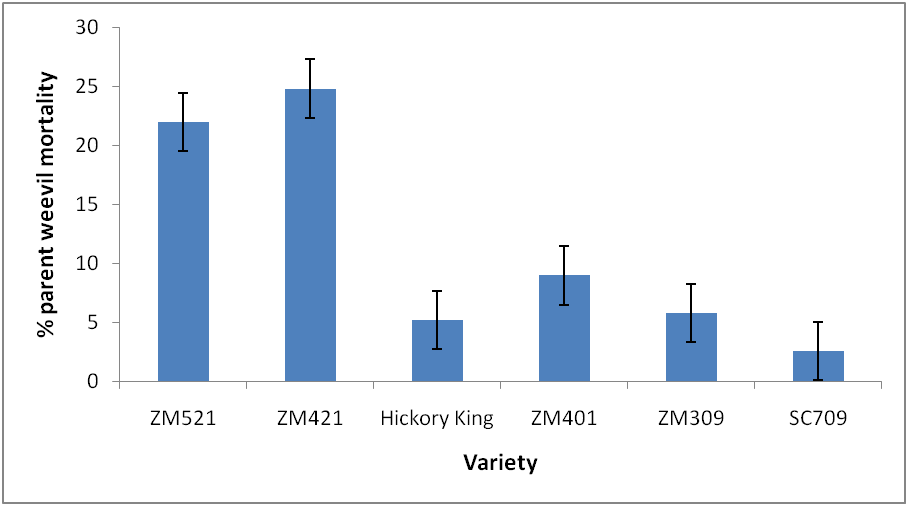 | Figure 1. Effect of different maize varieties on weevil mortality |
3.2. Number of Weevil Emergence
- There were variations and significant differences (p<0.05) were observed among the varieties in the number of weevils which emerged. The hybrid SC709 had the highest number of weevils which emerged followed by ZM309 and ZM401 whilst ZM421 and ZM521 had the least. The mean number of weevils emerged ranged from 0.6-16.2 (Figure 2). The differences in the number of weevils emerged showed that there existed variation in susceptibility to maize weevil attack among the varieties. The varieties which recorded the highest number of weevils emerged indicated greatest susceptibility to maize weevil attack and this might have been due to lack of resistance mechanisms in or on the grain[28]. The low weevil emergence in varieties ZM421 and ZM521 can be attributed to high mortality of parent weevils. These parent weevils might have died before laying eggs or after laying few eggs thus few progeny resulted. The low weevil emergence in these varieties may possibly be attributed to absence of essential nutrients and unbalanced proportion of nutrients leading to the death of the larvae[29]. The significant variation for number of weevils emerged among the varieties could be due to antibiosis effects in resistant varieties leading to retarded development of weevil progeny and sometimes death of weevils before laying eggs[30].
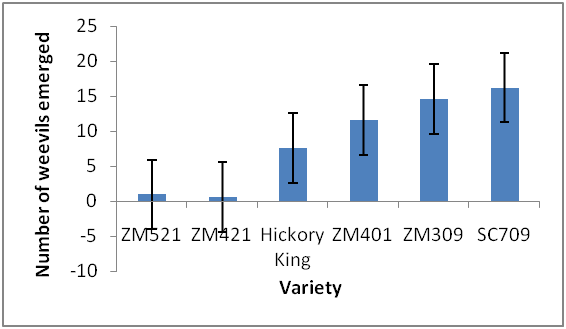 | Figure 2. Effect of different maize varieties on number of weevil emergence after 14 days of exposure |
3.3. Grain Weight Loss and Damage
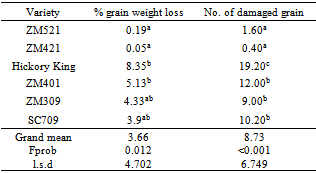
- Maize grain weight loss and damage were highly significant (p<0.001) among the experimental varieties. Hickory King recorded the highest weight loss, followed by ZM401, ZM309, and SC709 whilst ZM521 and ZM421 had the lowest weight loss (Table 1). Hickory King had the highest number of damaged grain after 45 days exposure to maize weevil followed by ZM401, SC709, ZM309 and ZM521 whilst ZM421 had the least number of damaged grains. The mean number of damaged grain ranged from 0.4−19.2 (Table 1). The researcher considered weight loss and grain damage as the most indicators of a variety’s susceptibility to weevil attack. Low weight loss in ZM521 and ZM421 could be due to resistance mechanisms in or on the grain which prevented weevil attack. Hickory King had the greatest weight loss thus could be said to be more susceptible to weevil attack than other experimental varieties. Resistance mechanisms could be in the form of deterrents which could be biochemical or morphological or a combination of both[26]. Biochemical compounds in the form of phenolic amides such as defeuroyl and dicoumaroyl may be antibiosis factors to the S. zeamais[15]. These phenolic compounds have been detected by fluorescence imaging techniques which clearly show the phenolic barrier to insects in the outer tissue[15]. It has also been reported that antibiotic effects increased restlessness of insects which reduced feeding and could explain how grain damage and weight loss were low among resistant varieties[26]. Some researchers[27] also suggested that variation in maize hybrids was due to antibiosis. Less grain damage could be attributed to antixenosis mechanisms like a smooth pericarp which could deter weevils from oviposition and feeding and also prevents mandibles from gripping maize kernels. The great variation observed in the germplasm evaluated forms a genetic resource base for further improvement to raise the levels of resistance to S. zeamais while conserving the farmer preferred traits. This variation in response to the maize weevil attack gives is evident of genetic diversity existence hence a rich genetic resource base for breeding for resistance exists. This offers the opportunity to exploit the variability with the aim of reducing post-harvest insect-pest losses through genetic improvement[31]. This implies that most of the variation among the genotypes is due to their genetic make-up with little influence from the environment, suggesting that maize improvement for resistance to storage pests is possible through selection[32].
|
3.4. Germination
- Significant differences (p<0.05) were observed among the treatments. Percentage germination after weevil attack was highest in variety ZM421 followed by ZM521, ZM309, Hickory King and ZM401 while SC709 had the least percentage germination. Mean germination percentage ranged from 68−96% with a mean of 80.3% (Figure 3). The observed differences in germination percentages showed that the varieties differed in susceptibility to maize weevils. ZM421 and ZM521 had the highest germination percentage indicating high ability to germinate after exposure to maize weevils. These varieties also recorded the least number of weevils emerged, highest mortality and least grain weight loss. Thus these two varieties might have resistance factors which could result in less maize weevil damage thus ability of the grain to germinate is not affected much by maize weevil attack. ZM401, Hickory King and ZM309 had low germination percentages indicating their susceptibility to maize weevil. This might be due to lack of resistance mechanisms within or in the grain to protect it from weevil attack. Weevil damaged grain germinated and this might be attributed to the fact that the weevils did not damage the embryo.
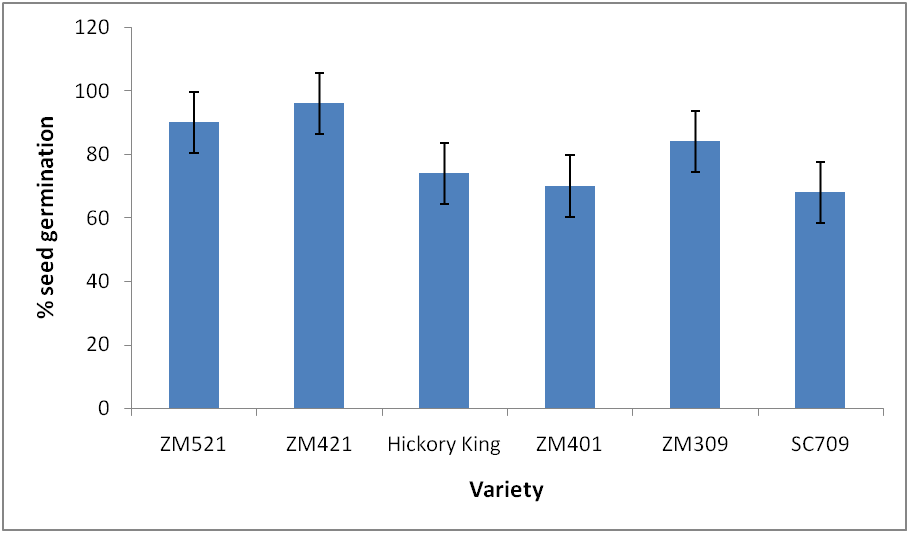 | Figure 3. Effect of different maize varieties on percentage germination after exposure to S. zeamais |
4. Conclusions
- The investigation showed that varieties had different response to maize weevil attack from very susceptible, moderately to tolerance. ZM421 and ZM521 were highly tolerant as evidenced by the least weight loss, grain damage, number of weevil emerged and highest parent weevil mortality and kernel germination. SC709 and ZM403 had moderate tolerant while ZM401 and Hickory King were highly susceptible. Breeding programmes should aim at breeding ZM521 and ZM421 maize weevil tolerant grain since there is evidence that some tolerant factors exist in the gene pool. OPV use leads to improved seed availability and ensure food security at family household level in Zimbabwe.
ACKNOWLEDGEMENTS
- The authors would like to acknowledge the management of Cotton Research Institute, with special gratitude to the Entomology Department personnel for allowing the experiment to be carried out in their laboratory.