
-
Paper Information
- Paper Submission
-
Journal Information
- About This Journal
- Editorial Board
- Current Issue
- Archive
- Author Guidelines
- Contact Us
Public Health Research
p-ISSN: 2167-7263 e-ISSN: 2167-7247
2016; 6(4): 106-109
doi:10.5923/j.phr.20160604.02

Strategy of Communication in Family Planning Program in Sidoarjo
 Abstract
 Reference
 Full-Text PDF
 Full-text HTML
Djarot Meidi Budi Utomo1, Yayuk Yuliati2, Kliwon Hidayat2, Soemarno2
1Doctoral Program of Environmental Studies, Graduate Program, University of Brawijaya, Malang, Indonesia
2Faculty of Agriculture, University of Brawijaya, Malang, Indonesia
Correspondence to: Djarot Meidi Budi Utomo, Doctoral Program of Environmental Studies, Graduate Program, University of Brawijaya, Malang, Indonesia.
| Email: |  |
Copyright © 2016 Scientific & Academic Publishing. All Rights Reserved.
This work is licensed under the Creative Commons Attribution International License (CC BY).
http://creativecommons.org/licenses/by/4.0/

The purpose of the study is to find information about the effect of communication strategy towards the Family Planning Program in Sidoarjo, East Java. The setting of the study was 18 (eighteen) regions or districts in Sidoarjo namely Tarik, Prambon, Krembung, Porong, Jabon, Tanggulangin, Temple, Sidoarjo, Tulangan, Wonoayu, Krian, Balongbendo, Taman, Sukodono, Buduran, Gedangan, Sedati, and Waru. The study is conducted in 2014. The findings reveal that (1) the most frequent type of contraceptive people in Sidoarjo use is condoms; the t-value is 5.5272 (P > 0.05); and (2) communication strategy has an impact on the Family Planning Program in Sidoarjo.
Keywords: Communication Strategies, Contraception, Family planning
Cite this paper: Djarot Meidi Budi Utomo, Yayuk Yuliati, Kliwon Hidayat, Soemarno, Strategy of Communication in Family Planning Program in Sidoarjo, Public Health Research, Vol. 6 No. 4, 2016, pp. 106-109. doi: 10.5923/j.phr.20160604.02.
Article Outline
1. Introduction
- One of the effects of regional autonomy in the implementation of the national family planning is reducing numbers of field personnel. There is significant decrease in the number of employees responsible for the national family planning program managers and supervisors. There is discrepancy between the current number of the employees and the current need of employees to take care of the national family planning program. The condition worsened due to retirement and mutation [1].Such condition affects successful implementation of the family planning and population control. The data show that in the past 5 (five) years, the population has increased significantly where the national population growth is 1.3 per year [2]. It is alarming because rapid growth of population results in various social impact and high social cost in the future.Therefore the East Java Association of the Family Planning Counsellors (IPKB) of East Java conducted a gathering to unify their visions and give some contributions towards issues related to the family planning and population control. This study is aimed to find information about the effect of communication strategy towards the Family Planning Program in Sidoarjo, East Java.
2. Material and Methods
2.1. Study Site
- Sidoarjo municipality is the smallest yet the most populated region in East Java. The total area is 63,438.534 hectares or 634.39 km2. The neighboring region is Surabaya (32.5) and it also is located next to Kali Porong (47km). The potential of Sidoarjo are:a. Rice field : 28,763 Hab. Sugar cane plantation: 8,164 Hac. Aquaculture : 15,729 Had. The remaining area consists of yards, residential areas, industrial areas, housing and others.Sidoarjo municipality was established on January 31, 1959; the geographical location is between 112.5– 112.9 East Longitude and 7.3 LS – 7.5 South Latitude. The boundaries are:• North: Surabaya and Gresik• South : Pasuruan• West: Madura• East: Madura StraitElevation from the Sea Levela. 0-3 m asl: The eastern area consists of aquaculture and beaches (29.99%); most of them are salt water.b. The middle are around the highway (40.81%) is fresh water area.c. The western area (29.20%)Based on the 1996 National Social Economic Survey, the total population in Sidoarjo is 1,354,749 and the population density is 2,135.52 per kilometer square. The average growth of population between1990-1996 is 2.92% per year. Growth of the industry, instead of unsuccessful implementation of the family planning, is the cause of growing population in Sidoarjo. Sidoarjo is the hub city or buffer zone for Surabaya, the capital city of East Java.
2.2. Variable Identification
- To give clear understanding towards the study, the researchers give some descriptions of the variables in the study. The independent variable is communication strategy (X) and the independent variable is the family planning.1. Communication strategy (X1) refers to reflective process or a process that is initiated and maintained only by agents or individuals whose purpose is authority or self- determination. On the other hand, other process gives individuals climate, relationship, sources and procedures to improve their standard of living.2. The family planning (Y) refers to individual or group activity where material becomes the foundation through particular system, procedure and methods in order to fulfill other people’s interests, which is in line with their rights.3. Contraception is an effort to anticipate and attain individual’s desired number of children as well as the spacing and timing of their birth using contraceptives [3]. In general, the family planning refers to a method to control birth rate in order to give some advantages for parents, babies and other family members. It is expected unwanted pregnancy will not affect a family in a negative way.
2.3. Data Collection
- The data collection techniques are questionnaire, observation, interview and documentation. Primary data are the data obtained, analyzed and described by researchers. The primary data are obtained by interviewing the respondents and distributing questionnaires. The questionnaire consists of a set of questions related to the technical information about the family planning revitalization in Sidoarjo given by the Ministry of Public Health. The information affects the revitalization of the program that ensures program sustainability in the future. It is the object of the study. As for the secondary data used is data from interviews and sidoarjo BKKBN data.On the other hand, secondary data are data obtained, analyzed and described by individuals other than the researchers. The secondary data are activities of all families participating in the family planning in Sidoarjo.
2.4. Data Analysis
- In order to answer the research question formulated in the form of hypothesis, regression analysis is needed [4].Y=a + b1x1 +b2x2 + eX = communication strategy Y = the family planning a = constantsb = regression coefficients To find out whether the hypothesis is accepted or rejected, quantitative data analysis is conducted. T-test is used in data analysis. Research hypothesis this is a model and communication strategy to give effect to the number of participants in the district of family planning Sidoarjo.
3. Results and Discussion
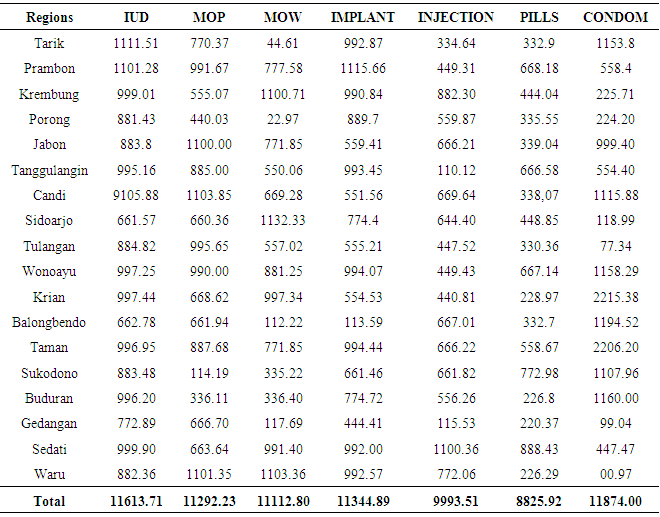
- Statistical data about the communication strategy in the implementation of types of contraceptives for new and active participants of the family planning in Sidoarjo in 2004 are described in the following figure 1.
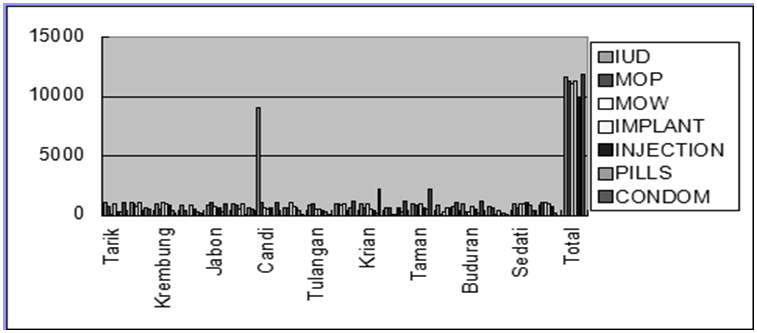 | Figure 1. Family Planning Program in Sidoarjo (2014) |
|
4. Conclusions
- Based on the findings of the study, it can be concluded that the most preferable type of contraceptive in Sidoarjo is condom. Furthermore, communication strategy used to describe the family planning program affects successful implementation of the program in Sidoarjo. A model and communication strategy to give effect to the number of participants in the district of family planning Sidoarjo. It is expected that future researchers conduct further studies about how convenient the family planning program is for the society. In addition, all individuals should get access to food, education, job, housing and health. All living being needs food even before he/she was born (fetus) until one passed away. Access to education begins once a person is 6 (six) years old, while job is needed once a person is at least 18 (eighteen) years old. When a person is at least 25 (twenty-five) years old, he/she will need a house. Health insurance is needed especially during the adulthood.