
-
Paper Information
- Paper Submission
-
Journal Information
- About This Journal
- Editorial Board
- Current Issue
- Archive
- Author Guidelines
- Contact Us
Physical Chemistry
p-ISSN: 2167-7042 e-ISSN: 2167-7069
2026; 14(1): 1-9
doi:10.5923/j.pc.20261401.01
Received: Jun. 22, 2026; Accepted: Jul. 13, 2026; Published: Jul. 15, 2026

Oxalic Acid Functionalized Diatomite for Enhanced Lead (II) ions Adsorption from Wastewater
 Abstract
 Reference
 Full-Text PDF
 Full-text HTML
Winny Chebeni Masai, Francis Maingi, Maximilla Makhanu
Department of Science Technology and Engineering, Kibabii University, Kenya
Correspondence to: Francis Maingi, Department of Science Technology and Engineering, Kibabii University, Kenya.
| Email: |  |
Copyright © 2026 The Author(s). Published by Scientific & Academic Publishing.
This work is licensed under the Creative Commons Attribution International License (CC BY).
http://creativecommons.org/licenses/by/4.0/

Increased global demand for batteries and paints has resulted in higher levels of heavy-metal contamination in waterways, harming aquatic life and human health. Lead is of particular concern due to its non-biodegradable nature and persistence at trace levels. Various technologies have been developed for heavy metal removal from wastewater, with adsorption being the most effective and resource-efficient. Information in literature shows that diatomite has the ability to adsorb heavy metal ions from aqueous media but suffers from a low adsorption capacity and specific surface area. This study therefore focused on enhancing the adsorption capacity of low-cost diatomite by functionalizing it with carboxyl groups via oxalic acid. Characterization techniques, including XRF, FT-IR, XRD, and Raman spectroscopy, confirmed the successful functionalization. Batch adsorption experiments demonstrated that functionalized diatomite effectively removed over 80% of Pb (II) ions, with an adsorption capacity of 8.00 mg/g. These findings suggest that functionalized diatomite is a promising potential adsorbent for remediation of heavy metal ions from wastewater.
Keywords: Adsorption, Diatomite, Functionalized, Lead, Wastewater
Cite this paper: Winny Chebeni Masai, Francis Maingi, Maximilla Makhanu, Oxalic Acid Functionalized Diatomite for Enhanced Lead (II) ions Adsorption from Wastewater, Physical Chemistry, Vol. 14 No. 1, 2026, pp. 1-9. doi: 10.5923/j.pc.20261401.01.
Article Outline
1. Introduction
- Water pollution is a serious environmental concern in Kenya, which has been exacerbated by industrialization, population increase, agriculture, and lack of proper waste management practices [1]. Heavy metals and other contaminants pose significant danger to the environment, water supplies, and human health, making water treatment and water purification systems an important and valuable tool. Water contamination by heavy metals like lead, copper, cadmium, and nickel is a serious environmental issue due to their persistence and non-biodegradability [2]. Heavy metal contamination poses serious environmental and health risks to both human and aquatic life. Various methods for wastewater treatment have been developed, with adsorption being the most effective for removing these metals. Diatomite is a naturally occurring, inexpensive siliceous material with high surface area and porous, making it a promising adsorbent. The hydroxyl groups on the surface of diatomite help improve its ability to stick heavy metal ions to its surface [3]. However, it suffers from low adsorption capacity and specific surface area. This study functionalized raw diatomite from Kariandusi, Kenya, with oxalic acid with the aim of improving its adsorption capacity and specific surface area. Functionalization of diatomite with oxalic acid further increases its adsorption capacity by introducing carboxylate groups that form stable complexes with divalent heavy metal cations, thereby improving its efficacy in water purification applications.
2. Materials and Methods
2.1. Chemicals and Reagents
- The oxalic acid was used in the functionalization of the natural diatomite. Lead (II) nitrate and distilled water were used for the preparation of synthetic wastewater, and NaOH or HCl was used for the pH adjustment. All reagents were of analytical grade.
2.2. Functionalization of Diatomite
- The wet functionalization method was used to functionalize raw diatomite in this study. Diatomite was pre-treated with 0.5 M oxalic acid solution. For effective functionalization, the mixture was shaken for 24 hours at room temperature using an orbital shaker. The slurry was then filtered using Whatman No. 41 filter paper and then washed several times with distilled water to rid of excess oxalic acid that may not be chemically bound with diatomite. Functionalized diatomite was later dried at 105°C for 12 hours in an oven. The sample was then grinded and sieved and stored in a desiccator [4].
2.3. Characterization of the Adsorbents
- The characterization of adsorbents is a crucial initial step in adsorption studies because it connects material properties with adsorption performance. This process explores retention mechanisms, particularly the interaction between adsorbent surfaces and target pollutants, by assessing key physical and chemical properties. The XRF, XRD, FT-IR, and Raman spectroscopic techniques were used to characterize natural and functionalized diatomite in this study.
2.4. Preparation of Pb (II) Ions Sorbates for Adsorption Studies
- Stock solutions for adsorption studies were prepared using lead (II) nitrate, which was of analytical grade. A lead (II) ions solution was prepared by dissolving an accurate quantity of 1.559 g of lead (II) nitrate in 500 mL of distilled water and diluting to 1000 mL. The solution was coded as 1000 ppm of Pb (II) ions. The stock solutions were serially diluted to yield working solutions.
2.5. Optimization of Sorption Parameters
2.5.1. Effect of pH on Adsorption of Pb (II) Ions
- Study experiments were carried out by varying pH from 2 to 6 using 0.1 M NaOH and 0.1 M HCl to study Pb (II) ions, keeping other conditions constant. 50 mL solutions of 100 mg/L Pb (II) ions were placed in 100 mL bottles containing 0.10 g of functionalized diatomite composite. The bottles were then shaken at 120 rpm for one hour at room temperature, with experiments conducted in triplicate. After shaking, the mixture was filtered, and residual metal ions were analyzed using AAS [5].
2.5.2. Effect of Adsorbent Dose on Adsorption of Pb (II) Ions
- The study was conducted to investigate the adsorption of Pb (II) ions by varying the adsorbent dose from 0.02 to 0.20 g while keeping other conditions constant. Solutions containing 100 mg/L of each ion in monocomponent systems were placed in stoppered plastic bottles with different masses of functionalized diatomite composite. The samples were shaken at 120 rpm for one hour in triplicate 5.
2.5.3. Effect of Contact Time on Adsorption of Pb 2+ Ions
- 50 mL solutions containing 100 mg/L of Pb (II) ions were mixed with 0.10 g of functionalized diatomite composite in plastic bottles and shaken at 120 rpm. The test was performed in triplicate, and samples were taken at specific intervals ranging from 10 to 120 minutes and then filtered to evaluate residual metal ions using AAS.
2.5.4. Effect of Temperature on Adsorption of Pb (II) Ions
- Batch experiments were carried out while varying the temperature between 25 and 45 °C while keeping other variables constant. 50 mL solutions of 100 mg/L Pb (II) ions were placed in 100 mL stoppered plastic bottles, to which 0.10 g of a functionalized diatomite composite was added. Bottles were shaken at 120 rpm for one hour in a temperature-controlled shaker. The experiment was conducted in triplicate, and the mean values were used for calculations. After shaking, the supernatant was filtered, and the residual metal ions were analyzed using AAS.
2.5.5. Effect of initial Concentration on Adsorption of Pb(II) Ions
- The effect of initial metal ion concentration was conducted by varying the Pb (II) ion concentrations from 25 to 200 mg/L while keeping other conditions constant. Solutions were placed in 100 mL bottles, to which 0.10 g of functionalized diatomite composite was added. The bottles were shaken at 120 rpm and 25°C for one hour. Triplicates were performed, and mean values were calculated. After shaking, supernatants were filtered, and residual metal ions were analyzed using AAS.
2.6. Adsorption isotherms
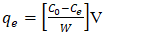
- Adsorption data of the adsorption of Pb (II) ions was fitted in both Freundlich and Langmuir isotherm models to assess the adsorption capacity of functionalized diatomite. The residual metal ion concentrations were measured using AAS, with the equilibrium adsorption (qe) amount calculated by Equation 1 [6].
 | (1) |
 | (2) |
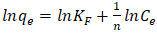
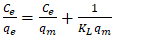
 = adsorption at equilibrium, 1/n= Heterogeneity index associated with adsorption intensity and Ce = concentration of the adsorbate in solution at equilibrium. Equation 3 shows the linearized Langmuir adsorption isotherm.
 | (3) |
 is the amount of Pb (II) ions adsorbed (mg/g);
  is the adsorption capacities (mg/g);
  is the isotherm constant (dm3 /mg) [7].
3. Results and Discussions
3.1. XRF Analysis of the Adsorbents
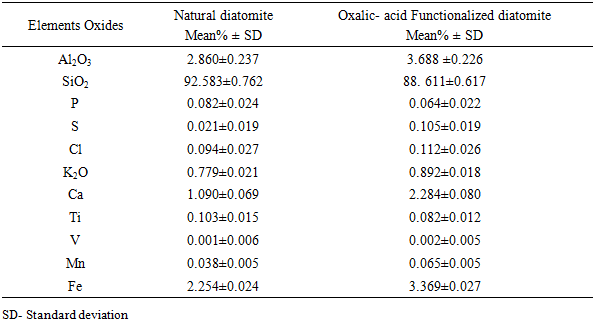
- The X-ray fluorescence spectrometer (model S1 Titan) was used to determine the chemical composition of natural and functionalized diatomite. Table 1 shows the chemical composition of both natural and functionalized diatomite.
|
3.2. X-ray Analysis of Natural and Functionalized Diatomite
- The XRD analysis of both natural and functionalized diatomite was performed using the XRD D6 Phaser model. The analysis was performed to determine if the sample was crystalline or amorphous in nature and mineralogical composition. The results are represented in Figures 1 and 2, respectively.
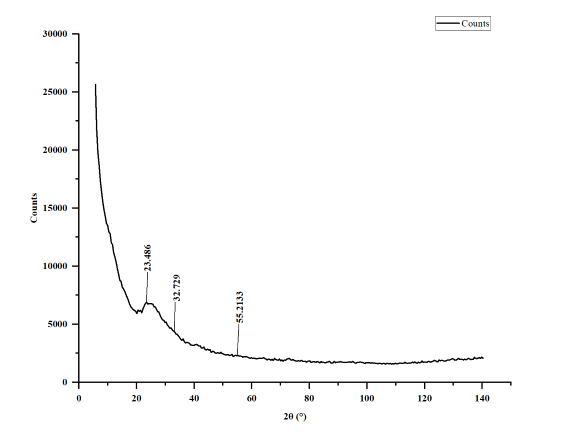 | Figure 1. XRD diffraction patterns of natural diatomite |
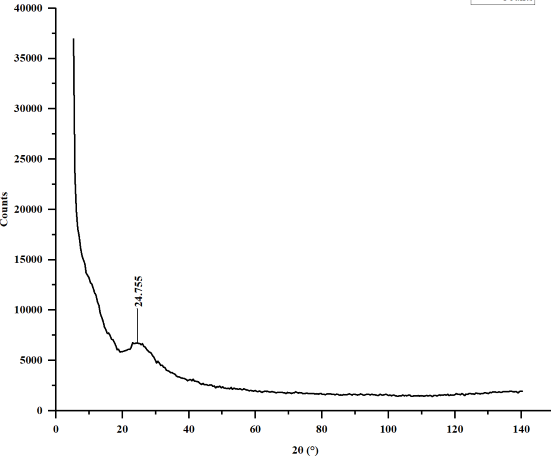 | Figure 2. XRD diffraction pattern of functionalized diatomite |
3.3. FT-IR Analysis of Natural and Functionalized Diatomite
- Fourier Transform Infrared (FT-IR) analysis was performed using a Shimadzu-119 instrument, calibrated after warming for 30 minutes with inactive potassium bromide. About 1mg of each powdered sample was mixed with potassium bromide in a 1:50 ratio, ground for homogeneity, and compressed into a translucent pellet. This pellet was then placed in the FT-IR machine for analysis, and the FT-IR spectrum was generated to interpret various peaks of interest. The spectrum for transmittance against wavelength for natural and functionalized diatomite is illustrated in Figures 3 and 4.
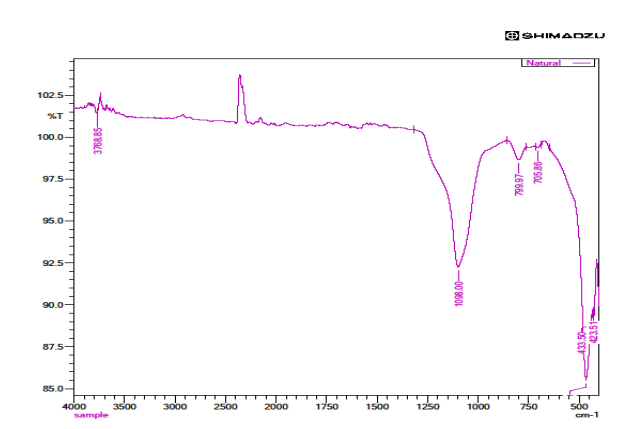 | Figure 3. FT-IR spectrum for natural diatomite |
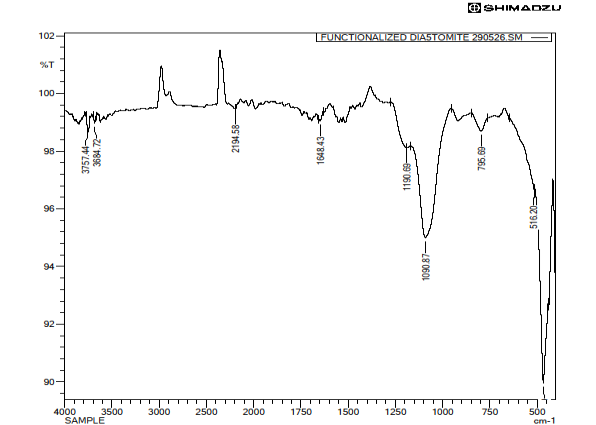 | Figure 4. FT-IR spectrum for oxalic acid functionalized diatomite |
3.4. Raman Spectroscopic Analysis
- Raman spectroscopic analysis was performed using the ATR 3000-785 instrument at a wavelength of 785 nm to determine the structural modifications occurring upon the functionalization of Kariandusi diatomite with oxalic acid and to authenticate the anchorage of the oxalate functional groups. The results obtained are as shown in Figure 5 and Figure 6, respectively.
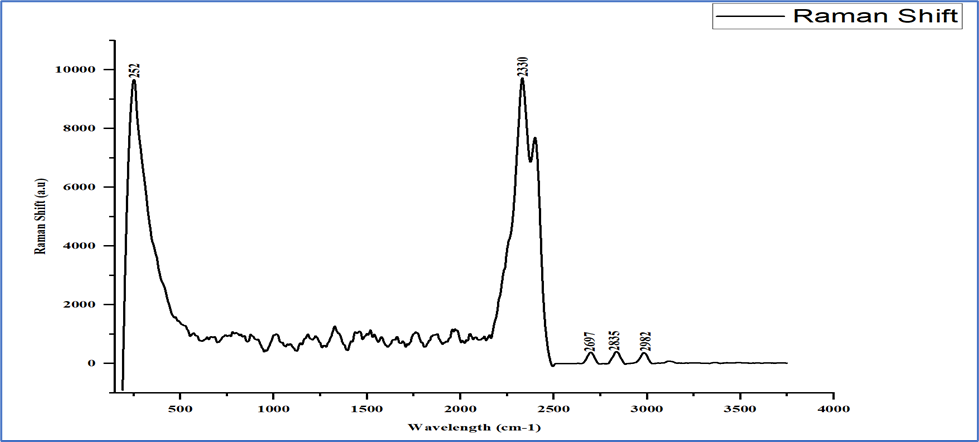 | Figure 5. Raman spectrum for natural diatomite |
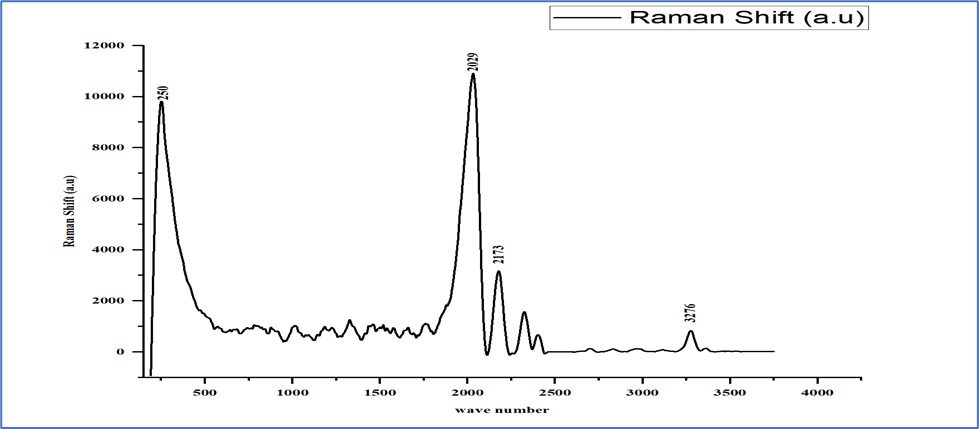 | Figure 6. Raman spectrum for oxalic acid functionalized diatomite |
3.5. Effect of pH on Adsorption of Pb (II) Ions Using Functionalized Diatomite
- The batch experiments varied the pH from 2 to 6, with results depicted in Figure 7, showing the adsorption of Pb (II) ions using functionalized diatomite adsorbent.
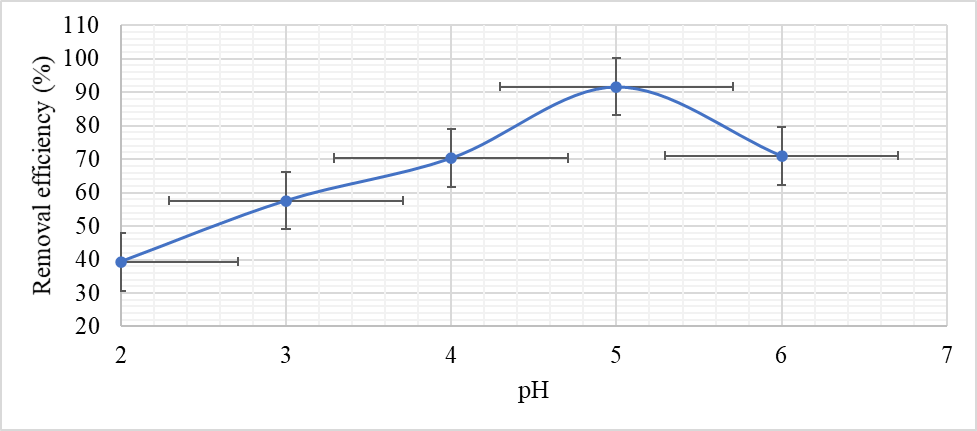 | Figure 7. Effect of pH on adsorption of Pb (II) ions on functionalized diatomite |
3.6. Effect of Adsorbent Dose on Adsorption of Pb2+ Ions
- The experimental study involved varying the adsorbent dose from 0.02 g to 0.2 g to investigate the effect of adsorbent dose on the percentage removal efficiency of Pb (II). Other parameters were kept constant. At a shaking speed of 120 rpm, the results obtained are as illustrated in Figure 8.
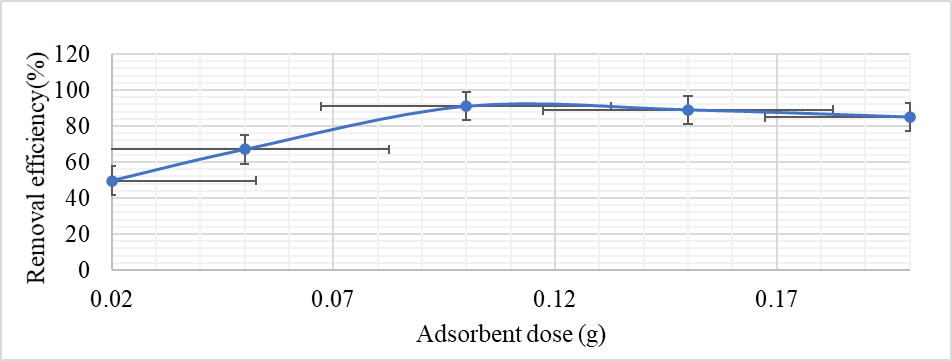 | Figure 8. Effect of adsorbent dose on Pb (II)+ ions removal efficiency using functionalized diatomite |
3.7. The Effect of Contact Time on the Removal Efficiency of Pb2+ on Adsorption Process
- The study involved varying contact times from 10 to 120 minutes and a shaking speed of 120 rpm while other parameters were kept constant. The results obtained are as shown in Figure 9.
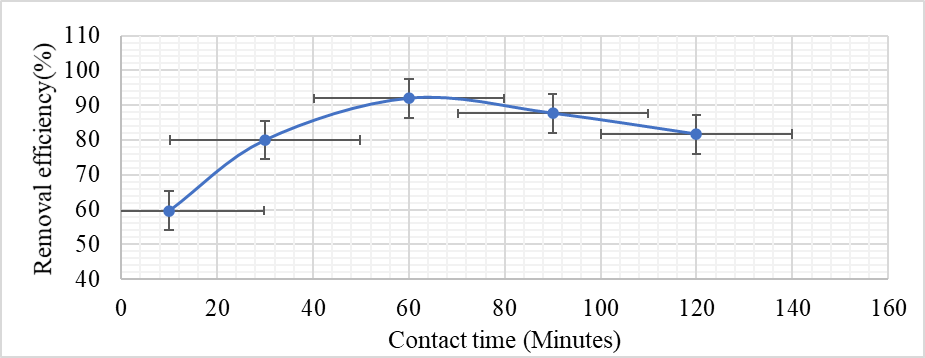 | Figure 9. Effect of contact time on the removal efficiency of Pb2+ ions |
3.8. The Effect of Temperature on Adsorption
- The study specifically examined the effect of temperature (25-60°C) on the percentage removal of Pb (II) ions at a starting concentration of 100 mg/L, using an adsorbent dose of 0.1 g/50 mL and a shaking speed of 120 rpm, with results illustrated in Figure 10.
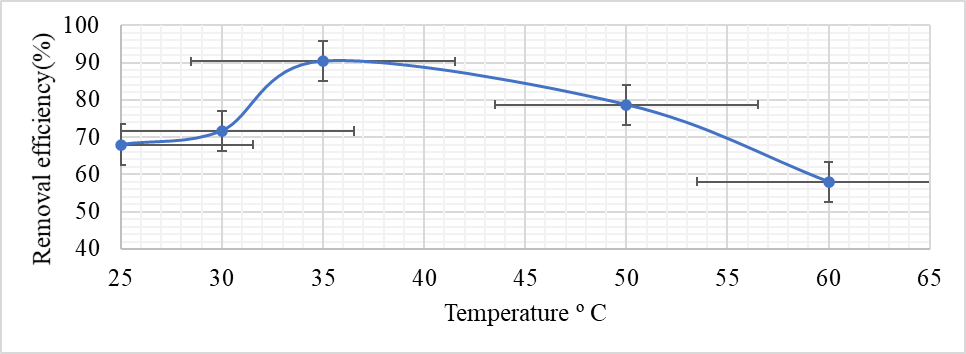 | Figure 10. Effect of temperature on the removal efficiency of Pb (II) ions using functionalized diatomite |
3.9. The Effect of Initial Concentration on Adsorption
- The effect of initial metal ion concentration on the percentage removal was investigated by varying the concentration of Pb (II) ions from 25 mg/L to 200 mg/L, using an adsorbent dose of 0.1 g/50 mL and a shaking speed of 120 rpm, with results illustrated in Figure 11.
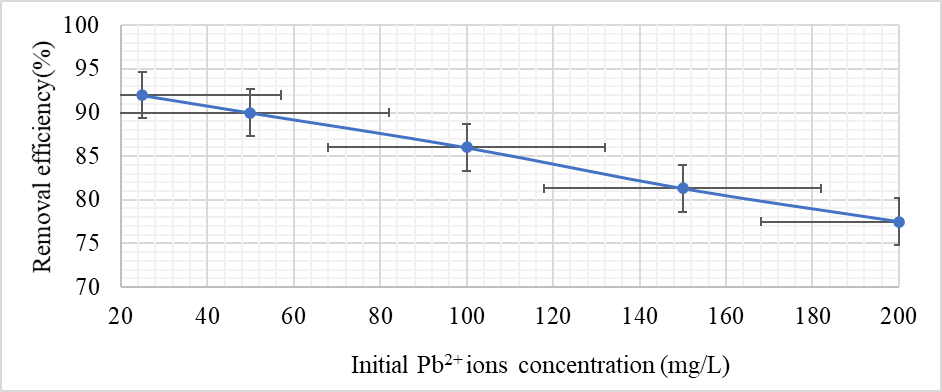 | Figure 11. Effect of initial concentration on the removal efficiency of Pb (II) ions using functionalized diatomite |
3.10. Adsorption Isotherms
- The adsorption data for Pb (II) ions were fitted onto both Langmuir and Freundlich isotherms. The isotherm constants and correlation coefficients obtained are tabulated in Table 2.
|

4. Conclusions
- The study successfully functionalized diatomite with oxalic acid to enhance its ability to adsorb Pb (II) ions from wastewater. Characterization techniques, including XRF, XRD, FT-IR, and Raman spectroscopy, confirmed that the functionalization altered the chemical composition and introduced oxygen-containing functional groups without changing the amorphous silica structure. The batch sorption experiments showed that the adsorption process was dependent on adsorption parameters. The findings suggest that oxalic acid-functionalized diatomite is a potentially effective, eco-friendly, and cost-efficient adsorbent for Pb(II) ion remediation from wastewater.
Conflict of Interests
- The authors declare that they have no known competing financial interests or personal relationships that could appear to have influenced the work described in this paper.
ACKNOWLEDGEMENTS
- The authors express gratitude to the Department of Science Technology and Engineering, Kibabii University’s for the assistance offered during the whole of research period.