
-
Paper Information
- Paper Submission
-
Journal Information
- About This Journal
- Editorial Board
- Current Issue
- Archive
- Author Guidelines
- Contact Us
Management
p-ISSN: 2162-9374 e-ISSN: 2162-8416
2026; 16(1): 1-8
doi:10.5923/j.mm.20261601.01
Received: Jan. 18, 2026; Accepted: Feb. 10, 2026; Published: Mar. 9, 2026

Spare Parts Availability Strategies and Organizational Performance of Licensed Motor Vehicle Assemblers in Kenya
 Abstract
 Reference
 Full-Text PDF
 Full-text HTML
Catherine B. Muthoni Warui1, Ibrahim Tirimba Ondabu2
1Department of Business Management, KCA University, Nairobi, Kenya
2Department of Accounting & Finance, KCA University, Nairobi, Kenya
Correspondence to: Ibrahim Tirimba Ondabu, Department of Accounting & Finance, KCA University, Nairobi, Kenya.
| Email: |  |
Copyright © 2026 The Author(s). Published by Scientific & Academic Publishing.
This work is licensed under the Creative Commons Attribution International License (CC BY).
http://creativecommons.org/licenses/by/4.0/

This study examined the influence of spare parts availability strategy on organizational performance among licensed motor vehicle assemblers in Kenya. The study adopted a descriptive research design targeting 110 employees across four licensed assemblers, achieving an 88.18% response rate (97 respondents). Data were collected using structured Likert-scale questionnaires and analyzed using descriptive statistics and multiple regression analysis. The findings indicate that spare parts availability strategy had a weak and statistically insignificant relationship with organizational performance (R = .086, R² = .007, p = .403). The model explained only 0.7% of the variance in organizational performance, suggesting that spare parts availability alone does not significantly predict performance outcomes within the sector. The study concludes that while spare parts management remains operationally important, it does not independently drive organizational performance. The findings recommend integrated strategic alignment of spare parts systems with broader organizational capabilities such as forecasting accuracy, digital integration, and supply chain coordination to enhance performance outcomes.
Keywords: Spare parts availability strategy, Organizational performance, Technology integration
Cite this paper: Catherine B. Muthoni Warui, Ibrahim Tirimba Ondabu, Spare Parts Availability Strategies and Organizational Performance of Licensed Motor Vehicle Assemblers in Kenya, Management, Vol. 16 No. 1, 2026, pp. 1-8. doi: 10.5923/j.mm.20261601.01.
Article Outline
1. Introduction
- Spare parts availability strategy is a structured plan that guides how an organization sources, manages, stores, and distributes spare parts to meet operational needs and customer demand. In industries like automotive manufacturing, equipment servicing, and heavy machinery, the strategy is a critical part of post-sale support and directly affects downtime, customer satisfaction, and profitability. The objectives of the spare parts strategy include minimizing downtime, enhancing customer retention, improving service efficiency, and supporting organizational performance. An effective spare parts strategy ensures operational continuity, reduces downtime, and strengthens post-sale customer relationships.Globally, spare parts strategies are using proactive and predictive models, driven by advances in data analytics, artificial intelligence (AI), and integrated supply chains. Multinational corporations in automotive, aerospace, and manufacturing sectors have adopted predictive maintenance, where IoT-enabled sensors detect early signs of wear and trigger pre-emptive replacements [1]. For example, Caterpillar uses telematics data from heavy equipment to anticipate parts demand and pre-position inventory worldwide, reducing downtime and improving customer service [2]. Digitalization has also revolutionized parts distribution, with players like Toyota offering online ordering portals and mobile applications for real-time inventory visibility [3]. In the East African automotive sector, spare parts strategies are shaped by infrastructure limitations, logistical challenges, and the need for localized solutions. Regional distributors, such as Toyota East Africa and CFAO Motors, operate centralized warehouses in Nairobi and Mombasa, complemented by satellite depots in Uganda, Tanzania, and Rwanda to shorten delivery lead times [4]. The use of predictive analytics is gradually gaining traction, with companies leveraging sales history and warranty claim data to forecast demand. In Kenya, licensed motor vehicle assemblers depend heavily on robust spare parts availability to maintain market competitiveness. Spare parts availability is a key driver of post-sale support, directly influencing customer satisfaction, service turnaround times, and repeat purchases [5]. Kenyan assemblers typically adopt a hub-and-spoke distribution model, with central warehouses in Nairobi and regional depots in Kisumu, Eldoret, and Mombasa to serve both urban and rural markets [6]. Organizational performance encompasses dimensions such as profitability, productivity, customer satisfaction, innovation, market share, and sustainability [7]. In contemporary business environments, performance is viewed holistically, incorporating not only economic metrics but also social and environmental impact, aligning with the Triple Bottom Line (TBL) approach [8]. The measurement of organizational performance has evolved from traditional financial ratios to balanced frameworks such as the Balanced Scorecard (BSC), which assesses performance from financial, customer, internal process, and learning and growth perspectives [7]. In the automotive sector, these dimensions are critical, as performance depends on operational efficiency, product quality, after-sales support, and the ability to adapt to changing market conditions.Globally, organizational performance is increasingly influenced by digital transformation, innovation capacity, and sustainability initiatives. Companies in mature markets leverage data analytics, AI, and IoT to optimize processes, improve customer experience, and reduce operational costs [9]. For instance, Tesla’s global performance is driven not only by its sales but also by its service network efficiency and customer engagement models [10]. In motor vehicle assembly industries, global leaders such as Toyota and BMW measure performance using integrated systems that track production efficiency, defect rates, post-sales satisfaction, and environmental impact [3]. In East Africa, regional integration initiatives like the African Continental Free Trade Area (AfCFTA) provide opportunities for cross-border trade and supply chain optimization, potentially improving market access and economies of scale [11]. Local subsidiaries of global brands like Toyota and Nissan in East Africa prioritize localized production, spare parts availability, and dealer network expansion as key performance drivers [6]. In Kenya, key assemblers including Isuzu East Africa, Associated Vehicle Assemblers, Kenya Vehicle Manufacturers, and Trans-Africa Limited measure performance through customer satisfaction scores, service turnaround times, spare parts sales revenue, and market share growth [6]. Companies that invest in technology integration, staff training, and localized supply chains are better positioned to achieve sustainable performance improvements.In the automotive industry, spare parts strategy plays a pivotal role in sustaining organizational performance. Effective spare parts management ensures the timely availability of components, reduces equipment downtime, improves service efficiency, and enhances customer satisfaction [5]. Globally, Industry leaders such as Caterpillar and Toyota use AI-driven demand forecasting and IoT-enabled predictive maintenance to pre-position inventory and minimize service delays [2]. The link to organizational performance is evident in higher Customer Satisfaction Index (CSI) scores, reduced service turnaround times, and increased repeat purchases [9]. In East Africa, the spare parts strategy is shaped by logistical challenges, import dependency, and the need for localized solutions. Automotive distributors often operate centralized warehouses in major cities with satellite depots in neighbouring countries to improve accessibility [4]. In Kenya, licensed motor vehicle assemblers rely heavily on spare parts availability to maintain a competitive advantage. A hub-and-spoke distribution model, with Nairobi as the central hub and regional depots in Kisumu, Mombasa, and Eldoret, is common practice [6]. The strategic focus is on fast-moving parts availability, integration of ERP systems for inventory visibility, and supplier partnerships to reduce lead times. For example, Isuzu East Africa achieves next-day delivery for over 90% of fast-moving parts, contributing to higher CSI scores and repeat sales [6]. Organizational performance in this context extends beyond profitability to include service quality, customer loyalty, market share growth, and operational efficiency [7].The motor vehicle assembly industry in Kenya forms a critical pillar of the country’s manufacturing sector, accounting for approximately 10% of manufacturing GDP [12], contributing to industrial growth, job creation, and import substitution. Licensed assemblers in Kenya operate under a Semi-Knocked Down (SKD) and Completely Knocked Down (CKD) assembly framework, in which vehicles are imported in parts and assembled locally to meet domestic and regional market demands [6]. This industry not only supports the automotive value chain but also stimulates auxiliary sectors such as spare parts manufacturing, logistics, and after-sales service provision [13]. The industry is a key employer, directly and indirectly supporting over 12,000 jobs in manufacturing, distribution, and service provision [14]. According to [6], the following are the main licensed motor vehicle assemblers in the country: Isuzu East Africa, Kenya Vehicle Manufacturers, Associated Vehicle Assemblers, and TransAfrica Limited.
2. Literature Review
- The availability of spare parts is a critical determinant of organizational performance in the motor vehicle assembly industry. An effective spare parts availability strategy reduces downtime, enhances service quality, improves customer satisfaction, and leads to increased operational efficiency. Research supports the linkage between spare parts strategies and Competitive Advantage theory by [15] that emphasizes the capacity of organizations to achieve superior performance by offering unique value propositions that differentiate them from competitors. Organizations can attain a competitive advantage through differentiation of their spare parts strategy. Reliable and timely provision of genuine spare parts reduces customer downtime, enhancing trust and satisfaction while discouraging reliance on counterfeit alternatives. These elements not only fulfill immediate customer needs but also generate repeat business [16]. Dynamic Capabilities Theory, introduced by [17], allows for organizations to adapt to market and technological change. The theory emphasizes the organization's ability to integrate, build, and reconfigure internal and external competencies in response to rapidly changing environments. Some assembling organizations with strong dynamic capabilities have introduced remote diagnostic tools and digitized their supply chain processes, enabling them to forecast spare parts, manage inventory, track repairs, or update software for customers at home. These capabilities align with DCT by allowing firms to adjust internal systems and customer touchpoints to meet evolving demands [18]. The implementation of dynamic capabilities in post-sale support contributes to spare parts strategy innovation, which is a key differentiator in today’s competitive automotive landscape, as they not only fulfill current customer expectations but also anticipates future needs. Empirical studies across global, regional, and local contexts consistently support this linkage.Globally, researchers have underscored the strategic role of spare parts management in enhancing firm performance across various industries. For instance, [19] conducted a comprehensive study on spare parts forecasting and inventory management within the automotive and aerospace sectors across Europe. Their findings revealed that companies that adopted proactive parts planning frameworks, supported by predictive analytics and digital monitoring tools, achieved up to 17% higher operational efficiency compared to firms relying on traditional inventory systems. These organizations also reported substantial reductions in customer service lead times, underscoring the direct influence of accurate demand forecasting on key performance indicators such as service responsiveness, repeat purchase rates, and long-term brand loyalty. The study, therefore, highlighted that spare parts management is not merely an operational requirement but a strategic lever that enhances customer experience and strengthens firms’ competitive positioning. Similarly, [20] investigated the relationship between post-sale support, particularly spare parts logistics, and organizational competitiveness in the Chinese automotive industry. Their research demonstrated that firms utilizing decentralized spare parts warehouses, coupled with end-to-end digitized supply chains, consistently reported 21% higher customer retention levels. These organizations also achieved 15% fewer service delays, which in turn contributed to increased market share and stronger customer trust. [20] concluded that a well-designed spare parts availability strategy constitutes a core competitive capability, enabling automotive businesses to differentiate themselves through superior after-sales service quality and operational agility.Within the African context, empirical studies have illuminated logistical constraints and supply chain inefficiencies as persistent challenges affecting spare parts availability. In Nigeria, [21] examined the relationship between spare parts availability and the performance of automotive firms in Lagos State. Their study found a strong positive correlation between timely access to genuine spare parts and overall customer satisfaction. Organizations that cultivated reliable supplier partnerships and embraced localized sourcing strategies outperformed competitors in post-sales service efficiency, customer complaint resolution, and revenue growth derived from after-sales operations. In South Africa, [22] explored the impact of spare parts logistics on service delivery performance among automotive dealerships. The research established that dealerships that integrated real-time inventory tracking systems, maintained optimal safety stock levels, and implemented automated re-ordering mechanisms experienced significantly fewer stock-outs. These operational improvements translated into faster repair turnaround times and higher customer loyalty indices. The study ultimately recommended improved policy alignment and collaborative planning between manufacturers and dealers to enhance inventory accuracy and strengthen the effectiveness of parts distribution networks.In the Kenyan motor vehicle assembly sector, the availability of spare parts continues to play a pivotal role in shaping organizational performance and sustaining industry competitiveness. [23] Conducted a comprehensive investigation into the relationship between spare parts strategies and organizational performance among licensed motor vehicle assemblers operating in Nairobi. Their findings indicated that firms that strategically invested in localized warehousing solutions were able to reduce lead times associated with parts procurement, especially for high-demand components. Additionally, companies that adopted digital inventory management systems, such as automated stock-level monitoring, barcode tracking, and integrated enterprise resource planning (ERP) platforms, experienced enhanced operational efficiency. These organizations recorded higher service throughput, attributable to quicker repair cycles and reduced downtime caused by part unavailability. Moreover, the study established that organizations maintaining direct and structured relationships with original equipment manufacturers (OEMs) benefited from priority access to genuine spare parts, predictable supply schedules, and reduced risks associated with counterfeit components. Collectively, these strategies contributed to measurable improvements in service quality, lower customer complaints, and increased profitability across the participating firms.Similarly, [24] assessed the extent to which inventory management practices influence service delivery outcomes within Kenya’s broader automotive industry. Their study highlighted that those inconsistencies in spare parts availability remained a major cause of operational inefficiencies, leading to prolonged vehicle turnaround times, customer dissatisfaction, and a decline in repeat business. In particular, organizations that relied heavily on manual inventory controls or reactive ordering processes struggled to maintain optimal stock levels, resulting in frequent stock-outs and service delays. Conversely, organizations that adopted automated stock tracking mechanisms and predictive restocking models supported by data analytics demonstrated substantially improved service reliability. These organizations were able to anticipate demand patterns more accurately, streamline procurement cycles, and maintain adequate safety stock levels for fast-moving parts. As a result, they achieved higher customer satisfaction scores, strengthened brand credibility, and secured a more competitive market position. The study emphasized that efficient spare parts management is not merely an operational concern but a strategic prerequisite for achieving sustainable growth in Kenya's rapidly evolving motor vehicle assembly ecosystem.
3. Methodology
- This study adopted a descriptive research design to investigate the relationship between post-sale support strategies and organizational performance among licensed motor vehicle assemblers in Kenya. A descriptive design was appropriate because the objective was to systematically and accurately describe characteristics of a population, phenomenon, or relationship, especially in real-world business contexts [25]. The target population was the four motor vehicle assemblers in Kenya [6]. That is, Isuzu East Africa, Associated Vehicle Assemblers (AVA), Kenya Vehicle Manufacturer (KVM), and Trans Africa Limited. The target population included Post-sales General Managers, Post-sales Coordinators, Marketing Administrators, Quality Assurance Team, Parts Manager, Post-sales Marketing Administrators, Post-sales customer service personnel, and Service Technicians. The total number of formal populations for the study was 110. The study adopted a census study. The technique ensured the entire population participated in the study, thereby eliminating sampling error and providing a more comprehensive and accurate understanding of the relationship between spare parts strategies and organizational performance. The study used structured questionnaires (Likert) to collect primary data from selected respondents. This instrument was efficient for collecting standardized data across multiple organizations and departments. The questionnaire was designed to capture descriptive data on post-sale support strategies and organizational performance indicators. Data collection commenced after obtaining official authorization from each organization. Appointments were scheduled with departmental heads to coordinate questionnaire distribution. Structured questionnaires (Likert) to collect primary data were distributed via email with follow-up phone calls to ensure timely completion. Within an agreed-upon timeline, the Google Form questionnaires were checked for completeness and coded for data entry and subsequent analysis. This systematic and ethical approach to data collection ensured high response quality and completeness, enhancing the validity and reliability of the study findings.In this study, A pilot test was conducted among 11 respondents drawn from licensed motor vehicle assemblers in Kenya, representing 10% of the target population. The respondents were selected from departments similar to those participating in the main study to ensure contextual relevance. The pilot test assessed clarity, structure, wording, and instrument reliability. Feedback led to refinement of ambiguous items and improvement of logical flow. Cronbach’s Alpha coefficient for spare parts availability strategy was 0.706, indicating acceptable internal consistency. The instrument was therefore deemed reliable for full deployment.The collected data were cleaned and coded into SPSS Statistics version 29 software. Thereafter, the Multiple Regression Model was used to analyze data as shown below:𝑌 = 𝛽0 + 𝛽1𝑋1 + 𝜀Where:Y = Organizational PerformanceX₁ =Spare-parts availability strategy β₀ = Intercept β₁ = Regression coefficients ε = Error term The analyzed data will be presented in the form of tables and figures.
4. Findings, Conclusions & Recommendations
- The study targeted a total population of 110 respondents drawn from licensed motor vehicle assemblers in Kenya. Out of these, 97 participants completed and returned the questionnaires, representing a response rate of 88.18%. This response rate is considered highly satisfactory for survey research. According to [26], a response rate of 70% and above is adequate for generalization in social science research, while [25] emphasizes that rates above 80% minimize non-response bias and enhance the reliability of findings. Therefore, the response rate achieved in this study provides a strong basis for credible and dependable analysis.A pilot test is a small-scale preliminary study conducted to evaluate the feasibility, reliability, and clarity of research instruments before the main data collection. A pilot test was conducted among a group of 11 tyre distributors in Nairobi Town to verify the clarity, reliability, and validity of the questionnaire before its full deployment. The group was selected based on their active involvement in tyre distribution, their experience in the industry, and their accessibility, which ensured that they reflected the characteristics of the target population. The respondents were purposively drawn from different distribution companies and asked to complete the questionnaire while providing feedback on the wording, structure, and relevance of the items for a face validity test. The exercise enabled the identification of ambiguous or unclear questions, as well as potential difficulties in interpretation. The measurement approach was also deemed appropriate. Responses were collected using Likert scales ranging from “Strongly Disagree” to “Strongly Agree.” The scale is widely recognized as an effective tool for capturing perceptions and attitudes, and it is suitable for subsequent statistical analyses. Necessary adjustments were made based on the feedback from the 11 respondents to refine the questionnaire, thereby enhancing its usability, accuracy, and ability to generate reliable data for the main study.In order to find out whether the questionnaire measures what it purports to measure, this study undertook a test of reliability using a Cronbach’s Alpha coefficient. The test requires alpha values of Cronbach to be at least 0.7, while the study found that the questionnaires had an average Cronbach’s Alpha coefficient of 0.706. This evidenced the consistency in the questionnaires; hence, they could be used to determine spare parts strategies and organizational performance of licensed motor vehicle assemblers in Kenya.
|

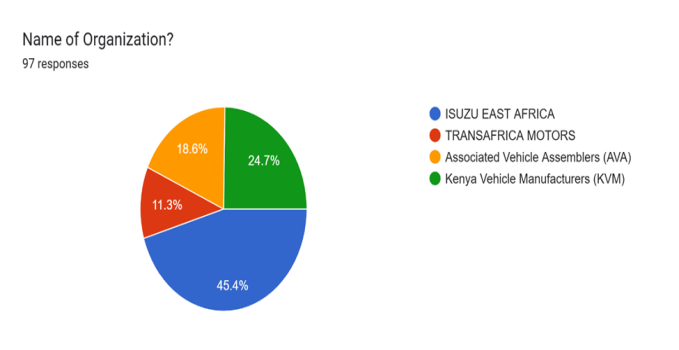 | Figure 1. Respondents’ Organization |
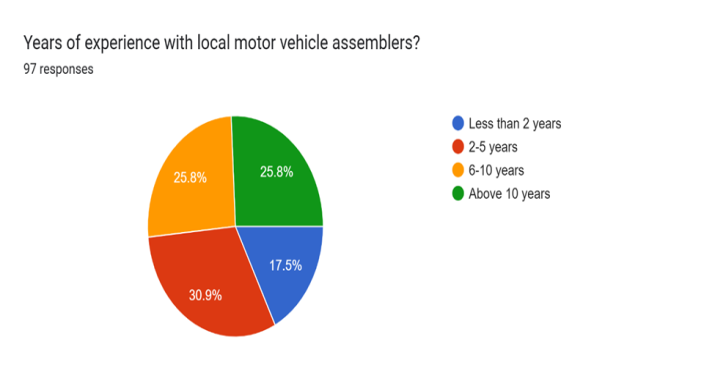 | Figure 2. Respondents’ years of experience with the local motor vehicle assembler |
|
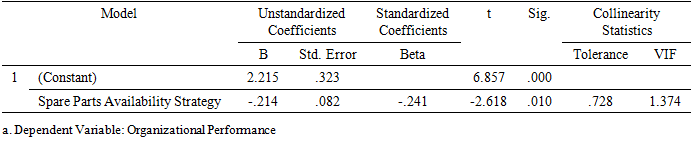
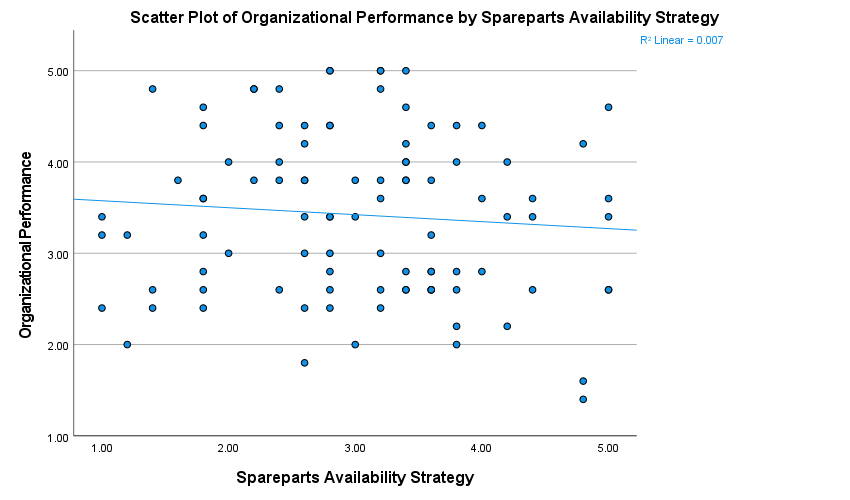 | Figure 3. Spare parts vs organizational performance |
|
|
|

|

5. Summary of Findings, Conclusions, and Recommendations
5.1. Summary of Findings
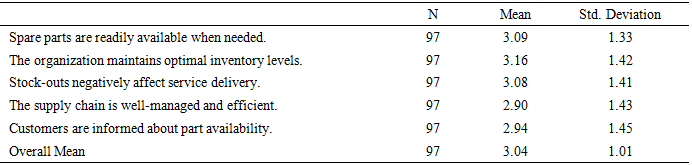
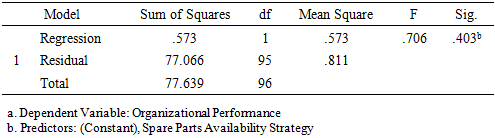
- The analysis of the spare parts availability strategy revealed that it exerted a weak and negative influence on organizational performance. Respondents’ generally neutral views regarding stock-outs, inventory levels, and communication about availability suggested a lack of strong confidence in the spare parts system. The regression results indicated that the spare parts availability strategy had a weak and statistically insignificant relationship with organizational performance (β = -.086, p = .403). The model explained only 0.7% of the variance in organizational performance (R² = .007). Although respondents moderately agreed that spare parts were available and inventory levels were maintained (M = 3.04), these perceptions did not translate into measurable performance impact. This suggests that spare parts availability, in isolation, may not be a sufficient determinant of organizational performance within Kenya’s motor vehicle assembly sector.The result contrasts with the findings of [27], who reported that effective post-sales service management, including spare parts logistics, significantly enhanced competitive advantage in Serbian manufacturing companies. Similarly, [21] found that efficient spare parts systems in Nigerian SMEs positively influenced profitability and customer retention. The negative relationship in the present study may reflect contextual differences in Kenya’s motor vehicle assembly sector, where logistical inefficiencies, forecasting challenges, and supply-chain fragmentation remain persistent [6]. Consequently, this study contributes to the literature by revealing that spare parts strategies can negatively affect performance when poorly implemented, highlighting the importance of transparency and supply-chain integration.
5.2. Conclusions
- From the findings, the spare parts availability strategy does not significantly predict organizational performance among licensed motor vehicle assemblers in Kenya. Despite its operational relevance, the statistical analysis revealed minimal explanatory power and no significant effect. This suggests that organizational performance in the sector is likely influenced by broader strategic factors such as market positioning, operational efficiency, digital integration, customer relationship management, and macroeconomic conditions [23]. Spare parts availability may function as a necessary operational support mechanism rather than a primary strategic performance driver. The negative relationship observed between spare parts availability and organizational performance further signals a deeper structural challenge within the sector. The current approaches appear to create uncertainty, impede customer loyalty, and limit the ability of assemblers to deliver timely support. This outcome contrasts with findings by [27], who reported that effective spare parts logistics strengthens competitive advantage in manufacturing organizations, and with [21], who found a positive influence on profitability and customer retention in Nigerian SMEs. The divergence underscores the contextual realities within Kenya’s motor vehicle assembly industry, where logistical bottlenecks, fragmented supply chains, and inconsistent forecasting practices remain prevalent [6].Overall, the study concludes that spare parts strategies can be a double-edged sword: when effectively planned and executed, they support organizational growth, but when poorly managed, they erode performance. For licensed assemblers in Kenya, improving supply-chain integration, adopting advanced digital inventory tools, and strengthening coordination with OEMs will be essential for transforming spare parts operations into a driver of sustainable organizational performance. These findings reinforce the importance of strategic alignment, technological investment, and process efficiency in unlocking the value of spare parts management in Kenya’s motor vehicle assembly sector.
5.3. Recommendations
- Although the findings revealed that spare parts availability strategy did not have a statistically significant effect on organizational performance, it remains operationally important within licensed motor vehicle assemblers in Kenya and should be strengthened through strategic integration rather than treated as an isolated function. Assemblers should enhance demand forecasting accuracy using data-driven predictive models, invest in integrated ERP systems and real-time inventory tracking technologies to improve visibility and coordination across the supply chain, and strengthen collaboration with Original Equipment Manufacturers (OEMs) to reduce lead times and supply uncertainties. In addition, organizations should align spare parts operations with broader performance management systems by linking after-sales activities to key indicators such as service turnaround time, customer retention, and after-sales revenue. Embedding spare parts management within a comprehensive strategic framework may enable organizations to unlock greater value and potentially improve overall organizational performance.