Yingchun Guo
College of Mathematics & Computer Seience, Hebei University, Baoding 071002, China
Correspondence to: Yingchun Guo, College of Mathematics & Computer Seience, Hebei University, Baoding 071002, China.
| Email: |  |
Copyright © 2012 Scientific & Academic Publishing. All Rights Reserved.
Abstract
The uncertainty of innovation determines its characteristic of high risks. The management of innovation risks is significant. The high risks of innovation activities require managers to implement scientific and effective innovation risk management. On the basis of a general review of the risk management of uncertain innovation, by combining the case of innovation project, this paper discussed the framework of uncertain innovation risk management which combination the qualitative and quantitative management methods, in the hope of providing scientific references for managers making innovation risk management decisions.
Keywords:
Innovation, Uncertainty, Risk, Innovation Risk, Risk Management, Framework
Cite this paper: Yingchun Guo, Research on Framework of Risk Management of Uncertain Innovation, Management, Vol. 3 No. 7, 2013, pp. 402-407. doi: 10.5923/j.mm.20130307.10.
1. Introduction
Innovation is the soul of a nation’s progress, an inexhaustible force for the prosperity of a nation, and the life source of enterprises (Siwei Cheng, 2009, p1-14). Without innovations, enterprises would not be able to upgrade the production structure. With weakening competitiveness, enterprises will die. However, innovation is a “double-edged sword”, with characteristics of high potentials, high inputs, high returns, and high risks. Particularly, high risks from technologies, market, and management frustrate or even kill many innovation activities, which may even threaten the healthy development of human society. Therefore, to manage the innovation risks is significant. At present, the classification of innovation project is mainly based on the innovation contents, which is divided into three types, i.e. technological innovation, product innovation, and management innovation. In perspective of risk management, this paper divides innovation project into “proper innovation”, “improper innovation”, and “uncertain innovation”. The “proper innovation” refers to the innovation that is beneficial to human healthy development and the harmonious development of human society, such as various new technologies and products that help to improve people’s life quality and social satisfaction. All social management organizations should create the environment and conditions to actively encourage and advocate this type of innovation. The “improper innovation” refers to the innovation that is harmful to human healthy development or the harmonious development of human society. For example, companies may deceive the quality inspection department by replacing qualified products with fake ones or using fewer raw materials for production in order to obtain more economic benefits. All social management organizations should strictly monitor and control this kind of behaviors, forbidding this type of “innovation” completely. The “uncertain innovation” refers to the innovation that produces unclear impacts on human healthy development and uncertain consequences on the harmonious development of human society, such as the genetically modified biotechnologies, and the use of a variety of food additives, etc. All social management organizations should strengthen the management of this type of innovation, perform the whole-process and comprehensive monitoring, establish the risk-early-warning and fast-response mechanism, and reduce the potential harms to the minimum level. This paper will focus on the risk management of uncertain innovation project. Because of the uncertainty of innovation project, it might bring about damages or bad influences on enterprises, industrial chain, or even the entire society, i.e. the risk. At present, most discussions on innovation focus on the approaches and patterns for promoting enterprises’ independent innovation. Only few researches are about the innovation risk. In addition, the existing literatures usually just discuss the economic risks of innovation project, mostly from the point of the innovation project failing to reach the expected return. This paper will not only consider the economic risks, but also think about the social risks of innovation project, including the environmental risk, human health risk, etc., from the long run. As an innovation project, its impacts are still unclear in the future. Therefore, managers should adopt a set of scientific and effective management approaches to identify problems and revise decisions immediately, in order to achieve the purpose of comprehensive risk control. Risk decisions run through the entire process of risk management. The risk decision-making is to make decision according to incomplete information. According to the objective of risk management, with basis of risk identification and risk evaluation, make reasonable choice and combination of different risk management methods, and offer a specific program for risk management. Faced high risks from technologies, market, and management, enterprise managers should master the scientific and feasible risk decision-making method, managing innovation risks effectively. This paper is to explore the effective quantitative risk decision-making method, in order to help enterprise managers to achieve effective innovation risk management. Bayesian approach is a powerful tool for risk decision-making (Richard Bradley, 2007; Xiaomo Jiang & Sankaran Mahadevan, 2007). Because of its simple and convenient attributes, this approach is widely applied to many fields. Due to its convenience and easiness, this approach is applying in many fields. Jacobus P. Venter and Cornelis C. V. Waveren (2009) used the Bayesian Decision technology to support the new product development management. Rajkumar Venkatesan, V. Kumar, and Timothy Bohling (2007) applied the Bayesian Risk Decision-Making Theory to the choice of customers in customer relationship management. Kwai-Sang Chin, Da-wei Tang, and Jian-bo Yang (2009) applied the Bayesian network method to the risk evaluation in new product R & D. Paul L. Reynolds and Geoff Lancaster (2007) proposed a Bayesian solution for enterprises predicting the strategic marketing management decision. Min Chen, Yusen Xia, and Xinlei Wang (2010) built a Bayesian model to achieve dynamic knowledge update, in order to deal with the supply uncertainties and risks. However, few literatures are about applying the Bayesian Risk Decision approach to the risk management of uncertain innovation project. This paper will discuss how to use the Bayesian Risk Decision approach to perform risk management of uncertain innovation project.
2. Framework of Uncertain Innovation Risk Management
The framework of risk management of uncertain innovation project includes five stages, i.e. risk identification, risk pre-assessment, risk decision making, risk monitoring, and emergency-response to risk. See to Figure 1.Risk identification refers to identify the risk sources of uncertain innovation project, such as economic risk, industrial chain risk, environmental risk, human health risk, etc.Risk pre-assessment means: before the application of innovation project, invite some professionals to form an expert team, ask them to make a comprehensive assessment of the risk, predict the consequences, and make a feasibility analysis of the project in perspective of the potential risk.  | Figure 1. Framework of uncertain innovation risk management |
Risk decision-making means: on the basis of comprehensive assessment of all potential risks, make relevant decisions about project inputs and operations. At this stage, we could not completely control the consequences of decision. So, it is called risk decision-making. The risk decision-making is the most key stage in the framework of risk management. This paper will focus on risk decision-making and adopt Bayesian decision theory, thus to realize the combination of qualitative and quantitative risk management.Risk monitoring means: during one decision-making cycle for the trial operation of innovation project, investigate and follow the whole process of the project, collect relevant data and information feedback, and monitor the positive or negative effects of the project on all social fields. According to the analysis of new information, identify problems and make risk pre-warning, adjust relevant risk decisions of innovation project in time, and achieve the purpose of risk control. Repeat the two risk management stages many times, i.e. from risk decision-making to risk monitoring and from risk monitoring to risk decision-making, we can achieve the dynamic risk management. Emergency-response to risk means: if unexpected risk event happens during the running cycle of project, we must perform the emergency management, according to the pre-established plans for emergencies. For example, call an emergency stop to the innovation project, or make immediate product recalls. By this way, we can reduce the risk consequence to the minimum level.
3. Introduction of Bayesian Risk Decision
Risk decision-making runs through the whole risk management process. By analyzing risks and losses scientifically, it can help to choose the reasonable risk management techniques and methods and finally get the most satisfying solution from several options. Every risk decision-making includes three elements: the state group consisted of different natural status, the action group consisted of a set of actions taken by decision makers, and the description of utility or losses from different combinations of statues and actions. From the three elements, we can get different risk conditions. Once the decision maker makes a decision with uncertain result, it means certain risk. The risk decision-making needs to get changeable market information by increasing inputs. Based on mastering various natural conditions in time, use the collected information reasonably, and select the decision scientifically, reducing risks, and improving economic and social benefits. In risk decision-making, the accuracy of estimation of natural conditions can directly affect the expected returns. In order to make better decision, it needs to update the information in time. After getting new information, we can revise the original estimated probability of emergence of certain natural condition, and use the revised probability distribution to make new decision. Because the probability correction is based on the Bayesian Theorem in probability theory, this decision is called Bayesian Decision.
4. Example of Uncertain Innovation Risk Decision
4.1. Three Elements for Innovation Risk Decision
(1) The group of natural states. The comprehensive evaluation on uncertain innovation project is . For instance, N1 stands for best, N2 stands for better, …, and Nm stands for worst. Experts give the prediction posterior probability of each state
 . (2) The group of actions. The action toward uncertain innovation project is
 . Here d1 stands for high investment, such as more investment in R & D, new production equipment, and new product. d2 stands for medium investment, d3 stands for low investment, d4 stands for no investment in innovation. (3) The group of descriptions of utility or losses:
  . Here, we define
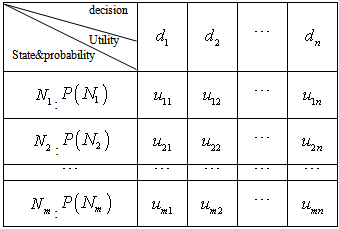
  is the economic utility that can be evaluated by money, or the utility function evaluated by non-monetary factors. Here, we suggest the second meaning, because innovation activities can not only generate economic benefits, but also social benefits, so as to bring intangible assets and long-term interests for enterprises. The utility function can be measured by the satisfaction degree, such as enterprises’ satisfaction degree, customers’ satisfaction degree, expert scoring, and other comprehensive scores (see to Table 1).
4.2. Data Description of Uncertain Innovation Risk
Suppose there are three states of comprehensive evaluations on economic utility and social benefits of a new innovation project:  . Here, N1 stands for good, N2 stands for medium, N3 stands for bad. According to the data analysis of the market survey and the expert prediction, the probability distribution of each state is

 The manager has four options:
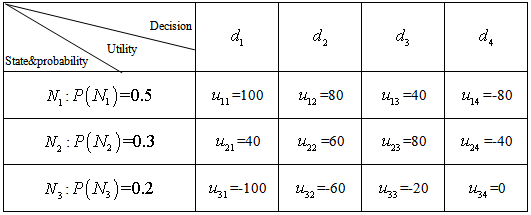
  , which d1 stands for high investment, d2 stands for medium investment, d3 stands for low investment, and d4 stands for no investment. The utility of four options under different states is in Table 2. Data description: the expected utility declines along with the diminishing prospect of market state. For example:
  is the expected utility on the condition that high investment and good market. In such conditions the economic utility and social benefits is the highest, so the expected utility could be
  =100;
=100;  is the expected utility on the condition that high investment and uncertain market. In such conditions the economic utility and social benefits are medium, so the expected utility could be
  =40;
=40;  is the expected utility on the condition that high investment and bad market. In such conditions the enterprise suffers from serious losses, the economic utility and social benefits are worst, so the expected utility is
  =-100. Here, focus on the last line. If the enterprise takes the no investment strategy, the expected utility will be low. For example,
  : the enterprise does not invest, though the market conditions are good. It will make the enterprise lose potential economic utility and social benefits. The expected utility
  =-80;
=-80;  : the enterprise does not make innovation investment and the market conditions are bad. Then, there is no economic benefit or social benefit. The expected utility
  =0.
=0.Table 1. Utility
 |
| |
|
Table 2. The expected utility of investment
 |
| |
|
4.3. Bayesian Risk Decision-Making Process
4.3.1. Prior Analysis
According to the probability of natural state and the expected utility (see to Table 2), by following the law of expectation, calculate the expected utility of each program. 
 . Accordingly, the optimal expectation for the optimal program is
 . For instance,
  0.5*100+0.3*40+0.2*(-100)=42; similarly,
  =46,
=46,  =40,
=40,  =-52. Then, the optimal decision and the optimal expected utility is
  . It means that the manager can take the medium investment strategy if only with the prior information.
4.3.2. Prediction Posterior Analysis
In prediction posterior analysis, estimate the value of complete information firstly. As the prediction of complete information is in the state  , it becomes the decision-making under certainty. Apparently, the optimal program is
  . Then, with complete information, the maximum expected utility from decision-making is:
 =0.5*100+0.3*80+0.2*0=74. Therefore, the value of complete information
  =74-46=28. It means the value of complete information is equal to 28 units of utility.
4.3.3. Posterior Analysis
(1) Supplement new informationAccording to the market conditions, investigate, explore, and consult the three states  (good),
  (medium),
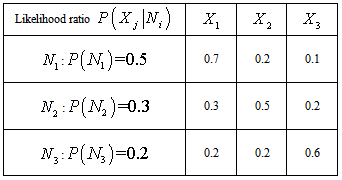
  (bad), and predict which one will appear. Meanwhile, get the conditional probability
  , which is the probability of predicting the emergence of
  when the natural state
  actually appears. (See Table 3)
Table 3. The likelihood ratio
 |
| |
|
Table 4. The posterior probability
 |
| |
|
Table 5. The posterior expected utility
 |
| |
|
(2) Revise the probabilityBased on the prior probability  (
( =1, 2, 3) and the conditional probability
  (
( =1, 2, 3;
  =1, 2, 3), calculate the probability distribution of
  :
: .For example,
  0.5*0.7+0.3*0.3+0.2*0.2=0.48.Similarly,
  0.29,
0.29,  0.23.Use the Bayesian formula to calculate the revised probability of
  , namely the posterior probability (see to Table 4):
 ,(
,( =1, 2, 3;
  =1, 2, 3).For example,
 =
=  (3) Posterior decisionSuppose the supplement information predicts the appearance of state
  . Use the posterior revised probability distribution
  (
( =1, 2, 3) to calculate the expected utility of each decision. By following the law of expectation, make the decision, i.e. posterior decision. Then,
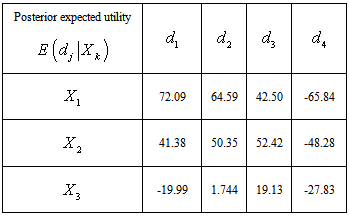
  (j=1, 2, 3, k =1, 2, 3).For instance, if the market survey shows that the market condition is
 , calculate the expected utility of
  (see to Table 5).
 = 0.7292*100+0.1875*40+0.0833*(-100) = 72.09. Similarly, there is
  64.59,
  =42.50,
  -65.84.These results mean: if the market condition is good, the manager can take the decision
  , for the maximum expected utility is
  72.09.Similarly, if the market condition is
  , calculate and compare the expected utility of each
  . The result mean: if the market condition is medium, the manager can take the decision
  , for the maximum expected utility is
  52.42. If the market condition is
  , calculate and compare the expected utility of each
  . The result mean: if the market condition is bad, the manager can take the decision
  , for the maximum expected utility is
  19.14. (4) Discussion: If the expected utility of risk decision is more than 50, that means the innovation project is do more good than harm, then we can continue to promote this innovation project; If the expected utility of risk decision is less than 50, that means the pros and cons of the project almost the same, then we can maintain the original scale and see how it behaves in the future; If the expected utility of risk decision is negative, that means the innovation project is do more harm than good, then we should stop the innovation project.The risk management of uncertain innovation is vital to the survival and the development of society, enterprise, and production chain. It is believed that the risk management of uncertain innovation is an issue of big and complicated system. The scientific innovation risk management involves many social aspects: not only the economic risk, but also social risk; not only the short-term risk, but also the long-term risk. And the risk management of uncertain innovation needs to motivate all social powers to be involved, including project sponsors, related experts, government regulators, most customers, and so on. Some project sponsors are eager for quick success. They just care about the short-term economic interests, but not consider the long-term consequences and social risks, which might cause serious damages to the industrial chain, social environment, or even human survival. In order to avoid such kind of tragedies, all managers at different social levels should take responsibilities and perform scientific risk management.
5. Conclusions
By combining with an example of uncertain innovation project, this paper discussed the framework of uncertain innovation risk management which combined the qualitative and quantitative management methods. The framework of risk management of uncertain innovation includes five stages, i.e. risk identification, risk pre-assessment, risk decision making, risk monitoring, and emergency-response to risk. Focused on risk decision-making, this paper adopted Bayesian decision theory, thus to realized the combination of qualitative and quantitative methods in innovation risk management. How to do a good job in information collection and make a good future market prediction is the key of the risk management.Here we should further emphasize one point, i.e. the risk management of uncertain innovation needs to repeat the application of the risk decision process in cycle, adjust the risk decision in time, and carry out the dynamic innovation risk management, in order to adapt to the constantly - changing social environment and help managers to achieve the scientific management of innovation risk.
References
| [1] | Cheng, Siwei. (2009). On the construction of an innovative country. China Soft Science. No.12. p1-14. |
| [2] | Jacobus P. VENTER, Cornelis C.V.Waveren. (2009). New product development with dynamic decision support. International Journal of Innovation and Technology Management. No.6(2). p155-167. |
| [3] | Kwai-Sang Chin, Da-Wei Tang, Jian-Bo Yang, etc. (2009). Assessing new product development project risk by Bayesian network with a systematic probability generation methodology. Expert Systems with Applications. No.36(6). p9879-9890. |
| [4] | Min Chen, Yusen Xia, Xinlei Wang. (2010). Managing supply uncertainties through Bayesian information update. IEEE Transactions on Automation Science and Engineering. No.1. p24-36. |
| [5] | Paul L. Reynolds, Geoff Lancaster. (2007). Predictive strategic marketing management decisions in small firms: A possible Bayesian solution. Management Decision. No.45(6). p1038-1057. |
| [6] | Rajkumar Venkatesan, V. Kumar, Timothy Bohling. (2007). Optimal customer relationship management using Bayesian Decision Theory: an application for customer selection. Journal of Marketing Research. No.XLIV(4). p579-597. |
| [7] | Richard Bradley. (2007). A unified Bayesian Decision Theory. Theory and Decision. No.63(3). p233-263. |
| [8] | Xiaomo Jiang, Sankaran Mahadevan. (2007). bayesian risk decision-making method for model validation under uncertainty. Reliability Engineering & System Safety. No.92(6). p707-718. |

 Abstract
 Reference
 Full-Text PDF
 Full-text HTML