Birgit Oberer
Department of Management Information Systems, Faculty of Engineering and Natural Sciences, Kadir Has University, Istanbul, Turkey
Correspondence to: Birgit Oberer, Department of Management Information Systems, Faculty of Engineering and Natural Sciences, Kadir Has University, Istanbul, Turkey.
| Email: |  |
Copyright © 2012 Scientific & Academic Publishing. All Rights Reserved.
Abstract
In order to be competitive in global markets and meet the needs of being competitive in an increasing area of globalization, public authorities must think about how to make their services more competitive and offer innovative products and services to the public. One aspect of becoming more competitive and contrasting with competitors on the market is investing in global oriented e-government strategies. In this study the Open Government Data (OGD) concept, which is currently applied in several OGD portals in Austria, following pilots in the US and UK, is analyzed in order prepare guidelines for implementing open government data portals within the European Union. The results of the study revealed that with these unique public data portals, selected government data, such as environment data, geographic data, or statistics about the population, are provided to the public (citizens and businesses) for further use, creating a competitive advantage for governments.
Keywords:
E-Government, Data Portal, Public Sector
Cite this paper: Birgit Oberer, How to Manage Governments? Innovation through Open Government Data Portals, Management, Vol. 3 No. 7, 2013, pp. 341-348. doi: 10.5923/j.mm.20130307.03.
1. Introduction
Based on the approach of business process re-engineering and the improvement and increase of customer satisfaction, governments must improve their public appearance within an international, competitive environment. Among other things, they can do so by using E-Government strategies following predefined goals, in turn transforming these strategies into measures in order to reach the defined goals and developing control structures for strategy progress analysis.Open government data, using non-personalized government data, is a result of a living change in governments and their authorities, which tries to offer government data to the public to benefit citizens and to offer new business challenges for companies. With the open data approach, government processes could become more transparent, a control mechanism for governmental authorities could be installed easier, and service quality for governmental services could be increased[1]. The main purpose of this study is to analyze the open government data portal approach, implemented in one member country of the European Union, focusing on strengths and weaknesses and preparing guidelines for other governments within the European Union how to implement such kind of data portals. The research approach applied in this study is based on a case study. After a literature review on E - Government and electronic government activities within the European Union the E-Government activities in one member country, Austria, are analyzed. Austria was chosen because this country was a pioneer in implementing E - Government in the mid 1990s and is now a pioneer in the EU in implementing open government data portals. It is analyzed what kind of strategy is available, how are these open government data portals organized and how many portals are available. Strengths ad weaknesses of the implemented portals in Austria are analyzed. Based on this the requirements for implementing open government data portals within the European Union can be derived and an EU wide strategy developed. The next steps to be taken are summarized in the discussion section.
2. Literature Review
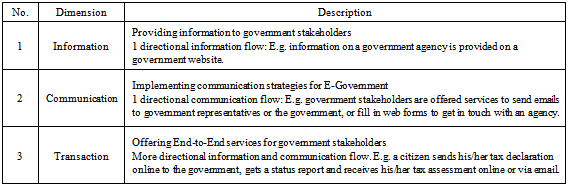
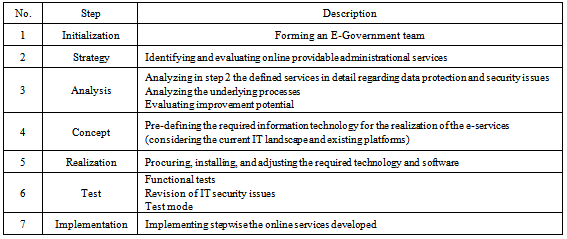
E-Government includes all administrational activities on the union, state, and local government level, and it should improve the requirement satisfaction of a government’s stakeholders, which are citizens, businesses, and internal customers (other governmental agencies). The E - Government approach focuses on the use of information and communication technologies to offer government services. Web based solutions (e-solutions) have an increasing influence on government stakeholders. The implementation of e-services for governments could improve the relationship between a government and its stakeholder, which are mainly citizens, businesses, and other customers, all of them as possible interaction partners for E-Government[7,8,14].An E-Government strategy is a fundamental element for managing the current change in governments. Government activities are driven by the need for higher effectiveness, efficiency, for 24/7 availability, and the online availability of an increasing amount of governmental services. Most governments follow certain strategies on E-Government to improve the web appearance of governmental agencies, serving the three dimensions of E-Government, which are summarized in table 2[9,10,11].Table 1. e-Government Dimensions[9,10]
 |
| |
|
Table 2. e-Government Development Process[7]
 |
| |
|
Governments nowadays collect, produce, store, manage, share, and use huge amounts of data, which become increasingly valuable for the administration itself and its stakeholders. Information and communication technologies evolve into increasingly complex, globally oriented networks, which causes challenges for governments offering effective, efficient, and mainly reliable services to their stakeholders[12,13].The main challenge for E-Government is processing stakeholder related processes. When implementing E-Government in the public sector the development process contains several main steps to be considered, which are summarized in table 2.
3. E-Government in Austria
In Europe, activities on E-Government started in 1994 with the formulation of an EU strategy on the ‘information society’. Most countries have chosen different ways to implement their national E-Government strategy, by founding national committees, consulting institutions, committees of ministers, public control committees on IT issues, and expert groups[14].One country forming expert groups to develop the national E-Government is Austria, which focused on the three supply models for E-Government: information, communication, and transaction (table 1).Austria started e-government earlier than other European Union members and developed services such as Finanzonline, which is a portal where citizens can find services related to income and tax. Those services became showcases for solutions within the EU. One milestone for Austria was the successful go live of HELP.GV.AT, a service portal for citizens (at least in the beginning businesses as well), which received the 'eEurope e-government Award' in 2003. With the 'e-government initiative 2003', Austria sought to make Austria one of the European leaders in e-government and ensure its position among the best five e-government countries in the European Union. This initiative was started in addition to the Information and Communication Technology Board. In 2004, Austria achieved fourth place within the European ranking and, in 2005, it placed second, claiming the title 'European Champion' in 2006, defending this title in 2007 and becoming a showcase country for e-government in Austria. In a study conducted in 2010 sponsored by the European Commission investigating e-government offerings in Europe as well as Iceland, Norway, and Switzerland, Austria was declared the 'European Champion in eGovernment' the fourth time in a row. The critical conditions for E-Government are (1) demand orientation, (2) organizational conditions, (3) legal conditions and (4) technological ones[14].
4. Open Government Data Portals
The platform ‘digital Austria’ is the coordination committee of the federal government for E-Government in Austria. E-Government includes all electronic public services for citizens and businesses in Austria. The Open Government Data Portal (URL:http://www.data.gv.at) is a platform that is organized by the federal chancellery and the Bundesrechenzentrum that offers a comprehensive view of the accessible national data of the Austrian government, which is unique in Europe. Together with the countries and cities, the portal is updated frequently and enables the online provision of data for citizens and businesses using various applications and visualization techniques. The basic idea is to provide government data, which are not related to individuals, to the public for free. The data are provided machine-readable, so that they can be used in an automated way. Open standards for the interfaces and software offer more transparency, participation, and collaboration.Data can be used in different ways. Citizens and businesses can use the provided data in order to design their own applications and services. Science and Research could also benefit from this simplified data exchange.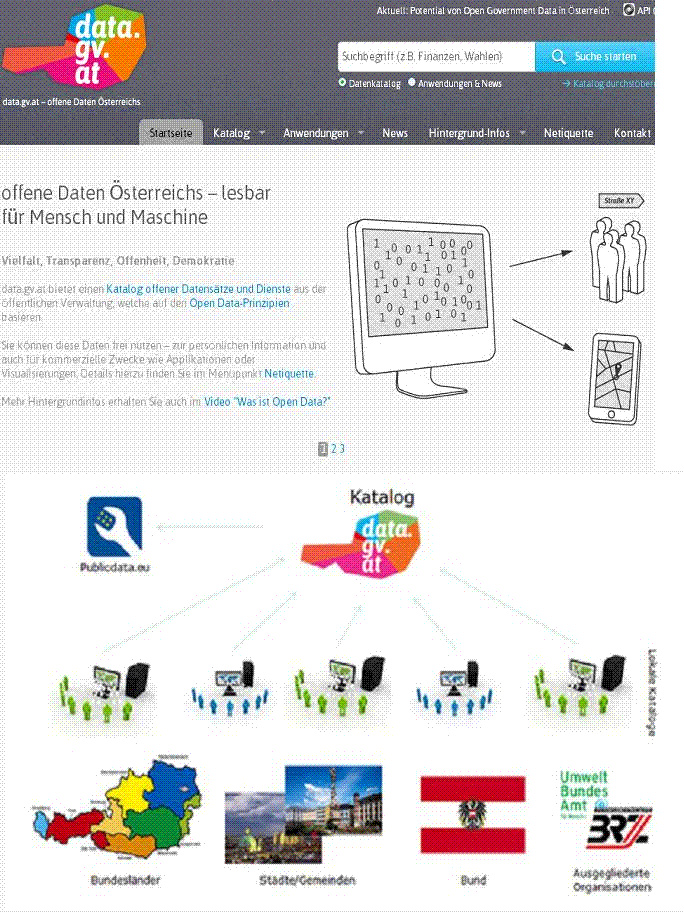 | Figure 1. The Open Government Data Portal (screenshot), www.data.gv.at |
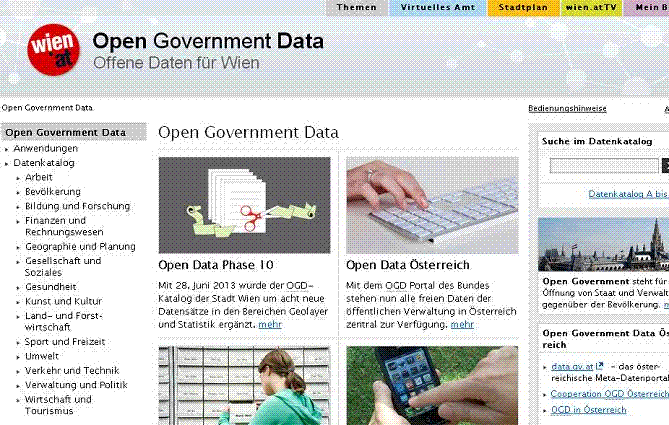 | Figure 2. The Open Government Data Vienna (screenshot), data.wien.gv.at |
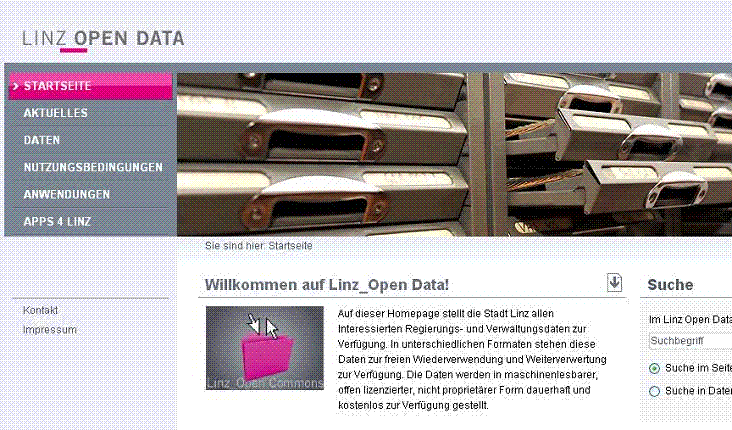 | Figure 3. The Open Government Data Portal Linz (screenshot), data.linz.gv.at |
In 2011, the cooperation on open government data Austria was founded with representatives in Linz, Vienna, Salzburg, and Graz, following the main idea to offer a national platform for government data. Tirol supports the initiative as well. The open government data (OGD) initiative is a directory showing where which data in which format are published. Vienna and Linz have established OGD portals. In Vienna, the OGD portal(www.data.wien.gv.at, figure 2) was launched in March 2011 and offers more than 100 records on health, geo data, traffic, tourism, leisure time, culture and environment and about 30 applications have been developed using these data, such as a parking app or Vienna event app. In 2012, the main issue was citizen participation, using citizen feedback to develop more applications or improve the existing ones, such as citizen participation for the content award Vienna or architecture projects[2].The OGD in Linz (data.linz.gv.at) was launched in October 2011 and currently offers about 110 records and applications from the local government, the local traffic agency and applications from private companies, including the timetable from the local traffic agency, and daily government appointments. To improve the applications the city founded the Apps4Linz award, where citizens, businesses, and institutions can propose changes to applications and new ones. The best approaches are evaluated once a year, and then developed and provided to the public. To guarantee a sustainable development for the OGD, the city of Linz cooperated with some web design companies and the University of Krems in order to build and develop a sustainable strategy on OGD, in which the Bundesrechenzentrum Austria has the technical responsibility for this project that mainly focuses on easy access to the data portal, which is based on the free software CKAN, which will be used for the planed data portal of the European Union as well[2].The structure of both portals is summarized in table 3. Sample applications for both open data portals are summarized in table 4.| Table 3. Open Government Data – portal structure |
| | Service categories | Vienna | Linz | | Work | X | - | | Citizens | X | X | | Education | X | X | | Financial | X | - | | Geography | X | X | | Society and social | X | X | | Health | X | X | | Culture and art | X | - | | Agricultural and forestry | X | - | | Sports and leisure time | X | X | | Environment | X | - | | Traffic and technology | X | X | | Administration and politics | X | X | | Economy and tourism | X | X | | City | - | X |
|
|
| Table 4. Open Government Data – sample applications |
| | Portal | Service | Description | Chargeable/Free | | Linz | Lilli Neu | Route planner | Free | | Linz | Linz Info | City Info system for smartphones | Free | | Linz | In Time Linz | Timetable/Train | Chargeable | | Linz | IZY Linz | Sightseeing App | Chargeable | | Vienna | Accessible Vienna | Sightseeing App | Free | | Vienna | Kultur.App | Culture App. | Free | | Vienna | Nature in Wien | Nature in Vienna | Free | | Vienna | Park finder Vienna | Park finder app | free |
|
|
5. Discussion
The open access to government data should be used to increase the involvement of politics, administration, citizens, and businesses in designing a sustainable government process landscape; an increased transparency on government data should increase the citizens’ trust in government activities and processes and should create new business models. Open data means data that are freely available, and free from any copyright, patent, or other control mechanism. According to the open data principle raw data have to be from one primary source, complete, actual, machine readable, accessible, non–discriminating, and license free.Personalized data are, because of data security issues, not suitable to be added to an open data portal[1,2]. Using open government data efficiently should result in (a) increased transparency for government processes and increased democratic control mechanism, (b) increased employment, (c) use of new and existing private products and services, (d) innovation, (e) simplified government processes, (f) result oriented administration, and (g) an improved alignment of internal and external knowledge and reduction of an administrative burden[1]. The main strategy elements for the Austrian approach are, beside the mentioned cooperation for the implementation, national defined standards and conventions (national catalog containing meta data, URLs, legal framework and business models), a national meta data portal as a central data pool to ensure an international compatibility and networking.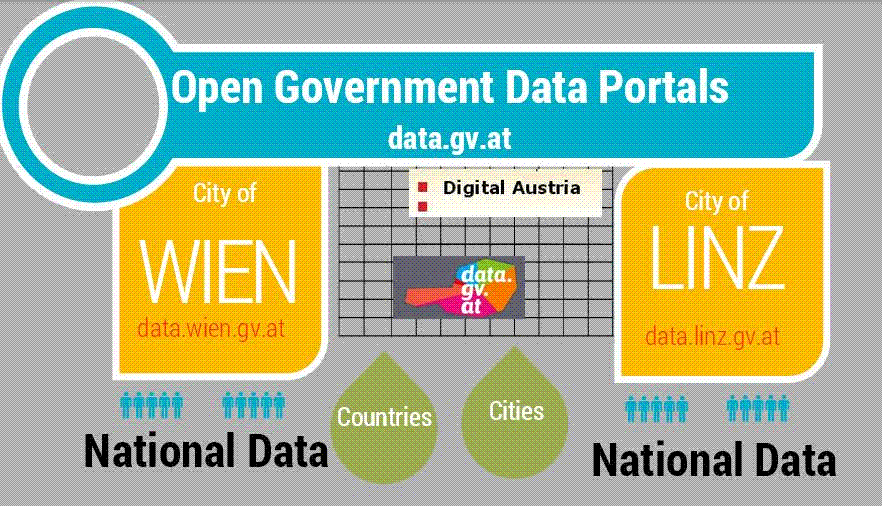 | Figure 4. The Austrian Open Government Data Landscape |
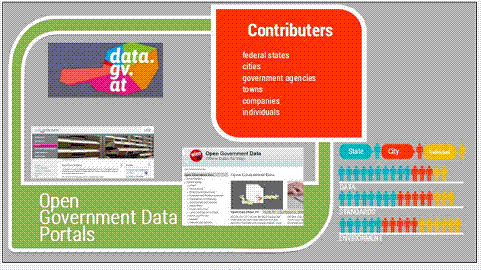 | Figure 5. The Austrian Open Government Data Approach |
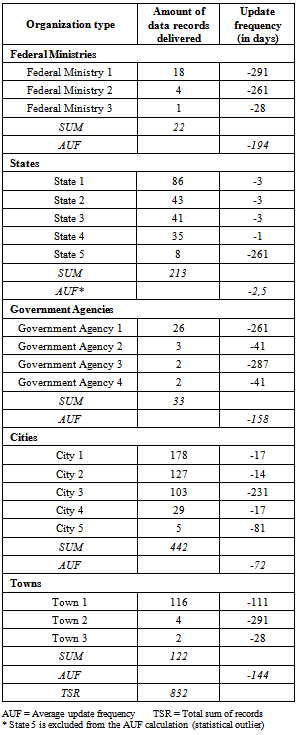
Austria has a leading position not only in developing E-Government strategies and applications but also in developing open government data portals. According to the Austrian E-Government responsibilities, countries such as Japan have requested Austrian consulting on E-Government issues[3]. According to the E-Government monitoring report (2011), more than 70% of all online users in Austria use E-Government services, and the citizens’ satisfaction index in Austria is much higher than the ones in Great Britain, Germany, and Sweden[4]. Currently, there are three OGD portals in Austria, representing data from local government and federal states (provided by selected local public authorities). For all three portals, implementation strategies for OGD concepts were developed independently at the state level. Currently, there is no national OGD concept that is implemented in a national OGD portal providing national data, including local and federal ones. The next steps to be taken by the Austrian government is to develop further OGD portals at the state level and to combine them under one national open government data strategy; as well as contributing at the EU level to the development of EU wide strategies on open government data provision.Transparency is one main target of the Austrian E-Government strategy: (a) transparency for processes and decision making (open Government) and (b) transparency for data bases and documents (open data); participation and collaboration and increased innovation and added value creating are some more targets to be reached with the open government data approach[1]. Apart from the benefits for citizens the open government data portals offer businesses the possibility to develop new business models, for using open government data[5]. A simplified target group model for open government data consists of (a) politics (follow the idea of a participative and open policy), (b) the government (wants to be closer to the citizen with new or improved processes), (c) businesses (offer new applications and services and increase employment) and (d) citizens (who use open government data)[1]. The requirement for professional open data portals are according to Kaltenböck & Thurner[1]: (a) availability, (b) standard interfaces, (c) resource wide standard formats, (d) data linking, (e) widgets. Berners-Lee has developed a five star approach for open linked data, (1 star) make your stuff available on the Web (whatever format), (2 stars) make it available as structured data (e.g. Excel instead of image scan of a table), (3 stars) non-proprietary format (e.g. csv instead of Excel), (4 stars) use URLs to identify things so that people can point at your stuff, (5 stars) link your data to other people’s data to provide context. Starting with the 4 stars level, open data become linked open data[1]. In the longer run, various providers will offer open data, such as the British open government data portal, which enables the linking of data from different sources, such as linking geographic data with environmental ones. The linked data approach offers the possibility to develop global data bases, which can be operated along the network formed for handling these data. Components of open data portals include (a) storage (meta data catalog and index, data storage, and thesaurus), (b) interfaces, (c) integration (import interfaces, data integration), (d) user management and community components.Table 5. Organizations delivering data for the Open Government Data Portals and their update activities (as of the day of the survey)
 |
| |
|
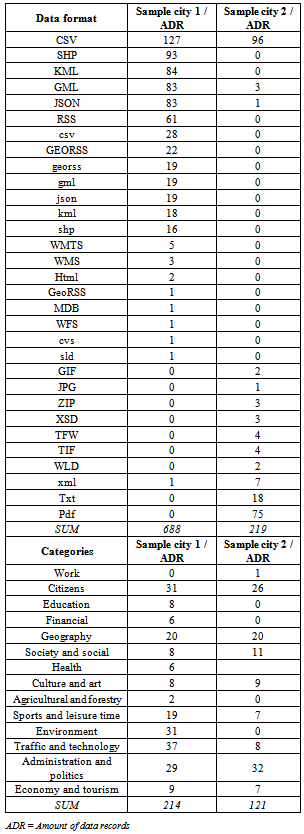
Table 6. Data formats and categories used for data delivery by one sample city
 |
| |
|
Currently, there are more than 830 different data records in the Austrian open government data portal available that are offered by 20 organizations, such as the states, selected cities, the Umweltbundesamt, Federal Ministry of Finance, or the Federal Ministry of Economy, Family, and Youth. Out of all the data records offered, Vienna (Wien) offers 178, Linz 127, Graz 103, states between 8 and 90, and ministries between 1 and 18. Out of all 20 organizations delivering open data for the open government portals, three federal ministries deliver together 22 data records, five states deliver 213 data records, four government agencies deliver 33 data records, five cities deliver 442 data records (out of these 305 are delivered by the two cities which operate their data portals), and 122 records are delivered by three towns. Considering the update frequency of the different organizations the shortest average update frequency have states with –2.5 (which means the last update was done 2.5 days before the day of the survey), followed by cities with an AUF of -72, towns -144, Government agencies -158, and federal ministries with an AUF of -194. The data formats and categories used for the data delivery of one city, as a sample, are listed in table 6.Considering sample city 1, most data are provided in the formats CSV, SHP, KML, GML and JSON. Categories, most frequently served by the sample city are traffic and technology (37 records), environment (31 records), citizen (31 records), and administration and policies (29 records).The most frequently used keywords used by the sample city for the open government data portals are (1) GIS, (2) population, (3) society, (4) city development and (5) budget, 6 entries for ‘budget’ up to 77 entries for ‘GIS’. For sample city 2 the most popular keywords are ‘geo’ and ‘geo data’ with together more than 50 records.In comparison to that, sample city 2 delivers most of the data in CSV format (96 records) and PDF format (75 records); categories most delivered by sample city 2 are administration and policies (32 records) and citizen (26 records). Until the day of survey no records were delivered by sample city 2 for the categories education, financial, agricultural and forestry and environment; sample city 1 delivered, apart from the category ‘work’, data records for all categories. To sum up, the next step to be taken is to develop a country wide open government strategy, develop a country wide open government portal, and providing one structure to all federal states as to how to develop their state open government portals, which data and how to include it, how often to update, which data to be provided for the national OGD Portal, and how to manage the national OGD portal and the ones of the federal states, having one (!) national appearance and focusing on the same aspects of the OGD strategy.
6. Conclusions
The results of this analysis revealed that Austria, apart from its general leading position within the European Union regarding E-Government development and implementation as well as user acceptance, is also a pioneer in using open government data that is provided to the general public. The potential benefits of open data are community as a process driver, raw data instead of modified information, not only data but also documents and processes, reduced response time for inquiries, added value because of combined raw materials, innovative processes, and improvedtransparency[1,6]. Open government data are a new form of cooperation between government and community in designing the need for governmental processes and cooperation between government, businesses, and community for the implementation.
References
| [1] | M. Kaltenböck and T. Thurner, T.,Open Government Data Weissbuch, Krems: Donau Universität Krems, 2011. |
| [2] | Digital Austria, Open Data - Open Government, presentation, November 21, 2011,[Online], Available:http://www.oesterreich.gv.at/DocView.axd?CobId=45699. |
| [3] | Futurezone.at, E-Government: Österreich bleibtVorzeigeland’, 2012,[Online], Available:http://futurezone.at/netzpolitik/8782-e-government-oesterreich-bleibt-vorzeigeland.php. |
| [4] | Institute for Public Information Management, IPIMA, E-Government Monitor 2011. Nutzung und Akzeptanz von elektronischen Bürgerdienstenim internationalenVergleich,[Online], Available:http://www.initiatived21.de/wp-content/uploads/2011/09/eGovernmentMONITOR2011-final1.pdf. |
| [5] | Futurezone.at, Open Data: Das neue Gold heben, 2012,[Online], Available:http://futurezone.at/b2b/8266-open-data-das-neue-gold-heben.php. |
| [6] | G. Eibl, Open Data – Open Government Überblick, Digital Austria, presentation, November 23, 2011,[Online], Available:http://www.oesterreich.gv.at/DocView.axd?CobId=45700. |
| [7] | A. Erkollar and B. Oberer, Governmental Public Processes – an implementation guide, in A. Erkollar (ed.) Enterprise & Business Management. A Handbook for Educators, Consulters and Practitioners, Tectum, Germany, 2006. |
| [8] | G. Aichholzer G. and B.S. Strau, The Austrian case: multi-card concept and the relationship between citizen ID and social security cards, Identity in the Information Society, Netherlands: Springer, 2010. |
| [9] | M. Chesher, R. Kaura, and P. Linton, Electronic Business & Commerce, London: Springer.´, 2003. |
| [10] | Z. Ebrahim and Z. Irani, E-government adoption: architecture and barriers, Business Process Management Journal, 11(5), pp.589-611, 2005. |
| [11] | J. Burn and G. Robins, Moving towards e-government: a case study of organizational change processes, Logistics Information Management, 16(1), pp.25-35, 2003. |
| [12] | S. Haselbeck, Neue Wege im Government. VomE-Government zum Cloud-Government? FabaSoft eGov-Suite[blog] March 13, 2011,[Online], Available:<http://blog.egov-suite.com/de/2011/03/vom-e-government-zum-cloud-government. |
| [13] | Ch. Pütter, 3 Megatrends und die Folgen. DasDaten-Management von morgen. CIO, 2011,[Online] Available: <http://www.cio.de/strategien/2264118/index2.html. |
| [14] | B. Oberer, International Electronic Government Approaches, in HICSS, pp. 127-133. |

 Abstract
 Reference
 Full-Text PDF
 Full-text HTML