
-
Paper Information
- Next Paper
- Previous Paper
- Paper Submission
-
Journal Information
- About This Journal
- Editorial Board
- Current Issue
- Archive
- Author Guidelines
- Contact Us
Journal of Microbiology Research
p-ISSN: 2166-5885 e-ISSN: 2166-5931
2013; 3(6): 224-227
doi:10.5923/j.microbiology.20130306.05
Effect of Different Carbon and Nitrogen Sources on the Growth of Two Thermophilic Actinomycetes and Their Cellulases Production
 Abstract
 Reference
 Full-Text PDF
 Full-text HTML
Md Towhid Hossain, Md Abul Kashem, Md Abul Manchur, Md Nural Anwar
Department of Microbiology, University of Chittagong, Chittagong-4331, Bangladesh
Correspondence to: Md Towhid Hossain, Department of Microbiology, University of Chittagong, Chittagong-4331, Bangladesh.
| Email: |  |
Copyright © 2012 Scientific & Academic Publishing. All Rights Reserved.
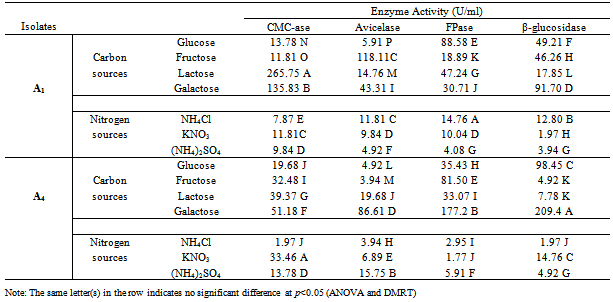
Thermophilic cellulases have emerged as promising alternatives in biotechnological applications. At present, most of the enzymes used in industrial processes have been isolated from mesophiles microorganisms due to the difficulties to grow thermopiles in high scale. The present investigation deals with optimization of the production medium with different carbon and nitrogen sources to observe their effect on the growth and production of extracellular proteins, reducing sugar, saccharification percentage, biomass yield and cellulases of the selected isolates at high temperature. In the present study, the isolate Streptomyces longisporus (A1) showed maximum production (activities) of CMCase (265.75 U/ml) and Avicelase (86.61 U/ml) in the presence of lactose and fructose as suitable carbon sources respectively; on the other hand the isolate Streptomyces bobili (A4) exhibited maximum production (activities) of FPase (177.16 U/ml) and β-glucosidase (209.65 U/ml) with galactose. KNO3 was found suitable nitrogen source for CMCase production (activities) of the both isolates. These findings will be helpful in prospect for increase the production of industrial enzyme.
Keywords: Thermophilic, Cellulase, Actinomycetes
Cite this paper: Md Towhid Hossain, Md Abul Kashem, Md Abul Manchur, Md Nural Anwar, Effect of Different Carbon and Nitrogen Sources on the Growth of Two Thermophilic Actinomycetes and Their Cellulases Production, Journal of Microbiology Research, Vol. 3 No. 6, 2013, pp. 224-227. doi: 10.5923/j.microbiology.20130306.05.
Article Outline
1. Introduction
- Cellulose is the most abundant organic compound found in nature. However, cellulosic residues from different sources have great potential as renewal energy, food, fertilizer, chemicals and other valuable products[1-3]. Cellulose is the major carbohydrate synthesized by plants. Plant residues in soil consist of a large amount of cellulose. Therefore, the degradation of cellulosic biomass by cellulolytic microorganisms such as fungi[4], actinomycetes [5], gliding bacteria and true bacteria[6] play a vital role in the biosphere. Nowadays, closer attentions have been made to thermophilic microorganisms that are capable of producing extracellular hydrolases and these enzymes exhibit unusual heat stability, which could be put to practical advantages. In view of the above, the present work undertaken to study the effect of different carbon and nitrogen sources for the maximum production of cellulases and β-glucosidase by two thermophilic actinomycetes. This investigation adapted the estimation of reducing sugar as the index of cellulose degradation.
2. Materials and Methods
- Two cellulolytic actinomycetes were provisionally identified as Streptomyces longisporus (A1) and Streptomyces bobili (A4) according to Bergey’s Manual[7]. They were screened for the production of extracellular protein, reducing sugar and enzyme activity. In present investigation Winstead’s medium[8] was used as basal medium with changing carbon (at the rate of 1.2%) and nitrogen (at the rate of 0.2%) sources.To test the cellulose and β-glucosidase activity in different carbon and nitrogen sources the selected isolates were inoculated in 50 ml Winstead’s medium in 100 ml conical flasks. After 12-15 days of incubation the culture filtrate were collected (by centrifuged at 12000 rpm at 4˚C for 10 min) and analyzed for proteins, reducing sugars and enzyme activity.
2.1. CMCase Activity
- Two milliliter of culture filtrate was added to 2 ml of 1% carboxy methyl cellulose (CMC) prepared in 0.1M citrate, pH 4.6 and 1 ml of 0.1 M citrate buffer in a test tube and incubated at 45˚C for 2h.
2.2. FPase Activity
- Two milliliter of culture filtrate was added to 1ml of 0.1M citrate buffer at pH along with 50mg Whatman No.1 filter paper strip in a test tube and incubated at 45˚C for 2h.
2.3. Avicelase Activity
- Two milliliter of culture filtrate was added to 1ml of 1 % avicel (microcrystalline cellulose) prepared in 0.1M citrate buffer pH 4.6 and 1ml of citrate buffer in a test tube and incubated at 45˚C for 2h.
2.4. Β-glucosidase Activity
- Two milliliter of culture filtrate was added to 2ml of 1% salicin prepared in 0.1M citrate buffer pH 4.6 and 1ml of citrate buffer in a test tube and incubated at 45˚C for 2h.
2.5. Reducing Sugar
- The amount of reducing sugar was determined by Nelson’s Modification of Somogyi Method[9] measuring absorbance at 500nm. Enzyme activity was expressed Uml {The amount of reducing sugars (μg) released/ml filtrate/hour}.
2.6. Protein Estimation
- Protein was determined by Lowry method[10] measuring the absorbance at 600 nm and compared with standard curve prepared by Bovine serum albumin. Biomass was measured by dry weight method. After collection of the supernatant, the biomass residue was dried at 80˚C and the yield was expressed as mg gm -1 of substrate.
2.7. Saccharification
- Saccharification percentage was calculated by applying the following equation:

2.8. Statistical Analysis
- Possible treatment differences among the factors (such as carbon, nitrogen sources, enzymes activity), were investigated by Complete Randomized Design (CRD) and Duncan’s Multiple Range Test (DMRT) by running MSTATC software.
3. Results and Discussion
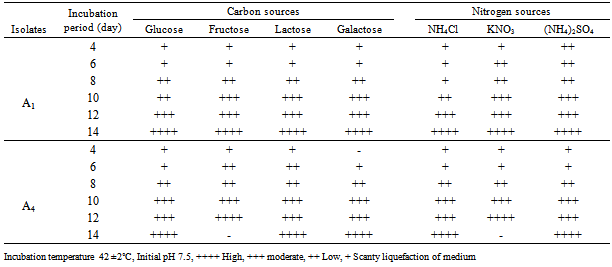
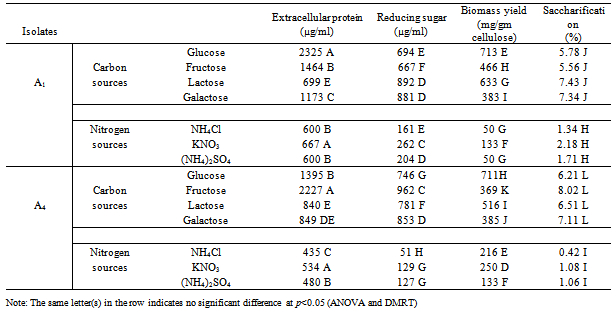
- In the present investigation, two thermophilic actinomycetes Streptomyces longisporus (A1) and Streptomyces bobili (A4) were screened using Winstead’s medium to observe the effect of different carbon and nitrogen sources on the growth and production of enzyme profiles of the isolates. After incubation, the effect of different carbon and nitrogen sources were recorded (Table 1). The liquefaction of the medium gradually increases with the increase of incubation time and found to liquefy the medium completely at 12-14 days by both the isolates.The effect of different carbon and nitrogen sources on the production of extracellular proteins, reducing sugar and saccharification percentage and biomass yield of the selected isolates (A1 and A4) were recorded (Table 2). The isolate(A1) showed maximum biomass yield (713 mg/gm cellulose) and extracellular protein (2325 µg/ml) in the presence of glucose, although highest reducing sugar (892 µg/ml) and saccharification percent (7.43) were recorded with lactose. On the other hand, the isolate (A4) exhibited maximum extracellular proteins (2227µg/ml), reducing sugars (962 µg/ml), saccharification percent (8.02) while fructose used as carbon source, but the maximum biomass yield (711mg/gm cellulose) was recorded with glucose. On the other hand, both of the isolate showed maximum production of extracellular proteins, reducing sugars, biomass and saccharification percentage while KNO3 was used as nitrogen source. This result suggested that glucose as carbon source and KNO3 as nitrogen source is suitable for maximum biomass yield.
|
|
|
4. Conclusions
- In this investigation, two thermophilic actinomycetes were screened, and both of the isolates were identified as suitable species for the production of thermostable cellulase. Different carbon and nitrogen sources of the production medium were also fixed for better production of thermostable enzymes. The screening of microorganism for the production of thermostable cellulase will open a new and simple route for synthetic processes and consequently the present work will be a very good baseline for the large scale production.