
-
Paper Information
- Paper Submission
-
Journal Information
- About This Journal
- Editorial Board
- Current Issue
- Archive
- Author Guidelines
- Contact Us
Journal of Microbiology Research
p-ISSN: 2166-5885 e-ISSN: 2166-5931
2013; 3(4): 131-134
doi:10.5923/j.microbiology.20130304.01
Production of Cellulases by the Endophytic Fungus Fusarium oxysporum
 Abstract
 Reference
 Full-Text PDF
 Full-text HTML
Sideney Becker Onofre1, Shaiana Paula Mattiello2, Géssica Caroline da Silva2, Deizi Groth1, Ivair Malagi2
1Department of Biological Sciences and Pharmacy, FAED - Faculty of Educational of Dois Vizinhos - União de Ensino do Sudoeste do Paraná – UNISEP - Av. Presidente Kennedy, 2601 –Bairro Nossa Senhora Aparecida - Dois Vizinhos, Paraná , Brazil
2Microbiology Laboratory, Department of Biological Sciences and Health, Paranaense University – UNIPAR, Unit of Francisco Beltrão, Av. Julio Assis Cavalheiro, 2000, Bairro Centro, Francisco Beltrão, Paraná, Brazil
Correspondence to: Sideney Becker Onofre, Department of Biological Sciences and Pharmacy, FAED - Faculty of Educational of Dois Vizinhos - União de Ensino do Sudoeste do Paraná – UNISEP - Av. Presidente Kennedy, 2601 –Bairro Nossa Senhora Aparecida - Dois Vizinhos, Paraná , Brazil.
| Email: |  |
Copyright © 2012 Scientific & Academic Publishing. All Rights Reserved.
Cellulose has enormous potential as a renewable energy source and the application of cellulases in the conversion of cellulolytic biomass may provide great economical benefits; in addition, cellulases can be used in a wide range of industrial applications.Given the biotechnological importance of cellulases, the aim of this study was to evaluate the production of cellulases by endophytic fungi of the genus Fusarium oxysporum isolated from Baccharis dracunculifolia D.C. (Asteraceae). The studies were conducted using a basic substrate of sugarcane bagasse that was pretreated for complete removal of the sugar content. The material was dried at 28°C for 96 days and quantified every seven days after 25 days of fermentation. To quantify the enzymes, the indirect spectrophotometric method was used, with DNS reagent. The results showed that the greatest peak of enzyme production was at 55 days of fermentation, with a yield of 55.21 ± 10.54 IU/g of fermented substrate, at pH 5.96. Thus, it can be concluded that the fungus Fusarium oxysporum is a producer of cellulase enzymes.
Keywords: Enzymes, Bioprocesses, Biotechnology, Biomass, Fermentation
Cite this paper: Sideney Becker Onofre, Shaiana Paula Mattiello, Géssica Caroline da Silva, Deizi Groth, Ivair Malagi, Production of Cellulases by the Endophytic Fungus Fusarium oxysporum, Journal of Microbiology Research, Vol. 3 No. 4, 2013, pp. 131-134. doi: 10.5923/j.microbiology.20130304.01.
Article Outline
1. Introduction
- The term cellulosic or lignocellulosic material is used to describe the major constituents of most plants, i.e., cellulose, hemicellulose and lignin, the composition of which not only depends on the type of plant, but also on growth conditions[1].Cellulose is the most abundant organic polymer on Earth and the main component of plant biomass. It is found in pure form, as in cotton, but is often found associated with hemicellulose and lignin in the cell wall[2]. Cellulose has a relatively simple structure, comprising of D-glucose monomers linked by glycosidic bonds β-1, 4.Hydrolase enzymes are widely used in various industries. Cellulases and amilases are enzymes from the most economically important group of carbohydrolases. The high consumption of cellulases may be explained by their wide use in the food industry, in the process of extraction of vegetable oils, in the maceration of fruit and clarification of juices, as well as in the manufacture of beer and wine; they are also used in the formulation of animal feeds[3].Filamentous fungi are the most widely used type of fungi in industry for the production of cellulases, especially those of the genera Aspergillus, Trichoderma, Humicola, Penicillium, Fusarium and Phanerochaete[4]. Currently, cellulases are the third most industrially produced enzymes worldwide because of their applications, for example in cotton processing, paper recycling, the extraction of juices, as enzymatic detergents and as animal food additives[2,5].The identification of the activity of enzymes in microorganisms and the studies related to optimizing their production are of great industrial interest. The isolation of samples with different production potentials of enzymes may represent alternatives for industry. Furthermore, the isolation of fungi from natural environments may result in lineages with greater production potential and that are more adapted to the environment[6].Biotechnological processes have gained a prominent place in worldwide technological development, and have economic and operational features that have more advantages than conventional chemical processes[7]. Annually, 5.4 x 10⁸ tons of cane sugar are processed in the world; on average, one ton of sugar cane generates 280 kg of bagasse[8]. Approximately 50% of the bagasse is used in power generation in power plants, while the remainder is stored. Given the importance and the increased production of sugar cane bagasse as industrial waste, there is growing interest in developing methods of producing biofuels and chemical products that offer economic and environmental advantages. Many trials have been carried out to degrade this complex material into simple, fermentable sugars for ethanol production. The degradation of cellulose by cellulases is a very well studied process and the role of these enzymes is affected by porosity and crystallinity of cellulose as well as the lignin and hemicellulose content of biomass[9].Endophytic microorganisms were first discussed at the beginning of the nineteenth century, but the first person who distinguished between them and plant pathogens was Bary in 1866. Generally, all plants have endophytic microorganisms. A single plant may contain several, including fungi and bacteria. There may be quite frequent species in a particular host, which are called the dominant species, in contrast to other more rare ones, which are called the secondary species[10].According to Martin[11], the endophytic fungi of the genus Fusarium are distributed worldwide and are found in the soil or associated with species of plants; they decompose organic matter in the soil and can cause many diseases in different plant species. The plant species Baccharis dracunculifolia D.C. (Asteraceae) has biological and ecological importance for the isolation of epiphytic and endophytic microorganisms, due to its adaptability to the diverse biomes of the Americas, particularly South America. It is represented by more than 500 species distributed mainly in Brazil, Argentina, Colombia, Chile and Mexico, and occupies the higher regions. The high concentration of species in Brazil and the Andes indicates that one of these areas is the probable center of origin of this genus. They are usually shrubs, and in Brazil are commonly called vassoura or vassourinha (which translates as broom, little broom) and measure 0.5 to 4.0 meters in height[12].
2. Materials and Methods
2.1. Microorganisms
- This study used the strain D3-FB of the endophytic fungus Fusarium oxysporum, isolated from Baccharis dracunculifolia D.C. (Asteraceae) in the period 2008 to 2009 and stored in the mycology collection of the Microbiology Laboratory of the Paranaense University-UNIPAR - University of Francisco Beltran - PR. All the collections were authorized by IBAMA (Brazilian Institute for the Enviroment) under protocol number 13.234-2, August 1st 2006.
2.2. Determination of Cellulolytic Activity
- The cellulolytic activity was measured using a basic support of sugarcane bagasse that had been rinsed successively in running water for complete removal of sugars. The washed bagasse was dried in a fan oven at 65 °C for 24 hours, and then was packed in polyethylene bags and stored in dry conditions.
2.3. Fermentation in Erlenmeyer Flasks
- Cellobiose (1%) and carboxymethylcellulose (1%) were added to the sugar cane bagasse substrate to induce the production of cellulases and also as initial carbon sources of the medium. This mixture was inoculated with a suspension of 5 g of the fungus inoculums, which had been previously grown on a rice culture. It was then homogenized in an Erlenmeyer flask and incubated at 28 °C for 69 days.
2.4. Analysis of Fermented Substrate
- Aliquots of five grams of the medium were collected every 7 days and mixed with 50 ml of distilled water in the presence of a 7.0 buffer. This suspension was continuously agitated for 30 minutes. It was then filtered to remove solids to yield a clear extract used for pH determination. The extract was centrifuged at 3000 rpm for 15 minutes and the supernatant was considered as an enzyme source to determine the reducing sugars via the indirect spectrophotometric method. The indirect spectrophotometric method was used to determine enzyme activity, based on the release of glucose molecules by the action of cellulolytic enzyme complex.
2.5. pH
- The pH was measured on a suspension obtained after homogenization of 5 grams of ferment in 50 mL of distilled water, which was continuously agitated for 30 minutes.
2.6. Measurement of Reducing Sugars
- The reducing sugars were measured by the reaction with 3,5-dinitrosalicylic "DNS"[13]. In an alkaline medium and at elevated temperature, 3,5-dinitrosalicylic turns into 3-amino-5-nitrosalicylic. It acquires a yellowish coffee color that absorbs at 540 nm. One unit of cellulases was defined as the amount of released enzyme capable of acting on the substrate and releasing 1 μmol of reducing sugar (expressed as glucose) per minute.
2.7. Statistical Analysis
- The statistical analysis was carried out using the program Statistica, version 5.0. Analyses of variance were in line with ANOVA standards. The significant differences between means were determined using the Tukey’s test. All activities were triplicated.
3. Results and Discussion
- The data concerning the behavior of the endophytic fungus Fusarium oxysporum are shown in Fig 1. Table 1 shows that the yields of cellulases during 69 days of fermentation were 21.25 ± 3.45; 43.5 ±12.65; 48.32 ± 10.35; 50.85 ± 13.05; 55.21 ± 10.54; 45.02 ± 8.90 and 15.12 ± 5.40 enzyme units for each gram of fermented substrate for the observation periods of 25, 32, 46, 49, 55, 62 and 69 days of fermentation, respectively. The data show that the period of greatest yield of the enzymatic complex was at 55 days of fermentation with a production of 55.21 ± 10.54 IU/g, at pH 5.96.Figure 1 shows that at the start of the fermentation process, when there is availability of cellobiose andcarboxymethylcellulose, these supplements acted as inducers for the metabolism of the fungus Fusarium oxysporum. They therefore initiated the production of enzymatic complex, which reacted with the cellulolytic components, thus degrading the cellulose and releasing glucose.
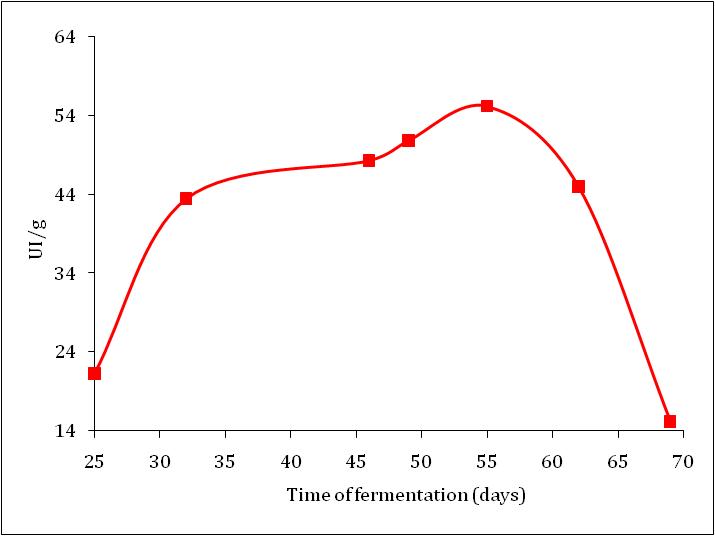 | Figure 1. Behavior of the endophytic fungus Fusarium oxysporum as a producer of the cellulolytic complex in semi solid state fermentation at a temperature of 28°C and initial pH of 5.74 |
4. Conclusions
- From the present study, one can conclude that the fungus Fusarium oxysporum is a producer of cellulolytic enzymes, and may thus be used in biotechnological processes to obtain these enzymes or to produce glucose. The sugarcane bagasse was effective at inducing Fusarium oxysporum to produce the cellulase enzymes. The highest level of enzyme production was observed at 55 days of fermentation at a constant temperature of 28℃, with an enzymatic production of 55.21 ± 10.54 IU/g of fermented substrate, at pH 5.96.
ACKNOWLEDGEMENTS
- We would like to thank IBAMA - Brazilian Institute for the Environment, for the license for collection of biological material and the União de Ensino do Sudoeste do Paraná, for financing this project.
Conflict of Interest
- The authors declare no commercial or financial conflict of interest.