
-
Paper Information
- Paper Submission
-
Journal Information
- About This Journal
- Editorial Board
- Current Issue
- Archive
- Author Guidelines
- Contact Us
Basic Sciences of Medicine
p-ISSN: 2167-7344 e-ISSN: 2167-7352
2026; 14(1): 1-6
doi:10.5923/j.medicine.20261401.01
Received: Sep. 9; Accepted: Oct. 2, 2026; Published: Oct. 9, 2026

The Correlation Between Body Mass Index (BMI), Blood Pressure, and Blood Glucose in Migrant Workers in Bali
 Abstract
 Reference
 Full-Text PDF
 Full-text HTML
Ni Nyoman Daiwi Pavitrani Trismalisa1, Putu Austin Widyasari Wijaya2, Ni Wayan Armerinayanti3
1Faculty of Medicine and Health Science, Universitas Warmadewa, Bali, Indonesia
2Department of Physiology and Biochemistry, Faculty of Medicine and Health Science, Universitas Warmadewa, Bali, Indonesia
3Department of Anatomy Pathology, Faculty of Medicine and Health Science, Universitas Warmadewa, Bali, Indonesia
Correspondence to: Putu Austin Widyasari Wijaya, Department of Physiology and Biochemistry, Faculty of Medicine and Health Science, Universitas Warmadewa, Bali, Indonesia.
| Email: |  |
Copyright © 2026 The Author(s). Published by Scientific & Academic Publishing.
This work is licensed under the Creative Commons Attribution International License (CC BY).
http://creativecommons.org/licenses/by/4.0/

Background: The world is currently facing various health problems, one of which is the shift to non-communicable diseases (NCDs), such as obesity, hypertension, and type 2 diabetes mellitus. One population at risk of NCDs is workers, especially migrant workers, due to a lack of physical activity, busy work schedules, and unhealthy eating patterns, which put them at risk of disorders related to body mass index (BMI), blood pressure (BP), and blood glucose levels. Methods: This study used a cross-sectional design, bivariate analysis in the form of Spearman's rho correlation test was used to determine the correlation between BMI and blood pressure and blood glucose levels in migrant workers in Bali. Results: The results show that the majority of male migrant workers (102) and most have a BMI in the obesity I category (65 people). Based on blood pressure, the majority (122) were in the normal category, and based on fasting blood glucose levels among migrant workers, the majority (118) were in the normal category. Furthermore, the results of bivariate analysis showed that there was a correlation between BMI and blood pressure and fasting blood glucose levels (FBG) among migrant workers in Bali, with values of p<0.001 and r=0.279 categorized as weak (BP), and r=0.494 categorized as moderate (FBG). Conclusion: There is a significant positive correlation between body mass index and blood pressure and fasting blood glucose levels, where an increase in BMI is associated with an increase in blood pressure and blood glucose levels.
Keywords: Body mass index, Blood pressure, Blood glucose level, Migrant workers
Cite this paper: Ni Nyoman Daiwi Pavitrani Trismalisa, Putu Austin Widyasari Wijaya, Ni Wayan Armerinayanti, The Correlation Between Body Mass Index (BMI), Blood Pressure, and Blood Glucose in Migrant Workers in Bali, Basic Sciences of Medicine , Vol. 14 No. 1, 2026, pp. 1-6. doi: 10.5923/j.medicine.20261401.01.
Article Outline
1. Introduction
- Non-communicable diseases (NCDs) are a category of diseases considered one of the primary health burdens in both developing and developed countries; these diseases are not transmitted to other individuals, and include conditions such as obesity, hypertension, and type 2 diabetes mellitus. [1] The primary risk factors that can lead to an increase in NCDs are metabolic disorder conditions such as obesity, high blood sugar, and high blood pressure, driven by unhealthy lifestyle trends among the public, particularly workers. [2] Workers represent a demographic at risk of experiencing NCDs, especially migrant workers. [3] These risky behaviours encompass various aspects such as a lack of physical activity due to dense work schedules, the low effectiveness of stress management mechanisms in coping with work pressure, limited rest periods, and unhealthy dietary patterns; consequently, they harbour a risk of experiencing deviations in body mass index (BMI) measurements leading to obesity, which can influence an elevation in blood pressure (hypertension) and an increase in blood glucose levels leading to diabetes mellitus (DM). [4] The prevalence of obesity in Indonesia among adults over 18 years of age, according to the 2023 Indonesian Health Survey, stands at 23.4%, where the prevalence of obesity in the province of Bali itself is 23.9%. [5]An increase in BMI in obesity can affect the elevation of an individual's blood pressure through various mechanisms; for instance, the condition of obesity, characterized by excessive body mass, can trigger an increase in cardiac output alongside relatively normal vascular resistance, and is associated with increased sympathetic nervous system activity, the Renin-Angiotensin-Aldosterone System (RAAS), and sodium retention. [6] An individual with obesity may also experience elevated blood glucose levels mediated by the hormone leptin, which plays a role in regulating satiety. High leptin levels will trigger insulin resistance, which can inhibit glucose utilization, causing blood glucose levels to rise; this can subsequently precipitate type 2 diabetes mellitus. [7]According to the 2023 Indonesian Health Survey data, the prevalence of DM in Indonesia among individuals over 15 years of age demonstrates a figure of 11.7% based on blood glucose level examinations and 2.2% based on physician diagnoses. [5] Meanwhile, in the province of Bali in 2023, the number of DM patients across all age groups was found to be 13,859 based on physician diagnoses. The prevalence of hypertension in Indonesia is also substantially high; among adults over 18 years of age, according to the 2023 Indonesian Health Survey data, it reached 30.8%. [5] Based on the aforementioned descriptions, a healthy physical condition in migrant workers prior to participating in work programs in destination countries is an essential and highly necessary prerequisite. This can be achieved through a series of medical examinations, specifically focusing on the three components that frequently experience disturbances—namely body mass index, blood pressure, and blood glucose levels—in prospective migrant workers in order to conduct initial NCD screening. [8] Therefore, this study was designed with the objective of analysing the correlation between body mass index (BMI) with blood pressure (BP) and blood glucose levels in migrant workers in Bali.
2. Material and Methods
- The design of this research is a quantitative study utilizing an analytic descriptive approach with a cross-sectional design to collect secondary data in the form of medical records. The sample population in this study consisted of a subset of migrant workers who underwent medical examinations at a Private Medical Checkup Clinic in Denpasar, Bali, between 2024 and 2025. The inclusion criteria were migrant workers who underwent a Medical Checkup (MCU) at the Denpasar Private MCU Clinic; possessed complete medical record data including name, age, gender, Body Mass Index (BMI), blood pressure, and fasting blood glucose (FBG) levels; and were aged 18-55 years (productive age). The exclusion criteria included subjects with a history of chronic diseases such as heart disease, diabetes mellitus, and kidney failure. The BMI classification used was based on the WHO Asia-Pacific classification, blood sugar was classified based on PERKENI guidelines, and blood pressure was classified based on the American Heart Association (AHA). [9]The sample size in this study was calculated using the ordinal correlative formula, resulting in a total of 178 samples. This study elucidates the correlation or causal relationship between the independent variable (body mass index) and the dependent variables (blood pressure and blood glucose levels). The implementation of this research has obtained ethical clearance and approval from the associated clinic. After the data were collected in accordance with the research instrument, they were analyzed univariately and bivariately using the Spearman’s rho correlation test.
3. Results
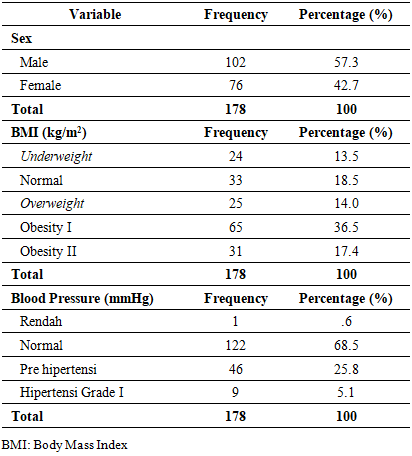
- Based on the univariate analysis of demographic characteristics in the study sample shown in Table 1, the majority of the sample population is male (57.3%), with the highest Body Mass Index (BMI) being obesity I (65%), and blood pressure being predominantly normal (68.5%) followed by pre-hypertension at 25.8%.
|
|
|
|
4. Discussion
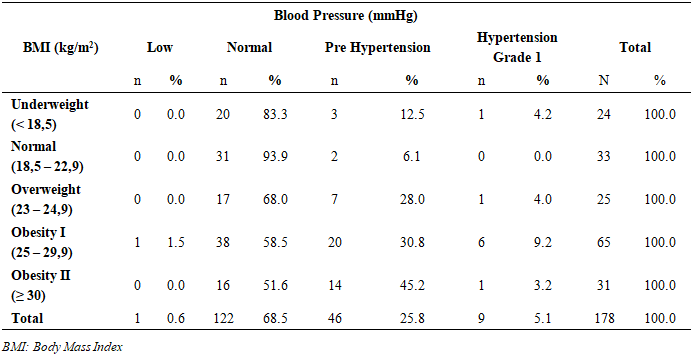
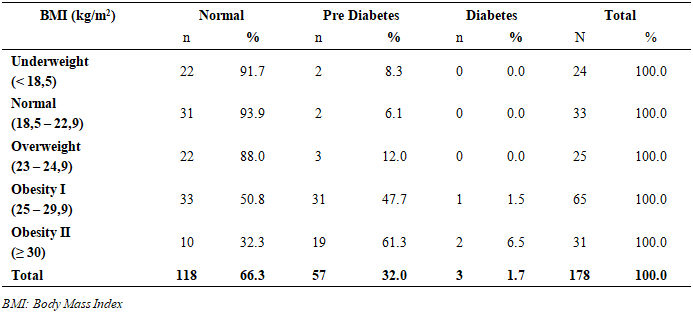
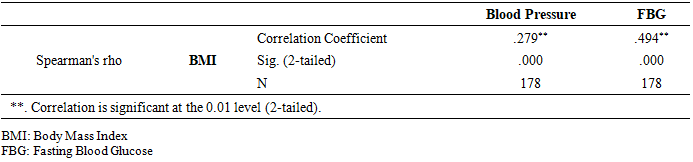
- The descriptive analysis results show that the majority of migrant workers are in the 18–23 years age group, numbering 107 people (60.1%), which illustrates that most migrant workers are young and remain active and productive. The results of this study align with the report from the Central Statistics Agency (BPS) (2025), which indicates that the majority of migrant workers originate from the young adult age group, within the 20–29 years age bracket upon initial departure. [10] Younger individuals possess a better level of physical strength compared to older individuals; however, younger ages tend to exhibit an excess BMI, which can precipitate obesity. Meanwhile, the sample characteristic analysis based on gender indicates that, in this study, the majority of migrant workers are male, totalling 102 people (57.3%), compared to female migrant workers who total 76 people (42.7%). The majority of migrant workers are male because this occupation more frequently entails physical exertion and prolonged working hours.The BMI distribution among the 178 samples demonstrates that the majority of migrant workers fall into the obesity I category, encompassing 65 people (36.5%). This result aligns with findings by Pratiwi & Thristy (2025), showing that the majority of respondents possessed a BMI in the obese category, amounting to 14 people (35%), followed by respondents having a normal BMI, (11 people, 27.5%). [11] The occurrence of obesity in these workers may be caused by insufficient regular physical activity stemming from excessively long working hours, thus resulting in bodily fat accumulation. Obesity is additionally closely related to blood glucose levels, where if an individual's BMI reaches obesity, it will trigger the risk of heightened insulin resistance alongside elevated blood glucose levels. [12] [13]Blood pressure characteristics in this study were predominantly in the normal category, with 122 people (68.5%), followed by the pre-hypertension category, with 46 people (25.8%). Similar results were discovered in a study conducted by Peng et al. (2022), which also showed that the majority of female migrant worker respondents in China had normal blood pressure, totalling 158 people (68.1%), followed by grade 1 hypertension at 44 people (19.0%). Although a substantial portion of the respondents in this study possessed normal blood pressure, the dominance of the pre-hypertension category signals a risk of blood pressure elevation that warrants vigilance. [14]The distribution of fasting blood glucose (FBG) levels in the majority of migrant workers fell within the normal category, amounting to 118 people (66.3%). The finding that the majority of migrant workers maintain FBG levels within normal limits is due to the predominance of migrant workers being in the young adult age group (18–23 years), who bear a lower risk of developing metabolic syndrome compared to older cohorts. This finding is corroborated by Septyaningsih's (2023) research, which stated that as age advances, the risk of developing metabolic syndrome correspondingly increases, marked by an elevation in blood glucose levels accompanied by obesity. [15] The results of this study were subsequently followed by 57 people (32.0%) in the pre-diabetes category, where the relatively high proportion of pre-diabetes implies an early-stage glucose tolerance impairment that frequently goes unnoticed, yet already reflects insulin resistance in peripheral tissues. According to Shaila et al. (2025), a pre-diabetes condition characterized by elevated FBG levels—even if it does not fulfill diabetes criteria—can indicate early dysfunction in pancreatic β-cells as well as insulin resistance. In this study, migrant workers maintaining a BMI in the obesity I category (31 people, 47.7%), concurrently experienced an increase in FBG levels reaching pre-diabetes in substantial numbers. [16] This occurs because their BMI lies within the obesity I category; therefore, conditions marked by visceral fat accumulation can trigger the release of a greater volume of free fatty acids circulated into the systemic circulation, causing insulin resistance and precipitating an increase in blood glucose levels. [16]Correlation of Body Mass Index with Blood Pressure in Migrant Workers in BaliBased on the correlation test, a positive and significant correlation was obtained between BMI and blood pressure in migrant workers in Bali, with a p-value < 0.001 and an r-value of 0.279. Although classified within the weak category, the relationship between these two variables lies on a positive spectrum, indicating that migrant workers with high BMIs tend to exhibit elevated blood pressure. An individual with obesity is characterised by the accumulation of adipose tissue within the body, capable of triggering vascular resistance. Obesity can impact blood pressure by increasing cardiac output and is correlated with the incidence of increased insulin resistance, the Renin-Angiotensin-Aldosterone System (RAAS), sodium retention, and sympathetic nervous system activity, which can enhance the secretion of the hormone norepinephrine, leading to peripheral vasoconstriction. [6] [17]The results of this study parallel the research conducted by Patel et al. (2025), which demonstrated a positive and significant correlation between BMI and systolic (p=0.001; r=0.46) and diastolic (p=0.002; r=0.39) blood pressure in young adults aged 18–25 years. [18] Another similar study conducted by Husna & Pramaningtyas (2024) indicated a significant and positively directed relationship between BMI and systolic blood pressure (p=0.000; r=0.570) categorized as moderate, and diastolic blood pressure (p=0.023; r=0.383) categorized as weak, among library staff at the Islamic University of Indonesia. [19] The mechanism underlying these findings suggests that obesity prompts an increase in sympathetic nervous system activity, sodium retention, and insulin resistance, all of which contribute to elevated blood pressure. Furthermore, adipose tissue functions as an endocrine organ that releases inflammatory cytokines and adipokines, which can induce vascular dysfunction and endothelial impairment, thereby magnifying the risk of hypertension. [18] Another study with corresponding results indicates that visceral fat accumulation can also instigate the release of excess free fatty acids that are subsequently distributed into systemic circulation, thereby generating insulin resistance and diminishing nitric oxide (NO) secretion in the endothelium. NO plays an instrumental role in blood pressure regulation as a vasodilator. Thus, if there is a reduction in NO secretion, it will cause the blood vessels to narrow more easily and peripheral resistance to heighten, directly triggering an elevation in blood pressure. [20] [17]Correlation of Body Mass Index with Fasting Blood Glucose Levels in Migrant Workers in BaliThe correlation between BMI and Fasting Blood Glucose showed a positive and significant relationship among migrant workers in Bali. This can be observed from the p-value < 0.001 with an r-value of 0.494, representing a stronger result compared to the correlation of BMI with blood pressure. The correlation coefficient (r) for these two variables falls into the moderate relationship or correlation category. Harahap et al. (2020) reported comparable findings in adult worker groups, where elevated BMI correlated with decreased insulin sensitivity in increased fasting blood glucose. The consistency of these results reinforces evidence that an increase in body mass serves as a crucial risk factor leading to pre-diabetes and even type 2 diabetes mellitus conditions. [20] [21]The results of this study are commensurate with research conducted by Wijaya & Ekayanti (2024), stating that there is a significant correlation between BMI and fasting blood glucose levels in migrant workers with p=0.021 < α 0.05. The correlation is positive due to an r-value of 0.234, signifying that these two variables correlate weakly. [8] The research explains that obesity serves as a primary factor in the genesis of insulin resistance, which subsequently disrupts glucose metabolism in the blood and ultimately exacerbates the obesity condition. This mechanism can manifest due to an increase in non-esterified fatty acid levels, glycerol, and pro-inflammatory cytokines, which can instigate tissue damage and interfere with insulin signalling pathways. [22]Additional studies with congruent outcomes reveal that obesity is a factor capable of causing diabetes mellitus. When bodily fat accumulates excessively, the pancreatic beta cells responsible for responding to blood glucose levels become less effective. Furthermore, the quantity of insulin receptors on somatic cells diminishes, preventing insulin from functioning optimally. As a result, the body becomes unable to utilize insulin to reduce blood sugar levels. [23] [24] An obesity condition can suppress the action and quantity of insulin receptors within body cells, while also causing the beta cells in the islets of Langerhans to become less sensitive to stimulation. Individuals with obesity further manifest heightened levels of leptin, which plays a pivotal role in regulating the body's energy balance. However, this elevated leptin level paradoxically inhibits insulin's action in suppressing blood glucose levels, thereby leaving blood glucose levels continuously elevated. [12] [25] [26]
5. Conclusions
- Based on the results of this study, it can be concluded that there is a positive correlation of a weak category between BMI and blood pressure among migrant workers in Bali. Meanwhile, the correlation analysis results between BMI and FBG levels exhibit a positive relationship or correlation of a moderate category among migrant workers in Bali. Descriptive analyses based on age, gender, and BMI denote that the majority of migrant workers fall within the productive age range, specifically 18–23 years, which is dominated by male migrant workers, and most harbor a BMI classified as obesity I. The proportion of migrant workers with obesity I who experienced an increase in blood pressure referring to a pre-hypertension condition, alongside elevated FBG levels referring to a pre-diabetes condition, was also notably high. Recommendations for future research include conducting studies by incorporating additional variables with the potential to influence research outcomes, such as smoking, dietary patterns, stress levels, physical activity, and sleep quality; it is also imperative to consider more comprehensive indicators such as waist circumference measurements, visceral fat, and HbA1c testing, to thereby provide a more accurate metabolic profile.
ACKNOWLEDGEMENTS
- This research was privately supported by authors and the authors express their gratitude to all participants of this study, mainly the Clinics and Institution.
Conflict of Interest
- There is no conflict of interest.
Funding
- The authors verify there are no sponsors involved in the research and could influenced the outcome of this article.
Author Contribution
- All authors contribute to this research and manuscript. NNDPT: Writing original draft, collecting and analyzing data. PAWW: Conceptualization, data interpretation, manuscript finishing. NWA: Methodology, Reviewing the manuscript.
Ethical Consideration
- This study was approved by the Ethic Committee of Faculty of Medicine and Health Science, Warmadewa University with number 717/UNWAR/FKIK/EC-KEPK/XI/2025.