American Journal of Materials Science

p-ISSN: 2162-9382    e-ISSN: 2162-8424

2026;  16(1): 11-18

doi:10.5923/j.materials.20261601.02

Received: Feb. 17, 2026; Accepted: Mar. 6, 2026; Published: Mar. 17, 2026

 

Synthesis and Application of Casein Carbon Quantum Dots on Cotton Textiles for Improving Flame Retardancy, Thermal Stability, and Abrasion Resistance

Monique Cotrim1, Patrícia Patrício2, Artur Mottin3, Eliane Ayres1

1Design School, State University Of Minas Gerais, Belo Horizonte, Brazil

2Department of Chemistry, CEFET-MG, Belo Horizonte, Brazil

3Department of Mechanical Engineering, CEFET-MG, Belo Horizonte, Brazil

Correspondence to: Monique Cotrim, Design School, State University Of Minas Gerais, Belo Horizonte, Brazil.

Email:

Copyright © 2026 The Author(s). Published by Scientific & Academic Publishing.

This work is licensed under the Creative Commons Attribution International License (CC BY).
http://creativecommons.org/licenses/by/4.0/

Abstract

In this work, eco-friendly carbon quantum dots derived from casein protein (CCDs) were synthesized through a simple caramelization route and applied to cotton fabric. The CCDs exhibited strong blue photoluminescence at 365 nm and a nitrogen- and oxygen-rich surface that enabled their interaction with cellulose. Cotton fabrics modified with CCDs (0.5% and 2.5% w/w) showed improved thermal stability, retaining key cellulose vibrational features even after exposure to 330°C, while the unmodified fabric underwent extensive degradation. Cigarette ignition tests demonstrated reduced surface deformation compared to pristine cotton, indicating enhanced flame retardancy. Abrasion tests revealed that the 0.5% CCD treatment yielded the best wear resistance, attributed to uniform nanoparticle dispersion and formation of a protective layer.

Keywords: Eco-friendly textile finishing, Casein carbon dots, Flame retardancy, Cotton abrasion resistance

Cite this paper: Monique Cotrim, Patrícia Patrício, Artur Mottin, Eliane Ayres, Synthesis and Application of Casein Carbon Quantum Dots on Cotton Textiles for Improving Flame Retardancy, Thermal Stability, and Abrasion Resistance, American Journal of Materials Science, Vol. 16 No. 1, 2026, pp. 11-18. doi: 10.5923/j.materials.20261601.02.

1. Introduction

The increasing demand for environmentally friendly functional textile materials has intensified research on bio-derived materials that can enhance fabric performance while minimizing environmental impact. Cotton, the most widely used natural fiber, is highly flammable due to its cellulosic nature and exhibits rapid flame propagation once ignited [1]. Conventional flame-retardant (FR) finishes for cotton textiles are typically based on halogenated compounds, phosphorus-based additives, or nitrogen–phosphorus systems [2]. Halogenated FRs have historically been effective in suppressing flame propagation; however, their use has declined due to concerns regarding toxicity, environmental persistence, and the generation of hazardous combustion by-products [3]. Phosphorus-based treatments, such as organophosphates and phosphonates, are widely used due to their ability to promote char formation in cellulose during thermal degradation. Nevertheless, many of these finishes require complex synthesis routes and involve non-renewable precursors [3]. Additionally, some commercial FR formulations rely on formaldehyde-based crosslinking systems, which raise health and environmental concerns. Consequently, there is increasing interest in developing bio-based flame-retardant systems derived from renewable resources that can be effective while reducing environmental impact [3-5].
Among bio-derived materials, casein has attracted particular attention as a sustainable flame-retardant agent for cellulose-based textiles [3-5]. Casein is a phosphoprotein naturally rich in nitrogen and phosphorus functional groups, which are well known to promote char formation and inhibit flame propagation in cellulosic substrates [3-5]. Compared with other nitrogen- or phosphorus-based additives, casein offers several advantages: it is renewable, biodegradable, widely available as a by-product of the dairy industry, and can be processed without the use of toxic reagents. These characteristics make casein a particularly promising precursor for developing environmentally friendly flame-retardant systems. Beyond its intrinsic FR properties, casein also represents a valuable carbon and nitrogen source for the synthesis of carbon quantum dots (CDs): nanometric structures with outstanding optical properties, high stability, biocompatibility, and functional surface groups [6-7]. The conversion of casein into CDs through hydrothermal carbonization yields nitrogen-doped structures with abundant carboxyl, hydroxyl, and amine moieties, facilitating their binding to cellulose and other biopolymers [8-9].
By incorporating nanoparticles alongside organic or inorganic compounds, it is possible to substantially modify fabric surfaces, enabling finishes that enhance abrasion resistance, water repellence, and protection against UV, electromagnetic, and infrared radiation [10].
Additionally, from a lubrication and microstructural perspective, CDs exhibit strong potential for tribological applications. Their nanoscale dimensions, large surface-to-volume ratio, and tailored surface chemistry enhance their performance. At the same time, their improved dispersibility and storage stability in polar media confer clear advantages over traditional carbon materials [11].
In this context, the present study aims to investigate the effect of casein-derived carbon quantum dots (CCDs) on the thermal stability and abrasion resistance of cotton. Although several studies have investigated carbon quantum dots for sensing, catalysis, and biomedical applications, their potential as functional finishes for textiles remains largely unexplored. In particular, limited research has examined the ability of CDs to enhance both thermal stability and mechanical durability of cotton fabrics. Furthermore, the use of casein-derived carbon quantum dots (CCDs) as a bio-based nanomaterial for textile finishing has not yet been systematically investigated. To the best of our knowledge, this is the first paper that investigates the effect of CDs on cotton abrasion resistance. CCDs were synthesized without any harsh chemicals by using a simple caramelization method [12]. The obtained material was characterized by UV-Vis and FTIR. CCDs cotton fabric samples were investigated by FTIR, Thermogravimetric analysis, flame resistance test, and Martindale abrasion test. This approach aims to merge the known charring ability of casein with the nanoscale reactivity and surface functionality of CDs, hypothesizing a cooperative mechanism of thermal protection and wear resistance.

2. Experimental Section

2.1. Materials

Bovine Milk Casein (Sigma Aldrich, USA) and Citric Acid (Nox, Brazil) were used without purification. 100% Cotton Fabric (twill 3x1, 0,260 g/ m2; dyed; Cedro Têxtil, Brazil) was previously washed with 2 gL-1 with non-ionic detergent (Oxiteno, Brazil) and dried at ambient temperature. A commercial 100% cotton FR textile (twill 3x1, 290 g/ m2, dyed; Cedro Têxtil, Brazil) was used as received.

2.2. Methods

2.2.1. Casein-Derived Carbon-Dots (CCDs) Obtention
Casein-derived carbon quantum dots (CCDs) were prepared using a simple caramelization method [12] of casein in citric acid. Briefly, casein powder (5% w/w) was added to an aqueous citric acid solution (80 gL-1) under agitation with the aim of a magnetic stirrer and kept at 70°C until its complete dissolution. The solution was then heated to 140°C and stirred until it turned into a viscous, dark-brown caramel solution. After that, deionized water was added to it at room temperature. The supernatant and solid residue were separated by filtration. The supernatant solution was filtered (0,22 µm and 0,045 µm). The following equation calculated the concentration of CCDs in solution,
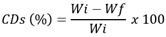
(1)
Where Wi refers to the initial weight of the CCDs solution and Wf to the solid weight after drying the solution at 100°C until constant weight. This procedure was conducted in triplicate. The solution obtained was used as feedstock, and diluted with water, resulting in the 0,5% w/w and 2,5% w/w concentrations used in the present work.
2.2.2. Casein Carbon-Dots Addition to Textile
As mentioned above, CCDs solutions were used in two concentrations (0,5% and 2,5% w/w). The solutions were heated at 60°C, and then textile samples were immersed for 15 minutes, passed through a lab-pad-roller, with a wet pick-up of 100%, and then air dried.
2.2.3. Characterization
CCD's absorption spectra were investigated using a UV/Vis spectrophotometer (Shimadzu UV-2600i) at a range of 185 to 800 nm. A 365 nm light source was used to investigate the photoluminescence of the CCD solution.
The Fourier transform infrared (FTIR) spectra of CCDs and textile samples were recorded on an Infrared Spectrum instrument (Agilent Technologies, USA), with a 4 cm-1 resolution, 80 scans, and a wavenumber range of 4000-600 cm-1, using the ATR mode. Textile samples (modified and control) were examined before and after being burned in a muffle furnace for 5 minutes at 220°C, 330°C, and 500°C as suggested elsewhere [13].
The effect of the addition on cotton fabric was investigated using a Martindale tester (Mathis, Brazil) in accordance with ISO 12947:1-2007. Briefly, circular samples (40 mm) were subject to several rubbing cycles (100, 200, 500, 730, and 1000 cycles) against an abrasive wool cloth and a 9 kPa load. Sample mass variation between cycles was verified by weighing samples with an analytical scale (± 0,0004g). One-way analysis of variance was used to determine statistically significant differences (p <0,05) between groups. All statistical analyses were performed using PAST software.
Thermogravimetric analysis (TGA, Shimadzu equipment, model DTG-60H) was conducted under an air atmosphere, with a flow rate of 50 mL min-1, at a heating rate of 10°C min-1, from ambient temperature to 600°C.
Flammability property was investigated in accordance with BS 5852 Part 1, using a cigarette as the heat source (source 0), as reported by Manasoglu et al. [14]. Briefly, the textile sample was affixed to polyurethane foam, and a lit cigarette was placed on top until it burned along its entire length. After removing the cigarette ash, the surface deformations were measured with a ruler and a caliper.

3. Results and Discussion

In our work, we investigated the production of environmentally friendly CDs using casein as a natural precursor (CCDs), without the use of any harsh chemicals. The as-prepared CCDs aqueous solution was yellowish and transparent under daylight and emitted strong blue fluorescence under UV light (365 nm), as shown in Figure 1A. (inset). The UV-vis spectra of CCDs (Figure. 1A) showed two absorption peaks at 250 and 280 nm, which were attributed to the π–π* transition of C=C and n–p* transition of C=O, respectively [12,15]. FTIR spectra of CCDs (Figure. 1B) indicate the presence of nitrogen and oxygen functional groups.
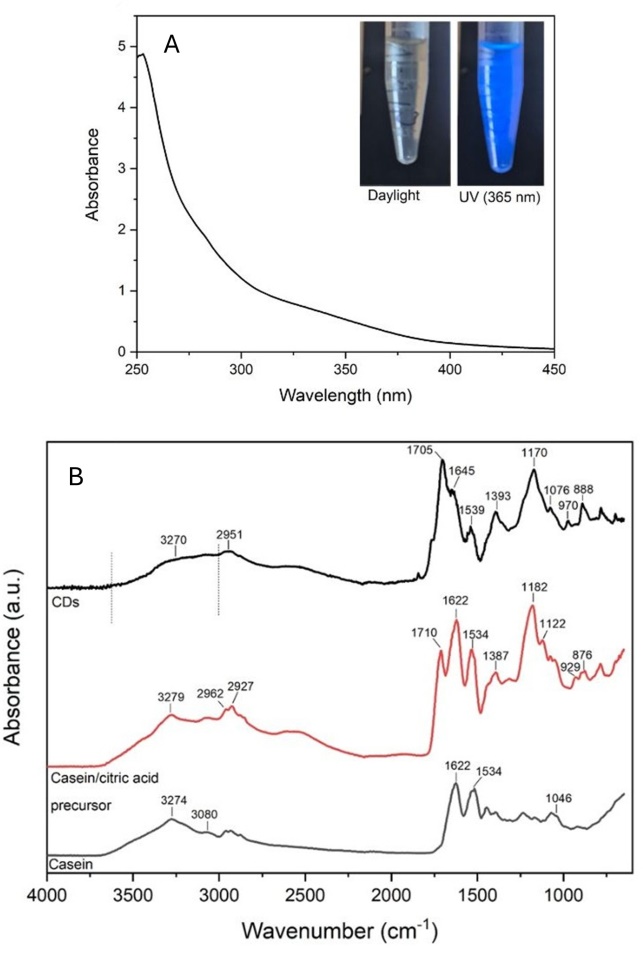
Figure 1. A) CCDs UV-vis absorption spectra and CCDS blue fluorescence at 365 nm (inset); B) FTIR spectra of CCDs, casein diluted in citric acid solution, and casein powder
A broad peak is observed at 3600-3000 cm-1 attributed to OH-bonded surface hydroxyl groups [6,12,16] and N–H stretching of amide [17-18]. The peak at 2950 cm-1 can be assigned to the asymmetric C-H stretching vibration [19]. It is worth noting that it appears at higher wavenumbers and as a doublet in the casein/citric acid precursor (2962 and 2927 cm-1) and in casein powder. Two peaks are observed at 1634 cm-1, attributed to the carbonyl groups (C=O) [19] in the Amide I region of the protein, and at 1645 cm-1, due to the presence of large numbers of amide (N–C=O) groups on the surface [6]. Such a peak can also be attributed to the formation of the unsaturated C=C group, which is also indicated by the π-π transition observed in the UV-vis spectrum (Figure. 1A). Such results suggest that casein underwent carbonization, driven by the breakdown of some peptide bonds in its protein chain and the partial condensation of aromatic structures [6].
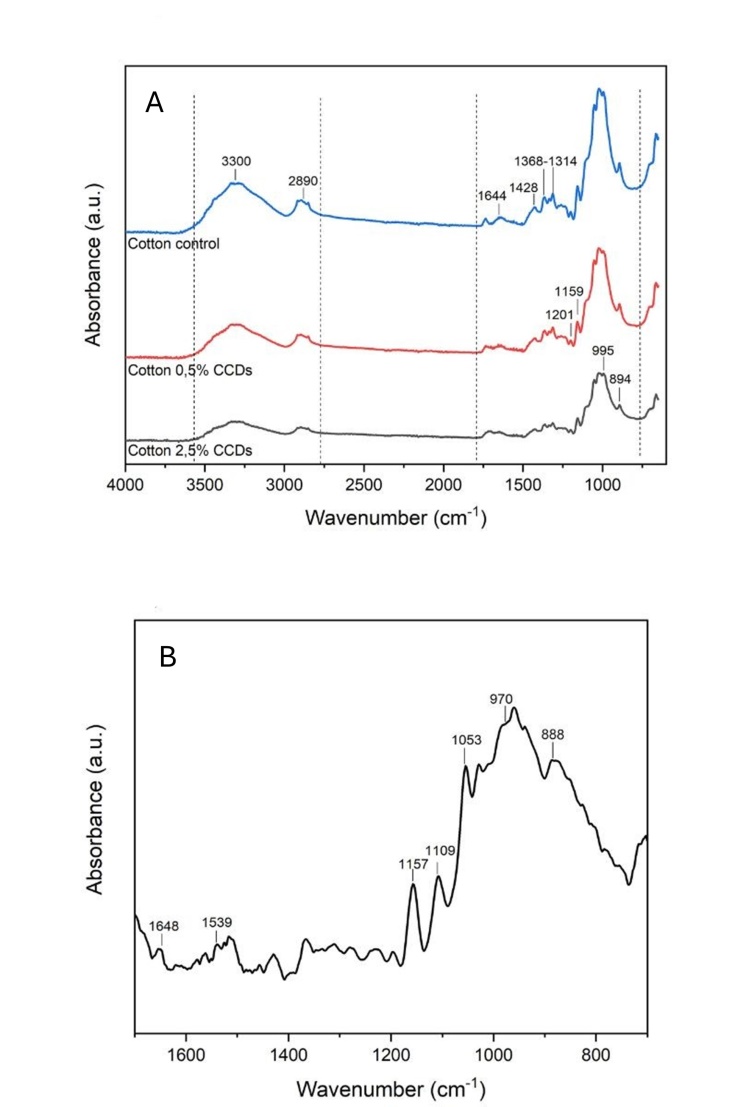
The modification of cotton textile by the addition of CCDs resulted in subtle alterations in the FTIR spectra compared to control cotton (unmodified), as observed in the figure. 2A. All samples present typical cellulose peaks such as a large peak centered at 3300 cm-1, due to H-bonded OH stretch; 2890 cm-1 attributed to CH stretching, 1644 cm-1 due to adsorbed water; 1428 cm-1 CH wagging (in-plane bending), 1368 cm-1 CH bending (deformation stretch); 1314 cm-1 CH wagging; 1201 cm-1 OH in-plane bending; 1159 cm-1 asymmetric bridge C–O–C; 1108 cm-1 asymmetric bridge C–O–C; 1052 cm-1 asymmetric in-plane ring stretch; 995 cm-1 CO stretch; 894 cm-1, asymmetric out-of-phase ring stretch: C1–O–C4; b glycosidic bond [20]. However, by subtracting the control spectra (unmodified cotton) from the CCDS (2,5% w/w) modified sample, the presence of two bands attributed to CCDs, at 976 cm-1, due to C-C aromatic vibration, and another at 888 cm-1 (Figure. 2B), attributed to C-C bond vibration modes in the pyrrolidone ring.
Figure 2. A) FTIR spectra of textile samples (control and CCDs modified) after heating in a muffle furnace at 330°C; B) Textile samples (control and CCDs modified) after heating in a muffle furnace at 500°C
To investigate the effect of CCDs addition on cotton thermal stability, samples were heated in a muffle furnace for 5 minutes at temperatures ranging from 220 to 500°C and then analysed by FTIR. After heating the samples to 220°C (data not shown), almost no changes were observed in the FTIR spectra of either the cotton control or the CCD-modified cotton. This result is consistent with the literature, which reports that the chemical structure of cellulose remains stable around 200°C [21].
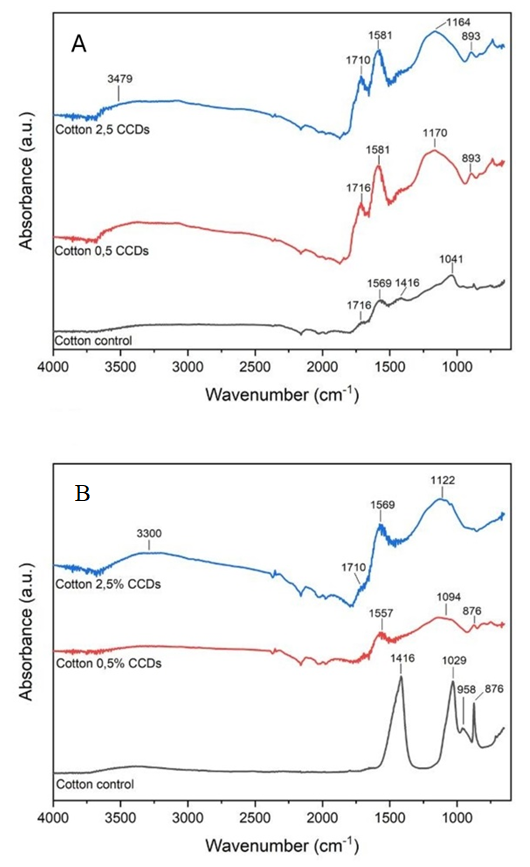
When the temperature increased to 330°C, more pronounced differences appeared (Figure. 3A). In the control cotton, evidence of cellulose degradation was indicated by the disappearance or reduction of characteristic glucopyranose-related bands, including 3300 cm⁻¹ (OH stretching), 2900 cm-¹ (CH stretching), 1428 cm⁻¹ (CH₂ deformation), 1367-1313 cm-¹ (CH and C–OH deformation), 1158 cm⁻¹ (antisymmetric stretching of the C–O–C ether bridge), and 1052 cm⁻¹ (skeletal C–O stretching) [21-23]. In contrast, CCD-modified samples (0.5% and 2.5% w/w) retained key cellulose peaks at 330°C. A broad band at 3400-3000 cm-¹, a shoulder in the 1400-1300 cm⁻¹ region, and especially the peak at 1164 cm-¹ suggest that the cellulose backbone (C–O–C linkages) was largely preserved.
At 500°C, the differences between the control and modified samples became even more evident (Figure. 3B). In the control cotton, new sharp peaks emerged at 1419 cm-¹, 1029 cm-¹, and 876 cm-¹, which are associated with the formation of aromatic structures during advanced cellulose degradation. This last peak was only subtly observed in the 0.5% CCDs sample and was absent in the 2.5% CCDs cotton sample. Besides that, in the CCDs-modified samples, some characteristic cellulose bands were still detectable, indicating that cellulose was not fully degraded and that the incorporation of CCDs contributed to enhanced thermal stability. Additionally, the intensity of the band at 1569 cm⁻¹ differed between the two modified samples: it was more pronounced at 0.5% CCDs than at 2.5% CCDs. Given that this band (typically around 1600 cm⁻¹) grows during cellulose aromatization at high temperatures [21], its reduced intensity in the 2.5% CCDs sample suggests that the higher CCDs content provided stronger protection against thermal degradation. These findings indicate that the incorporation of CCDs, particularly at 2.5% w/w, effectively increased the thermal stability of cotton textiles, delaying structural degradation even at 500°C.
Figure 3. A) FTIR spectra of control (unmodified) and CCDS cotton modified samples; B) Subtracted FTIR spectra of 2,5% w/w CCDs cotton
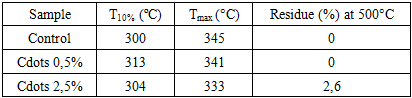
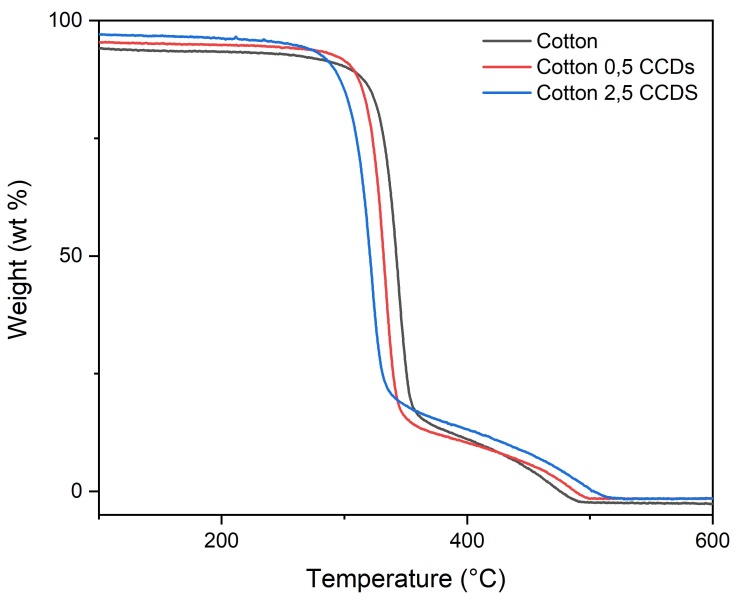
The thermal stability of modified cotton was further investigated by Thermogravimetric Analysis (TGA) in an air atmosphere. TGA curves are presented in Figure. 4. The decomposition temperature at 10% weight loss (T10%), temperature at the maximum weight loss rate (Tmax), and char formation (%) at 500°C were calculated from the TGA thermograms and presented in Table 1.
Table 1. TGA data of untreated and treated cotton fabrics under air atmosphere
     
The thermal decomposition process of cotton fabric and modified samples occurs in two stages in an oxidative atmosphere, at a temperature range of 25-600°C [25]. As seen in Figure 4. the highest weight loss for all samples occurred between 300-400°C. This first decomposition step is attributed to dehydration and further cellulose degradation [25]. During this decomposition step, two parallel mechanisms operate: one promotes the formation of aliphatic char, while the other produces volatile compounds [25].
Figure 4. TGA curves of CCDs modified samples and control (unmodified cotton)
As presented in Figure 4. the decomposition temperatures were lower in modified samples compared to control cotton. Such behavior is not unusual for flame-retardant materials when tested in an air atmosphere. Pan et al [26-27] reported that the addition of CDs to cotton fabric reduced the initial degradation temperature and increased char residue. Gao et al [28] reported a similar situation in PVA films modified with CDs for flame-retardant purposes. Hao et al [24] reported a reduction of the initial degradation temperature of modified cotton with intumescent polymer compared with pristine cotton fabric, and a larger amount of char residue compared with neat cotton.
It is known that char formation is enhanced by the presence of phosphorus and nitrogen in flame retardants, thence oxidation to CO and CO2 [25]. Taherkhani et al [29] reported that cotton fabrics containing phosphorous compounds exhibit a lower onset temperature for pyrolysis compared with untreated cotton. This behavior was attributed to the catalytic action of phosphorus-containing species, which accelerate the initial degradation reactions. The decrease in the decomposition temperature, together with the formation of phosphorus-based esters that are less flammable, promotes higher char yields. At these lower temperatures, heat is released more gradually, favoring condensed-phase reactions and enhancing the efficiency of char development.
The CDs (CCDs) produced in the present work were obtained from casein, a phosphorus-rich protein, and have a high phosphorus content (28,733%). It is interesting to note that Alongi et al. [30] reported that the addition of graphene carbon dots alone did not significantly affect the thermal degradation of cotton. So, the results obtained in the present work suggest that CCD addition contributed to an increase in char formation on the textile, due to the presence of phosphorous groups, and not exclusively due to the potential intumescent property of CDS. The formation of a carbon layer acted as a barrier, preventing the internal degradation of cotton fabric [24]. It is important to note that the formation of char in air is much lower than that reported in nitrogen [31], which underscores the significance of the present findings.
The effect of CCDs on textiles was also investigated by a flammability test. In this test, using a smouldering cigarette as the ignition source, burns were observed along the area where the cigarette was placed, and a color change was observed in all samples tested. However, the length and the degree of damage were different. Control cotton (neat cotton) had the longest deformation, and the area where the tip of the cigarette came into contact was punctured. By adding 0,5% w/w of CCDs to cotton, the deformation decreased by 3,3%. At the highest CCD addition (2,5% w/w), the deformation length decreased by 5%. Similar results were reported by Manasoglu et al. [14], who added carbonaceous nanoparticles (graphene) to polyester fabric and found that increasing the amount of these nanoparticles decreased the deformation length in such a test, with the best results obtained with the highest graphene content. In the present work, a commercial flame-retardant cotton was also tested in the cigarette test. It was observed that the deformation length obtained with the higher CCD concentration was only 1,67% smaller than its commercial counterpart. Although these results are considered promising, direct comparisons with commercial flame-retardant finishes should be interpreted with caution, given substantial differences in chemical composition, surface interactions, application methods, and evaluation protocols. Conventional textile flame-retardant systems are typically based on phosphorus- or halogen-containing formulations applied via industrial finishing processes that deposit substantial quantities of active compounds onto the fiber surface. In contrast, the treatment investigated in this study relies on bio-derived carbon quantum dots, which interact with the cotton substrate through a distinct surface chemistry and operate at the nanoscale. Because these systems differ not only in formulation and deposition strategy but also in the metrics used to assess performance, direct comparison may not accurately reflect their respective functional roles. The objective of the present work is therefore to explore the potential of bio-based nanostructured additives as an alternative strategy for modifying the thermal behavior of cotton fabrics.
The effect of CCDs on cotton abrasion resistance was also investigated. It is known that fabric abrasion resistance can be enhanced through textile finishing or surface modification, for example, by reducing friction at the material’s surface [32]. CDs have attracted growing interest as additives capable of minimizing friction and improving wear resistance [33]. Evidence indicates that their anti-wear behavior improves substantially under higher applied loads, whereas frictional reduction tends to exhibit a more moderate increase in performance [11,33]. The effect of carbonaceous nanomaterials, such as graphene nanoplates and carbon nanotubes, on textile wear (abrasion) resistance has been reported in the literature [14], but there is a gap in understanding the impact of CDs on cotton wear resistance.
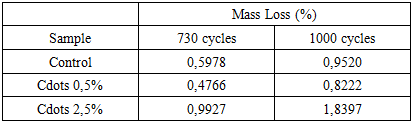
In the present work, the abrasion resistance of cotton fabric modified with CCDs was investigated by the Martindale test, and the percent weight loss, which is the difference between specimen mass before and after abrasion, is shown in Table 2. Cotton sample with the lowest concentration of CCDs (0,5% w/w) had the best wear performance to abrasion compared to the specimens tested, which may be due to an effective dispersion of CCDs in the cellulose fibers, creating a strong and smooth protective layer. Due to their nanoscale dimensions, CCDs can penetrate the wear gap, forming a protective layer that limits material loss. These nanoparticles may fill microscopic valleys or surface defects, resulting in smoother surfaces and reduced sliding resistance [34]. Wang et al reported that when an adequate amount of CDs becomes adsorbed onto the carbon steel surface, they assemble into a protective coating that serves as an efficient barrier at the friction interface [34].
Table 2. Weight loss percentage (%) due to abrasion cycles
     
On the other hand, the higher CCD concentration (2,5% w/w) used showed the poorest performance, even compared with the control. This decrease may be due to agglomeration, which directly affects the fabric's surface roughness. One hypothesis is that at higher CD concentrations, nanoparticle aggregation can increase stress concentrations. During abrasion, these rough peaks are more susceptible to friction and can tear away from the fabric, damaging the underlying fibers, as indicated by weight reduction and reduced overall resistance. The binding force within the agglomerated CCDs may also be weaker than the strong, uniform bond formed at lower concentrations. This causes the CDs' clumps to be more easily detached from the fabric surface, leaving the cotton fibers exposed and less protected. While a fine, even layer of CCDs enhances abrasion resistance, larger aggregates have the opposite effect.
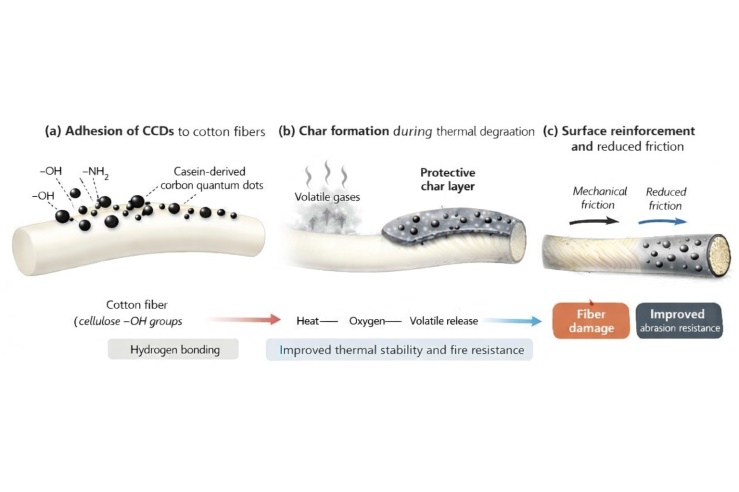
Based on the experimental results for thermal stability, flame retardancy, and abrasion resistance, a possible mechanism explaining the performance enhancement of cotton fabrics treated with casein-derived carbon quantum dots (CCDs) is proposed. CCDs contain abundant functional groups such as hydroxyl, carboxyl, and amino groups inherited from the protein structure of casein. These functional groups can interact with the hydroxyl groups of cellulose through hydrogen bonding, promoting the adhesion of the nanoparticles onto the cotton fiber surface and resulting in the formation of a thin protective nanostructured coating.
During thermal exposure, the nitrogen- and phosphorus-containing components derived from casein may promote dehydration and char formation during the thermal degradation of cellulose. The formation of a carbonaceous layer acts as a protective barrier that reduces heat transfer, limits oxygen diffusion, and suppresses the release of volatile degradation products, thereby improving thermal stability and enhancing flame retardancy of the treated cotton fabrics.
In addition, the nanoscale size and high surface area of CCDs allow them to fill surface irregularities and microvoids on the cotton fibers. This nanostructured coating can reduce friction between fibers and provide a lubricating and reinforcing effect, which may explain the improved abrasion resistance observed for fabrics treated with low concentrations of CCDs. The proposed mechanism is illustrated schematically in Figure 5.
Figure 5. Proposed mechanism for the enhancement of thermal stability, flame retardancy, and abrasion resistance of cotton textile treated with casein carbon dots (CCD)

4. Conclusions

This study demonstrated that casein-derived carbon quantum dots can be synthesized through a green, straightforward method and effectively incorporated into cotton textiles to enhance their functional performance. The presence of CCDs resulted in a synergistic improvement in thermal stability and flame retardancy, delaying cellulose degradation up to 500°C and reducing surface deformation under smouldering-cigarette ignition. The protective effect is attributed mainly to the phosphorus- and nitrogen-rich composition of casein-derived CDs, which promotes char formation and preserves the cellulose backbone at elevated temperatures.
Furthermore, abrasion testing revealed that a low CCD concentration (0.5% w/w) significantly improved wear resistance, likely due to the formation of a uniform nanoscale lubricating layer capable of reducing friction and protecting the fiber surface. Although higher CCD loading possibly led to nanoparticle aggregation and reduced abrasion performance, the overall results highlight the potential of CCDs as a versatile, bio-based nanostructured coating for sustainable textile engineering. These findings open new pathways for the development of environmentally responsible, thermally stable, and mechanically resilient cotton materials without resorting to toxic or non-renewable additives.

ACKNOWLEDGEMENTS

This paper was supported by Fundação de Amparo a Pesquisa de Minas Gerais (FAPEMIG) grant number BPD-00673-22. The authors also acknowledge the support from CNPq (Grant No. 308994/2022-1, Call 08/2022).

References

[1]  Ali, N.M., Saleh, S.N., Khaffaga, M.M., Hassan, M.S., El-Naggar, A.W.M., Rabie, A.G.M., 2024, Flame retardancy of cotton and cotton/polyester fabrics treated by coating with polymer blends containing aluminum and phosphorus metals under the effect of gamma irradiation, Polymer Degradation and Stability, 1, 227.
[2]  Chen, Y., Liu, S., Wan, C., Zhang, G., 2021, Facile synthesis of a high efficiency and durability L-citrulline flame retardant for cotton. International Journal of Biological Macromolecules, 166, 1429-38.
[3]  Alongi, J., Carletto, R.A., Bosco, F., Carosio, F., Di Blasio, A., Cuttica, F., et al, 2014, Caseins and hydrophobins as novel green flame retardants for cotton fabrics, Polymer Degradation and Stability, 99(1), 111-117.
[4]  Faheem, S., Baheti, V., Tunak, M., Wiener, J., Militky, J., 2019, Comparative performance of flame retardancy, physiological comfort, and durability of cotton textiles treated with alkaline and acidic casein suspension, Journal of Industrial Textiles, 48(6), 969-91.
[5]  Carosio, F., Di Blasio, A., Cuttica, F., Alongi, J., Malucelli, G., 2014, Flame retardancy of polyester and polyester-cotton blends treated with caseins, Industrial and Engineering Chemical Research, 12, 53(10), 3917-23.
[6]  Pricilla, R.B., Skoda, D., Urbanek, P., Urbanek, M., Suly, P., Bergerova, E., et al, 2022, Unravelling the highly efficient synthesis of individual carbon nanodots from casein micelles and the origin of their competitive constant-blue-red wavelength shift luminescence mechanism for versatile applications. RSC Advances, 1:12(25), 16277-90.
[7]  Ahmed, H.B., Abualnaja, K.M., Ghareeb, R.Y., Ibrahim, A.A., Abdelsalam, N.R., Emam, H.E., 2021, Technical textiles modified with immobilized carbon dots synthesized with infrared assistance, Journal of Colloid and Interface Science, 604, 15-29.
[8]  Abraham, A., Muhammed, P., Eldho, A., Bushiri, M.J., 2023, WO3·0.33H2O/carbon quantum dots hybrid nanostructures for efficient electrochemical hydrogen evolution reaction. Diamond and Related Materials, 1, 139.
[9]  Chen, X., Song, Z., Yuan, B., Li, X., Li, S., Thang Nguyen, T., et al, 2022, Fluorescent carbon dots crosslinked cellulose Nanofibril/Chitosan interpenetrating hydrogel system for sensitive detection and efficient adsorption of Cu (II) and Cr (VI), Chemical Engineering Journal, 15, 430.
[10]  Hasan T, Hossen MR, Rimon MIH, Mobarak MH. Advances of nanotechnology in fabric and clothing. Nano Trends.2025; 11:100140.
[11]  Shang, W., Cai, T., Zhang, Y., Liu, D., Liu, S., 2018, Facile one pot pyrolysis synthesis of carbon quantum dots and graphene oxide nanomaterials: All carbon hybrids as eco-environmental lubricants for low friction and remarkable wear-resistance. Tribology International, 118, 373-80.
[12]  Cheng, X.W., Huang, Y.T., Zhang, C., Gu, W.W., Ma, Y.D., Shi, F.Y., et al, 2020, Caramel product from glucose as a sustainable and effective flame retardant for silk fabric. Journal of Cleaner Production, 1, 266.
[13]  Wang, X., Wang. W., Wang, S., Yang, Y., Li, H., Sun, J., et al., 2021, Self-intumescent polyelectrolyte for flame retardant poly (lactic acid) nonwovens, Journal of Cleaner Production, 1, 282.
[14]  Manasoglu, G., Celen, R., Kanmaz, D., 2024, Improvement of thermal stability, flame retardancy, hydrophobicity, tear and wear performance of polyester fabrics with graphene nanoplatelet coating, Journal of Applied Polymer Sci. 141, e55765.
[15]  Song, J., Li, J., Guo, Z., Liu, W., Ma, Q., Feng, F., et al., 2017, A novel fluorescent sensor based on sulfur and nitrogen co-doped carbon dots with excellent stability for selective detection of doxycycline in raw milk, RSC Advances, 7(21), 12827-34.
[16]  Bajpai, S.K., D’Souza, A., Suhail, B., 2019, Blue light-emitting carbon dots (CDs) from a milk protein and their interaction with Spinacia oleracea leaf cells, International Nano Letters, 9(3): 203-12.
[17]  Khoshkalampour, A., Ahmadi, S., Ghasempour, Z., Lim, L.T., Ghorbani, M., 2024, Development of a Novel Film Based on Casein/Modified Tragacanth Gum Enriched by Carbon Quantum Dots for Shelf-Life Extension of Butter. Food and Bioprocess Technology, 17(5), 1183-200.
[18]  Xu, S., Liu, Y., Yang, H., Zhao, K., Li, J., Deng, A., 2017, Fluorescent nitrogen and sulfur co-doped carbon dots from casein and their applications for sensitive detection of Hg2+ and biothiols and cellular imaging. Analytica Chimica Acta, 2964:150-160.
[19]  Huang, S.W., Lin, Y.F., Li, Y.X., Hu, C.C., Chiu, T.C., 2019, Synthesis of fluorescent carbon dots as selective and sensitive probes for cupric ions and cell imaging. Molecules, 24(9).
[20]  Chung, C., Lee, M., Choe, E.K., 2004, Characterization of cotton fabric scouring by FT-IR ATR spectroscopy, Carbohydrate Polymers, 58(4): 417-20.
[21]  Soares, S., Ricardo, M.P.S., Jones, S., Heatley, F., 2001, High temperature thermal degradation of cellulose in air studied using FTIR and 1 H and 13 C solid-state NMR. European Polymer Journal, 37: 737-745.
[22]  Xu, F., Zhang, G., Wang, P., Dai, F., 2022, Durable and high-efficiency casein-derived phosphorus-nitrogen-rich flame retardants for cotton fabrics. Cellulose, 29(4), 2681-97.
[23]  Zaitsev, A., Moisan, S., Poncin-Epaillard, F., 2021, Cellulose carbon fiber: plasma synthesis and characterization, Cellulose, 28(4): 1973-88.
[24]  Hao, F., Geng, W., Liu, Q., Dong, W., Jin, F.L., Park, S.J., 2019, Synthesis and application of a polymeric intumescent flame retardant for cotton fabric. Bulletin of Materials Science, 42, 216.
[25]  Price ’n, D., Horrucks, A.R., Akalin, M., Faroq, A.A., 1997, Influence of flame retardants on the mechanism of pyrolysis of cotton (cellulose) fabrics in air, Journal of Analytical and Applied Pyrolysis, 40-41, 511-524.
[26]  Pan, Y., Liang, Q., Du, J., Zhang, H., Zhang, D., Zhao, H., et al., 2023, Influences of boron and nitrogen co-doped carbon dot based coating fabricated via layer-by-layer self-assembly on the UV protection and flame retardancy of cotton fabric, Cellulose, 30(17), 11249-59.
[27]  Pan, Y., Wang, W., Liang, Q., Du, J., Zhang, D., Zhao, H., et al., 2024, Effect of nitrogen and phosphorus co-doped carbon dots containing layer-by-layer self-assembled coating on UV resistance and thermal stability of cotton fabric, Cellulose, 30, 11249-11259.
[28]  Gao, R., Yi, X., Liu, X., Wang, H., Wang, L., Zeng, B., et al., 2024, Phosphorus-doped carbon dots as an effective flame retardant for transparent PVA composite films with enhanced UV shielding property, Reactive and Functional Polymers, 197: 105877.
[29]  Taherkhani, A., Hasanzadeh, M., 2018, Durable flame retardant finishing of cotton fabrics with poly(amidoamine) dendrimer using citric acid, Materials Chemistry and Physics, 219: 425-32.
[30]  Alongi, J., Ferruti, P., Manfredi, A., Carosio, F., Feng, Z., Hakkarainen, M., et al., 2019, Superior flame retardancy of cotton by synergetic effect of cellulose-derived nano-graphene oxide carbon dots and disulphide-containing polyamidoamines, Polymer Degradation and Stability, 169: 108993.
[31]  Nguyen, H.K., Sakai, W., Nguyen, C., 2020, Preparation of a novel flame retardant formulation for cotton fabric, Materials, 13: 54.
[32]  Textor, T., Derksen, L., Bahners, T., Gutmann, J.S., Mayer-Gall, T., 2019, Abrasion resistance of textiles: Gaining insight into the damaging mechanisms of different test procedures, Journal of Engineered Fibers and Fabrics, 14, 1-7.
[33]  Kumar, V.B., Sahu, A.K., Rao, K.B.S., 2022, Development of Doped Carbon Quantum Dot-Based Nanomaterials for Lubricant Additive Applications, Lubricants, 10: 144.
[34]  Wang, D., Jia, X., Yang, J., Wang, Z., Song, H., 2025, Fluorinated graphene intercalated by carbon quantum dots: Triple effect for reducing friction and wear, Chemical Engineering Journal, 15: 512.