Osuji Nwachukwu Joshua1, Moses Mario Idisi2, Callistus Chukwudi Ibe3
1Department of Maritime Transport and Logistics, Federal University of Petroleum Resources Effurun, Delta State Nigeria
2Department of Transport and Marine Management, Southern Delta University, Ozoro, Delta State, Nigeria
3Department of Logistics & Transport Technology, Federal University of Technology Owerri, Imo State, Nigeria
Correspondence to: Osuji Nwachukwu Joshua, Department of Maritime Transport and Logistics, Federal University of Petroleum Resources Effurun, Delta State Nigeria.
| Email: |  |
Copyright © 2026 The Author(s). Published by Scientific & Academic Publishing.
This work is licensed under the Creative Commons Attribution International License (CC BY).
http://creativecommons.org/licenses/by/4.0/

Abstract
This study evaluates passenger-crew relationship onboard aeroplanes using Entropy-EDAS as evaluation tools. EDAS and Entropy combination is known to produce more accurate, transparent, and objective alternative rankings as the combined weighting reduces assessment subjectivity. Entropy weight model was used to determine the weights of the criteria utilised in evaluating the alternatives. EDAS was used in computing positive and negative distance respectively form the average solution (PDA and NDA) with their respective weights, also computing the appraisal score or average score of judgment and alternatives ranking. Airline 1 exhibited remarkable benefits to passengers compared to the other sampled airlines, with average rating in the following criteria: Communication (C), Conflict Management (CM) and Cultural Sensitivity (CSN) while high rating in Courtesy & Respect (CR), Responsiveness (R), Safety Assurance (SA), Comfort Support (CS). With the resent happenings in Nigeria domestic airline operations, it shows that crew onboard airplane lacks effective communication, conflict management prowess and not sensitive to culture, knowing too well that Nigerians are culturally sensitive. However, investigation on the longitudinal effects of crew behavior on brand loyalty in Nigerian airlines, explore passenger-crew dynamics in international airlines operating within and outside Nigeria, study gender differences in passenger expectations and their effect on perceived crew performance and examine the role of emerging technologies (like AI-driven customer service tools) in reshaping passenger-crew interactions should be the center for further research.
Keywords:
Airplane, Passengers-Crew Relationship, Alternatives, Criteria, Entropy weight, EDAS
Cite this paper: Osuji Nwachukwu Joshua, Moses Mario Idisi, Callistus Chukwudi Ibe, Evaluation of Passengers' Crew Relationship Onboard Aeroplanes in Nigerian Domestic Airline Operations: An Entropy-Edas Method, Journal of Logistics Management, Vol. 14 No. 1, 2026, pp. 1-9. doi: 10.5923/j.logistics.20261401.01.
1. Introduction
The aviation industry serves as a fundamental element of modern global transportation, driving economic expansion, improving connectivity, and promoting globalization [1]. The history of domestic airline operations in Nigeria is intricately tied to the country’s economic and infrastructural development. Adapting to the evolving air travel environment requires a thorough comprehension of service quality, safety, and customer happiness [1]. The demise of Nigeria Airways paved the way for the liberalization of the aviation sector, allowing private airlines to enter the market. Airlines such as Arik Air, Aero Contractors, and Air Peace emerged, bringing new competition and innovations to domestic air travel [2]. However, the early 2000s also exposed the challenges inherent in the industry, including inadequate infrastructure, high operating costs, and frequent airline collapses. The inability of many operators to adhere to international standards led to concerns over safety and reliability, further compounding the sector’s challenges.Domestic airlines are commercial carriers that operate under national regulations within a given country for business purposes, transporting passengers and cargoes to major cities or regions across the country [3]. In the case of Nigeria the major cities, the domestic airlines transport passengers to are Lagos, Abuja, Calabar, Enugu, Kano, Port Harcourt, Kaduna, and Uyo.The aviation industry is a crucial component of any nation's transportation system, offering significant contributions to economic growth, regional integration, and global connectivity [4]. In Nigeria, domestic airline operations have long played a pivotal role in connecting cities, fostering trade, and supporting tourism. The sector has evolved over the decades, with numerous airlines entering and exiting the market due to a combination of operational challenges and management issues. Despite the apparent importance of domestic air travel, Nigeria's aviation renaissance is still evolving, as some structural issues continue to pose a risk to its momentum if not aggressively mitigated [5].Effective flight scheduling ensures that airlines maximize their fleet usage and manage passenger demand, while maintaining operational efficiency [6].Providing high-quality services. satisfying and establishing enduring connections with consumers is critical to the airline industry's long-term survival and competitiveness which could be likened to airline operators’ capacity. A good relationship with passengers helps ensure compliance with these regulations, such as wearing seat belts during takeoff and landing, following safety instructions, or cooperating during emergencies procedures. For passengers traveling for personal or emotional reasons, a compassionate and empathetic crew can make a significant difference in their travel experience. For example, crews who can assess and address a passenger's anxiety or provide reassurance can help passengers feel more at ease. Aviation authorities such as Nigerian Civil Aviation Authority (NCAA) by their statutory functions, monitor the safety and operational standards of airlines. An effective relationship between passengers and crew is key to meeting safety standards, passenger rights and overall compliance with regulations [8].
2. Literature Review
[9] investigated the impact of cultural differences on service interactions in the air transport sector in West Africa, emphasising the unique variation in the region's varied cultural environment. Furthermore, they explored the ways in which cultural norms, communication styles, and expectations impact employee interactions, customer service experiences, and overall operational efficiency in West African airlines. [10]. examined the correlation between passenger comfort (PC) and customer patronage (CP) of domestic airlines in Nigeria, emphasising the influence of in-flight services (IFS) and baggage handling (BH) on customer satisfaction (CS) and referrals (R). However, they recommended that airlines should focus more on comfort, meal quality, entertainment, and personalized experiences through enhanced in-flight services. [11] assessed that passenger experience with domestic airlines is significantly correlated with their patronage and advises that domestic airlines should adopt strategies to enhance passenger experience consistently to improve patronage levels.[12] analysed the influence of in-flight services on consumer loyalty to domestic airlines in Nigeria, emphasising cabin comfort, in-flight entertainment, and food and beverage offerings. [12] further find that customer experience is a critical factor in airline competition, with comfort and entertainment exerting greater influence than meal quality, especially for short-haul domestic flights. [13] evaluated the impact of airline service quality on passenger loyalty within the Nigerian civil aviation sector. They further examined the impact of pre-flight, in-flight, and post-flight service quality on passenger loyalty.[14] study evaluated the quality of airline passenger service in Nigeria in order to identify the elements that influence passengers' choice of airline service, frequency of airline use, and service quality for both domestic and international aircraft services. He further evaluated services that air passengers are dissatisfied with. In the reviewed literature, passenger-crew relationship experiences onboard airplanes have been evaluated without any of the considering the following criteria: Courtesy & Respect, Communication, Responsiveness, Safety Assurance, Comfort Support, Conflict Management and Cultural Sensitivity. Sampled airline will be used to evaluate the criteria in other to rank the best sampled airline using Entropy- Edas approach.
2.1. Review of the Applications of ENTROPY-EDAS Methodology
According to [15], EDAS and Entropy combination is known to produce more accurate, transparent, and objective alternative rankings as the combined weighting reduces assessment subjectivity. Having the capacity to examine the distribution of data, entropy weighting ensures that the weights that are produced accurately represent the relative relevance of each criterion while avoiding the impact of personal preferences or decisions that are not supported by evidence [15].In order to create an objective, transparent, and effective scoring system, [15] combined the EDAS method with Entropy for the best customer service selection process. Entropy's ability to automatically determine the weight of criteria based on available data was combined with EDAS's ability to evaluate and rank alternatives according to their distance from the average solution. [16] combined Entropy and EDAS to determine the best electrified car. They used Entropy method to determine the weights of the selection criteria while EDAS (Evaluation based on Distance from Average Solution) method was used to rank the electrified car alternatives.[17] employed Fuzzy Shannon entropy and Fuzzy EDAS to assess hazards related to large-scale construction projects due to the tremendous amount of work involved on a large building project which is a substantial workload. The objective of this research is to evaluate the passenger-crew relationship onboard airplanes in Nigeria using Entropy to determine the weight of the following criteria: Courtesy & Respect (CR), Communication (C), Responsiveness (R), Safety Assurance (SA), Comfort Support (CS), Conflict Management (CM) and Cultural Sensitivity (CS) while EDAS to rank the alternatives which are the airlines that were sampled in the research identified as Airline 1, Airline 2 and Airline 3.
3. Methodology
In this study, two methods Multi Criteria Decision Model of Entropy and EDAS were engaged. Entropy is applied to determine the weight of the following criteria: Courtesy & Respect (CR), Communication (C), Responsiveness (R), Safety Assurance (SA), Comfort Support (CS), Conflict Management (CM) and Cultural Sensitivity (CSN) as EDAS employed for the ranking of alternatives airlines that were sampled in the research and identified as Airline 1, Airline 2 and Airline 3 as illustrated in figure 1.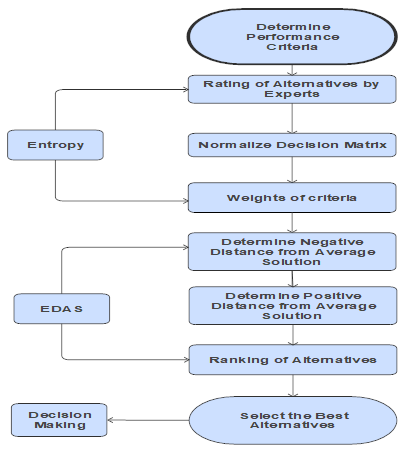 | Figure 1. A flowchart of Entropy Weight- EDAS Technique application in the selection of Best Airline Alternative |
3.1. Entropy Weight Application
This study employs the Entropy Weight model to determine the weights of the criteria utilised in evaluating the alternatives.The initial stage involves the normalisation of the measured values. The normalized value is represented as  . The steps involved in the Entropy method are described as follows as adopted from [18]:
  | (1) |
Describing the entropy value 𝑒𝑗, mathematically as follows: | (2) |
where: | (3) |
 number of alternativesThe weight, 𝑤𝑗 developed using the Entropy value 𝑒𝑗, the formular is as follow:
  | (4) |
3.2. Evaluation Based on Distance from Average Solution (EDAS) Method Application
Adopting [19] EDAS method. The EDAS Model technique is particularly effective when handling contradictory characteristics. Achieving ranking alternatives through EDAS techniques, requires two basic measures; Positive Distance from Average (PDA) Solution and Negative Distance from Average (NDA) Solution. Furthermore, using EDAS technique in alternative ranking, when the PDA value is high and the NDA value is relatively low, the optimal option is identified. [19], provides a full description of the EDAS method's computing processes. First step: is to establish a decision matrix with the label x, as shown, after selecting the criteria and possibilities.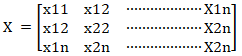 | (5) |
where denotes the performance evaluation of the particular alternative ἱ on the criterion 𝑗. It is considered that all 𝑥𝑖𝑗 are positive real numbersSecond Step: Utilising Equation (7) and (8) across all criteria to calculate Average Solution  | (6) |
where 𝑚 represents the number of alternativesThird Step: Utilising Equations (7), (8), (9) and (10) respectively based on the beneficial and non-beneficial criteria, the computing of the negative distance from the average solution (NDA) and the positive distance from the average solution (PDA) is achieved. 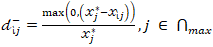 | (7) |
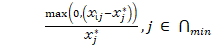 | (8) |
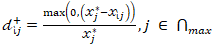 | (9) |
 | (10) |
beneficial and non-beneficial criteria are represented by ∩max and ∩min respectively while positive number is represented as 𝑥𝑗∗.Fourth Step: Using a vector w (𝑤1,𝑤2,𝑤2,...... 𝑤𝑛) comprising non-negative weights, calculate the weighted sum of PDA, 𝑄𝑖+ and the weighted sum of NDA 𝑄𝑖−, for all alternatives. 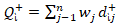 | (11) |
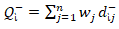 | (12) |
Weight of the criteria is represented as 𝑤𝑗.Fifth Step: Using Equation 13 and 14, normalized values of the weighted sum of Negative Distance from Average Solution (NDA) and Positive Distance from Average Solution (NDA) is calculated.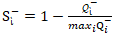 | (13) |
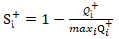 | (14) |
The normalized weighted sum of the Negative Distance from Average Solution (NDA) and the weighted sum of the Positive Distance from Average Solution (PDA) are represented by 𝑠𝑖− and 𝑠𝑖+ respectively.Sixth Step: Using Equation (15) the appraisal score 𝑠𝑖 for evaluated alternatives is calculated. | (15) |
Seventh Step: Alternatives are ranked in order of preference. The Alternative with the highest value of 𝑠𝑖 is considered the most advantageous.
3.3. Criteria Descriptions
Evaluating passengers-crew relationship onboard airplane in Nigeria domestic airline operations depends on various criteria. Some of the criteria are outlined as follows;Courtesy & Respect (CR): Professionalism and politeness of crew members.Communication (C): Clarity, frequency, and effectiveness of information shared.Responsiveness (R): Speed and effectiveness of crew responses to passenger needs.Safety Assurance (SA): Perceived sense of security from crew behavior.Comfort Support (CS): Crew effort in making passengers comfortable.Conflict Management (CM): How well crew resolve disputes or handle difficult passengers.Cultural Sensitivity (CSN): Understanding and respect for cultural diversity.
4. Results and Discussion
4.1. Airline Alternatives Descriptions
Three domestic airlines (Alternatives) were sampled by the researcher and was considered by the Passengers. The airlines for the purpose of this research where tagged Airline 1, Airline 2 and Airline 3 in other not to bridge research ethical protocols.Table 1. Benefit criteria rating scale (Nwaoha and Udosoh 2022)
 |
| |
|
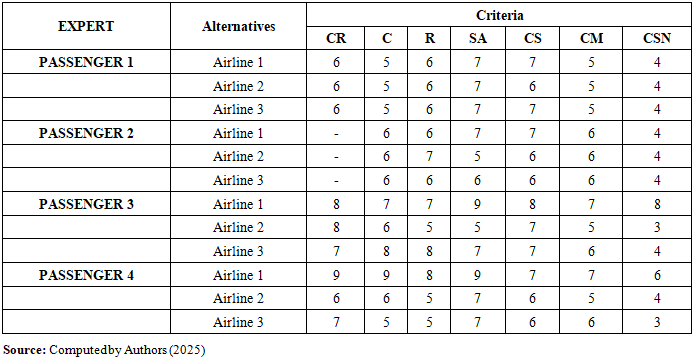
Table 1 represents the scale used by experts in rating each criterion against the alternatives as presented in Table 2 and shows the scale used in this study.
4.2. Entropy Application for Criteria’s Weight Determination
Table 2. Expert Rating
 |
| |
|
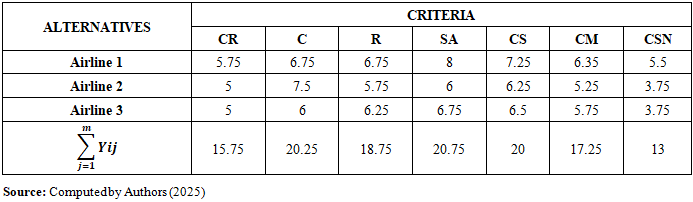
Table 2 represents the experts rating of each criterion against the alternatives, which are some sampled domestic airlines operating within Nigeria. The passengers that patronise the airlines were used as experts having had several experiences onboard the sampled three airlines spanning between 2-10 years. Table 3. Rating of Alternatives
 |
| |
|
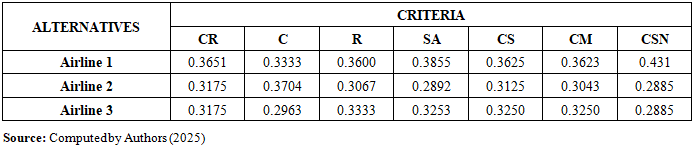
To normalise the decision matrix in Table 3, each value (𝑦𝑖𝑗) was divided by the sum of the values in each column, resulting in the normalised matrix presented in Table 4.Table 4. Normalized Decision Matrix
 |
| |
|
The normalised values in Table 4 were multiplied by their respective natural logarithm (ln) values to derive the results shown in Table 5.Table 5. Normalized decision matrix multiplied with their respective ln values
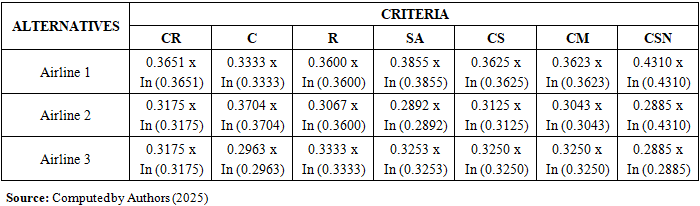 |
| |
|
The result of normalized decision matrix multiplied with their respective In value from table 5 is computed in table 6.Table 6. Result of normalized decision matrix multiplied with their respective ln values
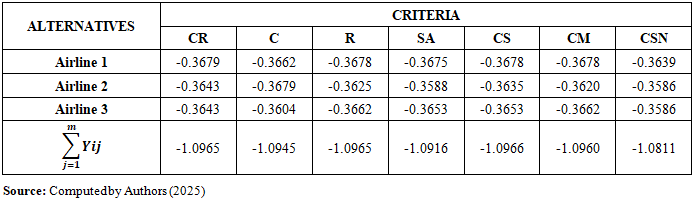 |
| |
|
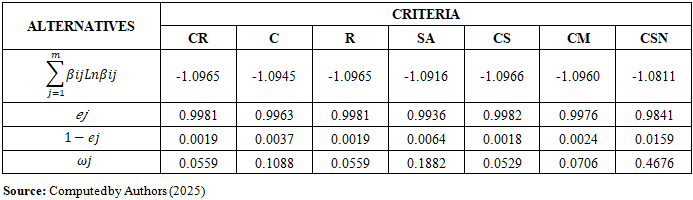
Applying equation 3, 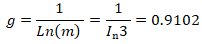 The mathematical description of the entropy value 𝑒𝑗 can be found in equation 2. The entropy value 𝑒𝑗 is descripted mathematically in Equation 2. Hence, 𝑒𝑗 is calculated in Table 7. The weight value is expressed mathematically in Equation 4.Consequently, the weight of criteria 𝑤𝑗 is calculated in Table 8.
Table 7. Entropy values for Seven criteria
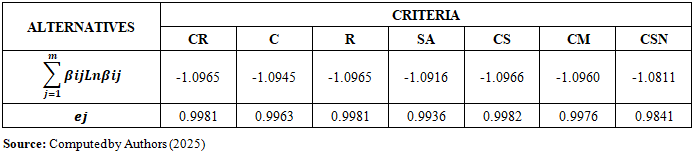 |
| |
|
Table 8. Weights of the criteria
 |
| |
|
4.3. EDAS Application for Alternatives’ Evaluation and Ranking Computation
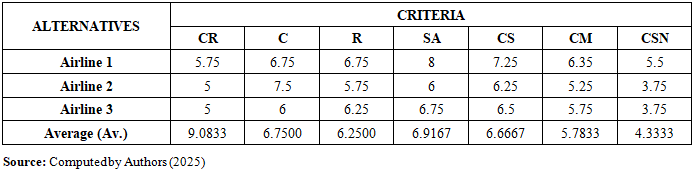
The EDAS method applied evaluated and ranked sampled domestic airline operators using a preset criteria weight calculated using the Entropy method. Table 9 shows the average passengers' rating values.Table 9. Average solution of criteria
 |
| |
|
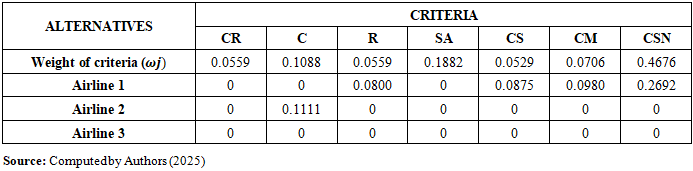
For each alternative, the positive distance from the average rating value was calculated using Equation 11 for beneficial criteria. Subtracting the average value from the rated value, and dividing the result by the average value. Using zero (0) to represent the division's negative value. The outcome shown in Table 10, was carried out for every column.Table 10. Positive distance from average solution (PDA)
 |
| |
|
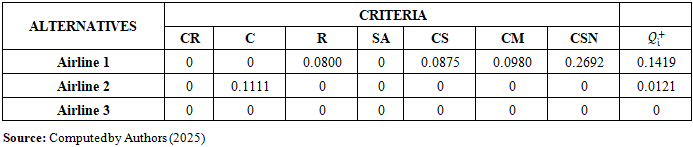
Equation 14 was used to get the weighted sum of the positive distance from the average rating value for each alternative. The findings shown in Table 11 were derived by multiplying the values obtained in each column by their corresponding weights. The total of all the values in the row is the  .
.Table 11. Weighted sum PDA
 |
| |
|
Applying Equations 9 for beneficial criteria, the negative distance from the average rating value was calculated for each alternative by deducting the rated value from the average value and dividing the result by the average value. Using zero (0) to represent the division's negative value. The outcome shown in Table 12, was carried out for every column.Table 12. Negative distance from average solution
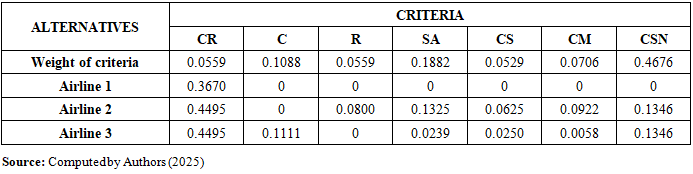 |
| |
|
Equation 13 was used to get the weighted sum of the positive distance from the average rating value for each alternative. The findings shown in Table 13 were derived by multiplying the values obtained in each column by their corresponding weights. The total of all the values in the row is the  .
.Table 13. Weighted sum of the NDA
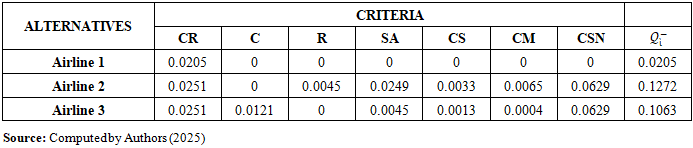 |
| |
|
Equations 13 and 14 were utilised to apply normalisation to the weighted sum of the positive and negative distances from the average rating value, respectively. The normalized value of  was obtained by dividing each value of
  by the maximum value of
  in the column to obtain the value of
  . The normalized value of
  was obtained by subtracting the value of
  from 1, and dividing it with the maximum value of
  to obtain the value of
  . The Appraisal Score
  or Average Score of Judgment
  for all considered alternatives were obtained using Equation 15, by dividing the sum of
  and
and  by two. The alternatives were ranked based on decreasing values of the appraisal score as presented in Table 14 with sampled Airline represented as Airline 1 toping followed by Airline 3 while the least in ranking alternatives is Airline 2.
Table 14. Ranking of alternatives
 |
| |
|
5. Conclusions
Entropy weight model was used to determine the weights of the criteria utilised in evaluating the alternatives. Reliable data from passengers that have boarded the sampled airlines for the period of 2-10 years were both incorporated into the evaluation model to facilitate effective decision-making using Table 1 as rating scale for Table 2. EDAS was used in computing positive and negative distance respectively form the average solution (PDA and NDA) with their respective weights, as well as compute the appraisal score or average score of judgment and ranked alternatives finally. Furthermore, in the sampled airlines, Airline 1 exhibited remarkable benefits to passengers compared to the other sampled airlines with average rating in the following criteria: Communication (C), Conflict Management (CM) and Cultural Sensitivity (CSN) while high rating in Courtesy & Respect (CR), Responsiveness (R), Safety Assurance (SA), Comfort Support (CS). With the resent happenings in Nigeria domestic airline operations, it shows that crew onboard airplane lacks effective communication skills, conflict management prowess and not sensitive to culture, knowing too well that Nigerians are culturally sensitive. Therefore, improving crew-passenger interaction is not only a customer service priority but also a strategic necessity for domestic airline survival and growth. Based on the findings of this study, the following recommendations are proposed:1. Enhance Crew Training: Airline operators should intensify ongoing training programs on cultural sensitivity, customer service, and conflict management.2. Standardize Service Protocols: A uniform service delivery standard should be developed across domestic airlines to ensure consistent passenger experiences.3. Feedback Mechanisms: Airlines should develop real-time feedback systems that allow passengers to rate crew interaction and report concerns.4. Improve Working Conditions: Better welfare and incentives should be provided to motivate crew to maintain high service standards.5. Integrate Passenger Psychology: Airlines should consider passenger psychology in crew training curricula to reduce flight anxiety and improve rapport.This study develops a framework for improving passenger-crew relations in domestic air services using data from Nigerian airlines and provides context-specific insights into how Nigerian cultural dynamics influence the service experience in aviation. It adds to the understanding of service quality assessment in the Nigerian aviation industry.Future researchers are encouraged to investigate the longitudinal effects of crew behavior on brand loyalty in Nigerian airlines, explore passenger-crew dynamics in international airlines operating within and outside Nigeria, study gender differences in passenger expectations and their effect on perceived crew performance and examine the role of emerging technologies (like AI-driven customer service tools) in reshaping passenger-crew interactions.
References
| [1] | Adesina, O. S., Adedotun, A. F., Ayoola, F. J., Adesina, T. F., Alayande, S. A., & Onayemi, O. O. (2024). Statistical learning insights on Nigerian aviation service quality. International Journal of Transport Development and Integration, 8(1), 1–7. https://doi.org/10.18280/ijtdi.080101. |
| [2] | Oluwakoya, A. O. (2011). The impact of deregulation and liberalization in the Nigerian air transport industry: An overview. Journal of Air Transport Studies, 2(1). |
| [3] | Ayasal, A. A., Jakada, A. T. D. B., & Bello, A. (2021). COVID-19 and domestic airlines operations in Nigeria: The emerging issues. International Journal of Advanced Research in Statistics, Management and Finance, 8(2), xx–xx. https://doi.org/10.48028/iiprds/ijarsmf.v8.i2.02. |
| [4] | Adedeji, A. O. (2024). The relevance of air transport in Nigeria and its socio-economic significance on national development. International Journal of Business and Quality Research, 2(2). |
| [5] | Shadare, W. (2025, August 10). Thoughts on aviation regulation, financing and Nigerian airlines’ survival. Aviation Metric. |
| [6] | Adeyemi, A. I. (2021). Customer perception of flight attendants’ behaviour on domestic flights in Nigeria. Journal of Transport and Logistics Research, 5(2), 88–101. |
| [7] | Ganiyu, R. A. (2016). Perceived service quality and customer loyalty: The mediating effect of passenger satisfaction in the Nigerian airline industry. International Journal of Management and Economics, 52(1), 94–117. |
| [8] | Nigeria Civil Aviation Authority. (2023). Passengers’ rights & responsibilities and airlines’ obligations (Part 19). https://ncaa.gov.ng/documents/regulations/statement-of-compliance-templates/passengers-rights- responsibilities-and-airlines-obligations/. |
| [9] | Ajayi, K., & Eze, U. (2023). Cultural diversity and service interaction in West African air transport. African Journal of Social Sciences, 14(1), 66–82. |
| [10] | Kpurukwe, O. I., Nwokah, E., & Abu, P. J. (2024). Effects of passenger comfort on customer patronage of domestic airlines in Nigeria. FULafia International Journal of Business and Allied Studies, 2(4), 188–204. https://fijbas.org/index.php/FIJBAS/article/view/140. |
| [11] | Sunday, P., Adiele, K. C., & Ikegwuru, M. (2025). Passenger experience and patronage of domestic airline companies in Nigeria. Journal of Contemporary Marketing, 10(1). |
| [12] | Obabuike, I. N., Tungkir, K. S., Nwokah, E., & Mzughulga, J. I. (2025). In-flight services and customer patronage of domestic airlines in Nigeria. EKSU International Journal of Management and Development Studies, 5(2). |
| [13] | Edim, E. J., Inyang, B. I., Dafe, O. A., Odinka, P. C., & Cobham, M. A. (2023). Airline service quality and passengers’ loyalty in the Nigerian civil aviation sector. Research Journal of Hospitality and Tourism Management, 2(1), 18–37. https://doi.org/10.52589/RJHTM-KR9M4JRS. |
| [14] | Etudaiye, O. M. (2023). Assessment of airline passengers service quality in Nigeria (Master’s thesis). |
| [15] | Setiawansyah, A. (2024). Combination of EDAS method and entropy weighting in the selection of the best customer service. CHAIN: Journal of Computer Technology, Computer Engineering and Informatics, 2(3), 107–119. https://doi.org/10.58602/chain.v2i3.144. |
| [16] | Büyükselçuk, E. Ç., & Tozan, H. (2022). Integrated entropy-EDAS methods for the electrified car selection problem. Kocaeli Journal of Science and Engineering, 24(1), 38–47. https://doi.org/10.34088/kojose.1015129. |
| [17] | Hatefi, S. M., Ahmadi, H., & Tamošaitienė, J. (2025). Risk assessment in mass housing projects using the integrated method of fuzzy Shannon entropy and fuzzy EDAS. Sustainability, 17(2), 528. https://doi.org/10.3390/su17020528. |
| [18] | Nwaoha, T. C., & Udosoh, N. E. (2022). Facilitating optimal operations of a wave energy converter using a preeminent mooring line: An entropy weight-VIKOR method. Journal of Mechanical and Energy Engineering, 6(46)(1), 77–84. |
| [19] | Osuji, N. J., Ibe, C. C., Okeudo, G. N., & Ejem, E. A. (2024). Evaluating suitable marine transportation vessel options for the efficient distribution of relief materials to the Damare IDP camp in Northeast Nigeria. International Journal of Traffic and Transportation Engineering, 13(2), 23–30. https://doi.org/10.5923/j.ijtte.20241302.01. |


 Abstract
 Reference
 Full-Text PDF
 Full-text HTML