
-
Paper Information
- Paper Submission
-
Journal Information
- About This Journal
- Editorial Board
- Current Issue
- Archive
- Author Guidelines
- Contact Us
Journal of Laboratory Chemical Education
p-ISSN: 2331-7450 e-ISSN: 2331-7469
2026; 14(1): 1-6
doi:10.5923/j.jlce.20261401.01
Received: Sep. 1, 2026; Accepted: Sep. 26, 2026; Published: Sep. 29, 2026

An Interesting Electrophilic Aromatic Substitution: The Preparation of Ethyl o-Nitrobenzoate from Acetophenone
 Abstract
 Reference
 Full-Text PDF
 Full-text HTML
Christine Asfaw, Mary Ibrahim, Nhi Trang, Sang H. Park, Richard Pennington, Joseph Sloop
School of Science and Technology, Georgia Gwinnett College, 1000 University Center Lane, Lawrenceville, GA, 30092, USA
Correspondence to: Joseph Sloop, School of Science and Technology, Georgia Gwinnett College, 1000 University Center Lane, Lawrenceville, GA, 30092, USA.
| Email: |  |
Copyright © 2026 The Author(s). Published by Scientific & Academic Publishing.
This work is licensed under the Creative Commons Attribution International License (CC BY).
http://creativecommons.org/licenses/by/4.0/

The preparation of ethyl o-nitrobenzoate from acetophenone, a three-step synthesis project, is described. The o-nitration of acetophenone is an unusual reaction since the acetyl group (-COCH3 electron-withdrawing group), is a meta-directing substituent. Nevertheless, students performed the electrophilic aromatic nitration twice under mild conditions and obtained the o-nitroacetophenone product in yields ranging from 21 – 23 %. The o-nitroacetophenone product was then oxidized to provide o-nitrobenzoic acid in 74 % yield. Fisher esterification gave ethyl o-nitrobenzoate in 81 % yield.
Keywords: Aromatic nitration, Green oxidation, Fischer esterification
Cite this paper: Christine Asfaw, Mary Ibrahim, Nhi Trang, Sang H. Park, Richard Pennington, Joseph Sloop, An Interesting Electrophilic Aromatic Substitution: The Preparation of Ethyl o-Nitrobenzoate from Acetophenone, Journal of Laboratory Chemical Education, Vol. 14 No. 1, 2026, pp. 1-6. doi: 10.5923/j.jlce.20261401.01.
Article Outline
1. Introduction
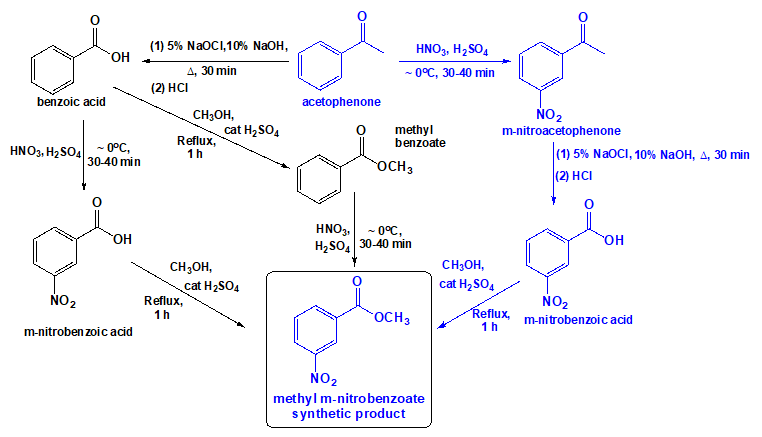
- As an option to the original organic chemistry II synthesis project published earlier, [1] undergraduate students taking the second semester of organic chemistry (Chemistry 2212K) at Georgia Gwinnett College engage in a semester-long URCE synthesis project in the laboratory. [2] Although this project can be carried out by individual students, instructors usually will have students work in small teams to conduct the synthesis project to encourage collaborative learning. The URCE project, adapted from Stradling and Gage [3], involves the preparation of methyl m-nitrobenzoate from acetophenone. See Figure 1.
 | Figure 1. Chemistry 2212K Organic Synthesis Project |
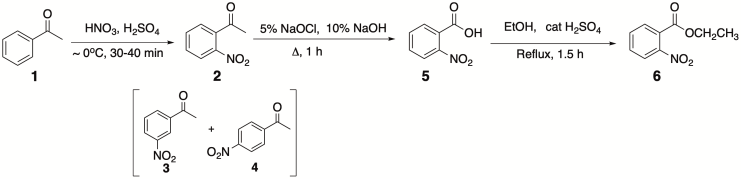 | Scheme 1. Synthesis of ethyl o-nitrobenzoate |
2. Materials and Instrumentation
- The materials and instrumentation used for this experiment include:a. Experimental Instructions (contained in the addendum to the on-line Laboratory Text – Chemistry 2211K/2212K). [2]b. Acetophenone, concentrated HNO3 and H2SO4, 6 M HCl, 50 % NaOH (aq) (v:v), Methanol, Ethanol, Acetone, household bleach (~ 5 % NaOCl), distilled, deionized water.c. 2.5 cm x 7.5 cm, plastic-backed, silica gel coated Gf 254 TLC plates, eluted with 3:1 hexanes:diethyl ether. d. 120 mesh silica gel for flash chromatography.e. Buchi Rotary Evaporator.f. UV-Visible lampg. Digimelt-45 apparatus for melting point analysis (uncorrected).h. Perkin-Elmer FTIR (Zn/Se ATR) for IR analysis with resolutions of 2 cm-1.i. Anasazi-90 NMR operating at 90.51 MHz for 1H spectroscopy.j. Shimadzu QP 20105 GC-MS for GC/MS analysis equipped with a DB-5ms column (30 m × 0.25 mm i.d., 0.25 μm film thickness) in scan mode to identify the acetophenones. Helium was used as the carrier gas at a constant pressure of 150.5 kPa. A 1.0 μL aliquot of the sample in methylene chloride was injected in splitless mode at an injector temperature of 280 °C. The GC oven temperature was initially held at 110 °C for 1 min, increased to 300 °C at a rate of 15 °C/min, and then held at 300 °C for 10 min. The GC–MS interface and MS ion source temperatures were maintained at 280 and 230 °C, respectively. Mass spectra were acquired in electron ionization (EI) mode at an electron energy of 70 eV over a mass range of m/z 40–370.k. Drying Lamp.l. Kontes 2” chromatography column (0-100 % Ethyl Acetate: Hexanes)
3. Experimental Procedure
3.1. Preparation for the Synthesis Project
- During the first laboratory session, students receive a presentation by the instructor on the project parameters and laboratory tasks students are expected to accomplish during the semester. [9] Students then form small teams and select which synthesis pathway they plan to pursue. Next, students prepare a synthesis plan briefing (ppt format) which they present orally to the instructor at the next laboratory session. The synthesis plan briefing includes the following items:• The overall reaction pathway scheme, • Balanced chemical equation for each step of the synthesis – all teams start with 2.0 grams of acetophenone,• Mole table for the first reaction in the synthesis plan,• General procedure for each synthesis step – adapted from [3], • Tentative timeline for completion of the project.Following feedback from the instructor and approval of their plan, students prepare their laboratory notebooks in accord with the GGC Organic Chemistry laboratory manual [2] for the first reaction in their synthesis plan and commence laboratory operations the following session.
3.2. Laboratory Synthesis Activities
3.2.1. Synthesis of o-nitroacetophenone (2)
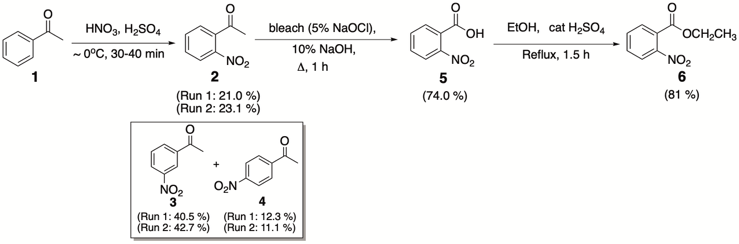
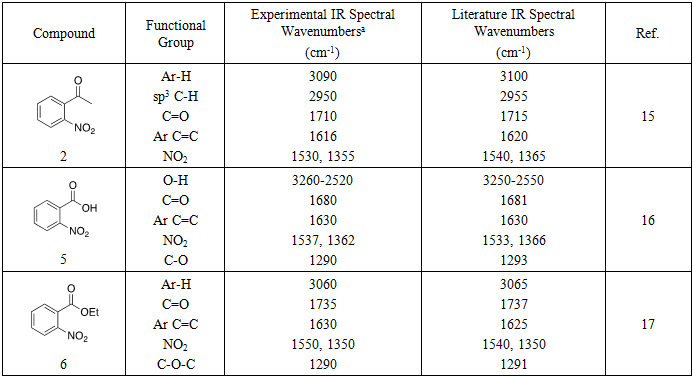
- Preparation of nitrating mixture. A 25 mL Erlenmeyer flask equipped with a thermometer and stir bar was placed into a salt-ice water bath and charged with HNO3 (1.33 mL, 12 M) and H2SO4 (2.0 mL, 18.8 M). The mixture was stirred and temperature monitored to ensure the mixture temperature was maintained within a narrow range of -5 °C - 0 °C.Preparation of o-nitroacetophenone. A 50 mL beaker equipped with a thermometer and stir bar was placed into a salt-ice water bath (ca. 0-5 °C) and charged with acetophenone (1) (2.00 g, 0.0166 mol) and concentrated H2SO4 (5.0 mL, 18.8 M) with continuous stirring. To the resulting solution was added the cold nitrating mixture dropwise slowly to prevent rapid temperature change over a 20-minute period. The temperature was observed to rise to ~10 °C during the administration of the nitrating mixture. The reaction was stirred for an additional 20 min once addition of the nitrating agent was complete while ensuring the low temperature (≤ 10 °C) was maintained. Then, the reaction mixture was slowly poured over an ice-water mixture (approximately 20 g ice and 20 mL distilled water) with stirring. When the ice was melted, the solution was filtered and approximately 0.51 g of m-nitroacetophenone was obtained. The filtrate was added to a separatory funnel, extracted with three 10 mL aliquots of EtOAc, The organic layers were combined, washed with 2 × 5 mL portions of distilled water, dried over Na2SO4 and the mixture separated via column chromatography. Upon concentration of the fractions under reduced pressure, a pale yellowish, semisolid product was obtained, o-nitroacetophenone (2) (run 1: 0.57 g, 21.0 % yield; run 2: 0.63 g, 23.1 % yield). TLC: Rf = 0.20. Melting range: 24-27 °C [lit m.p. 25-28 °C] [10]. IR (cm-1): 3090 (Ar-H), 2950 (sp3 C-H), 1710 (C=O), 1616 (Ar C=C), 1530, 1355 (NO2). 1H NMR (ppm, CDCl3):
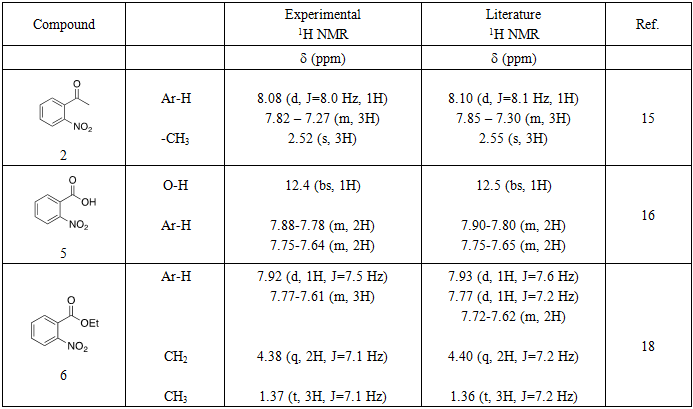
 8.08 (d, 1H, J=8.0 Hz), 7.82 – 7.27 (m, 3H), 2.52 (s, 3H). GC/MS (m/z): 165 (M+, 2 %); 150 (M+- CH3, 75 %); 91 (10 %); 76 (45 %); 43 (CH3CO+, 100 %). Additional fractions, containing 3-nitroacetophenone (3) (run 1: 0.60 g + 0.51 g*, 40.5 % yield; run 2: 0.62 g + 0.55 g*, 42.7 % yield) and 4-nitroacetophenone (4) (run 1: 0.34 g, 12.3 % yield; run 2: 0.30 g, 11.1 % yield) were also obtained, but were not carried forward in the synthesis.*Obtained during initial filtration.
3.2.2. Synthesis of o-nitrobenzoic acid (5)
- A 125 mL beaker, equipped with a stir bar, was charged with 2 (1.10 g, 0.0066 mol), household bleach (5 % NaOCl, 80 mL), 10 % NaOH (5 mL) and heated to ~ 80 - 85 °C with stirring. The reaction was allowed to proceed for 1 h. The reaction mixture was allowed to cool to room temperature and ~ 4 mL acetone added to destroy any remaining NaOCl. Then, 6 M HCl was added slowly to the solution with stirring until a pH of 2-3 was reached. The cloudy suspension was then placed in an ice bath for 15 min. The cold solution was subjected to vacuum filtration. The crude product was washed with 2 × 5 mL portions of distilled water and dried under a heat lamp. Recrystallization from hot water afforded 5 (0.82 g, 74 % yield) as a pale, yellow solid. TLC: Rf = 0.11. Melting range: 150-152 °C [lit m.p. 146 - 148 °C] [11]. IR (cm-1): 3260-2520 (COO-H), 1680 (C=O), 1630 (Ar C=C), 1537, 1362 (NO2), 1290 (C-O). 1H NMR (ppm, CDCl3):
 12.40 (1H, bs), 7.88-7.78 (m, 2H), 7.75-7.64 (m, 2H).
3.2.3. Preparation of ethyl o-nitrobenzoate (6)
- A 25 mL round-bottomed flask, equipped with a stir bar, was charged with 5 (0.80 g, 0.0048 mol), ethanol (6.5 mL, 95 %) and concentrated H2SO4 (0.33 mL, 18.8 M). A reflux condenser is affixed to the flask and the reaction mixture refluxed for 1.5 h with stirring. The resulting reaction mixture was allowed to cool to room temperature and then placed into a separatory funnel, extracted with 3 × 5 mL aliquots of EtOAc and the organic layers combined. The organic layer was washed with 3 × 5 mL saturated NaHCO3 and dried over Na2SO4. The solvent was removed under reduced pressure to afford 6 (0.76 g, 81 % yield) as a pale, yellow liquid that solidified upon cooling in an ice bath. TLC: Rf = 0.36. Melting range: 26 - 30 °C [lit m.p. 26-29 °C] [12]. IR (cm-1): 3060 (Ar-H), 2950 (sp3 C-H), 1735 (C=O), 1630 (Ar C=C), 1550, 1350 (NO2), 1290 (C-O-C). 1H NMR (CDCl3):
 7.92 (d, 1H, J=7.5 Hz) 7.77-7.61 (m, 3H), 4.38 (q, 2H, J = 7.1 Hz), 1.39 (t, 3H, J = 7.1 Hz).
4. Results and Discussion
4.1. Synthesis
- The synthesis plan undertaken is depicted in Scheme 2.
 | Scheme 2. Synthesis of ethyl o-nitrobenzoate |
4.2. Characterization
- For each of the products in the three-step synthesis, experimental IR and 1H NMR spectra were obtained and compared with reported literature spectroscopic data. In all cases, spectral results from compounds 2, 5 and 6 were found consistent with previously reported data. See Tables 1 and 2.
|
|
5. Conclusions
- This modification of the synthesis project represents an alternative pathway that students may follow in the event the nitration of acetophenone yields a substantial proportion of o-nitroacetophenone in addition to the usual m-nitroacetophenone. The ability to use this product instead of discarding it was in keeping the value of scientific inquiry as well as with the green chemistry principle of waste minimization. Subsequent oxidation to o-nitrobenzoic acid was accomplished using the procedures set forth by Stradling and Gage. [3] The final esterification step to prepare ethyl o-nitrobenzoate was the second modification to ensure a solid product is obtained. All products were satisfactorily characterized, and spectral results were found to be in good agreement with the scientific literature. Yields for the individual reactions with the modifications were also satisfactory, giving an overall reaction sequence yield of 13.2 %. The students conducting the experiments found that the synthesis, isolation and analysis of the intermediate and final products were interesting and challenging. They also enjoyed learning additional isolation and purification techniques while undertaking a synthesis pathway that resulted in different organic products.
ACKNOWLEDGEMENTS
- J. S. and R. P. wish to acknowledge the School of Science and Technology for supplying funding for this project.