
-
Paper Information
- Paper Submission
-
Journal Information
- About This Journal
- Editorial Board
- Current Issue
- Archive
- Author Guidelines
- Contact Us
Journal of Game Theory
p-ISSN: 2325-0046 e-ISSN: 2325-0054
2026; 15(1): 14-22
doi:10.5923/j.jgt.20261501.03
Received: Sep. 16; Accepted: Oct. 5, 2026; Published: Oct. 9, 2026

The Refinement of Nash Equilibrium Due to the Credibility of Threat Described by Incumbents' Stickiness to Equilibrium Output and Their Advertising Expenditures: The Choice of Optimal Path and the Revealed Preferences of n Firms in Sequential Games
 Abstract
 Reference
 Full-Text PDF
 Full-text HTML
Vasilios Kanellopoulos
University of Birmingham, School of History and Cultures, Edgbaston, Birmingham B15 2TT, United Kingdom
Correspondence to: Vasilios Kanellopoulos, University of Birmingham, School of History and Cultures, Edgbaston, Birmingham B15 2TT, United Kingdom.
| Email: |  |
Copyright © 2026 The Author(s). Published by Scientific & Academic Publishing.
This work is licensed under the Creative Commons Attribution International License (CC BY).
http://creativecommons.org/licenses/by/4.0/

The present research examines the refinement of Nash equilibrium due to the credibility of threat described by incumbents’ stickiness to equilibrium output and their advertising expenditures. First, the subgame perfect equilibrium is obtained after the incumbents’ stickiness to equilibrium output credible threat to a potential entrant. This is a refinement of simple Nash equilibrium as the latter is empty of threats. Second, the subgame credible Nash equilibrium is obtained after the introduction of the incumbents’ advertising expenditure additional credible threat to two potential entrants who try simultaneous entry besides the incumbents’ stickiness to equilibrium output credible threat. This is a refinement of subgame perfect Nash equilibrium as the latter does not include the additional credible threat of advertising expenditures. Finally, we develop a model which creates the incumbents’ optimal path and, then, their revealed preferences in sequential game are examined.
Keywords: Firms, Cournot oligopoly, Nash equilibrium, Refinement, Optimal path, Revealed preferences
Cite this paper: Vasilios Kanellopoulos, The Refinement of Nash Equilibrium Due to the Credibility of Threat Described by Incumbents' Stickiness to Equilibrium Output and Their Advertising Expenditures: The Choice of Optimal Path and the Revealed Preferences of n Firms in Sequential Games, Journal of Game Theory, Vol. 15 No. 1, 2026, pp. 14-22. doi: 10.5923/j.jgt.20261501.03.
Article Outline
1. Introduction
- The present research examines the issue of the refinement of Nash equilibrium due to the credibility of threat from incumbents. The threat goes to potential entrants and, in our analysis, is described by the incumbents’ stickiness to the
 -firm Cournot oligopoly equilibrium output as well as the advertising expenditures made by incumbents. As the refinement of Nash equilibrium has taken place, the current research focuses on the choice of the optimal path from the incumbents of Cournot oligopoly and their revealed preferences in sequential games. In game theory literature, several studies deal with the notion of the refinement of Nash equilibrium [1,2,3,4,5,6,7,8]. More specifically, [8] describes the logic of the refinement of Nash equilibrium and argues that it tries to capture further necessary conditions for self-enforcing norms of behavior. In turn, [4, p. 2] support that “refinements of John Nash’s 1950 definition aim primarily to distinguish equilibria in which implicit commitments are credible due to incentives. One group of refinements requires sequential rationality as the game progresses. Another ensures credibility by considering perturbed games in which every contingency occurs with positive probability, which has the further advantage of excluding weakly dominated strategies”. The theoretical studies focus on the refinement of Nash equilibrium for different reasons [1,2,3,5,6,7,9,10]. [3] deal with the robustness of equilibrium refinements while [9] and [10] focus on the perfection of the equilibrium. [7] concentrates on proper equilibrium while the interest of [5] and [6] is attracted by the concepts of the strategic stability of equilibria and sequential equilibria, respectively. In addition, [2] deal with signaling games and stable equilibria, whereas [1] proposes a refinement of sequential equilibrium for extensive form games by generalizing a restriction proposed for signaling games in [2]. [1] shows that the forward induction equilibrium correspondence is hemi-continuous in the outcome space with respect to the changes of parameters of the game. [11], in turn, give emphasis to three distinct infinite-game generalizations of perfect equilibria suggested by [10] as well as proper equilibria suggested by [7]. According to [11], these are the following: a) the strong approach, b) the weak approach and c) the limit-of-finite approach. In this vein, [12] develop a new limit-of-finite approach1 following [11] formulation.The present analysis goes beyond the literature of the refinement of Nash equilibrium and offers new insights regarding this issue. It succeeds it by assuming that the refinement of Nash equilibrium is due to the credibility of threat from incumbents in a
 -firm Cournot oligopoly. This threat refers to the incumbents’ (active firms) stickiness to the
 -firm Cournot oligopoly equilibrium and goes to a potential entrant who decides to enter or not the industry. Using this threat, the incumbents desire to deter the potential entrant from entry the industry. The equilibrium which arises is the subgame perfect Cournot Nash equilibrium and its operation is to reject and rule out some of the Nash equilibria as unreasonable [3,13]. Here, the most important argument is that the simple Nash equilibrium does not include threats (empty threats). In addition, an important meaning of this equilibrium is that the Cournot model can also lead to subgame perfect equilibrium besides the Stackelberg model (solved by backward induction) whose solution is the subgame perfect Nash equilibrium. This occurs as the backward induction identifies Cournot equilibrium with threats in the deterrent game played by incumbents and potential entrant. Another contribution of the current paper relates to the introduction of an additional threat from incumbents. This threat refers to advertising expenditures (another threat originated by incumbents besides their stickiness to the
 -firm Cournot oligopoly equilibrium) made by incumbents and goes to two simultaneous potential entrants in the relevant model. The main goal of the incumbents is to deter the two simultaneous potential entrants from entry the industry by introducing an additional threat (advertising expenditures). A significant strand of the literature (regarding the advertising expenditures) shows that the advertising expenditures constitute significant barriers to entry [14,15]. Here, the subgame credible Nash equilibrium is obtained and it constitutes refinement of the subgame perfect Nash equilibrium obtained previously during the deterrent game played by incumbents or existing firms of the oligopoly and the potential entrant. It is obvious that the subgame credible Nash equilibrium rules out some of the subgame perfect Nash equilibrium as unreasonable. This case concerns the absence of the additional threat which, in our analysis, is the advertising expenditures made by incumbents. However, the most significant contribution of the present research is that it develops a model of the choice of optimal path from incumbents and their revealed preferences (revealed preferences of
 firms) in sequential games. Keeping the logic of the deterrent game played by incumbents and potential entrant with the inclusion of the credibility of threat (incumbents’ stickiness to the
 -firm Cournot oligopoly equilibrium output) which is originated from incumbents and goes to potential entrant and changing, to some degree, the assumptions of the model2, the current paper creates the optimal paths for incumbents and the potential entrants. These optimal paths are functions of the sequence of the strategy profiles in the two periods. The paths are optimal as they include optimal situations such as the Nash equilibrium and the subgame perfect Nash equilibrium. In this case, we demonstrate that the incumbents (players) are indifferent between their paths and the path of the other players (potential entrants). When we change a condition for subgame perfect Cournot Nash equilibrium for potential entrants, the subgame perfect Nash equilibrium does not hold. There, the incumbents or existing firms of the Cournot oligopoly cannot credibly threaten the potential entrants with the threat of stickiness to the
 -firm Cournot oligopoly equilibrium output. Given that the path for incumbents is optimal, the path for potential entrants is not optimal. Here, we demonstrate that the incumbents weakly prefer their path to the path of the other players which are the potential entrants. Other studies in the literature [16,17] deal with the specific issue. The rest of the paper includes the model. This occurs in the next section. First, the case of the entry of a potential entrant in a n-firm Cournot oligopoly and the credibility of threat described by incumbents’ stickiness to equilibrium output is analysed. After, the case of the simultaneous entry of two potential entrants in a n-firm Cournot oligopoly and the credibility of threat described by incumbents’ stickiness to equilibrium output and their advertising expenditures is examined. Finally, the choice of optimal path and the revealed preferences of n firms in sequential games is described. The last section includes the conclusions and avenues for further researchers to turn their attention.
2. The Refinement of Nash Equilibrium Due to the Credibility of Threat Described By Incumbents’ Stickiness to Cournot Oligopoly Equilibrium Output and Their Advertising Expenditures: The Choice of Optimal Path and the Revealed Preferences of n Firms in Sequential Games
2.1. The Case of the Entry of a Potential Entrant in a n-firm Cournot Oligopoly and the Credibility of Threat Described by Incumbents’ Stickiness to Equilibrium Output
- We start with a
 -firm Cournot oligopoly. This oligopoly concerns some manufacturing industry. This industry produces a homogeneous product. The linear inverse demand function of the industry is given by:
 | (1) |
 is the total output of the industry with
 In addition,
 is the price of the output in this market.Here, we make the additional assumption that the industry has high profits. The profits of the industry are given by the following function:
 | (2) |
 and
 Then, the
 Cournot oligopoly equilibrium (Nash equilibrium) is given by:
 | (3) |
 | (4) |
 is the equilibrium level of the total revenue,
 is the number of firms in the industry,
 is the equilibrium output of the
 -firm Cournot oligopoly,
 is the price of the output in the Cournot oligopoly equilibrium,
 are the equilibrium profits of the industry while
 is the total cost of the
 active firms.Then, a potential entrant or a
 firm enters the industry in order to optimally respond to the
 -firm Cournot oligopoly equilibrium. This form pays a sunk entry cost,
 in order to enter the industry. Here, we assume that the sunk entry costs paid by the
 firm are small or alternatively some fixed costs are sunk. The equilibrium or maximum profits of the
 are the following:
 | (5) |
 is the total cost of the
 firm which enters the industry,
 is the equilibrium level of the output produced by the
 firm and
 is the equilibrium price of the Cournot oligopoly after the entry of the
 firm. However, the
 existing firms of the Cournot oligopoly threaten to stick to the
 -firm Cournot oligopoly equilibrium output which is the
 This equilibrium level of the output was described previously. If the threat is credible, the
 active firms deter the
 firm or potential entrant from the entry the industry [13]. In other words, the
 firm may be deterred from entering if there is an equilibrium of the post-entry Cournot subgame at which the potential entrant does not produce or if the potential entrants’ profits equal to the sunk entry costs. Against such a threat, it is optimal for the
 firm to stay out [13]. When the
 firm does not produce, we have:
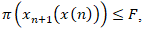
 | (6) |
 | (7) |
 | (8) |
 | (9) |
 | (10) |
 | (11) |
 | (12) |
 | (13) |
 | (14) |
 | (15) |
 | (16) |
 | (17) |
 | (18) |
 | (19) |
 | (20) |
 | (21) |
2.2. The Case of the Simultaneous Entry of Two Potential Entrants in a n-Firm Cournot Oligopoly and the Credibility of Threat Described by Incumbents’ Stickiness to Equilibrium Output and Their Advertising Expenditures
- As in the previous case, we assume that we have a
 -firm oligopoly which has the following linear inverse demand function:
 | (22) |
 is the output of the industry produced by
 firms and
 is the price of the output in this industry.In this market, the
 firms or incumbents have high profits. In addition, we assume that the incumbents expend some amount of budget for advertising5. The profits of the
 -firm Cournot oligopoly are given by:
 | (23) |
 and
 is the advertising expenditure6 spent by incumbents,
 Then, the Nash equilibrium is described:
 | (24) |
 is the equilibrium total revenue,
 is the number of the existing firms in the industry,
 is the equilibrium output of the
 -firm Cournot oligopoly,
 is the price of the output in the Cournot oligopoly equilibrium,
 are the equilibrium profits of the
 firms,
 is the total cost of the
 existing firms and
 is the advertising expenditure of the incumbents.Alternatively, the condition (24) can be written as:
 | (25) |
 Then two potential entrants or
 firms simultaneously enter7 the industry for optimally responding to the Cournot oligopoly equilibrium output of the
 existing firms,
 In order to enter, they pay small sunk entry costs,
 The maximum profits of the
 firms are given by the following equation:
 | (26) |
 is the cost of the
 firms which simultaneously enter the industry,
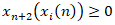 is the equilibrium output of the
 firms while
 is the price equilibrium of the Cournot oligopoly after the simultaneous entry of the
 firms.In this point, the incumbents use two credible threats to the simultaneous potential entrants: a) the incumbents’ threat to stick to the
 -firm Cournot equilibrium output,
 and b) the advertising expenditures in order to deter the potential entrants from entry [14,15,22]8. Besides the threat regarding the stickiness to the
 -firm Cournot equilibrium output, the incumbents add another credible threat which concerns the advertising expenditures. By employing these credible threats, the incumbents deter the two simultaneous potential entrants or
 firms from entry. This occurs if there is an equilibrium of the post entry Cournot perfect subgame at which the potential entrants not actually produce or if the two simultaneous potential entrants’ profits equal to the sunk entry costs. In any case, it is an optimal choice for the two simultaneous potential entrants or
 firms to stay out the industry as a double credible threat takes place from the incumbents. Given such double credible threat, the
 firms have more reasons to stay out the industry and not to enter. If the two simultaneous potential entrants do not produce, we take:
 | (27) |
 | (28) |
 | (29) |
 | (30) |
 When the two simultaneous potential entrants’ profits are equal to the level of sunk entry costs, we have:
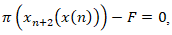 | (31) |
 | (32) |
 | (33) |
 | (34) |
 | (35) |
 | (36) |
 | (37) |
 | (38) |
 -firm Cournot equilibrium output which is the first credible threat) as a second additional credible threat is the requirement for subgame credible Nash equilibrium. Therefore, the post entry pure strategies Cournot subgame credible Nash equilibria is given by:
 | (39) |
 | (40) |
 | (41) |
 | (42) |
2.3. The Choice of Optimal Path and the Revealed Preferences of n Firms In Sequential Games
- We assume that we have the game played in the subsection 2.1. Here, some changes in the solutions can be occurred due to changes in the assumptions of the model. Besides the
 existing or active firms, at the initial node, there are
 potential entrants who are the other players. In addition, we assume that
 In other words, the number of existing firms is greater than the number of potential entrants. In the condition (3), we have the Nash equilibrium where the
 existing firm’s (the players) Nash equilibrium action is a best response to
 potential entrant’s (other players) Nash equilibrium actions (see Osborne, 2004). In Nash equilibrium, no player could gain more by changing his/her own strategy holding all the other player’s strategies fixed. After, we focus on the conditions (20) and (21) where the subgame perfect Cournot Nash equilibrium takes place. More specifically, the condition (20) is the optimal condition for the
 existing firms in the industry. This arises after the movement of an additional potential entrant to enter the industry10 and the incumbents’ subsequent threat through the stickiness to the
 -firm equilibrium output in order to deter the
 potential entrants plus the additional potential entrant from entry the industry. Given this threat from incumbents (active firms), the optimal choice of all potential entrants is to stay out and not to enter. As a result, the optimal condition for the
 (after the entry of the additional potential entrant) takes place through the condition (21)11. In addition, we assume that the Nash equilibrium described by the condition (3) occurs in the time 0 and the subgame perfect Cournot Nash equilibrium described by the conditions (18), (19), (20) and (21) and more properly by the corrected conditions described in the footnote 10 (which take into account the analysis in the subsection 2.3 with the new assumptions) occurs in time 1. As a result, we have two periods
 After, we create the set of strategy profiles of the
 active firms in two periods as follows:
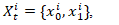 | (43) |
 at the initial node where the Nash equilibrium takes place, while after the entry of the additional potential entrant, the potential entrants become
 when the subgame perfect Cournot Nash equilibrium occurs) in two periods is the following:
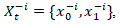 | (44) |
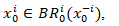 | (45) |
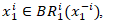 | (46) |
 is the best response. The (45) and (46) mean that the
 incumbents best respond to the strategies of the counterparts who are the potential entrants in the two periods.Then, we create the path of strategy profiles for the
 incumbents which is a function of the sequence of the strategy profiles in the two periods. As the strategy profiles refer to the Nash equilibrium (period 0) and the subgame perfect Cournot Nash equilibrium (period 1), the path of strategy profiles of the
 existing firms is optimal. This path is optimal as it includes optimal situations such as the Nash equilibrium and the subgame perfect Nash equilibrium. Given that this path is
 we have:
 | (47) |
 | (48) |
 potential entrants refers to the Nash equilibrium12 at the initial node in the period 0 and the strategy profile of the
 potential entrants (after the entry of the additional potential entrant) refers to the subgame perfect Cournot Nash equilibrium in the period 1, the path of strategy profiles of the potential entrants is optimal. The path is optimal as it includes optimal situations such as the Nash equilibrium and the subgame perfect Cournot Nash equilibrium13. Given that this path is
 we have:
 | (49) |
 | (50) |
 | (51) |
 is as good as
 . Alternatively, the
 incumbents are indifferent between the paths
 (their own path) and the path
 which is the path of the other players. Having demonstrated the choice of optimal path from incumbents and potential entrants as well as the revealed preferences in sequential games, we examine another case regarding this issue.More specifically, all the assumptions regarding the strategy profiles and the optimal path of
 incumbents (
 firms of the Cournot oligopoly) hold as described previously. The same occurs regarding the best responses of incumbents to the strategies of the counterparts who are the potential entrants. As a result, we have:
 | (52) |
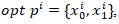 | (53) |
 potential entrants (after the entry of the additional potential entrant) does not hold. In other words, the following condition does not hold:
 | (54) |
 | (55) |
 | (56) |
 | (57) |
 potential entrants with the threat of stickiness to the
 -firm Cournot oligopoly equilibrium output. According to [13], in this point, there is no equilibrium in which it is shut out of production. This means that here we do not have cessation of the production and, thus, the production is continued. Obviously, this does not constitute a rational or optimal choice for the
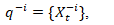
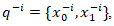
 potential entrants. As a result, the inequalities described in (56) and (57) do not constitute conditions for subgame perfect Cournot Nash equilibrium. Thus, the path of strategy profiles of the potential entrants is not optimal. Although the optimal situation of Nash equilibrium in the period 0 takes place, the optimal situation of subgame perfect Cournot Nash equilibrium in the period 1 does not takes place and does not hold. For this reason, the path of strategy profiles of the
 potential entrants is not optimal and then we take:
 | (58) |
 | (59) |
 | (60) |
 is at least as good as path
 . Alternatively, the
 incumbents weakly prefer the path
 to the path
 which is the path of the other players.
3. Conclusions
- This paper deals with the refinement of Nash equilibrium when a
 -firm Cournot oligopoly takes place. Here, the reason for the refinement of Nash equilibrium is the credibility of threat (the threat goes to potential entrants who try entry) described by incumbents’ stickiness to the
 -firm Cournot oligopoly equilibrium output and their advertising expenditures. As the existing literature about the issue described above is limited, this is one of the most important contributions of the current research. Here, several points attract the interest. First, a deterrent game played by the incumbents (existing or active firms) of the Cournot oligopoly and the potential entrant is presented. The incumbents introduce the credible threat through their stickiness to the
 -firm Cournot oligopoly equilibrium output when they understand that the potential entrant tries entry in order to optimally respond to the Nash equilibrium and the Cournot oligopoly equilibrium output. Here, the potential entrant is prevented from entry the industry and his/her best and optimal choice is to stay out and not to enter the industry. Then, the subgame perfect Cournot Nash equilibrium is obtained and is a refinement of simple Nash equilibrium as the latter is empty of threats. In addition, the deterrent game played by the incumbents of the oligopoly and two potential entrants who try simultaneous entry is presented. Besides the incumbents’ credible threat described by their stickiness to the
 -firm Cournot oligopoly equilibrium output, the incumbents introduce an additional credible threat which goes to two simultaneous potential entrants. This credible threat concerns the advertising expenditures made by incumbents. Here, a significant body of the literature underlines the importance of advertising expenditures and their use as barriers to entry. In this way, the incumbents deter the two simultaneous potential entrants from entry when they understand that these entrants try entry in order to give an optimal response to the Cournot oligopoly equilibrium output of the incumbents. Then, the optimal choice of the two simultaneous potential entrants is to stay out. After, the subgame credible Cournot Nash equilibrium is obtained and it constitutes a refinement of the subgame perfect Cournot Nash equilibrium given that the latter includes only the incumbents’ stickiness to the
 -firm Cournot oligopoly equilibrium output credible threat and does not take into account the second additional credible threat which is the incumbents’ advertising expenditures.The other important contribution of the present research is the creation of the incumbents’ optimal path and, then, their revealed preferences in sequential game are examined. In this paper, we develop a model for explaining this point. This model includes both the incumbents and the potential entrants (we assume that we have a finite number of potential entrants at the initial node) from the start of the game. In this game, the incumbents are the players and the potential entrants are the other players. Based on the equilibrium levels which are obtained in the sequential game, the optimal path of
 firms (the optimal path is a function of the sequence of the strategy profiles which correspond to equilibrium levels) of the Cournot oligopoly is created and the preferences of incumbents are revealed. A significant point which should be underlined here is that the other players (potential entrants) can have optimal path. The optimal path does not exist (the path is not optimal) when some condition for subgame perfect Cournot Nash equilibrium regarding the other players does not hold. As the existing literature which deals with the specific issue is small, this is another novel trait of the current research. The literature is smaller when the existing firms of a Cournot oligopoly (incumbents) represent the individual unit14. The future research could delve into issues regarding the refinement of Nash equilibrium. Aptly, [26] argues that there are several refinements of Nash equilibrium, such as subgame-perfect, perfect, proper, sequential, persistent, justifiable, neologism-proof, stable, perfect-sequential, intuitive, divine, undefeated, and explicable equilibria. [26] continues that all these refinements do not concern differences in the underlying concepts. On the contrary, all these refinements constitute attempts for formalization the same two or three intuitive ideas. It is reasonable that future researchers could give emphasis to these refinements of Nash equilibrium and go beyond the research in these areas. The application of these concepts in entrepreneurship and innovation could draw the attention of future research still more. Finally, the development of alternative models regarding the optimal choice of incumbents originated from the above concepts of the refinement of Nash equilibrium and their revealed preferences should be another concern of the future research.
Notes
- 1. According to [12], their “finitistic” approach to perfection defines a limit-of-finite perfect equilibrium as the limit of sequences of (exact) equilibria of neighboring finite Selten perturbations that respect the strategic aspects of the original (infinite) game, in the sense that they can be interpreted as “true” representations of certain infinite Selten perturbations. 2. The model developed herein keeps the
 firms of the oligopoly which are the players and changes the assumptions regarding the potential entry. More specifically, it assumes that, at the initial node, there
 potential entrants which are the other players. After, the potential entrants decide or not the entry of an additional potential entrant in order to optimally respond to the
 -firm (incumbents) Cournot oligopoly equilibrium output. 3. According to [18], a subgame perfect equilibrium is a strategy profile that induces a Nash equilibrium in every subgame.4. In the oligopoly literature, the Stackelberg solution is a subgame perfect Nash equilibrium. The Stackelberg model is solved by backward induction. In the current research, we show that a Cournot oligopoly model can lead to subgame perfect Nash equilibrium (as a refinement of the simple Nash equilibrium) when the game played by incumbents and potential entrant takes into account the credibility of threat. Backward induction identifies Nash equilibria with credible threats.5. [20], [21] and [22] use advertising expenditures in their models.6. Here, we assume that the advertising expenditure is a function of the output produced by the
 firms of the oligopoly.7. In this case, [23, p. 2] argues that “Lockheed and McDonnell Douglas simultaneously entered in the market for wide-body aircraft, leading both firms to huge losses”. [23, p.2] also continues that “British Satellite Broadcasting and Sky Television simultaneously attempted to enter the British Stellite TV industry, although BSB agreed to a merger that essentially left Sky under control”.8. [14,15,22] focus on the use of advertising expenditures as barriers to entry. 9. In his analysis, [24] supports that subgame credible Nash equilibrium retains the internal credibility requirement of subgame perfect Nash equilibrium (equilibrium behavior in every subgame) and adds an external credibility requirement across equivalent subgames.10. In order to optimally respond to the
 -firm Cournot oligopoly equilibrium, the
 potential entrants decide the entry of an additional potential entrant. 11. Given the fact that, in our analysis in 2.3 subsection, we consider that the other players are the
 potential entrants, these players are taken into account in the definition of the Nash equilibrium in the condition (3) besides the
 incumbents who are the players. As the sequential game is continued with
 potential entrants, these other players are taken into account in the analysis. These other players-potential entrants are considered in the analysis when the additional potential entrant enters the industry and all together face the threat of stickiness to
 -firm Cournot equilibrium output from the
 incumbents for exiting the industry. Then, after the entry of the additional potential entrant, the potential entrants become
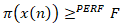
 It is obvious that the conditions for subgame perfect Cournot Nash equilibrium described in (18), (19), (20) and (21) change after the introduction of new assumptions herein. The corrected conditions for subgame perfect Nash equilibrium can be re-written:
 and
 Alternatively, these conditions can be written as:
 and
 12. For a definition of Nash equilibrium, see [18].13. Here, it is important to underline that it is an optimal choice for potential entrants to stay out or not to enter [13]. This optimal choice of the potential entrants is described by the subgame perfect Cournot Nash equilibrium. In this point, the production stops. 14. [16] generally refers to the individual players, their optimal path and their revealed preferences. In turn, [17] use consumers as the individual unit.