
-
Paper Information
- Paper Submission
-
Journal Information
- About This Journal
- Editorial Board
- Current Issue
- Archive
- Author Guidelines
- Contact Us
Journal of Game Theory
p-ISSN: 2325-0046 e-ISSN: 2325-0054
2026; 15(1): 1-7
doi:10.5923/j.jgt.20261501.01
Received: Apr. 19, 2026; Accepted: May 12, 2026; Published: May 23, 2026

The Insiders Who Exit the Industry, the Oligopoly Which Converges to the Long-Run Competitive Solution, Strict Domination and the Post-Entry Pure Strategies Cournot Subgame Equilibria
 Abstract
 Reference
 Full-Text PDF
 Full-text HTML
Vasilios Kanellopoulos
University of Birmingham, School of History and Cultures, Edgbaston, Birmingham B15 2TT, United Kingdom
Correspondence to: Vasilios Kanellopoulos, University of Birmingham, School of History and Cultures, Edgbaston, Birmingham B15 2TT, United Kingdom.
| Email: |  |
Copyright © 2026 The Author(s). Published by Scientific & Academic Publishing.
This work is licensed under the Creative Commons Attribution International License (CC BY).
http://creativecommons.org/licenses/by/4.0/

The present paper examines the post entry pure strategies Cournot subgame equilibria when all insiders exit the industry and, thus, the Cournot oligopoly converges to the long-run competitive solution. In this entry and exit game, special emphasis is given to the introduction of dominant strategies and, more specifically, the use of strict domination in pure strategies. As strict domination does not guarantee post entry pure strategies Cournot subgame equilibria, additional assumptions and demonstrations are needed to reach the post entry pure strategies Cournot subgame equilibria. In addition, other aspects of entry and exit game are presented in the current research, such as the case where no insider exits and the post entry pure strategies Cournot subgame equilibria and the case where some insiders exit and the symmetric mixed strategy equilibria.
Keywords: Entry, Exit, Long-run competitive solution, Post entry pure strategies Cournot subgame equilibria, Strict domination
Cite this paper: Vasilios Kanellopoulos, The Insiders Who Exit the Industry, the Oligopoly Which Converges to the Long-Run Competitive Solution, Strict Domination and the Post-Entry Pure Strategies Cournot Subgame Equilibria, Journal of Game Theory, Vol. 15 No. 1, 2026, pp. 1-7. doi: 10.5923/j.jgt.20261501.01.
Article Outline
1. Introduction
- This paper examines the post entry pure strategies Cournot subgame equilibria when all insiders exit the industry and the oligopoly converges to the long-run competitive solution. This examination takes place through game theory and special emphasis is given to strict domination in pure strategies. A significant brand of the literature deals with the entry game. Here, some authors focus on the sequential entry [1,2,3]. According to [4, p. 404], “it is a somewhat extreme framework, for arbitrating an artificial order of entry amounts to assuming “a considerable feat of coordination”. In addition, [4] and [5] deal with the simultaneous entry which is also a somewhat extreme framework, for it assumes there is very little coordination [4]. There, the potential entrants are treated symmetrically and the entry decisions are made simultaneously. Another strand of the literature examines the free entry game [6,7]. The former analyse the free entry under uncertainty and they find that the undetermined effect of uncertainty on the number of firms in an industry does no longer hold. The latter describe the conditions under which the free entry equilibrium number of entrants is excessive, insufficient, or optimal. [8] describes the post entry Cournot subgame equilibria, while [9] presents the post entry Cournot subgame equilibria when pure strategies are considered. More specifically, he presents the conditions under which the post entry pure strategies Cournot subgame equilibria holds. The specific game concerns the deterrence of the potential entrants from the incumbents in the
 -firm Cournot oligopoly. On the other hand, the strategic exit decisions have been examined by several authors, such as [10], [11], [12], [13] and [14]. Finally, [15] focuses on entry, exit, and coordination with mixed strategies. The present research draws the attention due to the fact that it employs game theory techniques in order to depict the post entry pure strategies Cournot subgame equilibria when all insiders exit the industry and, thus, the oligopoly Cournot converges to the long-run competitive solution. In this case, the profits of the
  -firm Cournot oligopoly are zero. In this way, the current research provides the existing literature with new insights regarding the entry game. In the previous studies, the interest turns to the deterrence of the potential entrants from the incumbents (all the insiders and incumbents are in the industry and, thus, no insider exits) regarding their entry in the
  -firm Cournot oligopoly as
  firms threaten to stick to the
  -firm Cournot equilibrium output. As a result, the post entry pure strategies Cournot subgame equilibria arises and the interaction between the incumbents and the potential entrant is further enlightened by applying the specific game. In the current research, the post entry behaviour of the potential entrants and the post entry pure strategies Cournot subgame equilibria are analysed when all insiders exit the industry and, thus, the oligopoly converges to the long-run competitive solution. In this case, an excess exit happens and the profits of the oligopoly are zero. Then, the potential entrants realise opportunities and enter the industry in order to dominate the market and gain profits by exploiting the exit of the existing firms. It is indicative of this aspect that periods of excess exit are followed by entry [15]. Besides the previous case of entry and exit game which constitutes the first significant contribution of the current research, this paper further enriches the existing studies by presenting two additional cases: a) the case where no insider exits and the post entry pure strategies Cournot subgame equilibria and b) the case where some insiders exit and the symmetric mixed strategy equilibria. Special emphasis is given to the second case where two approaches are analyzed for understanding the concept of symmetric mixed strategy equilibria and the fact the outsiders randomize between ‘in’ and ‘out’ and, thus, they are indifferent for entry when some insiders exit the industry.The second significant contribution of our analysis refers to the use of strict domination in pure strategies. We employ strict domination in pure strategies in order to describe the conditions under which the post entry pure strategies Cournot subgame equilibria holds. However, the strict domination does not guarantee post entry pure strategies Cournot subgame equilibria as strictly dominated strategies can never be best responses to any strategies of the other players. This means that rational players never play strictly dominated strategies. This further means that a player’s strategy or action strictly dominates his/her own strategies but it does not strictly dominate the strategies of the other players. In this paper, we demonstrate that a player’s strategy or action strictly dominates both his/her own strategies and the strategies of the other players. As a result, this is the best and maximum strategy from all the other available actions and strategies. Then, we adjust for our analysis and the post entry pure strategies Cournot subgame equilibria is guaranteed. The second section presents the case where no insider exits and the post entry pure strategies Cournot subgame equilibria, while the third section presents the case where some insiders exit and the symmetric mixed strategy equilibria. The fourth section describes the case where all insiders exit, the oligopoly which converges to the long-run competitive solution, the strict domination and the post entry pure strategies Cournot subgame equilibria. The fifth section maps the theory to real world cases. The last section concludes. In this way, the present paper is structured and developed.
 2. No Insider Exits and the Post Entry Pure Strategies Cournot Subgame Equilibria
- We have an oligopoly with
 firms in the industry,
  These firms are located at the
  region of a country. Here, the linear inverse demand function is given by:
 | (1) |
 is the total output with
  and
and  is the price of the output. As a result, all the output of the industry is produced by the
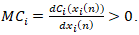
  firms. In addition, in this industry, the total costs are:
 and the marginal cost is:
  There are also sunk entry costs
  Given the finite set of firms
  with cardinal number
  [16], the vector of outputs
  is a Cournot equilibrium for the firms in
  if and only if:
 | (2) |
 is the equilibrium total revenue,
  is the number of the firms in the industry,
  is the
  -firm industry Cournot equilibrium output,
  is the price of the output,
  is the total cost of the
  firms and
  are the Cournot equilibrium profits of the
  firms. Assuming that no insider exits and the
  firms threaten to stick to the
  -firm Cournot equilibrium output [8] described above
  the start-up may be deterred from entering if there is an equilibrium of the post-entry Cournot subgame at which the potential start-up would not actually produce [8] or if the start-up profits are equal to the sunk entry costs. Here, [15] underlines that the outsiders have an optimal choice. If no insider exits, then it is optimal not to enter. If outsiders try entry, they receive payoff that is less than the entry sunk costs and they prefer to stay out with zero expected profit [15]. Given that the profits of start-ups after the entry are the following:
 | (3) |
 is the total cost of the start-up,
  and
and  Then,
Then, 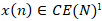 is a post-entry pure strategy Cournot subgame equilibria if the following conditions apply:
  | (4) |
 | (5) |
 and
and  given the entry of the start-up. Alternatively, the conditions (4) and (5) are written as:
 | (6) |
 | (7) |
 and
and
3. Some Insiders Exit and the Symmetric Mixed Strategy Equilibria
- After, we assume that some insiders exit [15]. According to [15, p. 1569], “if some insiders exit, outsiders randomize between ‘in’ and ‘out’ and thus they are indifferent”2. Here, we consider two approaches. First, we consider that there are
 potential competitors or potential entrants. If
  of them enter together with the one firm, then there are
  potential entrants and each potential entrant’s profits is [8]:
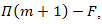 | (8) |
 other firms enter is [8]:
 | (9) |
 | (10) |
 | (11) |
 On the other hand, the payoff from nonentry is zero. On the optimum, the equilibrium probability of entry must solve the following condition of indifference between entry and nonentry:
 | (12) |
 In other words, he shows that the simultaneous entry model has a unique mixed strategy equilibrium where each potential competitor enters with positive probability less than one. The second approach takes into account the existence of
  rivals. Here, the entry is profitable if and only if they all stay out. According to [17], in a symmetric mixed strategy equilibrium3, this entry takes place with the following probability:
 | (13) |
 | (14) |
 | (15) |
 are the entry sunk costs and
  are the profits of the one firm which enters the industry. On the other hand, the payoff from nonentry is zero. Then, the strategy
  is the optimal and, thus, an equilibrium if it is a mutual response and this happens if and only if each firm is indifferent between entry and nonentry. Here, the following condition of indifference between entry and nonentry must be solved:
 | (16) |
 | (17) |
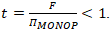
4. All Insiders Exit, the Oligopoly Which Converges to the Long-Run Competitive Solution, Strict Domination and the Post Entry Pure Strategies Cournot Subgame Equilibria
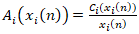
- In the third case, we assume that all insiders exit. However, when do all the insiders exit? The answer is given by the examination of the limiting properties and limiting behaviour of the
 -firm Cournot oligopoly [18,8].Given the inverse demand function described in the equation (1) and
  is the total market supply, we denote output per firm by:
 | (18) |
 | (19) |
 then we have:
 | (20) |
 | (21) |
 | (22) |
 is the average cost,
  is the total cost of the firm and
  is the output per firm. These functions tend to zero as
  tends to zero. In other words, we have:
 | (23) |
 | (24) |
 | (25) |
 firm
firm 
 | (26) |
 | (27) |
 | (28) |
 and
and  Then, the problem of the profit maximization of the
  firm becomes:
 | (29) |
 | (30) |
 is twice differentiable with
  and
and  it follows that:
 | (31) |
 and therefore the Cournot equilibrium price and quantity converge to the competitive solution if and only if [18]:
 | (32) |
 | (33) |
 | (34) |
 or
or  Given that
  and
and 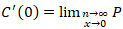 as we have previously shown, then:
 | (35) |
 -firm Cournot oligopoly equilibrium, the price equals to the minimal average cost. Putting (35) into the equation (34), we obtain:
 | (36) |
 | (37) |
 -firm Cournot oligopoly equilibrium, the profits of the oligopoly are zero4.Then, how does the best response and reaction of the potential entrants take place taking into account the fact that the equilibrium profits of the
  -firm Cournot oligopoly are zero? The response arises from the fact that the periods of excess exit are followed by entry [15]. There, the potential entrants realize opportunities and enter the industry in order to dominate the market and gain profits by exploiting the exit of the existing firms. In this case, the post entry pure strategies Cournot subgame equilibria is described by the two following conditions:
  | (38) |
 | (39) |
 is the number of the new firms or start-ups in the industry,
  is the Cournot equilibrium output of the start-ups,
  is the price in the market after the entry of the new firms, while
  is the total cost of start-ups and
  are the entry sunk costs. In addition,
  is the equilibrium output of the existing firms,
  is the price of the output and
  is the total cost of the existing firms when the Cournot oligopoly converges to the long-run competitive solution. Considering that the output of the start-ups is a function of the number of start-ups, the conditions (38) and (39) can be also written as:
 | (40) |
 | (41) |
 | (42) |
 | (43) |
 are the equilibrium profits of
  start-ups and
  are the equilibrium profits of
  existing firms when the Cournot oligopoly converges to the long-run competitive solution, the conditions (40) and (41) can be rewritten as:
 | (44) |
 | (45) |
 strictly dominates the action
  of course does not imply that
  strictly dominates all actions. Indeed,
  may itself be strictly dominated”. As a result, since a player’s Nash equilibrium action is a best response to the other players’ Nash equilibrium actions and strategies, a strictly dominated action is not used in any Nash equilibrium [19]. As a result, the condition (44) does not guarantee post entry pure strategies Cournot subgame equilibria. When the post entry pure strategies Cournot subgame equilibria is guaranteed? This is guaranteed if we put the maximum profits of the start-ups into the condition (44). We put the maximum profits of the start-ups into the condition (44) instead of the simple profits. These maximum profits strictly dominate all the levels of sunk entry costs6. As a result, the corrected post entry pure strategies Cournot subgame equilibria is described by the following conditions:
 | (46) |
 | (47) |
 | (48) |
 | (49) |
 | (50) |
 | (51) |
5. Mapping the Theory to Real-World Applications
- After the analysis of the post entry pure strategies Cournot subgame equilibria when all insiders exit the industry and, therefore, the Cournot oligopoly converges to the long-run competitive equilibrium, we map the theory to real-world cases and applications. In this way, a better illustration and understanding of theoretical scenarios is feasible.Despite the fact that the firm exit may be due to factors such as low profits, displacement and a permanent decrease in demand or at least a decrease in the rate of increase in demand [21], [22] examine the entry and exit in retailing and give special emphasis to the replacement effect besides the displacement effect. Using a data set of 23 Dutch shoptypes for the period 1981-1988 which implies a total of 184 data-points with the source of the data to be an ongoing panel of independent small Dutch retailers operated by EIM Small Business Research and Consultancy in Zoetermeer, [22] show that exit has a positive and significant effect on entry and, thus, the replacement effect occurs. This is due to two reasons. [22, p. 163] explain that “first, exit provide additional market room for (potential) entrepreneurs to enter (exit ‘allows’ entry). Second, entrepreneurs may wait to enter until they are offered the opportunity to take over a shop (and its clientele)”. In turn, [23] argue that it is mainly the potential rather than the actual exit which is more beneficial for an entry decision. It is indicative of this aspect that [24] put the potential exit variable into the entry equation and approximate this variable by the industry size. In addition, [25] show that exit has a positive influence on entry. [25] explain this finding by supporting that: a) a death may lower the price of the equipment and other resources required by a potential new retailer and b) the actual or threatened unemployment (due to the exit) and its push effect increase new firm formation.Another strand of literature deals with the foreign market re-entry [26,27,28,29]. [26] define foreign market re-entry as “the process by which firms restart operations in previously exited markets from which they have had a complete withdrawal”. Describing the re-entry into a foreign market after a market exit and mentioning some examples from multinationals all over the world, [28, p. 1106] argue that “in 2015, Alfa Romeo re-entered the United States market, and PSA Peugeot Citroen re-entered the Iranian market. Similarly, the market re-entries of Coca-Cola into the Chinese and Indian markets were not de novo entries. Coca-Cola exited mainland China following the Communist Revolution in 1949 while withdrawing from India due to other political risk factors in 1977”. [28] explain that the improvement of conditions as well as the adequate connection to the market through local partners, brand image and knowledge help the firms that exit a foreign market to restart operations. [27] findings show the importance of the exit stage in shaping re-entry decisions. Here, the time-out period moderates the relationship between the exit and re-entry stages [27]. In turn, [29] use a very extensive dataset of firm-level export entries and exits over the period 1997-2007. Their findings suggest that how firms react to market conditions at the time of exit is an important factor in determining the likelihood of re-entry in exporter’s foreign markets. This shows the re-entrants’ significant dependence on the strategic rationale for exit [29]. In this vein, [30] employ transactional level data on Chilean exports from 1991 to 2008 and show, among others, that the Chilean firms exit from exporting and subsequently re-enter the same market and sell the same products they sold to that importing country before.
6. Conclusions
- The present research makes a first effort to explore the conditions under which the post entry pure strategy Cournot subgame equilibria occurs when all insiders exit the industry and therefore the Cournot oligopoly converges to the long-run competitive equilibrium. In order to better comprehend the theory, we map the theoretical scenarios described herein to real world applications. The examination of the post entry pure strategy Cournot subgame equilibria and the conditions under which it holds when all insiders exit the industry and the Cournot oligopoly converges to the long-run competitive solution is the first novel trait and rallying point of the present research as previous studies concentrate on the post entry pure strategy Cournot subgame equilibria when no insider exits and the symmetric mixed strategy equilibria when some insiders exit. The former game concerns the deterrence of the potential entrants from the incumbents and insiders (no insider exits) regarding their entry the industry and then the post entry pure strategies Cournot subgame equilibria is achieved. The second game concerns the symmetric mixed strategy equilibria when some insiders exit. Here, important meanings are the randomization process of potential entrants between ‘in’ and ‘out’ and, thus, their indifference for entry. For this reason, two alternative approaches are presented in the current research. The second novel trait and rallying point of our analysis is the introduction of dominant strategies and, more specifically, the use of strict domination in pure strategies. As strict domination does not guarantee post entry pure strategies Cournot subgame equilibria, additional assumptions and demonstrations are needed to reach the post entry pure strategy Cournot subgame equilibria.Future research could extend the research regarding both the entry and exit game. There, the scholars and researchers could delve into the knowledge regarding several aspects of entry game and the equilibrium which arises. Special emphasis could be given to the sequential entry, the simultaneous entry and the free entry as well as equilibrium issues which are set in these cases. In addition, the exit game and the strategic exit decisions are another area of interest where the scholars could focus on. Finally, the interaction of entry and exit and the specific equilibrium issues which arise could draw the attention of the future research.
Appendix A1
- Generally, let
 denote player
  utility from a strategy profile
  . Let
. Let  denote the strategy profile of all players other than
  .Evidently,
  or equivalently
 the Cartesian product of the strategy spaces of all players other than
  (player
  “opponents”). In this point, we could rewrite the strategy profile as
  and player
  utility
  as
as  . Given strategies
  we say that
  is strictly dominated by
  , or that
  strictly dominates
  (written
  ) if:
) if: for any
Appendix A2
- In a strategic game with ordinal preferences, player
 action
  strictly dominates his/her action
  if:
if: | (A.2.1) |
 action
  strictly dominates his/her action
  the player
  action
  strictly dominates the other player’s actions and strategies
  if:
if: | (A.2.2) |
 action of the player
  . The above inequalities mean that the player
  action
  strictly dominates both his/her action
  and the other player’s actions
  This further means that the
  action and strategy of the player
  is the best and maximum from all the other available actions and strategies (both his/her own and the other players).
 Notes
- 1.
 is the set of Cournot equilibria for the set
  2. [8] argues that randomizing can only be the best response of a potential entrant, if he/she is indifferent between entry and nonentry.3. A mixed strategy equilibrium where each firm randomizes its entry decision is necessarily a symmetric equilibrium [17].4. When the firms of the oligopoly face sustained economic losses, they may exit the industry. They face losses due to intense and non-collusive competition. The firm exit reduces total market capacity and shifts supply to the left, raising the market price. This exit continues until the market price rises high enough to cover the average costs of the remaining firms, resulting in zero economic profits (zero economic profits of the remaining firms).5. In some games, a player’s strategy is superior to all other strategies regardless of what the other players do [20]. This strategy then strictly dominates the other strategies.6. For a proof of the fact that the maximum profits of the start-ups strictly dominate all the level of sunk entry costs, see Appendix A2.