
-
Paper Information
- Previous Paper
- Paper Submission
-
Journal Information
- About This Journal
- Editorial Board
- Current Issue
- Archive
- Author Guidelines
- Contact Us
International Journal of Virology and Molecular Biology
p-ISSN: 2163-2219 e-ISSN: 2163-2227
2026; 15(9): 209-212
doi:10.5923/j.ijvmb.20261509.02
Received: Sep. 28; Accepted: Oct. 22, 2026; Published: Nov. 7, 2026

Effect of Chloride and Sulfate Soil Salinity on the Dry Mass Formation of Sorghum Almum Parodi
 Abstract
 Reference
 Full-Text PDF
 Full-text HTML
Burkhan Avutkhanov1, Karimdjon Safarov2, Shokhira Atayeva3, Sardor Fayzullayev4
1PhD, Associate Professor, Samarkand State University named after Sharof Rashidov, Samarkand, Uzbekistan
2Doctor of Biological Sciences, Professor, National University of Uzbekistan named after Mirzo Ulugbek, Tashkent, Uzbekistan
3Lecturer, Samarkand State University named after Sharof Rashidov, Samarkand, Uzbekistan
4Lecturer, Kimyo International University in Tashkent, Samarkand Branch, Samarkand, Uzbekistan
Correspondence to: Burkhan Avutkhanov, PhD, Associate Professor, Samarkand State University named after Sharof Rashidov, Samarkand, Uzbekistan.
| Email: |  |
Copyright © 2026 The Author(s). Published by Scientific & Academic Publishing.
This work is licensed under the Creative Commons Attribution International License (CC BY).
http://creativecommons.org/licenses/by/4.0/

This article analyzes the effect of different levels of chloride and sulfate soil salinity on the dry mass formation of Sorghum almum Parodi (Columbus grass). Dry mass was assessed at the tillering, booting, heading, flowering and maturation phases in non-saline (control) soil and in soils with low, medium and high levels of chloride and sulfate salinity. Dry mass increased steadily until the end of the growing season, but decreased consistently as the salinity level rose. At the high level of chloride salinity, dry mass at maturation was 18.8% lower than the control, whereas at the high level of sulfate salinity the reduction was 12.6%. Sulfate salinity therefore reduced dry mass accumulation of S. almum less than chloride salinity did at the same salinity level. These results provide a scientific basis for evaluating S. almum as a forage crop for saline lands.
Keywords: Sorghum almum Parodi, Soil salinity, Dry mass, Forage crop, Salt tolerance
Cite this paper: Burkhan Avutkhanov, Karimdjon Safarov, Shokhira Atayeva, Sardor Fayzullayev, Effect of Chloride and Sulfate Soil Salinity on the Dry Mass Formation of Sorghum Almum Parodi, International Journal of Virology and Molecular Biology, Vol. 15 No. 9, 2026, pp. 209-212. doi: 10.5923/j.ijvmb.20261509.02.
Article Outline
1. Introduction
- The expansion of saline soils worldwide directly affects the growth and development of agricultural crops and causes a sharp decline in yields. In arid and semi-arid regions in particular, improper irrigation, high evaporation and shallow groundwater intensify the accumulation of water-soluble salts in the soil profile [6,8]. Soil salinity is one of the main abiotic stress factors: it hampers water uptake by plants, induces osmotic stress in cells and disturbs ionic balance. As a result, physiological and biochemical processes in plants are suppressed and dry biomass formation declines [10]. Water deficit first appears in plants because of the high osmotic pressure of the soil solution; if the stress continues, the accumulation of ions such as Na⁺ and Cl⁻ in tissues may cause ion toxicity. These processes impair photosynthesis, enzymatic activity, nutrient metabolism and cell membrane permeability [1].Species of the genus Sorghum are among the cereal crops that are relatively tolerant to drought and soil salinity, but this tolerance is not absolute. As salinity increases, the plant water regime, leaf area, photosynthetic rate, ion ratios and final dry biomass yield decline. Salt tolerance also differs markedly among Sorghum genotypes. In a study of 415 sorghum accessions, Yamazaki et al. found that biomass production under salinity varied among genotypes [9], and that some genotypes retained a comparatively good ability to grow and accumulate biomass in saline soils. The salt tolerance of Sorghum is linked to morphological and physiological traits, including root system development, high water retention in leaves, ion distribution among tissues and control of the K⁺/Na⁺ ratio [6,7].Sorghum almum Parodi, also known as Columbus grass, is a forage plant that produces high amounts of green and dry mass. It attracts worldwide interest as a nutrient-rich, high-biomass forage plant that is relatively tolerant to drought and salinity [2,3]. In Uzbekistan the species is being studied as a promising non-traditional forage crop for saline areas with limited water supply. A study published in 2026 described S. almum as a drought- and salt-tolerant, high-yielding plant under the conditions of Uzbekistan [8]. These data show the importance of studying the potential of cultivating high-biomass forage sorghums such as S. almum on saline soils.Studying the dry mass formation of S. almum under chloride and sulfate salinity is therefore important for the efficient use of saline lands and for strengthening the forage base of livestock production in Uzbekistan. The aim of this study was to determine the dry mass formation of S. almum at low, medium and high levels of chloride and sulfate soil salinity across developmental phases, and to compare the effects of the two salinity types.
2. Materials and Methods
2.1. Plant Material and Experimental Site
- The research object was Sorghum almum Parodi (Columbus grass), a new non-traditional forage plant for the Republic of Uzbekistan. Field experiments were conducted on the farm “Toshpo‘lat Diyorov” in Narpay district, Samarkand region. All experiments were carried out on the farm’s non-saline soil and on soils with chloride and sulfate salinity, at a soil moisture level of 70% of field moisture capacity.
2.2. Salinity Treatments
- The following treatments were used: non-saline soil (control, ECe < 2 dS/m), and sodium chloride (NaCl) and sodium sulfate (Na₂SO₄) salinity at low (ECe 2–4 dS/m), medium (ECe 4–8 dS/m) and high (ECe > 8 dS/m) levels, giving seven treatments in total (control, three chloride levels and three sulfate levels).
2.3. Determination of Dry Mass
- Dry mass was determined at the tillering, booting, heading, flowering and maturation phases using 25 plant samples, following the recommendations of Kuperman and Rzhanova [11]. Samples were dried in a thermostat (oven) to constant weight. The reduction of dry mass relative to the control was calculated as:K = [(N − T) / N] × 100where K is the reduction of dry mass, %; N is the dry mass in the control treatment; and T is the dry mass in the experimental treatment.
2.4. Statistical Analysis
- Data were statistically analyzed based on four biological replicates and are presented as mean ± standard deviation (SD). Two-way analysis of variance (ANOVA) was used to evaluate the effects of salt type (NaCl and Na₂SO₄), salinity level and their interaction. When significant differences were detected, treatment means were compared using the least significant difference (LSD) post-hoc test, and statistical significance was accepted at P < 0.05. All analyses were performed in the R statistical computing environment.
3. Results
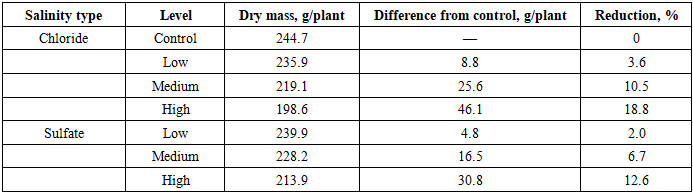
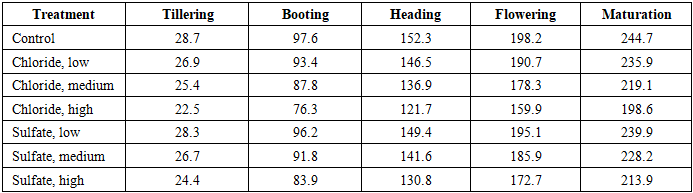
- The results showed that dry mass formation decreased consistently with increasing salinity. In the non-saline control, the dry mass of S. almum increased steadily with plant development: from 28.7 g/plant at the tillering phase to 244.7 g/plant at maturation, i.e., approximately 8.5-fold over the whole growing season.Figure 1 and Table 2 show that dry mass decreased relative to the control in all salinity treatments, with the magnitude of the decrease depending on salinity type and level. Chloride salinity had a stronger effect on dry mass formation than sulfate salinity. At the low level of chloride salinity, dry mass was 26.9 g/plant at tillering, 1.8 g/plant below the control. The difference was 4.2 g/plant at booting, 5.8 g/plant at heading, 7.5 g/plant at flowering and 8.8 g/plant at maturation.
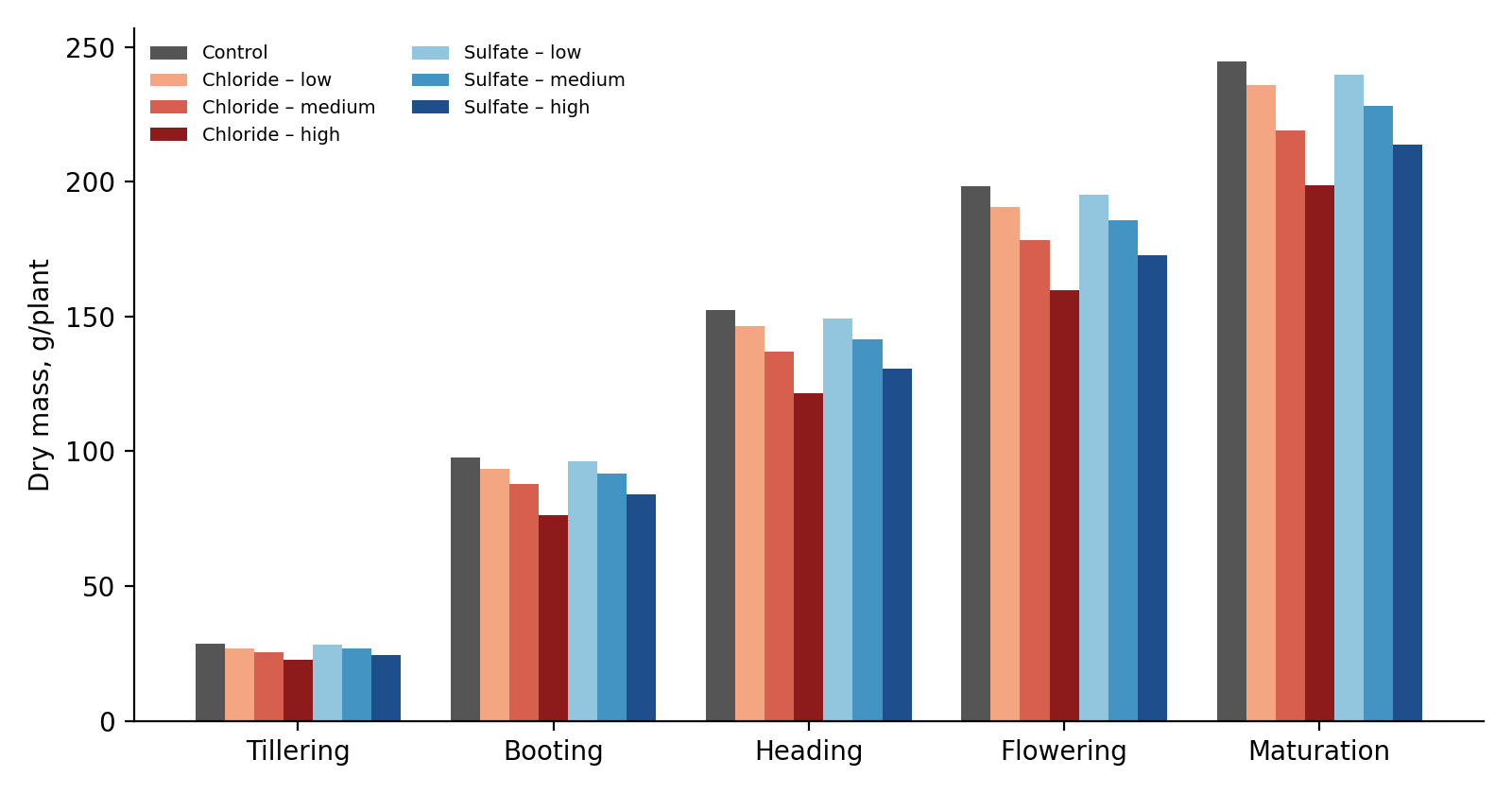 | Figure 1. Effect of salinity on the dry mass formation of Sorghum almum Parodi at different developmental phases, g/plant |
|
|
4. Discussion
- At the high level of chloride salinity, dry mass at maturation was 18.8% lower than the control, compared with 12.6% at the high level of sulfate salinity. Under our experimental conditions, sulfate salinity therefore had a smaller negative effect on the dry mass formation of S. almum than chloride salinity. The results agree with earlier studies showing that the salt tolerance of Sorghum species depends on genotype, salinity level and developmental phase [4,5].Yamazaki et al. showed that biomass accumulation is an important indicator for assessing salt tolerance in sorghum, and that the response to salinity differs greatly among genotypes [9]. Rajabi Dehnavi et al. likewise reported reduced dry mass in sorghum genotypes with increasing salinity, and attributed this to the negative effects of salt stress on photosynthesis, water exchange and ion balance [7]. Punia et al. recorded changes in morpho-physiological traits, chlorophyll content, water status and photosynthetic activity of sorghum under salinity, and noted that these mechanisms directly reduce dry biomass yield [6].The steady increase of dry matter in S. almum during the growth phases has also been reported in other studies: Hassan et al. found that growth stage and irrigation interval significantly affected the growth parameters of Columbus grass [3]. This is consistent with the progressive accumulation of vegetative mass during plant development.The high dry biomass and green forage yield of S. almum further increase its value as a promising crop for saline areas [2,8]. Its use could therefore help to raise the biological productivity of saline lands and expand forage resources. Because the experiments were conducted on one farm and with a single set of moisture conditions, further multi-site and multi-year trials, together with ion-content and physiological measurements, are needed to confirm the mechanisms underlying the difference between chloride and sulfate effects.
5. Conclusions
- This study examined how chloride and sulfate soil salinity affect dry mass formation of Sorghum almum Parodi across five developmental phases, and whether the two salinity types differ in their effect. The main findings are as follows:1. In non-saline soil, dry mass increased steadily from 28.7 g/plant at tillering to 244.7 g/plant at maturation (about 8.5-fold).2. Dry mass decreased progressively with increasing salinity under both salinity types, and the reduction was already visible at the tillering phase. At maturation, the reduction relative to the control was 3.6%, 10.5% and 18.8% at low, medium and high chloride salinity, and 2.0%, 6.7% and 12.6% at low, medium and high sulfate salinity.3. At the same salinity level, sulfate salinity reduced dry mass less than chloride salinity did (12.6% vs. 18.8% at the high level).Significance. Even at the high salinity level, S. almum retained 81.2% (chloride) and 87.4% (sulfate) of the control dry mass at maturation. These results provide a quantitative basis for evaluating this species as a forage crop for saline lands and for strengthening the forage base of livestock production in Uzbekistan. They also show that the type of salinity, not only the overall salinity level (ECe), should be taken into account when selecting forage crops for saline soils.Closure of the research problem. The research problem, namely how much chloride and sulfate salinity reduce the dry mass formation of S. almum at successive developmental phases, has been answered for the conditions tested: the reduction is dose-dependent, begins at early growth stages, and is consistently stronger under chloride than under sulfate salinity.Remaining gaps and future research. The experiments were conducted at one site and under a single soil moisture level (70% of field moisture capacity), and only dry mass was measured. The mechanisms behind the difference between chloride and sulfate effects therefore remain unconfirmed. Future studies should include: (i) multi-site and multi-year field trials; (ii) different irrigation and moisture regimes; (iii) measurements of tissue ion content (Na⁺, Cl⁻, SO₄²⁻, K⁺/Na⁺ ratio) and physiological traits such as photosynthesis and water status; (iv) assessment of forage quality and total green and dry forage yield; and (v) comparison with other forage sorghum genotypes to identify the most salt-tolerant material.