
-
Paper Information
- Next Paper
- Paper Submission
-
Journal Information
- About This Journal
- Editorial Board
- Current Issue
- Archive
- Author Guidelines
- Contact Us
International Journal of Virology and Molecular Biology
p-ISSN: 2163-2219 e-ISSN: 2163-2227
2026; 15(8): 190-194
doi:10.5923/j.ijvmb.20261508.03
Received: Sep. 28; Accepted: Oct. 22, 2026; Published: Oct. 30, 2026

Entomofauna of Sesame (Sesamum indicum L.) in the Conditions of the Khorezm Oasis: Species Composition and Bioecological Features
 Abstract
 Reference
 Full-Text PDF
 Full-text HTML
S. Q. Egamberdiev1, H. H. Kamolova1, Z. Sh. Matyakubov1, A. I. Iskandarov1, 2
1Khorezm Mamun Academy, Khiva, Uzbekistan
2Mamun University, Urgench, Uzbekistan
Copyright © 2026 The Author(s). Published by Scientific & Academic Publishing.
This work is licensed under the Creative Commons Attribution International License (CC BY).
http://creativecommons.org/licenses/by/4.0/

Sesame (Sesamum indicum L.) is one of the oldest oilseed crops cultivated in Uzbekistan, including in the Khorezm oasis, where it is grown on both rain-fed and irrigated lands. Despite the economic importance of the crop, the entomofauna of sesame agrocenoses in the Khorezm oasis has not been specifically studied, while the available data for Uzbekistan mainly concern the Tashkent and Kashkadarya regions. This paper presents the results of a study of the species composition and bioecological features of insects associated with sesame crops, carried out in 2024–2026 in the fields of the “Javohir Charosxon” farm (Beruni district, within the Khorezm oasis) on an area of 2 ha. The study revealed 28 insect species belonging to 14 families and 6 orders, of which 23 species were classified as phytophages (including potential sesame pests), 1 as a zoophytophage, 2 as entomophages, 1 as a pollinator, and 1 as a euryphage. The dominant species by abundance (D > 5%) were Aphis gossypii (12.6%), Thrips tabaci (8.9%), Frankliniella occidentalis (7.4%), Helicoverpa armigera (6.8%), Spodoptera exigua (5.7%) and Nesidiocoris tenuis (5.2%). The trophic structure and relative abundance of the identified species were established; the obtained data can be used in developing a sesame plant protection system for the conditions of the Khorezm oasis.
Keywords: Sesame (Sesamum indicum L.), Entomofauna, Species composition, Khorezm oasis, Beruni district, Pests, Entomophages, Bioecology, Dominance, Agrocenosis
Cite this paper: S. Q. Egamberdiev, H. H. Kamolova, Z. Sh. Matyakubov, A. I. Iskandarov, Entomofauna of Sesame (Sesamum indicum L.) in the Conditions of the Khorezm Oasis: Species Composition and Bioecological Features, International Journal of Virology and Molecular Biology, Vol. 15 No. 8, 2026, pp. 190-194. doi: 10.5923/j.ijvmb.20261508.03.
Article Outline
1. Introduction
- Sesame (Sesamum indicum L., family Pedaliaceae) is one of the oldest oilseed crops in the world and is cultivated in more than 90 countries of Asia and Africa for its seeds, which contain 45–55% high-quality edible oil and up to 25% protein [1]. In Uzbekistan, sesame has traditionally been cultivated on rain-fed and irrigated lands in the southern and south-western regions of the republic [2]; in recent years, owing to the implementation of the state policy of agricultural diversification and expansion of the area under oilseed crops [3], sesame cultivation has been gradually spreading to regions new to this crop, including the Khorezm oasis, where in 2024–2026 sesame was grown, in particular, on the “Javohir Charosxon” farm (Beruni district) on an area of 2 ha.The Khorezm oasis is an area of intensive irrigated agriculture with long-standing traditions of cultivating cotton, cereals, and vegetable and melon crops, whose agrocenoses are characterized by a rich and diverse complex of phytophagous insects and their entomophages [4,5]. The introduction of an oilseed crop new to the region, such as sesame, into local crop rotations is naturally accompanied by the formation of a specific insect complex on its crops, part of which migrates from adjacent crops (cotton, vegetables, melons), while another part is represented by species specialized on sesame or on other members of the family Pedaliaceae and associated families.A number of foreign studies have been devoted to the entomofauna of sesame, summarizing information on the pests of this crop and the damage they cause in India, Sudan, Uganda, Egypt and other countries [1,6–9]. With regard to Uzbekistan, the most complete data on the species composition of sesame pests have been obtained for the rain-fed and irrigated lands of the Tashkent and Kashkadarya regions, where a complex of representatives of the orders Coleoptera, Homoptera and Orthoptera has been recorded, and the sesame stem weevil (Acmaeodera ballionis), as well as the greenhouse and tobacco whiteflies (Trialeurodes vaporariorum and Bemisia tabaci), have been reported as the dominant pests [10]. Special studies of the sesame entomofauna in the Khorezm oasis have not been conducted to date, which determined the relevance of the present work.The aim of this study is to investigate the species composition and bioecological characteristics of insects associated with sesame crops in the Khorezm oasis.
2. Materials and Methods
- The studies were carried out in 2024–2026 on crops of the sesame cultivar ‘Kora Shahzoda’ in the fields of the “Javohir Charosxon” farm, located in Beruni district of the Republic of Karakalpakstan (within the Khorezm oasis; site coordinates: 41°39′35.8″ N, 60°43′54.1″ E), with a total area of 2 ha. Sampling plots were established in both rain-fed and irrigated crops in order to compare the composition of the entomofauna under different moisture conditions.Entomological material was collected by the route (transect) method and by sweeping with a standard entomological sweep net (25 sweeps per sampling point in four replicates), as well as by visual inspection and direct counting of insects on model plants (25 plants per sampling plot in four replicates). Soil excavations and pitfall traps for recording soil-dwelling stages of insects were not used. Sampling was carried out once every 10 days throughout the entire growing season of sesame, from mid-May to early September.The collected material was preserved in 70% ethyl alcohol or mounted on entomological pins according to standard methods [11]. Species identification was performed by comparison with the collection materials of the Institute of Zoology, and the nomenclature was verified against the international GBIF database (gbif.org).Quantitative processing of the material included calculation of the relative abundance (dominance) and frequency of occurrence of species using formulae generally accepted in faunistic studies:D = (n / N) × 100%where D is the dominance index of a species, n is the number of individuals of the given species, and N is the total number of recorded individuals of all species.Based on the value of the dominance index, the following groups of species were distinguished: eudominants (D > 10%), dominants (D = 5.1–10%), subdominants (D = 2.1–5%), recedents (D = 1.1–2%) and subrecedents (D ≤ 1%). According to feeding type, the identified species were divided into phytophages, entomophages (predators and parasites), pollinators and saprophages; phytophages were further classified by degree of food specialization into monophages (MP), oligophages (OP) and polyphages (PP), which corresponds to the approach previously used in studies of the entomofauna of other crops in the Khorezm region [4].
3. Results and Discussion
- Surveys of sesame crops on the “Javohir Charosxon” farm during the growing seasons of 2024–2026 revealed a diverse complex of insects differing in systematic position, feeding habits and economic importance. Along with phytophages, a considerable proportion of which pose a potential threat as pests of sesame, the collected material included entomophages, a zoophytophage, a pollinator and a euryphage, indicating the formation on this crop of a rather complex trophic structure of the agrocenosis, comprising both direct consumers of the plant and insect groups regulating their abundance.In total, 28 insect species belonging to 14 families and 6 orders were recorded on sesame crops during the study. The systematic composition of the identified complex, the relative abundance of each species (dominance index D), the corresponding dominance category, trophic affiliation and feeding habits are given in Table 1.
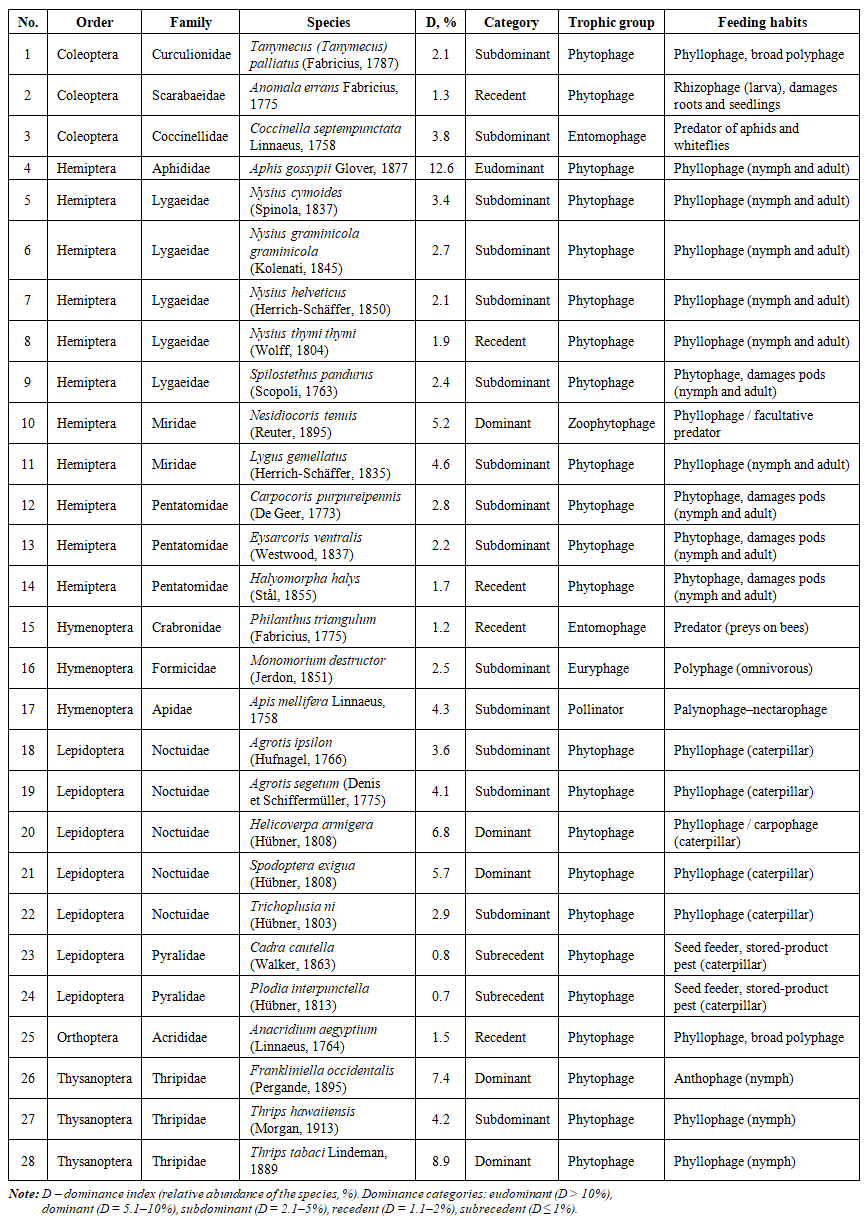 | Table 1. Species composition of insects recorded on sesame crops in the Khorezm oasis (“Javohir Charosxon” farm, Beruni district, 2024–2026) |
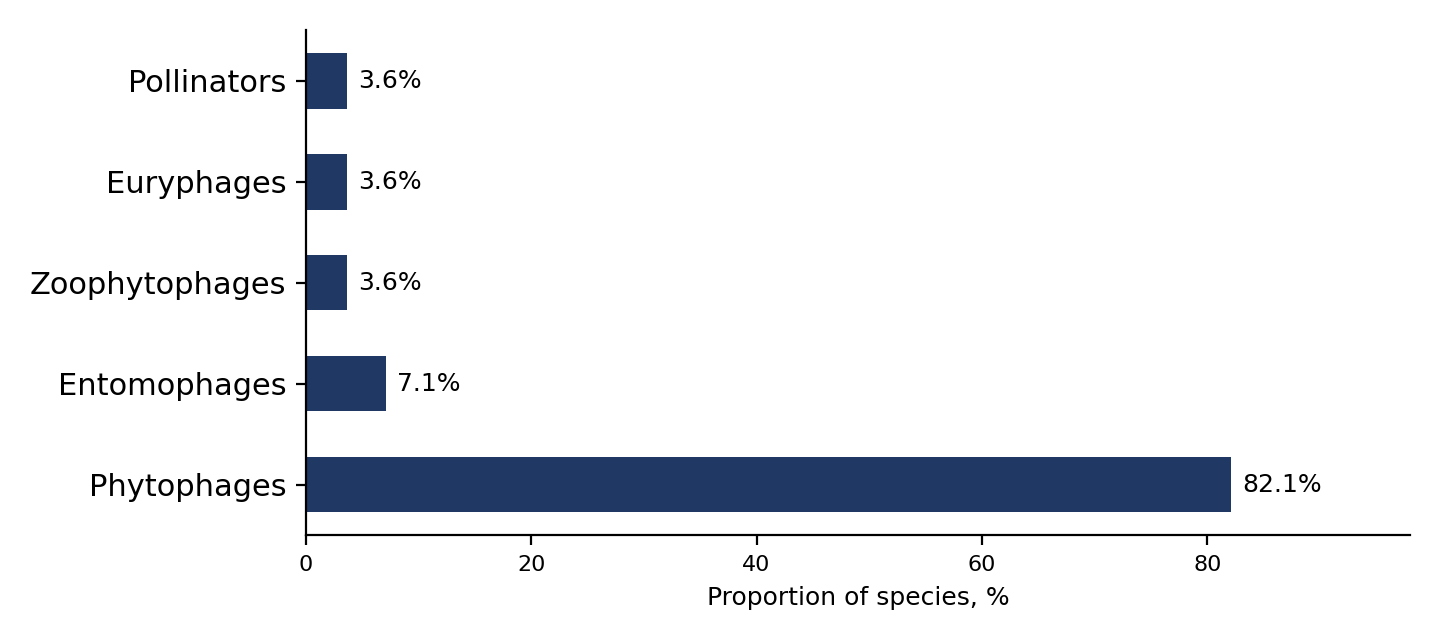 | Figure 1. Trophic structure of the sesame entomofauna in the Khorezm oasis (% of the number of species) |
3.1. Bioecological Characteristics of the Dominant Species
- Aphis gossypii Glover (melon or cotton aphid) is a eudominant species (D = 12.6%) and a broad polyphage damaging more than 700 plant species; in southern Uzbekistan it produces numerous parthenogenetic generations per season, forms winged (alate) and wingless (apterous) morphs, colonizes mainly young leaves and shoot tips, causing their deformation, and is a vector of a number of phytopathogenic viruses [12].Thrips tabaci (onion thrips) and Frankliniella occidentalis (western flower thrips) are dominant species (D = 8.9% and 7.4%, respectively) and polyphages damaging leaves and generative organs of plants; they are characterized by high fecundity and a short developmental cycle, which under favourable temperature conditions ensures several generations per growing season; in addition, F. occidentalis is a vector of tospoviruses [13,14].Helicoverpa armigera (cotton bollworm) and Spodoptera exigua (beet armyworm) are dominant polyphagous species (D = 6.8% and 5.7%), whose caterpillars damage the leaves and generative organs (capsules) of sesame; both species are widely known as dangerous polyphagous pests of cotton, maize, and vegetable and melon crops in Uzbekistan, are capable of producing several generations per year and undertake seasonal migrations between agrocenoses [15,16].Nesidiocoris tenuis is a dominant zoophytophage (D = 5.2%) of the family Miridae, widely used worldwide as a biological control agent against whiteflies, aphids and lepidopteran eggs, but capable under certain conditions (high population density, shortage of animal prey) of also feeding on plant tissues [17].
4. Conclusions
- As a result of the studies conducted on sesame crops of the “Javohir Charosxon” farm (Beruni district, Republic of Karakalpakstan) in the Khorezm oasis, 28 insect species belonging to 6 orders and 14 families were identified. Of these, 23 species were classified as phytophages (including potential pests of sesame), 1 as a zoophytophage, 2 as entomophages, 1 as a pollinator, and 1 as a euryphage. The dominant species in terms of abundance (D > 5%) were Aphis gossypii, Thrips tabaci, Frankliniella occidentalis, Helicoverpa armigera, Spodoptera exigua and Nesidiocoris tenuis, species that are predominantly broad polyphages and dangerous pests of cotton and vegetable and melon crops in Uzbekistan, which indicates their migratory origin on sesame crops.The results obtained represent the first special study of the sesame entomofauna in the Khorezm oasis and supplement the existing information on the insect fauna of oilseed crops in Uzbekistan. The materials of this work can be used in developing a system for monitoring and protecting sesame against pests in the Khorezm oasis. Further research should be directed towards clarifying the seasonal population dynamics of the identified dominants, studying their natural enemies (including the role of Coccinella septempunctata and Nesidiocoris tenuis), and developing a warning system for the optimal timing of protective treatments.