Juginisov T. I.1, Jumanov M. A.1, Isaev R. T.1, Ruzmatova F.2, Aytniyazova G.1, Dauletmuratov E. Z.1, Qaniyazov S. J.1, Duysengaliev E. S.1
1Department of Ecology and Soil Science, Karakalpak State University named after Berdakh, Nukus, Republic of Karakalpakstan, Uzbekistan
2Department of Biology, Urgench State University named after Abu Rayhan Biruni, Urgench, Uzbekistan
Correspondence to: Juginisov T. I., Department of Ecology and Soil Science, Karakalpak State University named after Berdakh, Nukus, Republic of Karakalpakstan, Uzbekistan.
| Email: |  |
Copyright © 2026 The Author(s). Published by Scientific & Academic Publishing.
This work is licensed under the Creative Commons Attribution International License (CC BY).
http://creativecommons.org/licenses/by/4.0/

Abstract
The desiccation of the Aral Sea has resulted in the formation of vast new terrestrial areas and intensified aridification in adjacent parts of the Southern Aral Sea region. This study summarizes information on terrestrial insects associated with these landscape changes. Hylotrupes bajulus (Linnaeus, 1758) (Coleoptera: Cerambycidae) was the principal quantitatively assessed xylophagous species, whereas Anacanthotermes turkestanicus (Jacobson, 1905) (Isoptera: Hodotermitidae) and Anacanthotermes ahngerianus (Jacobson, 1905) (Isoptera: Hodotermitidae) were considered comparative indicator and pest species of arid habitats. Field observations began in 2022, and the compiled monitoring records cover 2022–2026 in natural tugai biotopes, dry-wood substrates, urbanized areas, and historic wooden structures in the Southern Aral Sea region. The compiled study material contains more than 4,000 field samples and 167 monitoring points with recorded geographic coordinates. These observations documented the association of H. bajulus with dry-wood substrates. A. turkestanicus and A. ahngerianus are documented in Khorezm and Karakalpakstan as cellulose-feeding termite species in the regional comparative evidence. The synthesized results suggest that, under the arid conditions associated with the desiccation of the Aral Sea, H. bajulus, A. turkestanicus, and A. ahngerianus are associated with dry wood or other cellulose-containing substrates. Changes in vegetation and landscape structure provide an ecological context from the published literature; vegetation succession was not directly quantified in the insect dataset. Continued standardized, georeferenced monitoring is required to quantify taxonomic and functional changes on the newly exposed seabed.
Keywords:
Aridification, Bioindicators, Dry wood, Entomofauna, Khorezm, Monitoring, Southern Aralkum, Ustyurt Plateau
Cite this paper: Juginisov T. I., Jumanov M. A., Isaev R. T., Ruzmatova F., Aytniyazova G., Dauletmuratov E. Z., Qaniyazov S. J., Duysengaliev E. S., Updated Data on Terrestrial Insects of the Southern Aral Sea Region, International Journal of Virology and Molecular Biology, Vol. 15 No. 8, 2026, pp. 183-189. doi: 10.5923/j.ijvmb.20261508.02.
1. Introduction
The continuing desiccation of the Aral Sea is transforming a formerly aquatic system into a vast terrestrial landscape consisting of saline flats, sandy substrates, remnant wet areas, and dry zones transitioning toward artificially established green spaces. Long-term botanical studies on the exposed seabed indicate that colonization is not a single linear process: 30 dominant plant species have been distinguished across five ecosystem types, where soil texture, salinity, and groundwater depth exerted strong negative effects on plant development [1]. Such changes create new habitats for terrestrial insects, although entomological responses have been documented less extensively than vegetation succession.Since the 1960s, large-scale diversion of water from the Amu Darya and Syr Darya for irrigation, particularly for cotton cultivation, has sharply reduced inflow to the Aral Sea. The resulting retreat of the shoreline exposed extensive saline sediments, intensified desertification and dust transport, and altered nearby ecological conditions by the 2000s [2]. This hydrological transformation provides the background for changes in terrestrial habitats, but the present dataset does not establish that it directly caused termites to move from wild vegetation into buildings.Regional inventory data indicate the development of a rich insect fauna in the Southern Aralkum. Reymov et al. [3] summarized 271 species belonging to 18 orders, 49 families, and 153 genera and emphasized the positive role of the newly developing vegetation cover on the exposed seabed. More narrowly focused studies have also shown that the fauna remains in a dynamic state of change [4]. Three insect components are relevant to the assessment of arid terrestrial habitats in the region. First, Coleoptera include not only taxonomic groups that are active on the ground surface but also xylophagous species associated with dry-wood resources. Hylotrupes bajulus (Linnaeus, 1758) (Coleoptera: Cerambycidae) is a beetle capable of prolonged development within wooden structures; its concealed larval development and strong dependence on the food substrate make it useful for monitoring wood microhabitats [5,6,7]. Second, termites of the genus Anacanthotermes are cellulose-feeding insects characteristic of arid regions of Uzbekistan. Anacanthotermes turkestanicus (Jacobson, 1905) (Isoptera: Hodotermitidae) and Anacanthotermes ahngerianus (Jacobson, 1905) (Isoptera: Hodotermitidae) have been recorded in Khorezm and Karakalpakstan and are associated with dry plant residues, soil-based nesting, and woody substrates [8].The primary dataset used in this article was developed mainly to assess quantitative parameters of H. bajulus in natural and anthropogenically transformed areas of Khorezm. The synthesis also includes historical and regional entomological evidence for H. bajulus, A. turkestanicus, and A. ahngerianus in the dry landscapes of the Southern Aral Sea region. The design and quantity of observations were not equivalent among these species; therefore, the comparative termite information must not be treated as a quantitative extension of the beetle dataset.
2. Materials and Methods
Material was collected in the Khorezm sector of the Southern Aral Sea region, particularly in the Urgench and Khiva districts and at historical and cultural sites in the city of Khiva. The area has a sharply continental climate and includes remnant tugai vegetation, sandy and saline drylands, irrigated and urbanized areas, and long-standing wooden structures. These habitats form an important southern transition zone between the Lower Amu Darya oasis and the broader Aral–Ustyurt arid system.Field investigations commenced in 2022, and the material analyzed here spans the five calendar years 2022–2026. More than 4,000 samples associated with H. bajulus were collected from dry wooden materials and historic structures, and 167 geographic points were registered (Fig. 1). Surveys included inspections in different seasons, with special attention to the warmer months; however, comparable quantitative trap-catch data by month were not retained in the compiled dataset. In natural habitats, route surveys were conducted in tugai areas of Urgench and Khiva. At selected sites, dry or weakened trees and shrubs were examined for larval galleries, frass, emergence holes, dead adults, and living developmental stages. In urban areas and cultural heritage sites, wooden columns, beams, doors, frames, and stored timber were inspected.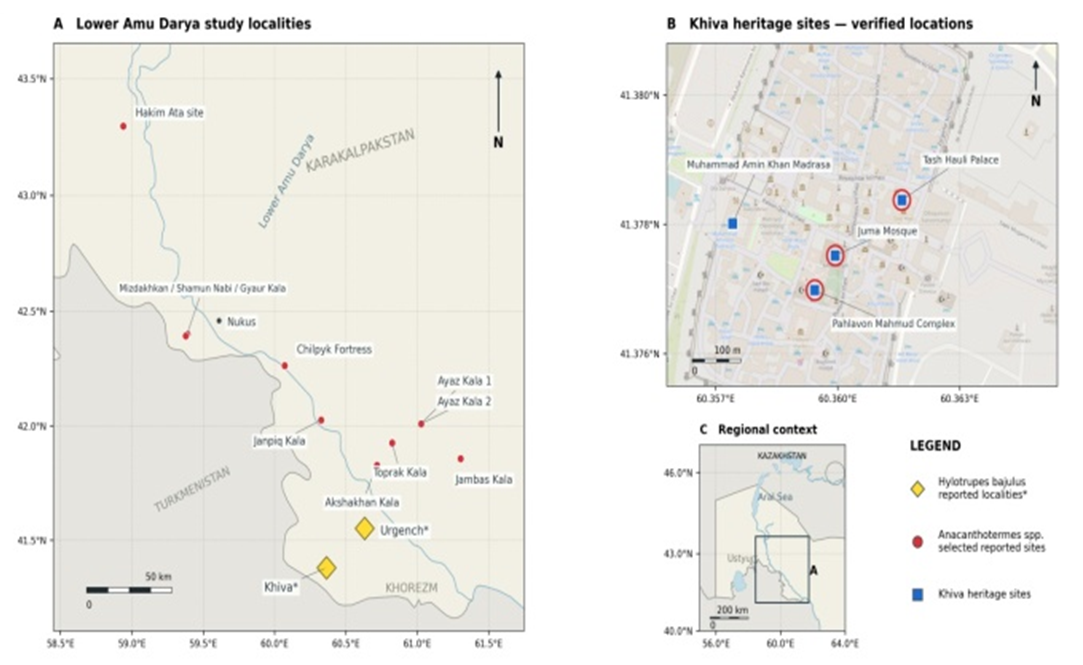 | Figure 1. Monitoring network for Hylotrupes bajulus in natural ecosystems and anthropogenically transformed areas of the Southern Aral Sea region |
Field monitoring and species identification.During the 2022–2026 study period, entomological, faunistic, morphological, ecological, visual, phenological, statistical, and comparative approaches were used in field observations and specimen identification. Damaged wood was inspected along survey routes, sticky traps were placed around wooden elements, and Barber-type pitfall traps were deployed as supplementary monitoring tools (Fig. 2). The original consolidated records do not contain reproducible trap-level capture counts, deployment and collection dates, or exposure intervals by sampling date. Trapping can therefore be described as part of field detection, but not used to calculate numerical adult abundance, monthly capture rates or a multi-year phenological graph.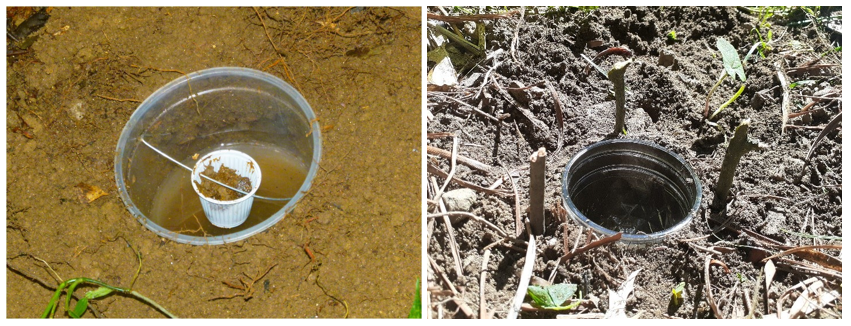 | Figure 2. Examples of Barber-type field traps used during entomological monitoring in natural habitats |
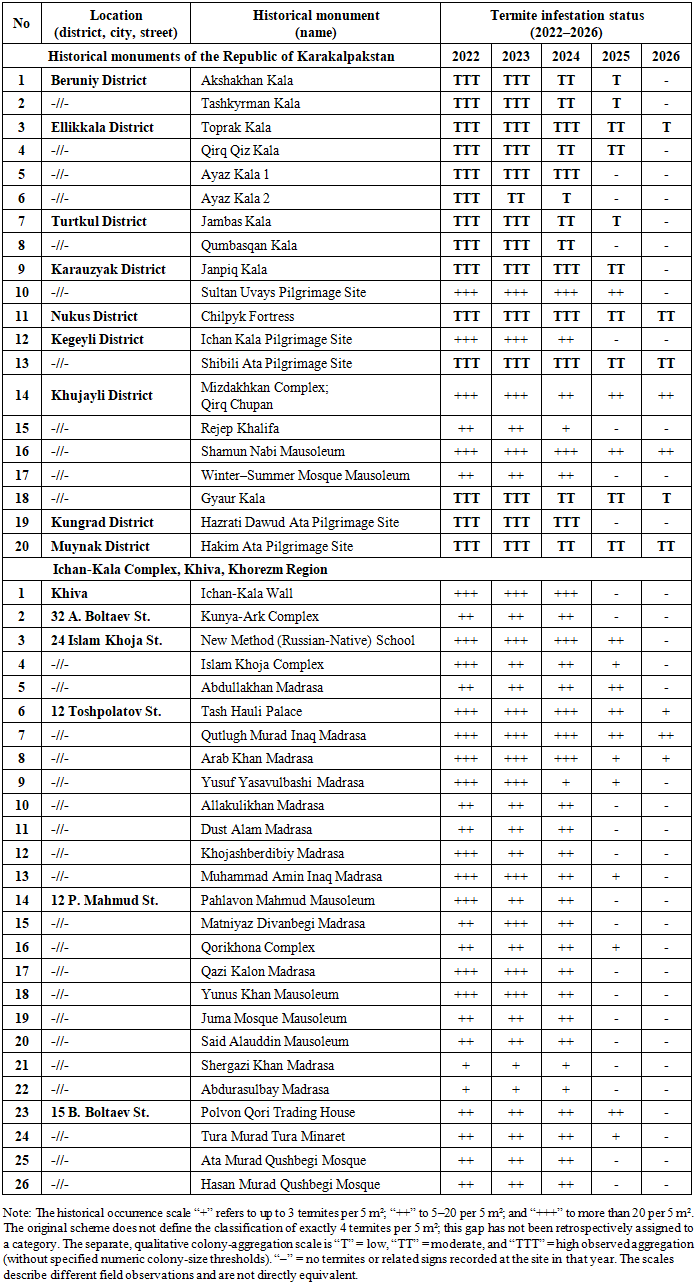
Geographic coordinates were recorded for mapped sites. Samples and pieces of damaged wood were brought to the laboratory for examination, and external infestation signs were recorded in the field. Identification of the principal beetle species relied on adult and larval morphology, the nature of the damage, and its association with wood. Monitoring included inspections of wooden elements for frass, larval galleries, emergence holes and adults. Adult H. bajulus were observed during field visits in June, July and August. Because date-specific captures and sampling effort are unavailable, these observations must be interpreted as qualitative records of presence rather than numerical evidence that flight peaked during these months. Whether traps were operated in May or September cannot be established from the available documentation; therefore, absence of adults in those months is not claimed. The pupal stage was reported as lasting approximately 20 days.Assessment of wood substrates.To compare feeding and infestation intensity among different construction timbers, heavily infested wood pieces were cut into standardized 20-cm sections and observed for one month. External surfaces were cleaned every three days, and newly produced frass was weighed. Experiments were conducted with eight replicates (n = 8), and results were expressed as mean ± standard error.Assessment of historical sites.Wooden elements were examined at selected historical monuments in the city of Khiva, Khorezm Region, as well as in storage/workshop areas. The monitoring dataset included 573 elements. The percentage of infested wooden elements was calculated as the number of infested elements relative to the total number examined. Coordinates in the source material were recorded in decimal degrees; the examined sites included the Juma Mosque (41.3790 N, 60.3623 E), the Pahlavon Mahmud Complex (41.3785 N, 60.3632 E), Tash Hauli Palace (41.3799 N, 60.3649 E), and the Muhammad Amin Khan Madrasa (41.3787 N, 60.3604 E).Comparative evidence for wood-boring beetles and termites.Historical and contemporary data on the distribution and pest characteristics of representatives of Hylotrupes (Cerambycidae) and Anacanthotermes were compared in natural and anthropogenically transformed conditions in Karakalpakstan and Khorezm. Primary quantitative substrate data were available for H. bajulus; the termite comparison was supplemented by regional studies [8]. For the historical-site records (Table 2), the authors confirm that the ordinal colony-aggregation codes T, TT and TTT indicate low, moderate and high observed aggregation, respectively. The symbol “–” means that no termites or signs of termite occurrence were recorded at the respective site and year. The separate “+”, “++” and “+++” codes denote categories of observed occurrence per 5 m² as specified in the table note. The T and + series are different field-rating schemes and must not be equated with one another. No numerical colony-size boundaries were defined for T, TT and TTT, so these levels are descriptive rather than quantitative counts.
3. Results
The Southern Aral Sea landscape is a complex mosaic of former water-level zones, recently exposed seabed, remnant tugai vegetation, irrigated land, and planted green cover. Existing regional data indicate that this is not a uniform “new-land fauna,” but rather an environment capable of supporting many insect orders [3]. The summarized inventory recorded 271 insect species belonging to 18 orders. Within this broad assemblage, Coleoptera occupy an important taxonomic and functional position.Karakalpakstan has a long history of entomological research. In 1932–1934, N. A. Voronsovskiy inventoried 476 insect species, with particular attention to 117 Coleoptera species. Early observations have also been reported from Khorezm for the termites Anacanthotermes turkestanicus and A. ahngerianus and the longhorn beetle Hylotrupes bajulus, all associated with plant resources of arid habitats. These records are important as baseline faunistic information.Beetle ResearchDuring the study, H. bajulus specimens collected from dry and weakened woody plants in the tugai areas of Urgench and Khiva, from urbanized sites, and from historic wooden structures in Khiva, Khorezm Region, Uzbekistan, were examined. During 2022–2026, more than 4,000 samples were analyzed and 167 coordinate points were registered. H. bajulus was recorded in concealed larval galleries within wood and in association with characteristic frass and emergence holes; the collected material was examined morphologically (Fig. 3).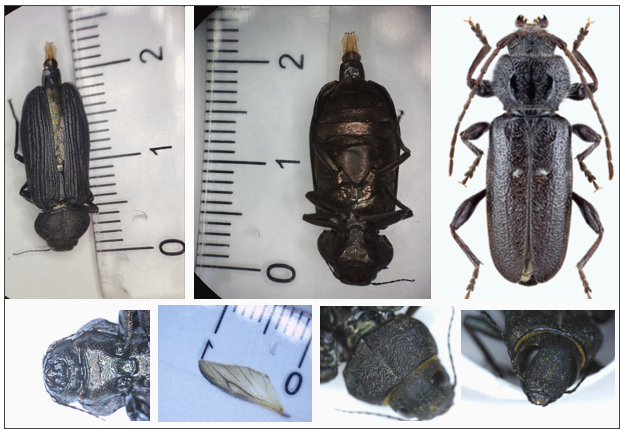 | Figure 3. Hylotrupes bajulus material and diagnostic views represented in the primary data collection (original images) |
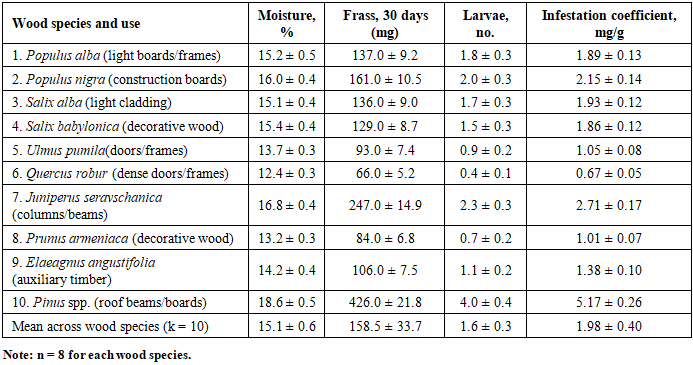
Experiments were conducted to assess the association of H. bajulus with different wood substrates. Infestation activity differed substantially among the tested wood species (Table 1).Table 1. Infestation indicators of Hylotrupes bajulus larvae in construction timbers (n = 8 for each wood species; values are M ± SE)
 |
| |
|
The final row was recalculated as the mean ± SE of the row means for the 10 wood species listed in the table; because the raw values for the 80 individual replicates were not provided in the table, an overall pooled SE was not calculated.The highest 30-day frass production and infestation coefficient were recorded for Pinus spp. (426.0 ± 21.8 mg; 5.17 ± 0.26 mg/g), followed by Juniperus seravschanica (247.0 ± 14.9 mg; 2.71 ± 0.17 mg/g). The lowest infestation coefficient was observed in Quercus robur (0.67 ± 0.05 mg/g). Overall means recalculated from the row means of the 10 wood species were: moisture content 15.1 ± 0.6%, 30-day frass production 158.5 ± 33.7 mg, number of larvae 1.6 ± 0.3, and infestation coefficient 1.98 ± 0.40 mg/g. The results indicate marked differences in infestation intensity among substrate types, with particularly high activity in pine and juniper wood.Adult H. bajulus were observed during field examinations in June, July and August, with adults or newly formed emergence holes noted in some historic structures. The observations support a qualitative statement of summer occurrence only. Numerical trap catches, the temporal interval between catches and May/September sampling coverage cannot be reconstructed from the available records; consequently, the results do not establish a month-by-month abundance curve, numerical seasonal peak, or absence outside June–August. Larvae remain concealed within wood, and feeding traces provide a longer-term indicator of infestation. Together, observations of adults and persistent larval damage support the use of xylophagous Coleoptera in complementary field surveillance.Termite ResearchTwo species of the genus Anacanthotermes occur in the Southern Aral Sea region: the Turkestan termite and the Greater Trans-Caspian termite (A. turkestanicus and A. ahngerianus). Especially over the past 20–30 years, they have caused substantial damage to residential houses, agricultural buildings, and even historical monuments in Karakalpakstan and Khorezm. Although termite-control measures have been developed, their concealed way of life, protection from external environmental factors, functional specialization of castes within termite nests, and very high colony abundance mean that even a small number of surviving termites can rapidly restore the population after control measures are applied.The study material includes extensive regional biological-control research on the Turkestan termite A. turkestanicus; termites are characterized as insects typical of dry habitats historically recorded in Karakalpakstan and Khorezm. Recent syntheses identify A. turkestanicus and A. ahngerianus as important species of the genus Anacanthotermes in Karakalpakstan and Khorezm [8]. Their subterranean colonies, cellulose-based feeding, and association with dry plant material differ ecologically from insects that develop within wood.Termites are important in natural ecosystems because they decompose organic and cellulosic residues, return this material to the soil, and participate in nutrient cycling. However, under anthropogenic conditions, some termite species shift to wooden structures and cellulose-containing materials and can cause damage in residential buildings, farm structures, and historical and cultural heritage sites.In the Southern Aral Sea region, development of natural areas and expansion of settlements and construction sites strengthen the connection between natural termite habitats and anthropogenic environments. Therefore, assessment of their distribution should consider not only infested buildings or wooden elements but also the surrounding soil, dry plant residues, and the availability of other cellulose sources.Considering the pest characteristics of A. turkestanicus and A. ahngerianus, termite occurrence and visible infestation signs were compiled at historical and cultural heritage sites for 2022–2026 (Table 2). According to the authors’ field-code clarification, “T” denotes low, “TT” moderate, and “TTT” high observed termite-colony aggregation; these are ordinal ratings without documented numerical boundaries. The separate categories “+”, “++” and “+++” represent the historical occurrence scale based on termite observations per 5 m². A dash (“–”) denotes no termites or termite-related signs recorded for the corresponding site-year examination. The two positive rating systems should not be compared numerically, and no unrecorded colony counts have been inferred.Table 2. Monitoring indicators of Anacanthotermes termites at historical and cultural heritage monuments in the Southern Aral Sea region (2022–2026)
 |
| |
|
During the study, many historical and cultural heritage monuments of the Southern Aral Sea region were found to have earthen walls and to be situated in open natural landscapes, creating favorable conditions for termites to form very large aggregations (at least 42,000 individuals).Table 2 presents the authors’ historical-site observation codes for 46 monuments: 20 in the Republic of Karakalpakstan and 26 in Khiva, Khorezm Region, over 2022–2026. The “+” series is an occurrence category expressed per 5 m², whereas the “T” series is a low/moderate/high ordinal colony-aggregation rating. As confirmed by the authors, “–” signifies that termites or their signs were not recorded at that site and year, rather than an unexamined site. These codes are not directly comparable as numerical abundance values. The site records did not identify the two Anacanthotermes species separately; thus, the observations describe genus-level infestation status, not species-specific population trends.Positive termite codes were recorded at all 46 historical sites in each of 2022, 2023 and 2024. In 2025, positive codes were reported for 24 of 46 sites (52.2%); in 2026, for 10 of 46 (21.7%), with the other entries coded as no termite signs observed. Within Karakalpakstan, detection codes were present at 20, 20, 20, 13 and 7 of the 20 sites in successive years, compared with 26, 26, 26, 11 and 3 of the 26 sites in Khiva. These figures describe the proportion of sites with recorded termite-related signs within this monitoring table. Because detailed repeat-visit frequencies and standardized detection probabilities are unavailable, the observations must not be interpreted as directly measured changes in colony numbers or infestation intensity.In Karakalpakstan, the “T” series indicating colony aggregation was recorded at 14 sites in 2022, 14 sites in 2023, 14 sites in 2024, 10 sites in 2025, and 5 sites in 2026. Positive termite-related codes in 2026 remained at Toprak Kala, Chilpyk Fortress, the Shibili Ata Pilgrimage Site, the Mizdakhkan Complex, the Shamun Nabi Mausoleum, Gyaur Kala, and the Hakim Ata Pilgrimage Site. In Khiva, occurrences at the “+” or “++” level were recorded in 2026 at Tash Hauli Palace, Qutlugh Murad Inaq Madrasa, and Arab Khan Madrasa.The proportion of examined historical sites with a positive termite code was lower in 2025–2026 than in 2022–2024; entries coded “–” were reported by the authors as having no termites or signs detected. Nevertheless, the available data do not document consistent inspection effort, repeat-visit frequency, colony-size thresholds for T/TT/TTT, or species-specific counts for every site-year. The observed difference therefore should not be presented as proven regional population decline or as evidence of termite-control effectiveness. Future monitoring should retain survey effort, repeated 5 m² sample-area observations, colony and individual counts, dates and separate identifications of A. turkestanicus and A. ahngerianus.The primary quantitative evidence presented here concerns H. bajulus in wood substrates. Regional records on A. turkestanicus and A. ahngerianus provide ecological context for historical-site monitoring; they are not equivalent to standardized insect counts, and the present analysis does not establish the effectiveness of control measures or quantitative trends for other pest species.The results for H. bajulus are particularly important for understanding the wooded and built-environment components of the Southern Aral Sea transition zone. The high infestation coefficients recorded in Pinus spp. and Juniperus seravschanica, together with the concentration of active infestation signs at some historical sites, indicate that suitable wood substrates can maintain persistent populations regardless of the dryness of the surrounding surface. This is consistent with previous studies of the concealed biology of old house borer larvae and with research identifying wood properties and prolonged larval development as key drivers of infestation ecology [5,7]. The highest relative infestation in workshop/collection-storage environments also suggests that stored wood may serve as a local pest reservoir within the broader urban landscape.Anacanthotermes termites operate at a different spatial scale: their colonies are soil-associated, cellulose-dependent, and persistent, and A. turkestanicus and A. ahngerianus are currently recognized as important species for the region [8]. Therefore, a monitoring program that combines surface-active beetles, plant-associated Lepidoptera, wood-inhabiting Coleoptera, and subterranean termites can capture different components of the terrestrialization process.The evidence, however, must be interpreted cautiously. The quantitative data in this article are based primarily on H. bajulus records from Khorezm and Khiva rather than on a study in which Coleoptera, Lepidoptera, and termites were simultaneously sampled using standardized methods across the entire newly exposed seabed. The Lepidoptera and Anacanthotermes sections are comparative and are supported by literature data. This distinction avoids artificially overstating the evidence and defines the next research stage: repeated sampling with methods appropriate to each insect guild across a common network of georeferenced points extending from the exposed Aralkum through the Ustyurt, remnant tugai, and oasis habitats.
4. Conclusions
In the Southern Aral Sea region, terrestrialization has created a mosaic of saline soils, sparse vegetation, dry wood and human-made wooden habitats. In investigations initiated in 2022 and reported through 2026, the primary H. bajulus substrate data indicate a strong association with wood type and local conditions: infestation signs were detected in 19.9 ± 1.7% of the 573 historical wooden elements examined, and the infestation coefficient ranged from 0.67 ± 0.05 mg/g in Quercus robur to 5.17 ± 0.26 mg/g in Pinus spp. Adults were noted in June–August, but the absence of dated trap-catch counts prevents a quantitative seasonal-activity graph or conclusions about flight activity in May and September. Termite-related signs were recorded in fewer monuments in 2025–2026 than in 2022–2024 using the authors’ qualitative field codes, but the underlying colony sizes and causes of that pattern cannot be determined from these records.Regional evidence for Anacanthotermes broadens this interpretation, but it should not be merged with the primary beetle dataset. Together, the three groups represent complementary monitoring dimensions — vegetation and landscape context, dry-wood resources, and soil/cellulose habitats. Future studies should use synchronized field-sampling methods on the newly exposed Aral Sea bed and in adjacent control habitats so that community-level responses can be tested directly and quantitatively rather than inferred from separate datasets.
ACKNOWLEDGEMENTS
The authors would like to express their sincere gratitude to all co-authors for their valuable contributions to the preparation of this manuscript, including the collection and analysis of research materials, interpretation of the results, and preparation of the final version of the article. Special appreciation is extended to Juginisov T.I. and Duysengaliev E.S. for their substantial contribution to the English translation and linguistic preparation of the manuscript, as well as for their assistance in preparing and organizing the tables and developing the GIS-based map used in the study. Their contribution significantly improved the presentation and overall quality of the manuscript.
References
| [1] | Adilov B, Shomurodov K, Rakhimova T, Sultamuratov A, Polvonov F, Begjanova G, Jabbarov Z, Wang L, Zhao Z (2025) Vegetation colonization and biodiversity dynamics on the exposed Aral Sea bed: A 35 years investigation. Ecological Indicators 177: 113789. https://doi.org/10.1016/j.ecolind.2025.113789. |
| [2] | Micklin P (2010) The past, present, and future Aral Sea. Lakes & Reservoirs: Research & Management 15(3): 193–213. https://doi.org/10.1111/j.1440-1770.2010.00437.x. |
| [3] | Reymov QD, Gulimbetov BD, Tajibaeva J, Seytmuratov AK, Seyilkhanova AN, Medetov MZh (2023) Janubiy Orolqum entomofaunasiga ayrim antropogen omillarning ta'siri [Effects of selected anthropogenic factors on the entomofauna of the Southern Aralkum]. Science and Society 3-1: 36-37. [In Uzbek] |
| [4] | Medetov M, Seylkhanova A, Tilepov J, Reymov Q, Shakarboyeva S, Akhmedova M, Miratdinova A, Kamalov Q, Erjanova D (2025) Fauna and importance of blister beetles (Coleoptera, Meloidae) of the Southern Aral Sea Region (Uzbekistan). Biosystems Diversity 33(1): e2506. https://doi.org/10.15421/012506. |
| [5] | Cannon KF, Robinson WH (1981) Wood consumption and growth of Hylotrupes bajulus (L.) larvae in three environments. Environmental Entomology 10(4): 458-461. https://doi.org/10.1093/ee/10.4.458. |
| [6] | Fettköther R, Dettner K, Schröder F, Meyer H, Francke W, Noldt U (1995) The male pheromone of the old house borer Hylotrupes bajulus: identification and female response. Experientia 51: 270-277. |
| [7] | Krajewski A, Jakieła S, Witomski P (2022) Detection of old house borer larvae in wooden structures by acoustic emission method - influence of larval size and sensor location. BioResources 17(2): 3435-3444. |
| [8] | Matyakubov ZSh, Abdullaev II (2025) Biology and ecology of termites in Khorezm and Karakalpakstan, Uzbekistan. Development and Innovations in Science 4(13): 52-57. https://doi.org/10.5281/zenodo.17934270. |


 Abstract
 Reference
 Full-Text PDF
 Full-text HTML