
-
Paper Information
- Paper Submission
-
Journal Information
- About This Journal
- Editorial Board
- Current Issue
- Archive
- Author Guidelines
- Contact Us
International Journal of Virology and Molecular Biology
p-ISSN: 2163-2219 e-ISSN: 2163-2227
2026; 15(7): 163-166
doi:10.5923/j.ijvmb.20261507.03
Received: Sep. 28; Accepted: Oct. 17, 2026; Published: Oct. 23, 2026

Association Between Elevated Serum TNF-α Levels in Patients with Diabetes Mellitus and the Development of Diabetic Neuropathy
 Abstract
 Reference
 Full-Text PDF
 Full-text HTML
Saatov T. S.1, Ibragimova E. A.1, Toshtemirov A. E.1, Alimov T. R.1, 2, Ibragimov Z. Z.1, Ishankhodjayev T. M.1, Artykbaeva G. M.1, Mustafakulov M. A.1, Shamansurova Z. M.1, 3, Abdurakhimov S. A.1, Nasriddinova P. M.1, Maksutova N. N.4
1Institute of Biophysics and Biochemistry at the National University of Uzbekistan named after Mirzo Ulugbek, Tashkent, Uzbekistan
2Republican Specialized Scientific-Practical Medical Center of Hematology, Ministry of Health of the Republic of Uzbekistan
3Central Asian University, Tashkent, Uzbekistan
4Republican Specialized Scientific-Practical Medical Center of Endocrinology named after academician Ya.Kh. Turakulov, Ministry of Health of the Republic of Uzbekistan
Copyright © 2026 The Author(s). Published by Scientific & Academic Publishing.
This work is licensed under the Creative Commons Attribution International License (CC BY).
http://creativecommons.org/licenses/by/4.0/

To investigate the relationship between TNF-α levels and the development of neuropathy in diabetes mellitus. The study involved patients with type 2 diabetes mellitus (T2DM) without complications and patients with diabetic neuropathy (DN) undergoing inpatient treatment at the Republican Specialized Scientific-Practical Medical Center of Endocrinology (Ministry of Health of the Republic of Uzbekistan). Biochemical parameters and TNF-α cytokine levels were measured in the blood. It was established that serum TNF-α levels in patients with diabetic neuropathy correlate directly with the severity of the disease.
Keywords: T2DM, Diabetic neuropathy (DN), Cytokine, TNF-α
Cite this paper: Saatov T. S., Ibragimova E. A., Toshtemirov A. E., Alimov T. R., Ibragimov Z. Z., Ishankhodjayev T. M., Artykbaeva G. M., Mustafakulov M. A., Shamansurova Z. M., Abdurakhimov S. A., Nasriddinova P. M., Maksutova N. N., Association Between Elevated Serum TNF-α Levels in Patients with Diabetes Mellitus and the Development of Diabetic Neuropathy, International Journal of Virology and Molecular Biology, Vol. 15 No. 7, 2026, pp. 163-166. doi: 10.5923/j.ijvmb.20261507.03.
Article Outline
1. Introduction
- In recent years, the role of the cytokine tumor necrosis factor-alpha (TNF-α) in the pathogenesis of various human diseases has been intensively studied. It has been established that TNF-α acts as a key pro-inflammatory mediator involved in the development of insulin resistance and the pathogenesis of type 2 diabetes mellitus. TNF-α is one of the triggering factors in the development of obesity, diabetes mellitus, and its complications [5,7]. A link has been identified between changes in TNF-α levels and the course of various metabolic, autoimmune, and neurodegenerative diseases [1,3]. According to the literature, elevated blood concentrations of TNF-α in diabetic patients may be associated with increased secretion of this cytokine by monocytes/macrophages in patients with type 2 diabetes [2].TNF-α is detectable in the blood at various stages of the inflammatory process. Numerous studies indicate that elevated blood TNF-α concentrations serve as an indicator of carbohydrate metabolism disorders, impaired glucose tolerance, and insulin resistance in diabetes mellitus [10]. Evidence exists regarding the pro-atherogenic properties of TNF-α and its role in lipid metabolism and the development of atherogenic dyslipidemia [8,9,15]. TNF-α has been shown to influence plasma triglyceride concentrations, contributing to decreased HDL-cholesterol levels and increased LDL-cholesterol levels. Elevated TNF-α levels block insulin signaling via serine phosphorylation of insulin receptor substrate-1 (IRS-1) and induce insulin resistance in adipocytes and peripheral tissues. It has been established that TNF-α contributes to the impairment of insulin's biological action, leading to the development of type 2 diabetes mellitus [4,13].Diabetic neuropathy (DN) is a severe complication of diabetes mellitus. Assessing peripheral blood TNF-α levels may be significant in evaluating the progression of complications in type 2 diabetes, particularly diabetic neuropathy.
2. The Aim of the Study
- The aim of the study was to investigate the relationship between serum TNF-α levels and the development of neuropathy in patients with diabetes mellitus (DM).
3. Materials and Methods
- The study involved 70 patients with type 2 diabetes mellitus undergoing inpatient treatment at the Academician Ya.Kh. Turakulov Republican Specialized Scientific-Practical Medical Center of Endocrinology (Ministry of Health of the Republic of Uzbekistan). Patients were divided into groups based on clinical history and clinical-laboratory findings:Group I – patients with DM without complications (n=20)Group II – patients with diabetic neuropathy (DN) (n=50)Group III – individuals without DM (n=10)Group II was further divided into two subgroups based on DN severity: moderate (DN1) and severe (DN2) disease course. The control group consisted of individuals with no clinical or laboratory signs of carbohydrate metabolism disorders.Fasting capillary blood glucose levels were determined using the glucose oxidase method with "Cypress Diagnostics" (Belgium) kits. Biochemical analyses were performed using HUMAN (Germany) kits. Serum TNF-α concentrations in patients with DM were measured via enzyme-linked immunosorbent assay (ELISA) using "TNF-alpha-ELISA BEST" (Russia) kits.Measurements were performed using an MR96 microplate photometer (Mindray, China).
4. Results and Discussion
- Assessment of the subjects' age revealed no statistically significant difference between the group of patients with diabetes mellitus and the control group (p > 0.05). The duration of the disease was 7.67 ± 5.4 years.Analysis of peripheral blood biochemical parameters in patients with type 2 diabetes mellitus (T2DM) yielded the following findings. Patients diagnosed with T2DM exhibited carbohydrate and lipid profiles characteristic of this pathology. A significant increase was observed in fasting glucose levels (3.6-fold) and glycated hemoglobin (HbA1c) levels (3.1-fold) (p < 0.05) compared to the control group. Regarding lipid abnormalities, the most significant changes included a 3.1-fold increase in triglyceride (TG) levels (p < 0.05) and elevated very-low-density lipoprotein cholesterol (VLDL-C) levels; the latter may be attributed to either increased production or reduced catabolism of VLDL-C.It is possible that the alterations in blood carbohydrate and lipid levels observed in T2DM patients were also associated with elevated levels of the cytokine TNF-α. Considering this possibility, the TNF-α levels in the peripheral blood of the study groups were measured.ELISA-based analysis of serum TNF-α levels revealed a significant increase in TNF-α concentration in patients with diabetes (3.05 ± 0.44 pg/mL) compared to non-diabetic subjects (1.10 ± 0.05 pg/mL; p < 0.05).A comparison of serum TNF-α levels in patients with type 2 diabetes mellitus—with and without diabetic neuropathy—revealed a trend toward increased TNF-α concentrations in patients who had developed diabetic neuropathy; the mean level across the entire patient group was 5.2 ± 0.44 pg/mL (Figure 1). Our study results showed no significant difference in TNF-α levels between patients with moderate diabetic neuropathy (DN1) and those without neuropathy (3.62 ± 0.89 pg/mL and 3.05 ± 0.44 pg/mL, respectively).
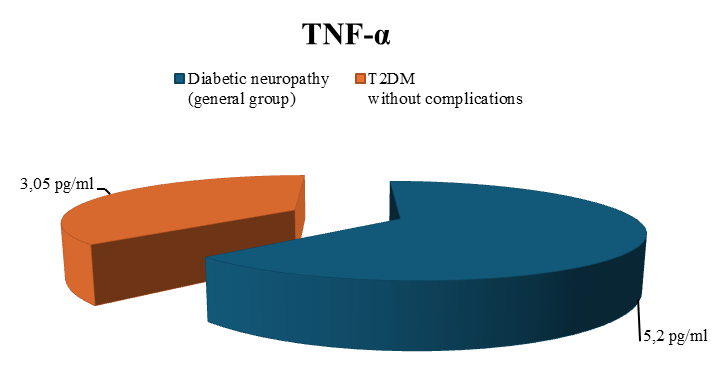 | Figure 1. Comparison of serum TNF-α levels in patients with type 2 diabetes mellitus without neuropathy and with diabetic neuropathy |
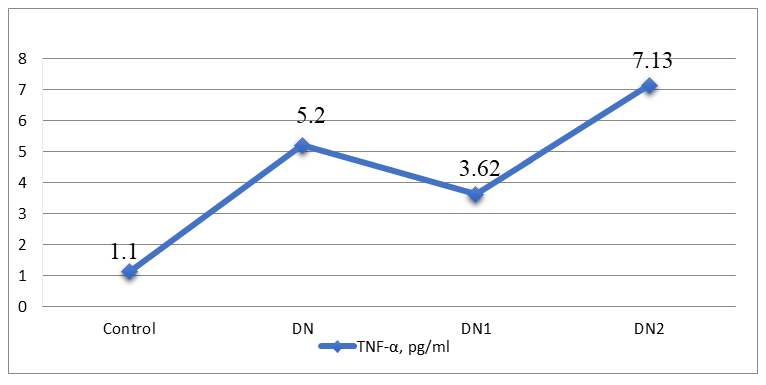 | Figure 2. Serum TNF-α levels in patients with diabetic neuropathy (pg/mL, p < 0.05); DN – combined group of patients with diabetic neuropathy; DN1 – moderate diabetic neuropathy; DN2 – severe diabetic neuropathy |
5. Conclusions
- It has been established that serum TNF-α levels in patients with diabetes mellitus correlate directly with the severity of diabetic neuropathy. Measuring peripheral blood TNF-α levels may have prognostic value in assessing the progression of type 2 diabetes complications, particularly diabetic neuropathy.