
-
Paper Information
- Previous Paper
- Paper Submission
-
Journal Information
- About This Journal
- Editorial Board
- Current Issue
- Archive
- Author Guidelines
- Contact Us
International Journal of Virology and Molecular Biology
p-ISSN: 2163-2219 e-ISSN: 2163-2227
2026; 15(6): 146-149
doi:10.5923/j.ijvmb.20261506.03
Received: Aug. 25, 2026; Accepted: Sep. 19, 2026; Published: Sep. 22, 2026

Evaluation of Antibiotic Susceptibility of Pathogen Staphylococcus Aureus Isolates
 Abstract
 Reference
 Full-Text PDF
 Full-text HTML
Murodova Ijobatxon Abdulbosi qizi1, Kutliev Jamshid Amanbayevich2, Bakhramova Nazira Nazimovna3, Ergasheva Khilola Irkinovna4, Turakulov Erkin Xasanovich5, Ibragimov Adil Ahmedovich6, Sharafitdinova Gulnora Xashimovna7
1Department of Microbiology, Virology and Immunology, Tashkent State Medical University, Uzbekistan
2Department of Military Hygiene, Epidemiology and Biosafety, Military Medical Institute, Uzbekistan
3Laboratory of Microbiology and Antimicrobial Resistance, National Biopharmaceutical Research Institute, Uzbekistan
4Department of Medical and Biological Disciplines, Tashkent International University Kimyo, Uzbekistan
5Department of Children, Adolescents and Food Hygiene, Tashkent State Medical University, Uzbekistan
6Laboratory of Special Devices, National Biopharmaceutical Research Institute, Uzbekistan
7Bacteriology Laboratory of the Republican Scientific Center for Emergency Medical Care
Correspondence to: Murodova Ijobatxon Abdulbosi qizi, Department of Microbiology, Virology and Immunology, Tashkent State Medical University, Uzbekistan.
| Email: |  |
Copyright © 2026 The Author(s). Published by Scientific & Academic Publishing.
This work is licensed under the Creative Commons Attribution International License (CC BY).
http://creativecommons.org/licenses/by/4.0/

In this article, the antibiotic susceptibility of Staphylococcus aureus strains isolated from clinical samples in March 2026 at the Bacteriology Laboratory of the Republican Scientific Center for Emergency Medical Care was assessed using the disk diffusion method (DDM). A total of 928 Staphylococcus spp. were isolated from 1785 clinical samples, of which 645 were S. aureus isolates. The susceptibility of the isolates to rifampicin, cefoxitin, linezolid, gentamicin, ciprofloxacin, and erythromycin was studied. The results showed that there was a significant difference in the level of antibiotic resistance between MRSA and MSSA strains.
Keywords: Staphylococcus aureus, MRSA, MSSA, Antibiotic susceptibility, Disk diffusion method, Clinical isolate
Cite this paper: Murodova Ijobatxon Abdulbosi qizi, Kutliev Jamshid Amanbayevich, Bakhramova Nazira Nazimovna, Ergasheva Khilola Irkinovna, Turakulov Erkin Xasanovich, Ibragimov Adil Ahmedovich, Sharafitdinova Gulnora Xashimovna, Evaluation of Antibiotic Susceptibility of Pathogen Staphylococcus Aureus Isolates, International Journal of Virology and Molecular Biology, Vol. 15 No. 6, 2026, pp. 146-149. doi: 10.5923/j.ijvmb.20261506.03.
Article Outline
1. Introduction
- Staphylococcus aureus (S. aureus) infections are a global health problem. A number of antibiotics are used to treat infections caused by this bacterium, and they are aimed at affecting key bacterial intracellular processes such as cell wall synthesis, translation, transcription, and DNA synthesis. However, antibiotic resistance is an increasing problem, leading to treatment failures and high medical costs [2,9]. Antibiotic resistance arises through several mechanisms, such as targeted drug modifications, enzymatic drug inactivation, increased flux of antimicrobial compounds and altered drug entry, and the spread of resistance is facilitated by numerous mobile genetic elements. The resistance of this bacterium to antibiotics poses serious challenges in the effective treatment of infections [10,11]. In particular, MRSA (Methicillin-Resistant Staphylococcus aureus) strains limit the possibilities for treatment. Therefore, assessment of susceptibility to various antibiotics is important in selecting an optimal therapeutic approach [1,3]. S. aureus produces various enzymes, such as protease, lipase, and hyaluronidase, which degrade tissues. These bacterial products may facilitate the spread of infection to adjacent tissues, but their role in the pathogenesis of the disease is not well understood. β-lactamase, produced by the bacterial cell, is an enzyme that inactivates penicillin. Penicillin-binding proteins are enzymes located in the cytoplasmic membrane and are responsible for the resistance of S. aureus to penicillins and cephalosporins. The enzyme coagulase is a prothrombin activator that converts fibrinogen to fibrin [4,5].Although resistance has been observed for almost all compounds, individual strains resistant to all drugs have not emerged. Nevertheless, resistance still poses a challenge to treatment. Fully resistant strains are rare, but despite a small increase in the prevalence of intermediate resistance, they are associated with more severe infections and longer duration of treatment than susceptible strains. This highlights that we have limited knowledge of how resistance genes and mutations affect the overall biology of resistant strains and the impact of resistance on pathogenesis [7,8]. In this article, we focus on the biology of antibiotic resistance in S. aureus and the behavior of resistant strains, and we conclude by describing some novel therapeutic approaches that may become future treatments for infections with antibiotic-resistant staphylococci.
2. Materials and Methods
2.1. Hospital Setting
- In accordance with the purpose of the microbiological study, the biological and pathogenic factors of these S. aureus strains were studied in detail in March 2026 using traditional methods in the “Adult Resuscitation Department”, “Children's Departments (I, II, somatic)” and “Emergency Cardiology Department” of the Republican Scientific Center for Emergency Medical Care of Uzbekistan (RSCEMCU). Biological materials from patients treated for acute respiratory infections, bronchitis, and unilateral and bilateral pneumonia were collected: nasopharyngeal swabs, sputum, venous blood, and urine. Collection of biological materials, bacteriological examinations of S. aureus by microscopy, cultivation in nutrient media, determination of sensitivity to antibiotics were carried out in the Bacteriology Laboratory of the RSCEMCU, MALDI–TOF–MS for species-specific identification in the Bacteriology Laboratory of the Department of Sanitary Epidemiological Control of the Main Medical Department under the Administration of the President of the Republic of Uzbekistan, and molecular genetic studies were carried out in the Laboratory of Special Devices of the National Research Institute of Biopharmaceutics.
2.2. Bacterial Strain and Culture Conditions
- Microbiological characteristics of S. aureus were determined: morphological - by the Gram method, cultural - by fermentation of carbohydrates and production of carotenoid pigment of gold on MSA agar, and 5% blood agar was used to determine the hemolytic properties of the derivatives. Biochemical analyses of virulence factors - by the production of DNAse, hemolysin, plasmacoagulase, lecithinase enzymes were carried out.
2.3. MALDI–TOF–MS Analysis
- MALDI–TOF–MS analysis for species-specific identification of isolated S. aureus strains with atypical biochemical characteristics. MALDI–TOF–MS was used to identify isolated colonies obtained on dense nutrient media. In order to confirm the results obtained by traditional cultural biochemical methods, identification was performed on a MALDI–TOF mass spectrometer "Microflex LRF" (Bruker Daltonics, Germany) in real-time mode using the Biotyper version 3.0 program, according to the manufacturer's instructions. The conclusion about the taxonomic affiliation of the microorganism was made based on the value of the similarity index (score - parameter C). The value of C from 1.7 to 1.99 indicates identification up to the genus, and C > 2 indicates identification up to the species and identification to the exact species. A score below 1.7 was scored as unreliable identification.
2.4. Statistical Analysis
- The data obtained during the study were evaluated using parametric and nonparametric analysis methods. The data were collected and stored in an Excel database. The comparison of numerical data and the assessment of the significance of their differences were carried out using the Pearson χ2 test.
3. Results
- 3.1. A total of 1785 clinical samples analysis was done. A total of 1785 clinical samples were analyzed from various departments of the Republican Scientific Center for Emergency Medical Care. Among the patients, 48% were female and 52% were male, comprising the following age groups: 0–20 years (65.11%), 20–40 years (20.9%), 41–60 years (6.9%), and over 60 years (6.9%).928 Staphylococcus spp. from 1785 samples was determined. An age-based analysis revealed that S. aureus infections occur predominantly in the age group up to 20 years. Complications are observed to be fatal, especially in young children.3.2. 645 of them S. aureus formation during the study, a total of 645 biological samples were subjected to bacteriological analysis and the frequency of S. aureus was assessed across sample types (Figure 1). According to the results, this microorganism was most frequently detected in throat swab samples, with 420 samples, which was 65.12% of the total samples.
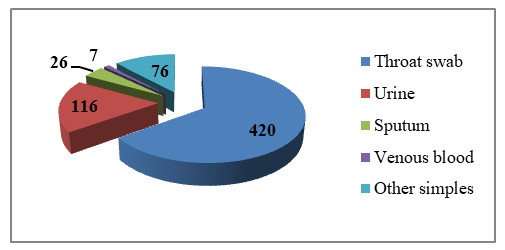 | Figure 1. Rate of occurrence of Staphylococcus aureus in clinical samples |
|
|
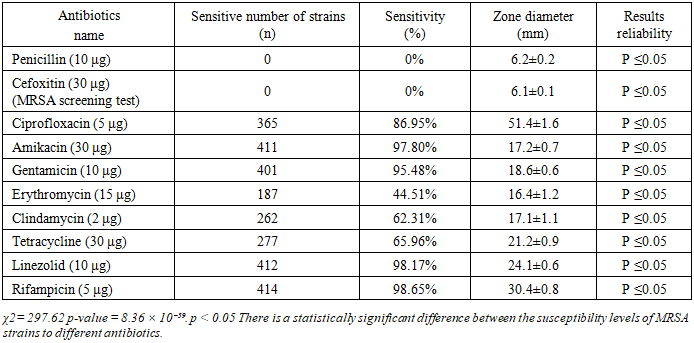
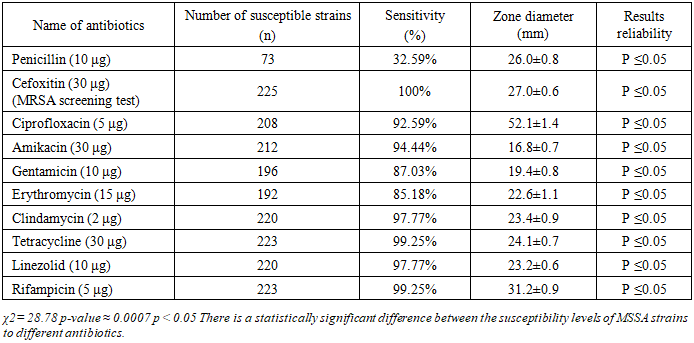
4. Conclusions
- The present study demonstrated a high prevalence of MRSA among the clinical S. aureus isolates investigated. Of the 645 S. aureus isolates identified, 420 (65.12%) were classified as MRSA, whereas 225 (34.88%) were identified as methicillin-susceptible S. aureus (MSSA). These findings indicate a substantial burden of methicillin resistance among clinical S. aureus isolates and highlight the importance of continuous antimicrobial susceptibility surveillance in hospital settings.The disk diffusion susceptibility testing revealed distinct antimicrobial susceptibility patterns between MRSA and MSSA isolates. MRSA isolates demonstrated complete resistance to penicillin and cefoxitin, confirming the phenotypic characteristics of methicillin resistance. In contrast, MSSA isolates showed comparatively higher susceptibility to the tested antimicrobial agents. Among the MRSA isolates, the highest susceptibility rates were observed for linezolid, rifampicin, amikacin, and gentamicin, whereas greater resistance was observed to erythromycin and clindamycin.Clinically, these findings emphasize that empirical treatment of suspected S. aureus infections should take into consideration the high local prevalence of MRSA and the antimicrobial susceptibility profile of circulating strains. Reliance on local antibiogram data, together with microbiological identification and susceptibility testing, is essential for rational antibiotic selection, optimization of antimicrobial therapy, and reduction of inappropriate antibiotic use.The observed differences in susceptibility between MRSA and MSSA isolates were statistically significant, supporting the clinical relevance of differentiating these two phenotypic groups during laboratory diagnosis and therapeutic decision-making. Therefore, routine surveillance of antimicrobial resistance, early laboratory identification of MRSA, and continuous monitoring of changes in susceptibility patterns are important components of effective infection control and antimicrobial stewardship.Overall, the findings indicate that S. aureus remains an important clinical pathogen, with a substantial proportion of isolates exhibiting methicillin resistance. Strengthening microbiological surveillance and implementing susceptibility-guided therapy may contribute to improved clinical outcomes and more effective management of staphylococcal infections.