
-
Paper Information
- Paper Submission
-
Journal Information
- About This Journal
- Editorial Board
- Current Issue
- Archive
- Author Guidelines
- Contact Us
International Journal of Virology and Molecular Biology
p-ISSN: 2163-2219 e-ISSN: 2163-2227
2026; 15(5): 128-135
doi:10.5923/j.ijvmb.20261505.05
Received: Aug. 12, 2026; Accepted: Sep. 6, 2026; Published: Sep. 18, 2026

Taxonomic Composition, Harmfulness, and Preventive Measures of Hemiptera: Miridae Bugs Under the Conditions of Karakalpakstan
 Abstract
 Reference
 Full-Text PDF
 Full-text HTML
Juginisov Tangirbergen Isaevich1, Jollibekova Gulnara Perdebaevna2, Duysengaliev Erbol Sarsengalievich3
1Doctor of Biological Sciences, Professor, Berdaq Karakalpak State University, Uzbekistan
2Doctoral Student, Nukus State Pedagogical Institute named after Ajinizay, Uzbekistan
3Doctor of Philosophy (PhD) in Biological Sciences, Berdaq Karakalpak State University, Uzbekistan
Copyright © 2026 The Author(s). Published by Scientific & Academic Publishing.
This work is licensed under the Creative Commons Attribution International License (CC BY).
http://creativecommons.org/licenses/by/4.0/

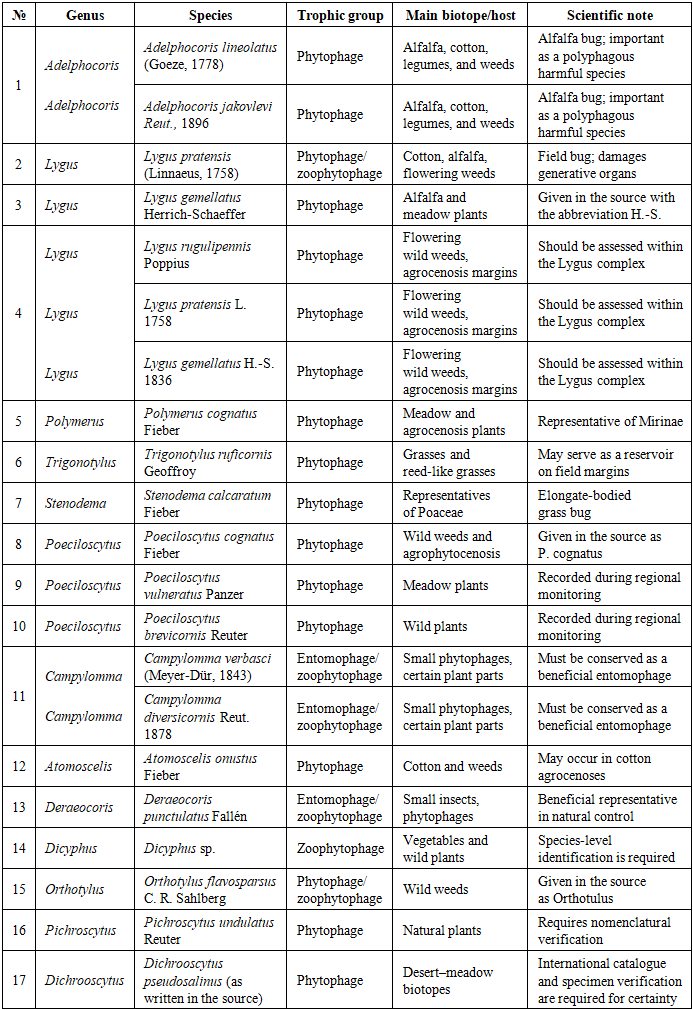
This article analyzes the taxonomic composition, trophic groups, patterns of damage to cotton and forage crops, and preventive management measures of bugs of the family Miridae Hahn, 1833 occurring in cotton, alfalfa, and vegetable agrocenoses and natural ecosystems of the Republic of Karakalpakstan, particularly in the Amu Darya and Khujayli districts. Although representatives of Hemiptera are sometimes called beetles in the scientific literature, taxonomically beetles belong to the order Coleoptera, whereas Miridae is a family of true bugs within Hemiptera: Heteroptera. The analysis was based on data on 19 species recorded in the Amu Darya–Khujayli area in 2015–2020, including 17 phytophagous and 2 entomophagous species. Regional data were compared with international taxonomic catalogues, GBIF, and recent Miridae/Heteroptera studies published in Uzbekistan. The results show a strong association of Miridae species with the generative organs of cotton, alfalfa, vegetables, and wild host plants. Local sources report that Miridae feeding causes 5–7% damage to the cotton yield; under other agroclimatic conditions of Uzbekistan, certain mirids, especially Adelphocoris lineolatus, Lygus pratensis, and Creontiades pallidus, have been associated with significant yield losses. The article proposes an integrated preventive system consisting of monitoring, management of weeds and reservoir plants, conservation of entomophages, a trap-crop approach, and decision-making based on the economic threshold of damage.
Keywords: Miridae, Hemiptera, Heteroptera, Karakalpakstan, Amu Darya, Khujayli, Cotton, Alfalfa, Phytophage, Entomophage, Integrated pest management
Cite this paper: Juginisov Tangirbergen Isaevich, Jollibekova Gulnara Perdebaevna, Duysengaliev Erbol Sarsengalievich, Taxonomic Composition, Harmfulness, and Preventive Measures of Hemiptera: Miridae Bugs Under the Conditions of Karakalpakstan, International Journal of Virology and Molecular Biology, Vol. 15 No. 5, 2026, pp. 128-135. doi: 10.5923/j.ijvmb.20261505.05.
1. Introduction
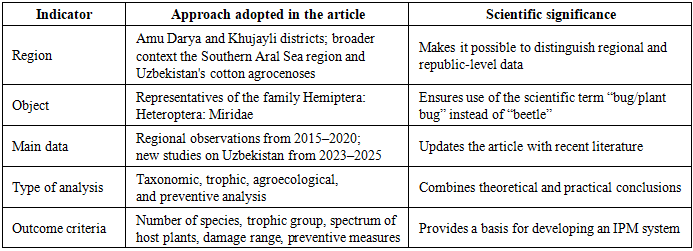
- Miridae Hahn, 1833 is one of the largest and ecologically most important families within Heteroptera, comprising thousands of species worldwide. In cotton agrocenoses of Uzbekistan, certain representatives of this family damage generative organs buds, flowers, bolls, and capsules as sap-sucking phytophages, while other representatives are important as entomophages or zoophytophages feeding on eggs and larvae of small insects. [2] Therefore, generalizing Miridae species solely as pests is scientifically insufficient: the trophic status, phenology, host plants, and function of each species in the agrocenosis should be assessed separately.The issue of Miridae in Karakalpakstan is relevant for two reasons. First, the region has an arid climate, while irrigated areas in the Amu Darya delta are located in a landscape where cotton, alfalfa, and vegetable agrocenoses intersect with natural desert–meadow biotopes. Such a mosaic landscape creates favorable conditions for the migration of phytophagous bugs between crop fields and wild reservoir plants. Second, the Southern Aral Sea region and Lower Amu Darya area have been actively studied in recent years in terms of Heteroptera diversity: in 2025, the composition of Heteroptera in the Southern Aral Sea region was reported to comprise 258 species, 25 families, and 104 genera. [4] This indicates the need to strengthen regional inventory and practical monitoring of Miridae.
|
2. Results
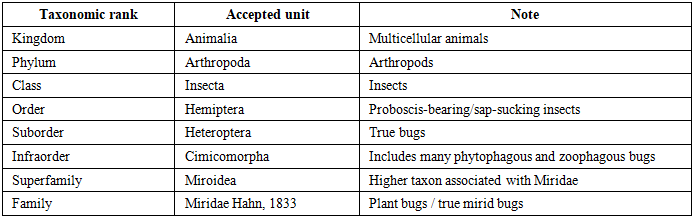
- The family Miridae belongs to the infraorder Cimicomorpha within the superfamily Miroidea. In GBIF data, for example, the complete hierarchy for Lygus pratensis is Animalia – Arthropoda – Insecta – Hemiptera – Miridae – Lygus – Lygus pratensis. [8] The Catalogue of Life lists the “On-line Systematic Catalog of Plant Bugs” dataset as a separate global taxonomic resource in its 2026 version. [7]
|
|
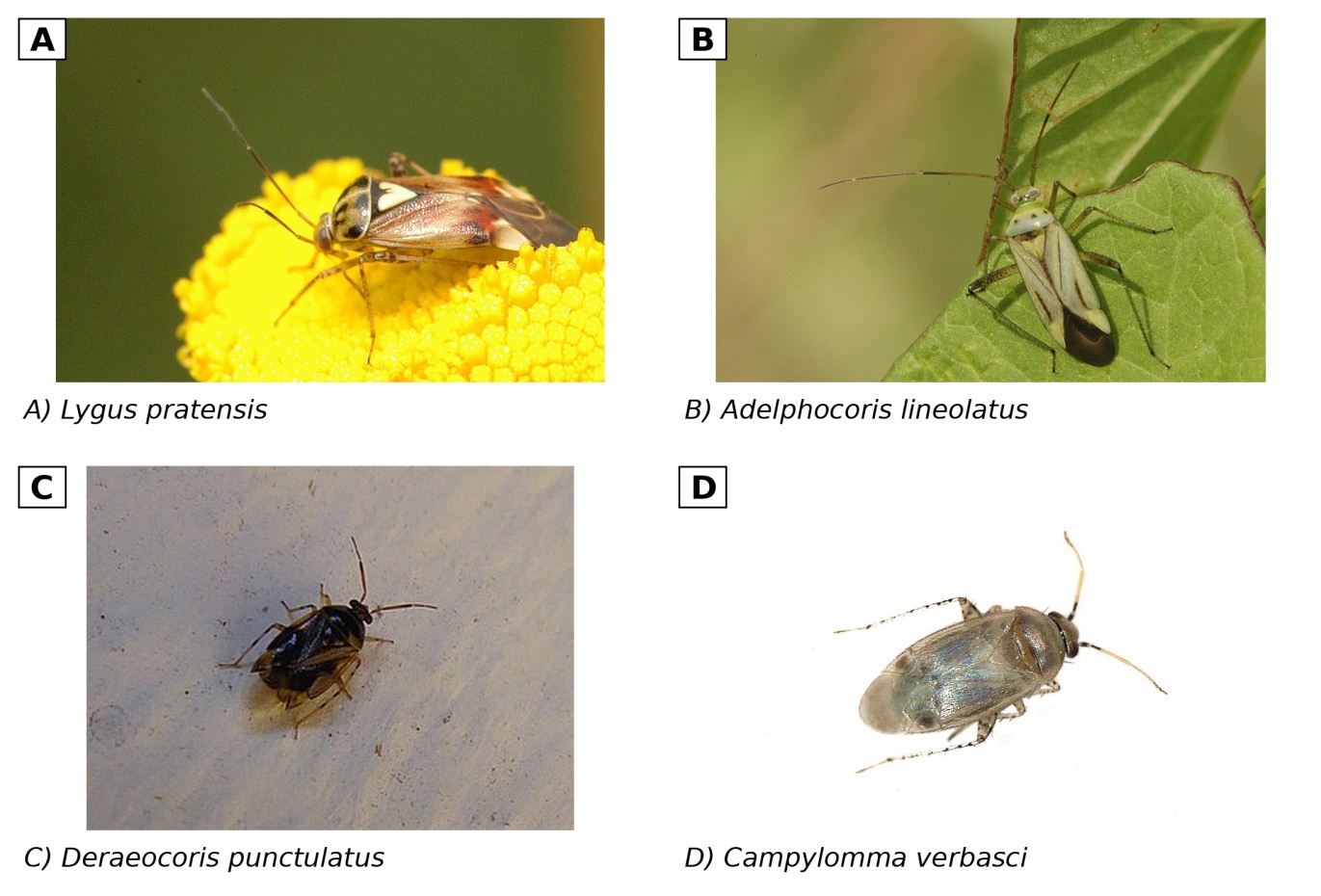 | Figure 1. Real photographs of species belonging to the family Miridae obtained from the Internet: A — Lygus pratensis, B — Adelphocoris lineolatus, C — Deraeocoris punctulatus, D — Campylomma verbasci. Photo credits and licenses: Wikimedia Commons. [13] |
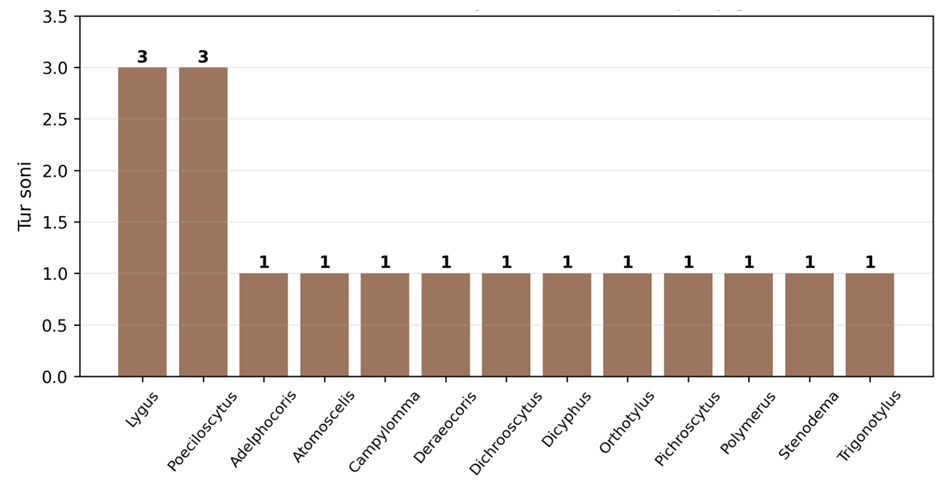 | Figure 2. Number of species by clearly identified Miridae genera in the Amu Darya–Khujayli data. The graph was reconstructed based on the taxonomic table in the source |
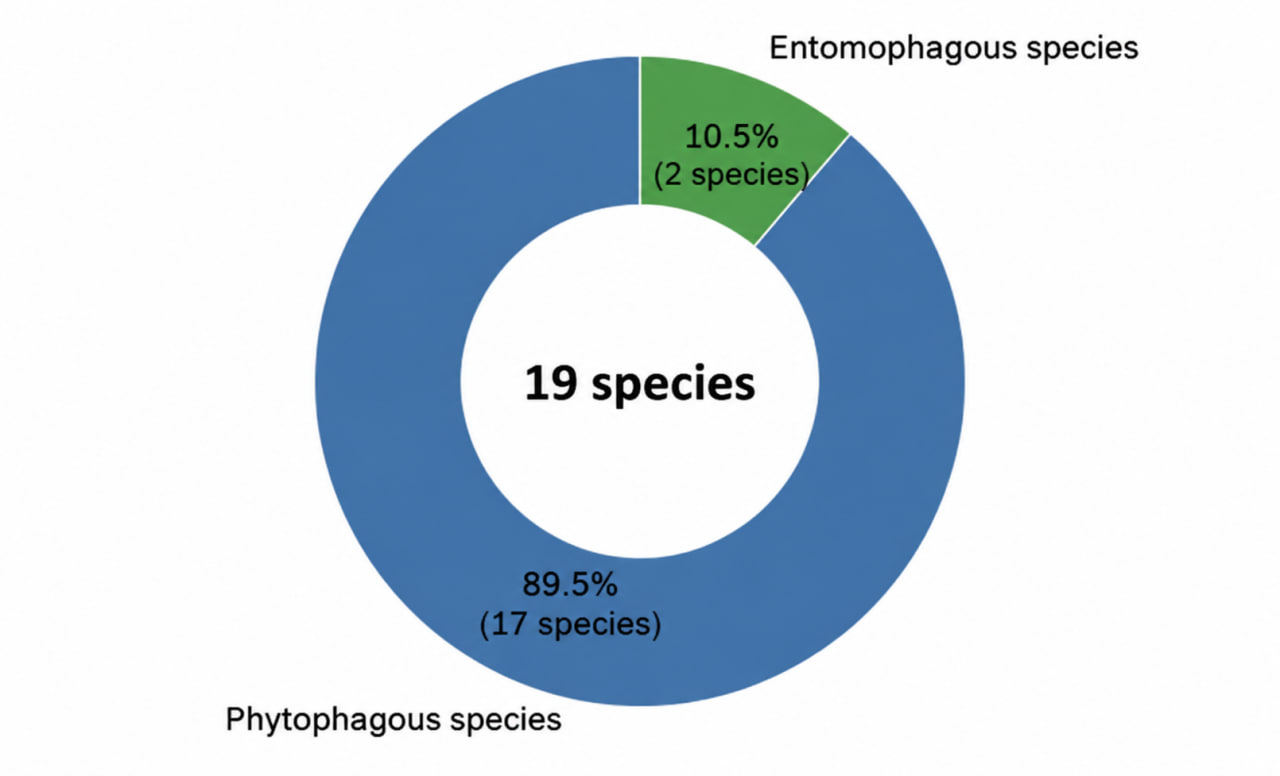 | Figure 3. Ratio of trophic groups of Miridae species recorded in the Amu Darya and Khujayli districts |
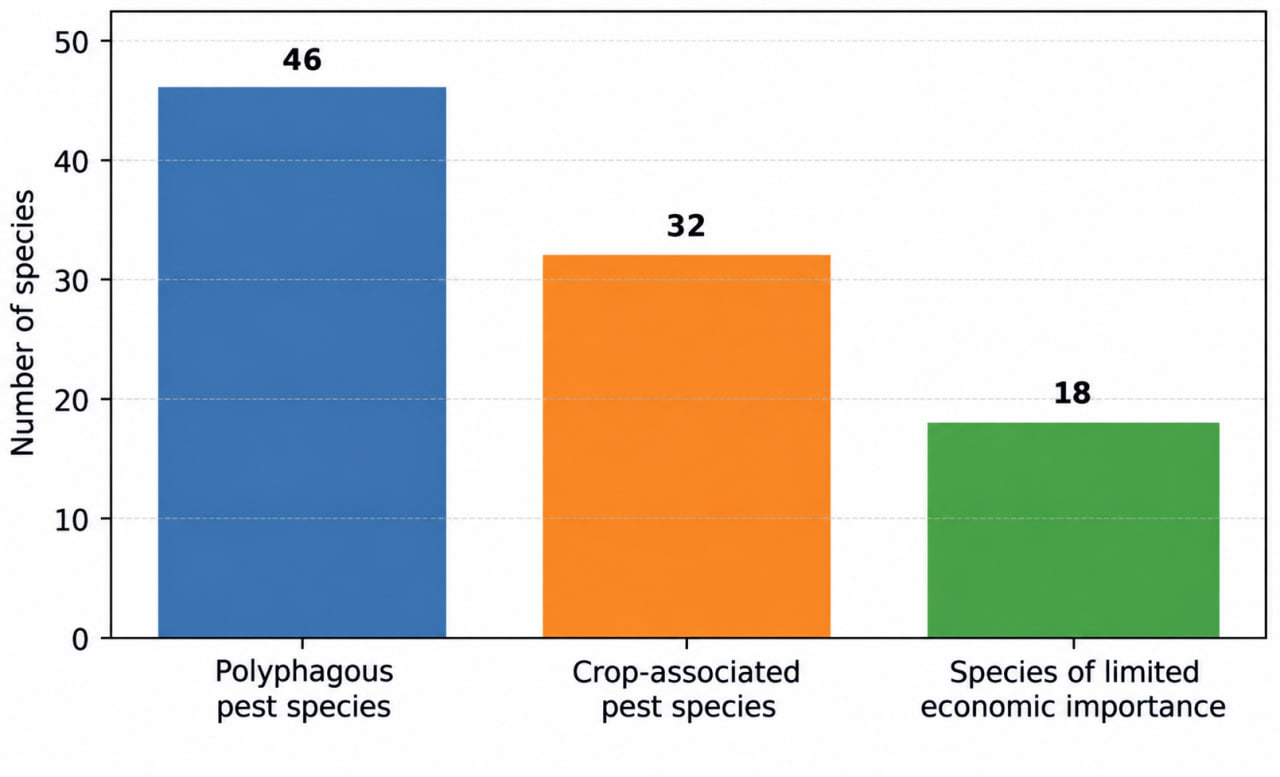 | Figure 4. Spectrum of host plants associated with Miridae representatives: number of plant species, species on which oviposition was recorded, and number of plant families |
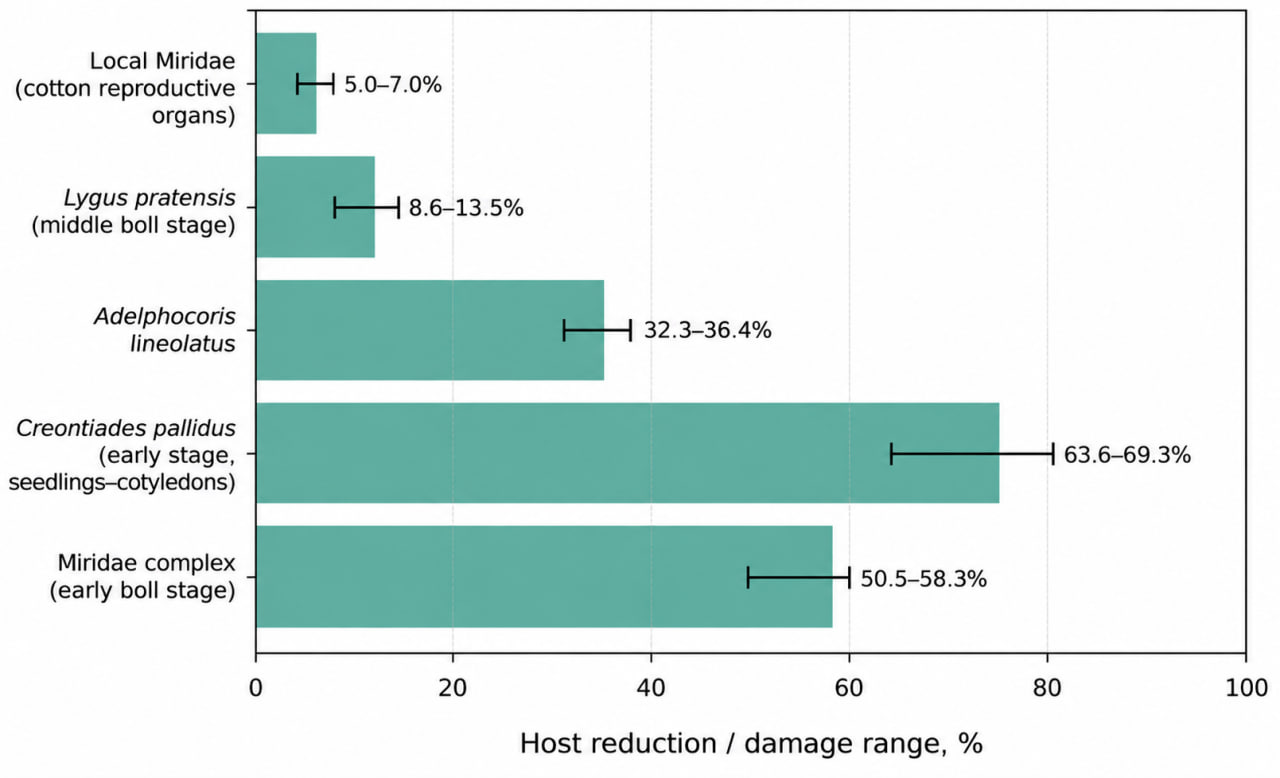 | Figure 5. Ranges of cotton damage by Miridae reported in Uzbek sources. Data on Creontiades pallidus are provided for comparison at the republic level and do not refer to Karakalpakstan |
|
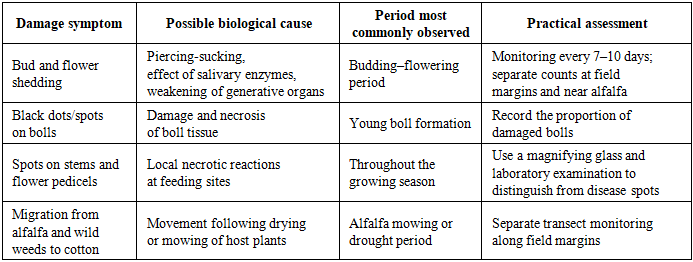
3. Discussion
- The results show that the Miridae problem under the conditions of Karakalpakstan is not limited to a single crop or a single species. Cropland, alfalfa, vegetables, wild plants, and natural biotopes form an interconnected agroecological system. Therefore, prevention should not rely solely on chemical treatment; instead, it should combine monitoring, agronomic practices, biological control, conservation of natural enemies, and, where necessary, selective chemical measures.Recent studies indicate that the Heteroptera fauna of Uzbekistan is being rapidly updated. For example, in 2024, Asciodema obsoleta was reported for the first time for the fauna of Uzbekistan, based on material from the Khorezm, Namangan, and Fergana regions. [6] This confirms the need to maintain the Miridae list not as a static inventory but as a continuously updated database.A particular risk for Karakalpakstan is that alfalfa and wild flowering plants may serve as reservoirs for phytophagous Miridae. International literature notes that trap crops for Lygus species, particularly alfalfa-based border crops, may divert pests from the main crop; however, if such an approach is improperly managed, the reservoir field itself may become a source of pests. [9] Therefore, as a preventive measure, alfalfa mowing, field margins, vegetation along ditches, and migration periods between crops should be planned together. The need to link preventive work with seasonal monitoring is also evident in the work of Juginisov T.I., Kurbaniyazov B.T., Duysengaliev E.S., and co-authors on seasonal changes in the development of Anacanthotermes termites. [18]Preventive Measures System. The following system is a recommended preventive model for the cotton–alfalfa–vegetable agrocenoses of Karakalpakstan. It is not a pesticide dosage or field-treatment instruction; chemical measures should be carried out only in accordance with labels of registered products, local phytosanitary regulations, and the instructions of qualified specialists.
|
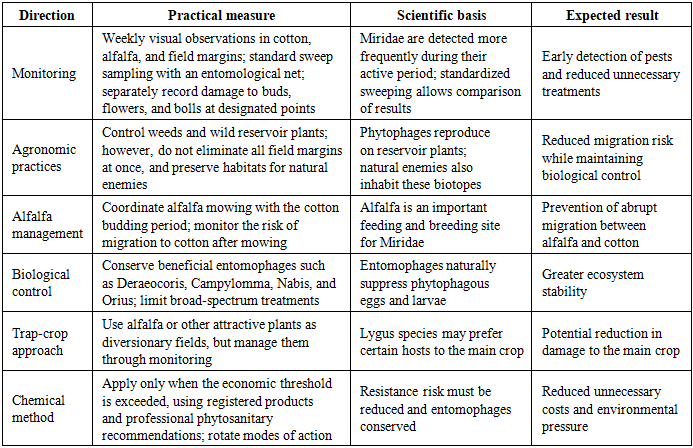
4. Conclusions
- Representatives of the family Miridae in the agrocenoses of the Amu Darya and Khujayli districts of Karakalpakstan form a multi-component complex associated with cotton, alfalfa, vegetable crops, and natural plants. Published regional data record 19 species of Miridae, of which 17 are indicated as phytophagous and 2 as entomophagous. For scientific accuracy, some taxon names should be re-examined using international catalogues, collection specimens, and, where necessary, DNA barcoding. Miridae damage is most pronounced in the generative organs of cotton: damage to buds, flowers, and young bolls, black spots, shedding, and reductions in yield-forming elements are observed. Local sources report damage of 5–7%, but special experiments in other regions of Uzbekistan show considerably higher yield losses for some species. The preventive system should combine monitoring, agronomic management, control of alfalfa and field-margin reservoirs, conservation of entomophages, and scientifically justified chemical intervention only when necessary.Scientific Novelty and Practical Significance. Maqolaning ilmiy yangiligi Miridae bo‘yicha mahalliy Qoraqalpog‘iston maʼlumotlarini so‘nggi xalqaro va respublika nashrlari bilan uyg‘unlashtirish, shuningdek, turlarni fitofag-entomofag funksional guruhlari bo‘yicha profilaktik boshqaruv nuqtai nazaridan qayta talqin qilishdan iborat. Amaliy ahamiyati esa paxta va beda agrotsenozlarida keraksiz kimyoviy bosimni kamaytirgan holda Miridae xavfini erta aniqlash va boshqarish algoritmini taklif etishidadir.