
-
Paper Information
- Paper Submission
-
Journal Information
- About This Journal
- Editorial Board
- Current Issue
- Archive
- Author Guidelines
- Contact Us
International Journal of Virology and Molecular Biology
p-ISSN: 2163-2219 e-ISSN: 2163-2227
2026; 15(5): 124-127
doi:10.5923/j.ijvmb.20261505.04
Received: Aug. 25, 2026; Accepted: Sep. 12, 2026; Published: Sep. 14, 2026

Biological Effectiveness of Integrated Preventive Control Measures Against Trialeurodes Vaporariorum in Greenhouse Agrobiocenosis
 Abstract
 Reference
 Full-Text PDF
 Full-text HTML
Serjanova G. S.1, Juginisov T. I.2
1Nukus State Pedagogical Institute named after Ajiniyaz, Nukus
2Karakalpak State University named after Berdakh, Nukus
Copyright © 2026 The Author(s). Published by Scientific & Academic Publishing.
This work is licensed under the Creative Commons Attribution International License (CC BY).
http://creativecommons.org/licenses/by/4.0/

This article examines the effectiveness of integrated preventive control measures against Trialeurodes vaporariorum in the greenhouse agrobiocenosis. The study was conducted in greenhouses under the conditions of Southern Aral region, using a complex of agrotechnical, biological, and chemical methods. The results demonstrated that the integrated pest management system exhibited high biological efficiency in suppressing whitefly populations.
Keywords: Aleyrodidae, Trialeurodes vaporariorum, Greenhouse, IPM, Encarsia formosa, Monitoring
Cite this paper: Serjanova G. S., Juginisov T. I., Biological Effectiveness of Integrated Preventive Control Measures Against Trialeurodes Vaporariorum in Greenhouse Agrobiocenosis, International Journal of Virology and Molecular Biology, Vol. 15 No. 5, 2026, pp. 124-127. doi: 10.5923/j.ijvmb.20261505.04.
1. Introduction
- Trialeurodes vaporariorum is one of the most widespread and highly damaging pests in greenhouse conditions. By sucking sap from plant leaves, it disrupts the process of photosynthesis and spreads viral diseases. It causes particularly great economic damage to tomatoes, cucumbers, and other greenhouse crops. The long-term use of chemical insecticides causes environmental problems and leads to the formation of resistance in pests. Therefore, an integrated control system (IPM), i.e., the combination of biological, agrotechnical, and chemical methods, is considered relevant [1,2,3,5].It is noted that agrotechnical measures play an important role in reducing the white-winged population. Among them, crop rotation, the elimination of weeds, the use of healthy planting material, the adaptation of planting dates, and the destruction of plant residues are the main agrotechnical methods. Sequential planting of the same plant leads to the accumulation of pest populations. Seed rotation disrupts the biological cycle of whiteflies. Whiteflies develop on many wild plants. Weeds serve as a reservoir for the virus and an additional source of food for the pest. In greenhouse conditions, Trialeurodes vaporariorum spreads rapidly through seedlings. The use of certified, pest-free seedlings is an important preventive measure. Selecting planting dates that do not coincide with the pest's mass reproduction period reduces population pressure. Destruction of infected plant residues at the end of the growing season reduces wintering stages [6,7,9].In recent years, special attention has been paid to biological control methods in agriculture. The main one remains the use of entomophages. Encarsia formosa is a very small (about 0.5–1 mm) parasitoid insect primarily used in biological control against whiteflies. It is one of the most effective entomophages, especially against Trialeurodes vaporariorum. The female insect lays eggs on a whitefly larva and develops inside the larva. The parasitized whitefly turns black (diagnostic sign). The full cycle of Encarsia is 15-25 days, depending on temperature. The adult Encarsia exits. Its mechanism of action is that it destroys the whitefly larva from within, naturally reduces the population, and ensures control without chemicals. Biological control with an efficiency of up to 70-90% yields the highest results in greenhouses [1,8]. Regular use yields a stable effect. In addition, natural enemies of whiteflies include golden-eyes Chrysopidae, ladybird beetles Coccinellidae, and other predatory insects that destroy eggs and larvae [5]. They are distinguished by their environmental safety.Chemical methods are particularly effective in combating whiteflies when the damage is severe. Below are the main methods of insecticide application:Systemic insecticides - penetrate the plant and destroy the pest from within (for example: imidacloprid, thiamethoxam). Contact insecticides include pyrethroids, which act by touching the insect's body.Intestinal agents poison the pest during feeding. The preparations are mixed with water and sprayed, paying special attention to the underside of the leaves. Spraying is recommended in the morning or evening. Using the same chemical for a long time creates resistance in whiteflies. Therefore, insecticides of different groups should be used alternately. Do not exceed the dosage; strict adherence to the instructions is essential for plant and human health. Combining chemical methods with agrotechnical and biological methods yields the best results. In addition, yellow adhesive traps and bleached films are particularly effective in greenhouse conditions and are widely used [2,6,7,9].Advantages of the Integrated Protection System (IPM) according to the results of experiments, this method increases environmental safety, slows down the development of resistance, preserves entomofauna, and increases economic efficiency. Monitoring is central to the IPM system. Chemical measures are recommended only when the pest population exceeds the economic damage threshold. An analysis of scientific sources shows that a single method is insufficient for combating representatives of the Aleyrodidae family [1,10]. The most effective approach is the scientifically grounded combination of agrotechnical, biological, and chemical measures. Especially in greenhouse conditions, the implementation of monitoring systems in conjunction with biological control agents yields high results.
2. Materials and Methods
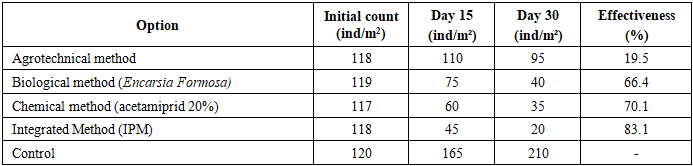
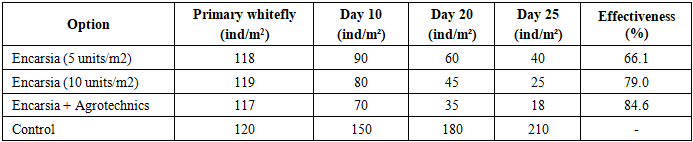
- Research was conducted in 2024-2026 in greenhouses across the Southern Aral region, including the Amudarya, Ellikkala, Turtkul, and Beruni districts, primarily on tomatoes and cucumbers. As a result of agrotechnical, biological, chemical, and their combined integrated control measures against the greenhouse whitefly, which is primarily found on vegetable crops, biological efficacy was recorded for 25 days. (Table 1,2). During the experiment, comprehensive agrotechnical measures were applied aimed at preventing the spread and reducing the population of the whitefly. Before planting crops in the greenhouse, plant residues, weeds, and sources of pests were completely destroyed. The new seedlings were carefully inspected before planting, and the infected plants were isolated. To prevent the pest from entering the greenhouse, the ventilation openings were covered with special meshes, and a double-door system was used at the entrances. During the growing season, the plants were regularly monitored, and as soon as the first signs of whitefly were detected, the infected leaves or plants were removed. Monitoring was carried out using yellow sticky traps, which allowed for the determination of the number of insects in the imago stage. This complex of agrotechnical measures ensured the reduction of the whitefly population at the initial stage and served to increase the effectiveness of subsequent chemical or biological control methods. During the experiment, experiments were conducted using Encarsia formosa, which is one of the main entomophages in the biological control of the greenhouse whitefly. In this case, observations were conducted under optimal conditions with a greenhouse temperature of 21–27°C, humidity of 60–80%, and sufficient lighting. The encarsia was released into the greenhouse using puppets attached to special paper cards. Depending on the degree of damage, 5-10 potatoes per 1 m2 were hung on the lower part of the plant's branches. The adhesive cards were replaced 3–4 days after release. This process continued until 80% of the white-winged population was infected. During the examination, black infected greenhouse whitefly pupae were found, which are easily distinguishable from uninfected pupae by their black color.
|
|
3. Results
- As a result of studies conducted in 2024–2026 in greenhouses under the conditions of the Southern Aral region, significant differences were identified in the effectiveness of agrotechnical, biological, chemical, and integrated control methods applied against Trialeurodes vaporariorum. During the experiment, the density of the pest population at the initial, 15th, and 30th days, as well as biological efficiency indicators, were taken into account. In the agrotechnical control variant, the whitefly population decreased from 118 individuals/m2 on the 15th day to 110 individuals/m2 and to 95 individuals/m2 on the 30th day. In this variant, the biological efficiency was 19.5%. This result showed that agrotechnical measures have a preventive significance in limiting the penetration and spread of the pest population into the greenhouse rather than its direct destruction. The number of whiteflies decreased from 119 individuals/m2 on the 15th day to 75 individuals/m2 on the 30th day and to 40 individuals/m2 on the 30th day. In this variant, the biological efficiency was 66.4%. Consequently, the use of E. vaporarium allowed for a significant reduction in the population of Trialeurodes vaporariorum In the chemical control variant using 20% acetamipride, the pest density decreased from 117 individuals/m2 to 60 individuals/m2 on the 15th day and to 35 individuals/m2 on the 30th day. As a result, the biological efficiency was 70.1%. This indicator is higher compared to agrotechnical and biological methods, indicating the rapid effect of chemical control in cases of high pest density. In the study, the highest result was recorded in the integrated IPM variant. In this variant, the initial density of Trialeurodes vaporariorum was 118 units/m2, which decreased to 45 units/m2 on the 15th day and to 20 units/m2 on the 30th day. Biological efficiency was 83.1%. This indicator was 63.6 percentage points higher than the agrotechnical method, 16.7 percentage points higher than the biological method, and 13.0 percentage points higher than the chemical method. In the control variant, on the contrary, a steady increase in the number of white wings was observed.The initial pest density of 120 individuals/m2 increased to 165 individuals/m2 on the 15th day and to 210 individuals/m2 on the 30th day. No biological efficacy was observed during this period. This controlled growth indicates that the Trialeurodes vaporariorum population has the potential for rapid reproduction under greenhouse conditions.Experiments conducted using various doses of Encarsia formosa also showed that the amount of the biological agent directly affects its effectiveness. Upon application at a rate of 5 units/m2, the whitefly population decreased from 118 individuals/m2 to 40 individuals/m2 on the 25th day, and the biological efficiency was 66.1%. At a rate of 10 pcs/m2, the pest population decreased from 119 pcs/m2 to 25 pcs/m2, and the efficiency reached 79.0%.The highest biological efficiency was observed in the combination of the use of Encarsia formosa with agrotechnical measures. In this variant, the pest population decreased from 117 individuals/m2 to 70 individuals/m2, on the 20th day to 35 individuals/m2, and on the 25th day to 18 individuals/m2. The final biological efficiency was 84.6%. This result showed that the combined effect of the biological method and agrotechnical preventive measures yielded higher results compared to the biological method used separately.In the control variant, the whitefly population increased from 120 individuals/m2 to 150 individuals/m2 on the 10th day, to 180 individuals/m2 on the 20th day, and to 210 individuals/m2 on the 25th day. This situation demonstrated the rapid growth of the pest population in the absence of biological agents and preventive measures.During the experiment, a sharp decrease in the pest population was observed when Encarsia formosa was used. Particularly high efficiency was noted when applied at a rate of 10 units/m2 [4,8]. The highest result was achieved when combined with agrotechnical measures. The results of the study show that, in general, Encarsia formosa is a key component of the integrated control system, reducing the need for chemical agents and ensuring environmental safety.
4. Discussion
- The results obtained showed that the use of an integrated protection system is more effective in controlling the population of Trialeurodes vaporariorum in the greenhouse agrobiocenosis than individual control methods. According to the experimental results, in the control variant, the whitefly population increased from 120 to 210 individuals/m2, while in the variant using the integrated protection system, the pest population decreased from 118 to 20 individuals/m2. As a result, the biological efficiency was 83.1%.During the agrotechnical control method, a decrease in the whitefly population from 118 to 95 individuals/m2 was observed, and the biological efficiency was 19.5%. This result indicates that agrotechnical measures are of significant preventive importance in limiting the entry, spread, and initial reproduction of the pest into the greenhouse rather than directly drastically reducing its population. In the experiment, the basis of this approach was the use of measures such as weed eradication, removal of plant residues, the use of healthy seedlings, covering ventilation openings with protective nets, and the use of yellow sticky handles. In the biological control variant, the use of Encarsia formosa led to a reduction in the whitefly population from 119 to 40 individuals/m2, and the biological efficiency was 66.4%. This result indicates the limited development of the pest as a result of the parasitoid's impact on Trialeurodes vaporariorum larvae. 21–27°C h under experimental conditions °The results of Table 2 show that increasing the amount of Encarsia formosa leads to an increase in biological efficiency. When applied at a rate of 5 units/m2 on the 25th day, the efficiency was 66.1%, while at a rate of 10 units/m2, this indicator reached 79.0%. In particular, the highest result of 84.6% was recorded when using Encarsia formosa in combination with agrotechnical measures. In the control variant, the number of pests increased from 120 to 210 individuals/m2.When using 20% acetamipride in the chemical control variant, the whitefly population decreased from 117 to 35 individuals/m2, and the biological efficiency was 70.1%. Although the biological effectiveness of the chemical method is significantly higher than that of the agrotechnical method, its main limitation is related to the formation of drug resistance and the possibility of negative impact on beneficial entomofauna. Therefore, it is advisable to use chemical preparations not regularly and based on the same active substance, but only when the pest population exceeds the economic damage threshold and in combination with other protection methods.The most important aspect of the research results is that the 83.1% biological efficiency obtained in the integrated protection system was higher than the efficiency of individual methods. At the same time, agrotechnical measures limited the initial spread of the pest, biological control means damaged its larval stages, and the chemical method provided additional control in cases of increased pest density. Thus, the complementarity of the methods contributed to an increase in the overall effectiveness of protection. The increase in the number of whiteflies from 120 to 210 individuals/m2 in the control variant indicates rapid population growth in greenhouse conditions with favorable conditions for Trialeurodes vaporariorum. Therefore, instead of a control strategy aimed at destroying the pest only after mass reproduction, it is important to identify its initial appearance and begin preventive measures early.Overall, the results obtained indicate the need to organize agrotechnical, biological, and chemical measures for the control of Trialeurodes vaporariorum based on a unified system. In particular, the use of Encarsia in combination with agrotechnical measures yielded an efficiency of 84.6%, which indicates the possibility of wider application of biological protection in the greenhouse agrobiocenosis. In the integrated variant, an efficiency of 83.1% was achieved, which is important from the perspective of reducing the need for chemical preparations, preserving beneficial entomofauna, and preventing the formation of resistance in pests.
5. Conclusions
- Overall, the use of a single method for controlling Trialeurodes vaporariorum in the greenhouses of the Southern Aral region is not sufficiently effective. Therefore, it is necessary to implement comprehensive monitoring, agrotechnical, biological, and chemical measures. The integrated control system against Trialeurodes vaporariorum in the greenhouse agrobiocenosis has an efficiency of over 80% [1,3,9].The integrated protection system not only increases yields but also plays a crucial role in environmental protection. Thus, the results obtained confirm that the integrated approach not only possesses high biological efficiency but is also an environmentally sustainable and practical method. Therefore, it is recommended for wide implementation in the conditions of Southern Aral region. Such a system allows for the sustainable control of pest populations while maintaining the ecological stability of the greenhouse agrobiocenosis.