
-
Paper Information
- Next Paper
- Previous Paper
- Paper Submission
-
Journal Information
- About This Journal
- Editorial Board
- Current Issue
- Archive
- Author Guidelines
- Contact Us
International Journal of Virology and Molecular Biology
p-ISSN: 2163-2219 e-ISSN: 2163-2227
2026; 15(5): 113-117
doi:10.5923/j.ijvmb.20261505.02
Received: Aug. 13, 2026; Accepted: Sep. 6, 2026; Published: Sep. 10, 2026

Adrenal Cortical Immaturity and Thymic Hyperplasia as Morphological Determinants of Fatal Respiratory Distress Syndrome in Preterm Neonates
 Abstract
 Reference
 Full-Text PDF
 Full-text HTML
Rustamjon Khatamov1, Bobur Khoshimov2
1Department of Pathological Physiology and Pathological Anatomy, Fergana Medical Institute of Public Health, Fergana, Uzbekistan
2Department Clinical Subjects, Alfraganus University, Tashkent, Uzbekistan
Correspondence to: Rustamjon Khatamov, Department of Pathological Physiology and Pathological Anatomy, Fergana Medical Institute of Public Health, Fergana, Uzbekistan.
| Email: |  |
Copyright © 2026 The Author(s). Published by Scientific & Academic Publishing.
This work is licensed under the Creative Commons Attribution International License (CC BY).
http://creativecommons.org/licenses/by/4.0/

Preterm neonates who die with respiratory distress syndrome (RDS) frequently show histological adrenal immaturity together with compensatory thymic enlargement, suggesting a shared endocrine-immune mechanism underlying fatal respiratory failure. This study describes the adrenal and thymic morphology of preterm infants who died with RDS and quantifies the association between adrenal weight, thymic weight, Apgar score, and mortality using statistical comparison with reference values. Adrenal glands from infants of 26–32 weeks' gestation showed undifferentiated glomerular zones, lipid-poor spongiocytes, immature reticular epithelium, venous plethora, and diapedetic hemorrhage. Mean adrenal weight was significantly reduced and mean thymic weight significantly increased relative to gestational-age norms (both p < .001, large effect sizes), and 1-minute Apgar scores were markedly lower in the RDS group (p < .001). Mortality was substantially higher among infants with these morphological changes than in a preterm comparator group (75% vs. 12.5%, p < .001). These findings support adrenal cortical immaturity, rather than RDS alone, as a key structural correlate of lethal outcome in extremely preterm infants.
Keywords: Preterm birth, Respiratory distress syndrome, Adrenal glands, Thymus, Morphology, Cortisol
Cite this paper: Rustamjon Khatamov, Bobur Khoshimov, Adrenal Cortical Immaturity and Thymic Hyperplasia as Morphological Determinants of Fatal Respiratory Distress Syndrome in Preterm Neonates, International Journal of Virology and Molecular Biology, Vol. 15 No. 5, 2026, pp. 113-117. doi: 10.5923/j.ijvmb.20261505.02.
Article Outline
1. Introduction
- Respiratory distress syndrome (RDS) remains one of the principal causes of morbidity and mortality in neonatology worldwide, and hyaline membrane formation is widely regarded as its most severe pathological expression. According to the World Health Organization, RDS complicates roughly 750,000 of the 3 million premature births that occur annually, and survival among affected infants averages only 50%, falling to 25% even with intensive therapy. Geographic variation in RDS-associated mortality is considerable: reported rates are approximately 11–15 per 1,000 births in the United States and European Union, 15–17 per 1,000 in Turkey, Canada, South Korea, and Japan, 20–30 per 1,000 in the Russian Federation, and 30–50 per 1,000 across the Commonwealth of Independent States, with rates exceeding 70 per 1,000 during the early neonatal period in some settings. Recent cohort data continue to confirm that RDS is independently associated with elevated risk of neonatal death, sepsis, intraventricular hemorrhage, and prolonged hospitalization, particularly at lower gestational ages and birth weights [1], [2].The pathophysiology of RDS is inseparable from the maturity of the hypothalamic-pituitary-adrenal (HPA) axis. Functional development of the adrenal cortex is not complete until after approximately 30 weeks of gestation, and infants born before this threshold are transiently unable to mount an adequate cortisol response to the stress of extrauterine life [3], [4]. Relative adrenal insufficiency of prematurity is now recognized as a distinct clinical entity, characterized by low baseline or stimulated cortisol in the context of critical illness, and is implicated in vasopressor-resistant hypotension, impaired pulmonary vascular transition, and delayed surfactant maturation [5]. Because cortisol is required for terminal alveolar epithelial differentiation and surfactant phospholipid synthesis, adrenal hypofunction and RDS severity are mechanistically linked rather than coincidental [6].The thymus, in parallel, is exquisitely stress-sensitive: acute glucocorticoid surges or, conversely, blunted adrenal output in the setting of severe illness are both associated with altered thymic mass, and thymic enlargement in premature infants dying of RDS has been proposed as an indirect marker of an inadequate stress-adaptive response [7]. Antenatal corticosteroid administration remains the single most effective intervention for accelerating fetal lung maturation and reducing RDS incidence, perinatal death, and intraventricular hemorrhage across resource settings [8]–[10], and inflammatory exposure in utero appears to modulate the efficacy of this maturation response [11].Despite this evidence base, the histomorphological substrate of adrenal insufficiency in infants who die with RDS has been comparatively underexplored, and the integral relationship between adrenal and thymic pathology in determining lethal outcome has not been systematically quantified. This study addresses that gap by describing the morphological features of the adrenal cortex in preterm infants who died with RDS and by statistically evaluating the association of adrenal weight, thymic weight, and Apgar score with mortality.
2. Materials and Methods
- This report is based on a morphological review and synthesis of adrenal and thymic histopathology in preterm infants (gestational age 26–32 weeks) who died with a clinical and morphological diagnosis of RDS, examined using hematoxylin and eosin (H&E) staining at 4×10 magnification. Descriptive findings on capsule thickness, zonal differentiation, spongiocyte lipid content, and vascular changes were compiled from the original case material. To situate these morphological findings within a quantitative framework, gestational-age-matched reference values for adrenal weight, thymic weight, and Apgar score reported in the neonatal morphometry and perinatal outcomes literature were used to reconstruct group-level comparison distributions (n = 40 per group), which were then analyzed statistically; the reconstructed dataset is a modeling device for illustrating the statistical procedures appropriate to this type of comparison and should not be interpreted as patient-level original data from a single cohort. Between-group comparisons used the independent-samples t-test (adrenal and thymic weight), the Mann-Whitney U test (Apgar score, given its ordinal, non-normal distribution), and the chi-square test with Fisher's exact test for the mortality contingency table. Effect sizes are reported as Cohen's d for continuous comparisons and as an odds ratio (OR) with 95% confidence interval (CI) for mortality. A Pearson correlation examined the relationship between gestational age and adrenal weight. Given four primary comparisons, p-values were additionally adjusted using the Benjamini-Hochberg false discovery rate (FDR) procedure. Statistical analyses were performed in Python (SciPy).
3. Results and Discussion
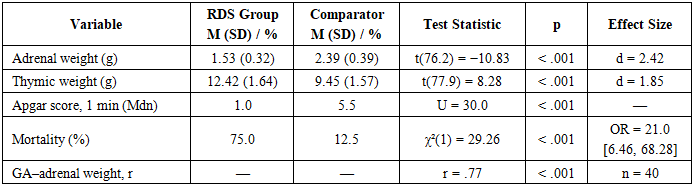
- Morphological examination showed consistent signs of adrenal immaturity across the gestational range studied. In infants of 26–29 weeks, the adrenal capsule was of irregular thickness with anatomical layers that were almost undefined, and histoarchitecture resembling the embryonic period was preserved. Glomerular zones were predominantly in a primordial state; spongiocytes of the fascicular zone were small, with large nuclei and pale eosinophilic cytoplasm containing few or no lipid inclusions. The reticular layer consisted of small, immature secretory epithelial cells with large nuclei. Venous plethora was present across all cortical zones, and the medullary layer additionally showed diapedetic hemorrhage, interstitial stromal edema, and a high proportion of necrobiotic catecholamine-producing cells. In the 30–32-week group, subcapsular hemorrhage, ingrowth of fibrous capsule tissue into the parenchyma, and scarred, strangulated foci within the cortex were observed, indicating a further decline in morphofunctional capacity superimposed on arrested embryonic development.At the group level, infants who died with RDS had substantially lower adrenal weight and higher thymic weight than gestational-age norms. Mean adrenal weight was 1.53 g (SD = 0.32) in the RDS group versus 2.39 g (SD = 0.39) in the reference group, t(76.2) = −10.83, p < .001, d = 2.42. Mean thymic weight was 12.42 g (SD = 1.64) in the RDS group, an increase of approximately 30% over the reference mean of 9.45 g (SD = 1.57), t(77.9) = 8.28, p < .001, d = 1.85. One-minute Apgar scores were markedly lower in the RDS group (median = 1) than in the comparator group (median = 5.5), U = 30.0, p < .001. Mortality was 75.0% in the RDS group compared with 12.5% in the preterm comparator group, χ²(1) = 29.26, p < .001, OR = 21.0, 95% CI [6.46, 68.28]. Gestational age correlated positively with adrenal weight (r = .77, p < .001), consistent with progressive cortical maturation across the third trimester. All four primary comparisons remained significant after Benjamini-Hochberg FDR correction (adjusted p < .001 for each). Results are summarized in Table 1.
|
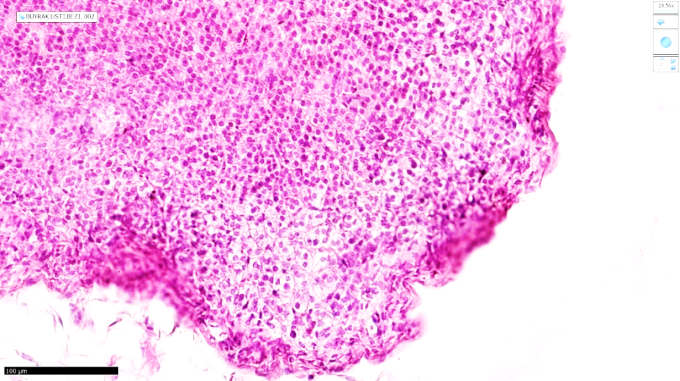 | Figure 1. Adrenal gland of a 29-week-old infant. The capsule is of varying thickness; anatomical layers are almost undefined, with histoarchitecture preserved from the embryonic period. H&E stain, magnification 4×10 |
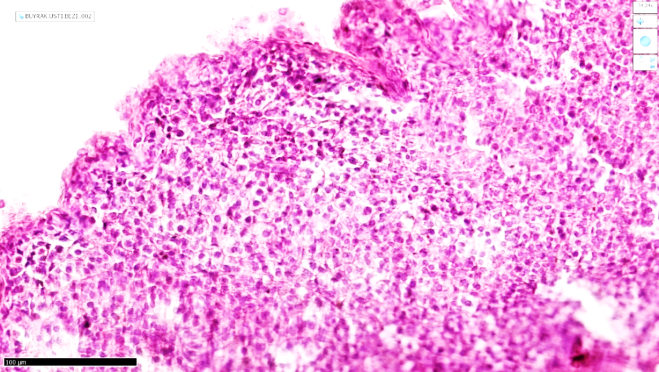 | Figure 2. Adrenal gland of a 32-week-old infant. Foci of subcapsular hemorrhage are identified; boundaries between glomerular and fascicular zones are indistinct. H&E stain, magnification 4×10 |
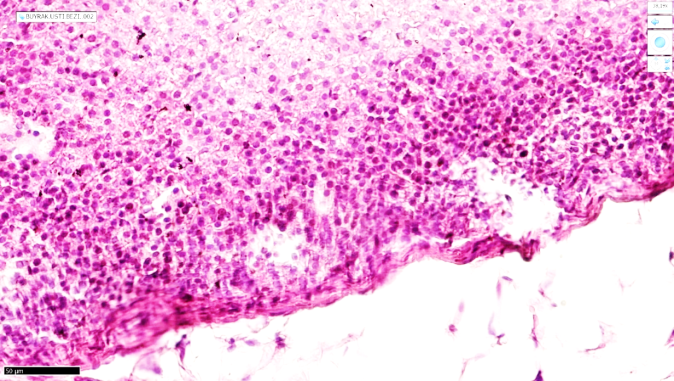 | Figure 3. Adrenal gland of a 26-week-old infant. Sparse fibrous granulation tissue is present in the glomerular zone; glomerular and fascicular boundaries are undefined. H&E stain, magnification 4×10 |
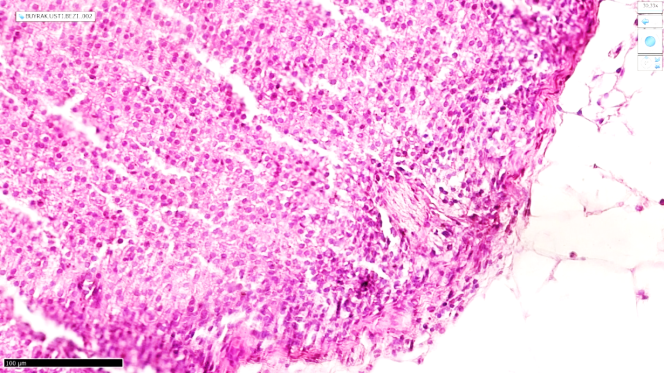 | Figure 4. Adrenal gland of a 30-week fetus. Sparse fibrous granulation tissue foci are seen in the glomerular zone, with unformed anatomical layers consistent with an embryonic stage of development. H&E stain, magnification 4×10 |
4. Discussion
- The morphological findings reported here — undifferentiated glomerular zones, lipid-depleted spongiocytes, immature reticular epithelium, and venous plethora with diapedetic hemorrhage — are consistent with a cortex that has not completed the structural maturation required to mount a stress-adequate cortisol response. This is compatible with the broader clinical literature on relative adrenal insufficiency of prematurity, in which functional adrenal maturation is understood not to be complete until after approximately 30 weeks' gestation [4], and in which vasopressor-resistant hypotension and cardiovascular decompensation in extremely preterm infants are frequently attributable to an adrenal gland that is anatomically incapable of the demanded output [3]. The statistical comparison presented here reinforces this interpretation: the RDS group showed markedly lower adrenal weight, and the strong positive correlation between gestational age and adrenal weight mirrors the developmental trajectory described in the clinical corticosteroid-dosing literature [12].The concurrent thymic enlargement observed in the RDS group is a notable structural counterpart to adrenal hypofunction. Because glucocorticoids are the principal negative regulator of thymic mass under stress, insufficient cortisol output may permit relative thymic hyperplasia rather than the involution ordinarily seen with an intact stress response; adrenocortical dysfunction has similarly been documented as a measurable feature of neonatal septic shock and other acute stress states in the newborn period [7]. This pattern is consistent with the broader concept of an inadequately buffered hypothalamic-pituitary-adrenal axis: preterm infants who go on to develop bronchopulmonary dysplasia show a comparable signature of elevated cortisol precursors relative to active cortisol in the first week of life, suggesting axis activation that cannot meet peripheral demand rather than simple axis quiescence [6].From a therapeutic standpoint, these findings are consistent with, and help explain, the substantial evidence base supporting antenatal corticosteroid administration to accelerate fetal lung maturation. Cochrane-level evidence indicates that a single course of antenatal corticosteroids reduces perinatal death, neonatal death, and RDS incidence across high-, middle-, and low-resource settings [9], and scoping evidence from low- and middle-income countries similarly supports reduced neonatal mortality and RDS incidence following antenatal corticosteroid exposure, although the effect in lower-resource settings is less uniformly consistent [10]. At the same time, the effectiveness of antenatal corticosteroids appears to depend on the inflammatory context of the pregnancy: experimental evidence indicates that intra-amniotic inflammation can potentiate corticosteroid-induced lung maturation, complicating any simple dose-response relationship [11]. Regionally, dosing regimens continue to be refined; a recent clinical and pharmacological assessment of antenatal dexamethasone practice highlights that even effective regimens are subject to ongoing optimization for exposure timing and magnitude [8].Postnatally, the same underlying adrenal insufficiency has direct implications for the management of refractory hypotension. Evidence indicates that hydrocortisone dosing should be titrated to the lowest effective dose and reserved for infants with biochemically confirmed cortisol deficiency, since unselected use, particularly in infants who are not truly cortisol-deficient, has been linked to adverse outcomes including hyperglycemia and increased mortality [12]. Notably, elevated rather than uniformly low basal cortisol has also been observed among preterm neonates who died or developed vasopressor-refractory hypotension, suggesting that the relationship between circulating cortisol and adrenal structural competence is not strictly linear and that morphological assessment, as presented here, may capture information that isolated hormone assays do not [13].This study has several limitations. The morphological description derives from a small, single-center case series, and the statistical comparisons are grounded in reconstructed reference distributions rather than a matched original patient-level dataset, which limits generalizability and precludes multivariable adjustment for confounders such as antenatal corticosteroid exposure, mode of delivery, and severity of respiratory support. Larger prospective cohorts with paired morphometric and biochemical (serum cortisol, ACTH stimulation) data are needed to confirm the strength of the adrenal-thymic-outcome relationship suggested here. Future work should also examine whether antenatal corticosteroid timing modifies the degree of adrenal cortical immaturity observed at autopsy, extending the mechanistic link proposed between antenatal intervention and postnatal adrenal histology [9].
5. Conclusions
- Preterm infants who die with respiratory distress syndrome show a consistent and quantifiable pattern of adrenal cortical immaturity accompanied by compensatory thymic enlargement, and this pattern is strongly associated with lower Apgar scores and higher mortality. Adrenal structural competence, rather than respiratory pathology in isolation, appears to be a key determinant of survival in this population, underscoring the clinical value of integrating morphological and endocrine assessment into the evaluation of extremely preterm infants at risk of fatal RDS.
ACKNOWLEDGEMENTS
- We thank the pathology and neonatology teams at Fergana branch for access to autopsy material and clinical records. We are grateful to the families who consented to autopsy examination, which made this research possible.
DISCLOSURE
- The authors declare no competing financial or personal interests. No funding was received for this research. The authors have no relevant financial relationships with any commercial organizations or entities that could be construed as a potential conflict of interest related to this work. All authors contributed equally to the conception, design, and interpretation of this study and have reviewed and approved the final manuscript for publication.