
-
Paper Information
- Next Paper
- Paper Submission
-
Journal Information
- About This Journal
- Editorial Board
- Current Issue
- Archive
- Author Guidelines
- Contact Us
International Journal of Virology and Molecular Biology
p-ISSN: 2163-2219 e-ISSN: 2163-2227
2026; 15(5): 109-112
doi:10.5923/j.ijvmb.20261505.01
Received: Jul. 31, 2026; Accepted: Aug. 22, 2026; Published: Sep. 10, 2026

Effect of Calpastatin and Myostatin Genes on the Activity of Transamination Enzymes in Sheep Blood Serum
 Abstract
 Reference
 Full-Text PDF
 Full-text HTML
Urinboeva Maftuna Makhmudjonovna
Research Institute of Karakul Breeding and Desert Ecology, Uzbekistan
Correspondence to: Urinboeva Maftuna Makhmudjonovna, Research Institute of Karakul Breeding and Desert Ecology, Uzbekistan.
| Email: |  |
Copyright © 2026 The Author(s). Published by Scientific & Academic Publishing.
This work is licensed under the Creative Commons Attribution International License (CC BY).
http://creativecommons.org/licenses/by/4.0/

This study investigated the influence of calpastatin (CAST) and myostatin (MSTN) gene polymorphisms on the activity of serum transamination enzymes in Karakul, Jaydara, and Hissar lambs. The activities of aspartate aminotransferase (AST) and alanine aminotransferase (ALT) were evaluated in animals with different genotypes. The results demonstrated that lambs carrying the N allele of the CAST and MSTN genes exhibited relatively higher AST and ALT activities compared with other genotypes. These findings indicate a significant relationship between these genetic markers and protein metabolism, as well as their potential association with meat productivity traits. The obtained results may serve as a scientific basis for the application of marker-assisted selection programs in sheep breeding.
Keywords: Sheep, Karakul sheep, Jaydara sheep, Hissar sheep, CAST gene, MSTN gene, Calpastatin, Myostatin, AST, ALT, Transamination enzymes, Genotype, Protein metabolism, Molecular genetics, Marker-assisted selection
Cite this paper: Urinboeva Maftuna Makhmudjonovna, Effect of Calpastatin and Myostatin Genes on the Activity of Transamination Enzymes in Sheep Blood Serum, International Journal of Virology and Molecular Biology, Vol. 15 No. 5, 2026, pp. 109-112. doi: 10.5923/j.ijvmb.20261505.01.
Article Outline
1. Introduction
- In the 21st century, ensuring the population with safe, high-quality, and nutritious food products remains one of the most pressing strategic challenges facing humanity. According to the Food and Agriculture Organization (FAO), more than 6.2–6.3 million Karakul sheep are currently raised in over 40 countries worldwide. Sheep breeding is characterized by its environmental sustainability, adaptability to diverse ecological conditions, ability to utilize inexpensive feed resources, and potential to provide a wide range of livestock products. Therefore, the introduction of modern breeding methods and intensive production technologies aimed at improving productivity and genetic merit in sheep populations has become an important priority.In the Republic of Uzbekistan, a number of legislative and regulatory documents have been adopted to modernize the livestock sector, increase productivity, preserve genetic resources, and promote their scientifically based development. These include Presidential Decree No. PF-60 of January 28, 2022, “On the Development Strategy of New Uzbekistan for 2022–2026” [1], and Resolution No. PQ-4420 “On Measures for the Comprehensive Development of the Karakul Breeding Industry” [2], which define priority directions for the scientific development of Karakul sheep breeding and animal genetic improvement.Further advancement of sheep breeding in Uzbekistan, particularly the genetic evaluation of meat productivity in Karakul, Jaydara, and Hissar sheep breeds, as well as the determination of relationships between hereditary traits and product quality characteristics, remains an important scientific task. In particular, the identification of polymorphisms in the calpastatin (CAST) and myostatin (MSTN) genes and the investigation of their associations with meat-fat productivity, morphological traits, and biochemical indicators may provide opportunities for scientifically based planning and optimization of breeding programs.The present study investigates the genetic polymorphism of calpastatin and myostatin genes in Karakul, Jaydara, and Hissar sheep breeds under the conditions of Uzbekistan. Furthermore, the relationships between these genetic markers and productivity traits were comprehensively evaluated to establish a scientific basis for breeding and selection programs. Therefore, the research topic possesses both theoretical and practical significance and contributes to the scientific development of the sheep breeding industry in Uzbekistan.
2. Literature Review
- Improving the productivity of farm animals represents one of the primary objectives of livestock genetics. In this regard, the study of gene structure and function, particularly molecular mechanisms associated with economically important traits, is of considerable importance. In recent years, the calpastatin (CAST) and myostatin (MSTN) genes have attracted significant attention as promising molecular markers in meat-oriented breeding programs due to their influence on muscle development and fat deposition.Substantial contributions to research on meat-fat sheep breeds in Uzbekistan have been made by prominent scientists, including S.Yu. Yusupov, E.S. Shaptakov, P.F. Kiyatkin, A. Rahimov, A. Amirov, I.A. Tapilskiy, Sh. Abdivaitov, and Kh. Zohidov. Their studies scientifically demonstrated the high meat-fat productivity of sheep raised under pasture conditions. The findings of these researchers serve as important scientific sources for the accurate evaluation of breed potential, rational utilization of resources, and improvement of breeding efficiency.The application of genetic methods enables the assessment of the productive potential of lambs immediately after birth. This facilitates the early implementation of selection programs and enhances the efficiency of breeding activities in sheep production systems. Genetic markers associated with productivity traits can be utilized as reliable tools for selection because they are directly linked with qualitative and quantitative characteristics of livestock products (Khlestkina, 2013).
3. Materials and Methods
- Research object - The study was conducted on Karakul, Jaydara, and Hissar lambs raised at “Bobotog Suri” LLC located in Kumkurgan District, Surkhandarya Region, Uzbekistan. Blood samples and meat-fat tissue samples obtained from these animals were used for the investigations.Research subject the subject of the study was the influence of calpastatin and myostatin gene genotypes on growth, development, and the formation of meat-fat productivity traits in lambs of different breeds.Research methods. Zootechnical, biological, laboratory, and biometric-statistical methods were employed in the present investigation.For genotyping, biological material consisted of blood samples collected from the jugular vein of 21-day-old lambs using a SARSTEDT (Germany) S-Monovette closed blood collection system (4.9 mL) containing EDTA anticoagulant.Polymerase Chain Reaction (PCR), one of the most widely applied methods in molecular biology, was introduced by K.B. Mullis and colleagues in 1986 and is currently extensively used in biology, medicine, veterinary science, and related disciplines. PCR is based on the principle of natural DNA replication; however, in this case, selective amplification of specific short DNA fragments is achieved.Genetic equilibrium was assessed according to the Hardy–Weinberg law using the chi-square (χ²) test:
 where O represents the observed value and E represents the theoretically expected value for a given group.The expected distribution of phenotypes was calculated according to the Hardy–Weinberg equation. The degree of agreement between observed and expected distributions was evaluated using the chi-square (χ²) test.Statistical analyses were performed following the methodologies recommended by N.A. Plokhinsky (1980) and E.K. Merkureva (1970). Mean values and their standard errors were calculated using BioStat and Microsoft Excel software. Differences between numerical data were evaluated using Student–Snedecor’s t-test.Amino Acid Analysis. To determine amino acid composition, samples were subjected to acid hydrolysis. Initially, all samples were ground to approximately 1 mm particle size. A 5 g portion of each sample was weighed using an FA220 4N analytical balance with an accuracy of 0.001 mg. The sample was then transferred into a 200 mL flask equipped with a reflux condenser, and 50 mL of 6 N hydrochloric acid was added. Hydrolysis was carried out at 110°C for 24 hours with continuous stirring using a magnetic stirrer.After completion of hydrolysis, the solution was cooled to room temperature. Subsequently, 10 mL of the hydrolysate was centrifuged at 12,000 rpm for 10 minutes. A 5 mL aliquot of the supernatant was collected and neutralized with 6 N sodium hydroxide solution. Then, 1 mL of the prepared solution was filtered through a 0.45 μm membrane filter and transferred into a vial for chromatographic analysis. Analytical measurements were subsequently performed and recorded.
4. Research Scheme
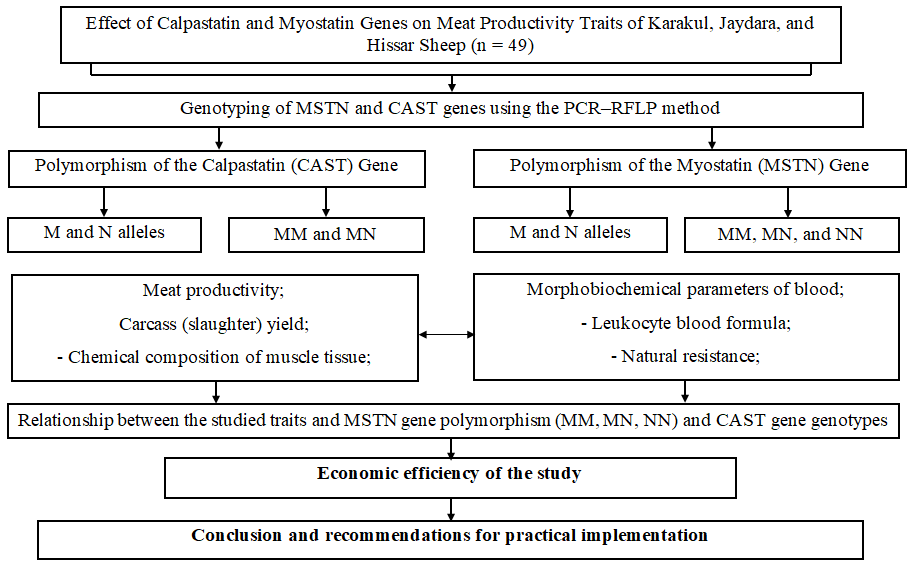 | Figure 1 |
5. Results and Discussion
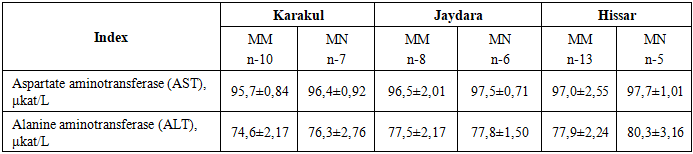
- Characteristics of Protein MetabolismBiochemical parameters of blood serve as important indicators for evaluating the health status and productive potential of ruminants [3]. Therefore, the blood biochemical profiles of 21-day-old Karakul, Jaydara, and Hissar lambs were analyzed according to their calpastatin (CAST) and myostatin (MSTN) genotypes.Transamination enzymes, namely aspartate aminotransferase (AST) and alanine aminotransferase (ALT), are considered important indicators of health and productive performance in young animals [4]. Significant genotype-dependent differences in AST and ALT activities were observed among animals carrying different variants of the CAST and MSTN genes. (Table 1).
|
|

6. Conclusions
- The results of protein metabolism analysis in Karakul, Jaydara, and Hissar lambs indicate that animals carrying the N allele of both the calpastatin (CAST) and myostatin (MSTN) genes possess higher concentrations of total protein and transamination enzymes, while exhibiting relatively lower levels of protein degradation products.These findings suggest that sheep carrying the N allele demonstrate more efficient protein metabolism and enhanced protein synthesis and turnover processes. Furthermore, a significant positive relationship was identified between genotype and protein metabolism indicators, confirming the considerable influence of these genes on growth performance and productivity traits in sheep.