D. U. Mamadiyarova1, S. B. Azimova2, M. U. Mamadiyarov3
1Department of Physiology, Samarkand State Medical University, Uzbekistan
2Department of Normal and Pathological Physiology, Tashkent State Medical University, Uzbekistan
3Department of Biology, Samarkand State Pedagogical Institute, Uzbekistan
Copyright © 2026 The Author(s). Published by Scientific & Academic Publishing.
This work is licensed under the Creative Commons Attribution International License (CC BY).
http://creativecommons.org/licenses/by/4.0/

Abstract
This study investigates the influence of clinical and demographic characteristics, including age, gender, duration of diabetes, and medical history, on the development and progression of angiopathy in patients with type 2 diabetes mellitus (T2DM). A total of 94 patients diagnosed with T2DM were included in the analysis. Comprehensive clinical data were collected through detailed patient examinations, with particular attention to demographic variables, disease duration, associated comorbidities, and relevant medical history. A systematic and multivariate statistical analysis was performed to identify factors associated with the occurrence and severity of diabetic angiopathy. The findings provide valuable insights into the relationship between patient characteristics and vascular complications, contributing to improved risk assessment, early diagnosis, and individualized management strategies for patients with type 2 diabetes mellitus.
Keywords:
Demographic characteristics, Diabetic angiopathy, Oxidative system, Antioxidant system, Vascular damage, Role of age-related changes, Remodeling
Cite this paper: D. U. Mamadiyarova, S. B. Azimova, M. U. Mamadiyarov, The Role of Gender, Age, and Anamnestic Factors in the Development of Diabetic Angiopathy, International Journal of Virology and Molecular Biology, Vol. 15 No. 4, 2026, pp. 94-98. doi: 10.5923/j.ijvmb.20261504.02.
1. Introduction
Diabetes mellitus is becoming one of the leading threats to human health, second only to cancer and heart disease in terms of severity [2,4,5].The development of this disease and its complications is underpinned by oxidative stress a condition in which the body is unable to cope with excess free radicals. This leads to cellular damage and disruption of vital systems [1,3].The antioxidant system provides protection against oxidative stress [5,7,8]. Its effectiveness depends largely on a person's genetic makeup: gene variations can either enhance or weaken the body's ability to resist oxidation [6,10]. Because diabetes mellitus is a complex disease influenced by both genetics and lifestyle, scientists are actively researching the role of antioxidant enzymes in its pathogenesis [1,2,11]. Diabetic angiopathy should be considered not as a separate pathology, but as part of a systemic cardiovascular disease [9,10,11]. Therefore, a detailed analysis of the comorbidity profile of patients was carried out in order to identify the cumulative effect of various risk factors affecting the onset and progression of this disease [2,4,9].For Uzbekistan, where the number of patients with diabetes is increasing, a thorough study of these mechanisms, taking into account gender and age factors, is critical to improving the quality of medical care.Objective of the study: To determine the role of gender, age and medical history in the development of diabetic angiopathy.
2. Study Materials and Methods
The study included 94 patients with type 2 diabetes mellitus registered at the Samarkand Endocrinology Dispensary, including those assigned to the main group based on clinical and laboratory tests. All patients were citizens of Uzbekistan and resided in Uzbekistan.The diagnosis was established based on a combination of clinical, laboratory, and instrumental data and confirmed according to the international classification. The main group was divided into two subgroups: Group 1 – patients with uncomplicated diabetes (n=43), Group 2 – patients with diabetes complicated by diabetic angiopathy (n=51).
3. Study Results
Our initial study aimed to comprehensively assess the role of constitutional and biological risk factors, including gender and age, in the development of diabetic angiopathy. We subsequently attempted to statistically substantiate the association of the observed metabolic and genetic differences between groups with the pathological process itself, rather than with demographic differences in the sample composition. The results of this comparative analysis of age and gender composition are presented in Table 1.Table 1. Comparative characteristics of the age and sex structure of the surveyed groups and assessment of relative risks
 |
| |
|
A thorough analysis of demographic characteristics revealed a high degree of homogeneity in the study sample. A statistical assessment of the mean age of patients demonstrated significant similarity between groups (t = 1.62; p = 0.108). This result confirms the appropriateness of the sample selection and allows us to mitigate the potential confounding effect of age in subsequent genetic association analyses (see Figure 1).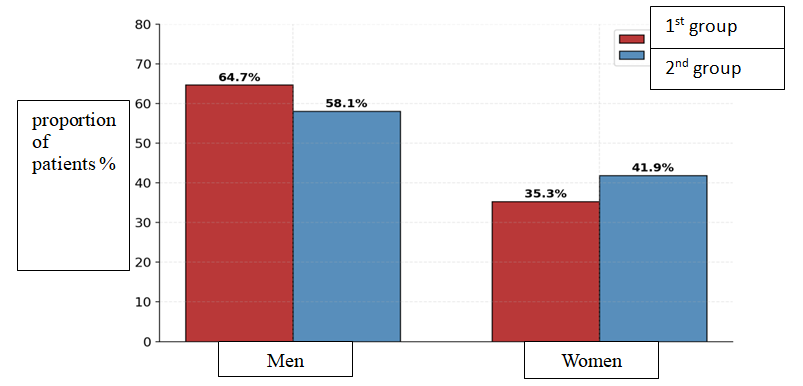 | Figure 1. Gender structure of the surveyed groups |
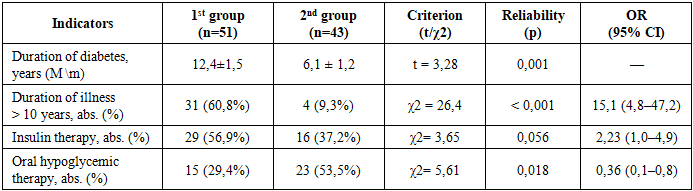
An analysis of age characteristics revealed that patients with complicated diabetes (Group 1) had a higher mean age (61.2 years) compared to patients in Group 2 (57.8 years), representing a difference of 3.4 years. From a clinical perspective, this age difference reflects the contribution of involutional processes to the pathogenesis of diabetic angiopathy. It is known that with age, calcium accumulates in the arterial wall (Mönckeberg sclerosis) and elastin fibers degrade, which potentiates vascular susceptibility to the effects of hyperglycemia. However, the presence of a significant proportion of patients over 60 years of age (46%) in Group 2 with fully preserved basal blood flow indicates that older age is more of an underlying factor than an absolute predictor of the development of diabetic angiopathy.An analysis of the gender structure revealed another pattern: in the main group (with critical ischemia), there was a numerical predominance of men (64.7%), while in the second group their share was 58.1%. Despite the lack of statistically significant difference (p = 0.510), the calculated odds ratio (OR = 1.32) indicates a positive association of male gender with the risk of developing severe forms of angiopathy. Pathophysiologically, this trend can be explained by the absence of a pronounced estrogen-dependent endothelial-protective effect in men, characteristic of women. In addition, the influence of behavioral risk factors, such as smoking, traditionally widespread among men in Uzbekistan, cannot be ruled out. It is a potent vasotoxic agent, putting additional pressure on the endothelium. Therefore, male gender should be considered an additional non-modifiable risk factor.A study examining the impact of disease duration on the risk of developing diabetic angiopathy in the patients examined yielded the following results: Fundamental pathophysiological research aims to establish the critical time interval after which metabolic dysfunctions initiate irreversible morphological transformations of the vascular wall. The duration of chronic hyperglycemia's effect on tissue correlates with the degree of glycation of vascular basement membrane proteins. A comparative analysis of the anamnestic data in the study groups revealed the following fundamental differences (see Table 2).Table 2. The influence of disease duration and the nature of hypoglycemic therapy on the risk of developing angiopathy
 |
| |
|
The study demonstrated that the duration of diabetes mellitus (DM) varied significantly between the groups, and these differences were statistically significant. The average period during which patients in the main group suffered from diabetes was 12.4 years, with a margin of error of ±1.5 years. This figure was almost twice as high as that of patients in the second group, whose average duration of diabetes was 6.1 years, with a margin of error of ±1.2 years. The significance of these differences was confirmed by the results of statistical analysis using Student's t-test (t = 3.28; p = 0.001), which rules out the possibility of random variation in the observed discrepancies.Statistical analysis revealed a high risk of developing diabetic angiopathy. Specifically, the likelihood of developing angiopathy and gangrene increases by 15.1 times in patients with diabetes for more than 10 years. These results provide clear evidence of the phenomenon of "metabolic memory." In this case, previous high blood sugar levels (hyperglycemia) cause epigenetic changes and the accumulation of vascular damage products (AGEs), which persist even after blood sugar levels are normalized. Therefore, effective blood sugar control during the "therapeutic window," that is, the first 10 years of the disease, is essential for preventing angiopathy. After this period, preventing the development of angiopathy becomes virtually impossible. The effect of antidiabetic therapy was also studied. Insulin therapy increases the risk of developing angiopathy by 2.23 times, indicating the severity of the disease and insulin deficiency. In contrast, oral medications such as sucralose reduce the risk of vascular complications (0.36), meaning the body has better control over its own insulin production and carbohydrate metabolism.Examining the profile of comorbidities and the role of systemic mechanisms in the pathogenesis of diabetic angiopathy reveals that diabetic angiopathy is not an isolated process but rather a localized manifestation of generalized cardiovascular disease. Therefore, we conducted a detailed analysis of the comorbidity profile to assess the cumulative contribution of various risk factors to the development and progression of diabetic angiopathy (see Table 3).Table 3. Concomitant diseases in the examined patients
 |
| |
|
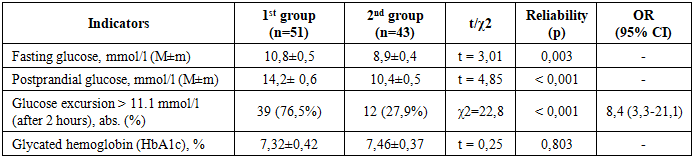
In the first group of patients, 74.5% had arterial hypertension. This condition almost doubled the risk of developing blood vessel problems (OR = 1.91). This is due to the fact that persistently high blood pressure damages the inner wall of blood vessels (mechanical detachment) and leads to the proliferation of muscle cells in the vessel wall, which accelerates the process of atherosclerosis (hardening of the arteries). Visceral obesity (accumulation of fat around the abdomen): We found that visceral obesity (body mass index ≥30 kg/m²) is a significant risk factor for the development of diabetic angiopathy in patients with diabetes (OR = 1.95). In the context of diabetes, adipose tissue acts as an active endocrine organ. This leads to persistent inflammation and hypercoagulability. Non-alcoholic fatty liver disease (NAFLD) is a significant indicator, increasing the likelihood of developing it by 1.83 times. This fact underscores the role of lipotoxicity and liver insulin resistance in worsening systemic atherosclerosis.In this study, we analyze the role of metabolic status and anthropometric parameters in the etiopathogenesis of diabetic angiopathy.Although chronic hyperglycemia is considered a major trigger for vascular pathology, the extent to which this pathological potential is realized depends on individual and specific phenotypic characteristics of carbohydrate metabolism. Scientific data indicate that the amplitude of glucose fluctuations (postprandial peaks) causes the greatest endothelial damage, inducing oxidative stress through mitochondrial dysfunction.Furthermore, adipose tissue plays a significant role in the pathogenesis of angiopathy by supporting systemic low-grade inflammation. Therefore, we aimed to determine the contribution of individual components of metabolic syndrome to the development of critical ischemia by comparatively analyzing the "glycemic triad" (fasting glucose, postprandial glucose, and HbA1c) and anthropometric markers of visceral obesity.We are analyzing the predictive power of glycemic profiles and postprandial blood sugar fluctuations for certain outcomes.In routine clinical practice, diabetes monitoring is often limited to measuring glycated hemoglobin (HbA1c), which is an integrated indicator of glycemia over a period of approximately three months. However, our data demonstrate significant limitations of this biomarker in patients with severe vascular complications. To comprehensively assess the glycemic profile, we compared carbohydrate metabolism parameters between groups, using postprandial glycemia levels exceeding 11.1 mmol/L as a high-risk criterion.When we analyzed how the patients' bodies handled carbohydrates (see Table 4), we discovered an interesting pattern: the overall indicators didn't quite match what was happening at a specific moment. For example, fasting blood sugar levels in patients in our group were significantly higher (10.8±0.5 mmol/L) than in those we used for comparison (8.9±0.4 mmol/L, p = 0.003). This suggests that the liver in patients with angiopathy actively produces sugar at night and in the morning, which is a sign that the liver is not responding well to insulin.Table 4. Comparative characteristics of carbohydrate metabolism indicators and assessment of the risk of metabolic decompensation
 |
| |
|
The second key observation was the significant fluctuations in glycemic levels after meals. In patients in the first group, after a standard meal, the average glucose level reached a critical value of 14.2 ± 0.6 mmol/L 2 hours later. This value was approximately 4 mmol/L higher than in patients in the second group, where the average value was 10.4 ± 0.5 mmol/L (p < 0.001). Our analysis demonstrated that a significant proportion of patients with angiopathy (76.5%) experienced pronounced postprandial hyperglycemia, exceeding both the renal threshold and the toxic limit of 11.1 mmol/L. In the comparison group, the proportion of such patients was significantly lower – no more than 27.9%.Calculation of the Pearson test (χ2 = 22.8) and odds ratio (OR = 8.4) allows us to state with a high degree of certainty that the presence of high postprandial glucose excursions increases the risk of developing angiopathy by 8.4 times.Moreover, glycated hemoglobin (HbA1c) levels were virtually identical in both groups (7.32% vs. 7.46%; p > 0.05). This confirms the low sensitivity of HbA1c to diurnal blood glucose fluctuations in patients with diabetes. Patients in the first group experience what are known as "sugar swings" (from hypoglycemia to peak hyperglycemia). This results in a "normal" average HbA1c level, but vascular damage is not slowed.Based on this, we believe that the amplitude of glycemic excursions, rather than the average blood sugar level, is the primary driver of oxidative stress.
4. Conclusions
Our large-scale, multi-stage clinical and laboratory study included 94 patients. At this stage, we focused on identifying the main phenotypic predictors of the development of diabetic angiopathy of the lower extremities in patients with type 2 diabetes. Using multivariate statistical analysis methods (including likelihood ratios and receiver operating characteristic curves), we were able to create a pathogenetic model that, in addition to confirming the presence of abnormalities, allowed us to identify factors with the greatest prognostic value.Our key findings from the clinical phase of the study are that traditional markers of diabetes control, particularly glycosylated hemoglobin (HbA1c), are insufficiently sensitive to predict the development of vascular complications of diabetes (AUC = 0.54). We believe that the real factor causing harm is postprandial hyperglycemia (glycemic variability). Peak glucose levels above 11.1 mmol/L are the primary cause of mitochondrial oxidative stress, increasing the risk of developing angiopathy by 8.4 times. Visceral obesity (OR = 3.7) contributes to systemic inflammation as an additional aggravating factor.A central problem in the pathogenesis of diabetic angiopathy is the disruption of adaptive antioxidant defense mechanisms. Patients with angiopathy have been found to have a sharp decrease in superoxide dismutase activity (OR = 35.2). This leads to the uncontrolled accumulation of malondialdehyde (OR = 192.0), which, at high concentrations, has a toxic effect, causing chemical damage to endothelial cell membranes and hardening of blood vessel walls.
References
| [1] | Ageeva E.S., Shramko Yu.I., Kubyshkin A.V., Fomochkina I.I., Zhukova A.A., Tarimov K.O., Nastoyashchy S.G. 174 Health risk analysis. 2024. No. 3. (in Russian). |
| [2] | Belousova O.N., Sirotina S.S., Yakunchenko T.I., and Zhernakova N.I. "Molecular and genetic mechanisms of pathogenesis of type 2 diabetes mellitus" Actual problems of medicine, vol. 31, no. 16 (213), 2015, pp. 12-19. (in Russian). |
| [3] | Dausheva A.Kh., Zarubina E.G., and Bogdanova Yu.V. "Genetic markers of endothelial dysfunction in chronic obstructive pulmonary disease." Pacific Medical Journal, no. 1 (95), 2024, pp. 48-52. doi: 10.34215/1609-1175-2024-1-48-52. (in Russian). |
| [4] | Dzugkoev Sergey Gavrilovich, Mozhaeva Irina Viktorovna, Margieva Olga Ivanovna, and Dzugkoeva Fira Solomonovna. "Mechanisms of development of endothelial dysfunction and methods of pathogenetic correction in diabetes mellitus." Medical Bulletin of the North Caucasus, vol. 10, no. 4 (38), 2015, pp. 451-459. (in Russian). |
| [5] | Demidova, T. Yu., and Titova, V. V., “Phenotypic and genetic clusters of type 2 diabetes mellitus: associations with the risk of complications and therapeutic strategies,” FOCUS. Endocrinology, vol. 7, no. 1, 2026, pp. 48–57. doi: 10.62751/2713-0177-2026-7-1-06. (in Russian). |
| [6] | Ivantsov E.N., Khasanov N.R., and Makarov M.A. "THE ROLE OF GENETIC FACTORS IN ATHEROSCLEROTIC LESION OF CORONARY ARTERIES IN PATIENTS WITH ACUTE CORONARY SYNDROME AND DIABETES MELLITUS" Practical Medicine, vol. 20, no. 7, 2022, pp. 79-84. (in Russian). |
| [7] | Gerasimchuk Petr Aleksandrovich, Kisil Pavel Vasilievich, Vlasenko Vadim Grigorovich, and Pavlyshin Andrey Vladimirovich. "Indicators of Endothelial Dysfunction in Patients with Diabetic Foot Syndrome." Bulletin of the Russian Academy of Medical Sciences, vol. 69, no. 5-6, 2014, pp. 107-110. (in Russian). |
| [8] | Khamkhoeva S.M., Borisova V.E., and Satonkina O.A. "The role of genetic factors in the pathogenesis of type 1 diabetes mellitus: analysis of hereditary predisposition" Paradigm, no. 4-1, 2025, pp. 153-159. (in Russian). |
| [9] | Kiseleva T.A., Valeeva F.V., Islamova D.R., Medvedeva M.S. Genetic aspects of type 2 diabetes mellitus // Practical medicine. - 2023. - Vol. 21, No. 3. - P. 14-18. (in Russian). |
| [10] | Newgard C.B. Metabolomics and Metabolic Diseases: Where Do We Stand? // Cell Metab. ‒ 2017. ‒ Vol. 25, № 1. ‒ P. 43–56. DOI: 10.1016/j.cmet.2016.09.018. |
| [11] | Pathophysiology of Type 2 Diabetes Mellitus / U. Galicia-Garcia, A. Benito-Vicente, S. Jebari, A. Larrea-Sebal, H. Siddiqi, K.B. Uribe, H. Ostolaza, C. Martín // Int. J. Mol. Sci. ‒ 2020. ‒ Vol. 21, № 17. ‒ P. 6275. DOI: 10.3390/ijms21176275. |


 Abstract
 Reference
 Full-Text PDF
 Full-text HTML