
-
Paper Information
- Paper Submission
-
Journal Information
- About This Journal
- Editorial Board
- Current Issue
- Archive
- Author Guidelines
- Contact Us
International Journal of Virology and Molecular Biology
p-ISSN: 2163-2219 e-ISSN: 2163-2227
2026; 15(4): 89-93
doi:10.5923/j.ijvmb.20261504.01
Received: Jun. 21, 2026; Accepted: Jul. 11, 2026; Published: Jul. 15, 2026

Ative Analysis of Anthropometric and Physical Fitness Indicators in 4–6 Year-Old Preschool Children Across Urban and Rural Settings in the Fergana Region, Uzbekistan
 Abstract
 Reference
 Full-Text PDF
 Full-text HTML
Gavharoy Aliyeva1, Xasanboy Toshpo’latov2
1CAMU Assistant Professor, Department of Physiology and Pharmacology, International Medical University, Fergana, Uzbekistan
22nd-Year Student of the Faculty of Medicine, Department of Physiology and Pharmacology, International Medical University, Fergana, Uzbekistan
Correspondence to: Gavharoy Aliyeva, CAMU Assistant Professor, Department of Physiology and Pharmacology, International Medical University, Fergana, Uzbekistan.
| Email: |  |
Copyright © 2026 The Author(s). Published by Scientific & Academic Publishing.
This work is licensed under the Creative Commons Attribution International License (CC BY).
http://creativecommons.org/licenses/by/4.0/

This study examined morphofunctional and physical fitness characteristics of 4- to 6-year-old children enrolled in preschool educational institutions across urban and rural districts of the Fergana region, Uzbekistan. A total of 157 children from four localities — Fergana city, Quva district, Fergana district, and Yozyovon district — were assessed using standardised anthropometric measurements and motor performance tests. Statistical analysis employed Student's t-test (p<0.05). Rural children (Quva district) demonstrated significantly superior explosive leg power (standing long jump: 102.22 vs 93.00 cm, p<0.05) and lower resting heart rates (115.33 vs 121.45 bpm, p<0.05) compared to urban peers at age 6, suggesting better cardiovascular economy. Urban children showed superior breath-holding capacity at age 5 (22.75 vs 20.25 s, p<0.05). In 4-year-olds, structured physical exercise programmes produced statistically significant improvements in growth indicators, limb circumferences, and oxygen saturation (SpO₂: 96.85% → 98.45%, p<0.05). These findings highlight the role of residential environment and organised physical activity in early childhood motor development.
Keywords: Preschool children, Physical fitness, Anthropometry, Urban–rural comparison, Motor development, Uzbekistan, Cardiovascular adaptation, Physical education
Cite this paper: Gavharoy Aliyeva, Xasanboy Toshpo’latov, Ative Analysis of Anthropometric and Physical Fitness Indicators in 4–6 Year-Old Preschool Children Across Urban and Rural Settings in the Fergana Region, Uzbekistan, International Journal of Virology and Molecular Biology, Vol. 15 No. 4, 2026, pp. 89-93. doi: 10.5923/j.ijvmb.20261504.01.
Article Outline
1. Introduction
- Early childhood represents a critical window for physical development, during which motor patterns, anthropometric trajectories, and cardiovascular regulation are highly responsive to environmental influences [1,2]. Preschool-aged children in Uzbekistan, particularly in the Fergana region, experience markedly different physical activity contexts depending on their urban or rural residential environment, and this variation may exert lasting effects on their morphofunctional status and physical fitness [3].International literature consistently reports that residential environment modulates children's activity levels, growth patterns, and cardiorespiratory fitness [4,5]. Rural children often engage in more spontaneous unstructured play involving locomotion, jumping, and object manipulation, whereas urban children may have greater access to structured programmes but face constraints on free movement. However, empirical data comparing these groups within Central Asian preschool settings remain scarce.The present study was conducted in preschool educational institutions across four localities in the Fergana region: Fergana city (urban), Quva district (rural), Fergana district (peri-urban), and Yozyovon district (rural-suburban). The study aimed to: (i) compare anthropometric and functional indicators among 4–6 year-old children by residential setting; (ii) evaluate the effect of structured physical exercise on anthropometric and SpO₂ outcomes in 4-year-olds; and (iii) identify indicators that consistently differentiate urban and rural groups.
2. Materials and Methods
2.1. Participants
- A total of 157 children aged 4–6 years were recruited from state preschool institutions in Fergana city (n=19–20 per age cohort), Quva district (n=19–20), Fergana district (n=19), and Yozyovon district (n=20). Participation was voluntary, and written informed consent was obtained from all parents or legal guardians. Children with known chronic diseases or contraindications to physical activity were excluded.
2.2. Measurements
- Morphofunctional indicators included: body height (cm), body weight (kg), head circumference, chest circumference, waist circumference, hip circumference, thigh circumference, calf circumference, sitting height, forearm circumference, and peripheral oxygen saturation (SpO₂, %). Motor performance was assessed using: 30-metre sprint (s), standing long jump (cm), medicine-ball throw (m), one-leg static balance (s), and breath-holding duration (Stange test, s). Heart rate was measured at rest by auscultation (bpm).Anthropometric measurements were taken in the morning following standard protocols. Motor tests were administered on a separate day under standardised conditions. For 4-year-olds, measurements were taken before and after a 12-week structured physical exercise programme.
2.3. Statistical Analysis
- Data are presented as mean ± standard error of the mean (M±m). Between-group differences were evaluated with Student's independent t-test; pre–post differences within the 4-year-old cohort were assessed with the paired t-test. Statistical significance was set at p<0.05, corresponding to the critical value Tst under normal distribution (Gaussian assumption verified by the coefficient of variation V%). All calculations were performed in Microsoft Excel 2019.
3. Results
3.1. Six-Year-Old Children: Fergana City vs. Quva District
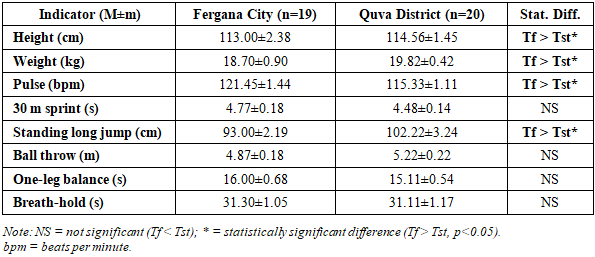
- Table 1 presents morphofunctional and physical fitness data for 6-year-old children from Fergana city (n=19) and Quva district (n=20). Rural children demonstrated statistically significant advantages in body weight (+1.12 kg), standing long jump (+9.22 cm), and resting heart rate (lower by 6.12 bpm). Urban children showed no significant advantage on any physical performance test. No significant difference was observed in breath-holding duration (p>0.05).
|
3.2. Six-Year-Old Children: Fergana District vs. Yozyovon District
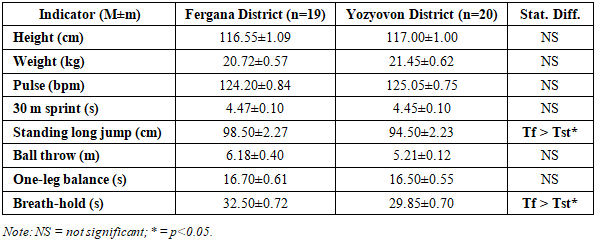
- The comparison between Fergana district (peri-urban, n=19) and Yozyovon district (n=20) shown in Table 2 revealed a predominantly homogeneous morphological profile. No significant differences were detected in height, weight, pulse rate, sprint time, ball throw, or balance. Fergana district children outperformed Yozyovon children in standing long jump (98.50 vs 94.50 cm, p<0.05) and breath-holding duration (32.50 vs 29.85 s, p<0.05), suggesting locally superior explosive leg power and pulmonary functional reserve.
|
3.3. Five-Year-Old Children: Fergana City vs. Quva District
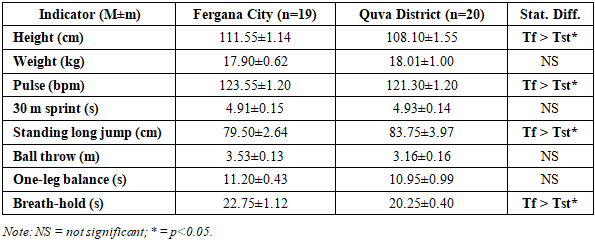
- Among 5-year-old children (Table 3), Fergana city children were significantly taller (111.55 vs 108.10 cm, p<0.05). Quva district children showed a significant advantage in standing long jump (83.75 vs 79.50 cm, p<0.05), reflecting superior neuromuscular explosive power. Urban children demonstrated higher breath-holding duration (22.75 vs 20.25 s, p<0.05), indicating better respiratory functional reserve — a finding consistent with the role of structured indoor physical activities in urban settings on improving pulmonary capacity [7].
|
3.4. Four-Year-Old Children: Effects of Structured Physical Exercise (Quva District)
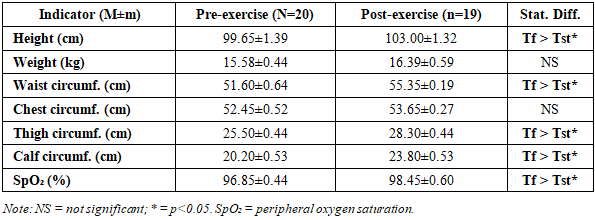
- Table 4 presents anthropometric and SpO₂ data in 4-year-old children from Quva district before and after a structured 12-week exercise programme. Significant post-exercise improvements were observed in height (+3.35 cm), waist circumference (+3.75 cm), thigh circumference (+2.80 cm), calf circumference (+3.60 cm), and SpO₂ (+1.60 percentage points). These data confirm that early, systematic physical activity programmes have measurable positive effects on somatic growth trajectories and peripheral oxygen delivery in preschool children [8].
|
3.5. Summary of Key Differences
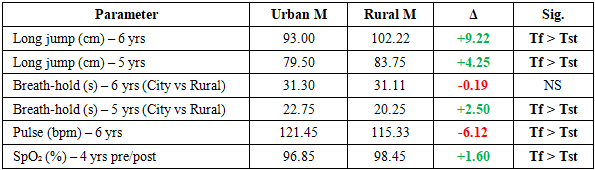
- Table 5 synthesises the most clinically and educationally relevant between-group and pre–post differences across all age cohorts and comparisons.
|
3.6. Visual Comparison of Key Physical Fitness Indicators
- Figure 1 presents group-level standing long jump performance across all six study groups. Rural and peri-urban children generally demonstrate higher explosive leg power relative to their urban counterparts at the same age, consistent with a greater frequency of outdoor locomotor play.
 | Figure 1. Standing long jump performance (cm) across study groups — bar chart (scale 60–110 cm) |
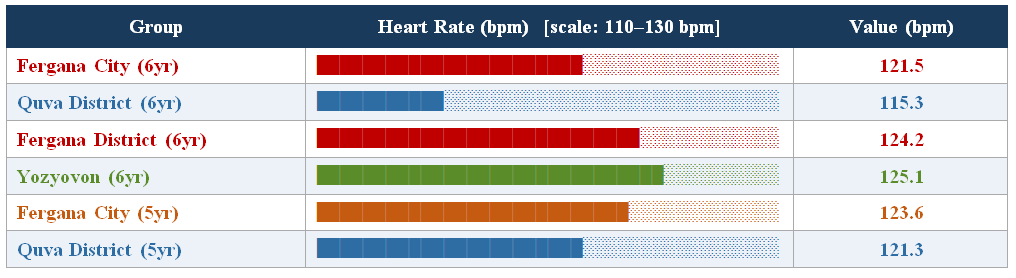 | Figure 2. Resting heart rate (bpm) across study groups — bar chart (scale 110–130 bpm) |
4. Discussion
- The present study provides a detailed cross-sectional and longitudinal characterisation of physical development in preschool children across contrasting residential environments in the Fergana region. The key finding is that rural children (Quva district) exhibit significantly superior explosive leg power and cardiovascular economy at age 6, while urban children demonstrate advantages in pulmonary functional reserve at age 5 — a dissociation that points to the importance of activity type rather than quantity in shaping specific fitness dimensions.The superiority of rural children in standing long jump across both age groups (ages 5 and 6) is consistent with literature indicating that children in rural and semi-rural environments engage more frequently in jumping and running during unstructured play [4]. In contrast, urban preschool settings may provide more structured but less explosive activity. The lower resting heart rate in 6-year-old Quva children is a particularly meaningful index: in paediatric exercise physiology, resting bradycardia relative to age-matched peers is interpreted as evidence of enhanced vagal tone and greater stroke volume per beat — adaptations classically associated with systematic physical conditioning [6].The higher breath-holding duration in Fergana city children at age 5 may reflect the quality of indoor physical education programmes, which in urban institutions tend to include more directed breathing and aerobic exercises. This interpretation aligns with evidence that structured aerobic training improves respiratory muscle endurance and hypoxic tolerance in young children [7].The pre–post exercise data from 4-year-old children in Quva district deserve particular attention. The significant improvement in SpO₂ (from 96.85% to 98.45%) following 12 weeks of structured physical activity suggests that organised exercise programmes, even at this very early age, improve peripheral oxygen delivery — potentially through enhanced capillary density, improved haemodynamic efficiency, or both. Improvements in limb circumferences (thigh, calf) indicate concurrent gains in muscle mass, which are developmentally consistent with motor skill maturation driven by physical loading [8].From a pedagogical perspective, these results advocate for the prioritisation of explosive and locomotor activities (jumping, running, throwing) in rural preschool programmes, while urban institutions should reinforce outdoor play and ensure physical education sessions maintain sufficient cardiorespiratory intensity. The near-absence of significant morphological differences between comparison pairs in the 5-year-old cohort (Fergana district vs. Yozyovon) confirms that gross somatic growth in this age group is primarily driven by genetic and nutritional factors rather than physical activity milieu [2].
5. Conclusions
- This study demonstrates meaningful environment-related differences in selected physical fitness indicators — particularly explosive leg power and cardiovascular economy — between urban and rural preschool children in the Fergana region of Uzbekistan. Rural children showed superior explosive strength, while urban children showed advantages in pulmonary functional reserve. Structured physical exercise programmes in 4-year-olds produced significant improvements in anthropometric parameters and SpO₂ within 12 weeks. These findings underscore the importance of environment-adapted physical education curricula in preschool institutions and provide evidence that early, structured physical activity can meaningfully enhance physiological indicators even at the earliest preschool age.Future studies should employ longitudinal designs with objective accelerometry-based activity monitoring, larger sample sizes, and controls for nutritional status to better disentangle the causal pathways linking residential environment, physical activity, and morphofunctional outcomes in early childhood.