
-
Paper Information
- Paper Submission
-
Journal Information
- About This Journal
- Editorial Board
- Current Issue
- Archive
- Author Guidelines
- Contact Us
International Journal of Virology and Molecular Biology
p-ISSN: 2163-2219 e-ISSN: 2163-2227
2026; 15(3): 82-87
doi:10.5923/j.ijvmb.20261503.04
Received: Jun. 2, 2026; Accepted: Jun. 26, 2026; Published: Jun. 30, 2026

Hydrobiological Diversity and Adaptive Microbial Communities in the Dried Aral Sea Basin (Muynak and Shegekul Areas)
 Abstract
 Reference
 Full-Text PDF
 Full-text HTML
Tukhtaboeva Y. A.1, Ikramov N. B.2, Tursunova Sh. A.3, Mirzaolimova M. M.1, Rakhmatov A.2
1KIUT Namangan Branch, Namangan, Uzbekistan
2Namangan State University, Uzbekistan
3Kokand State University, Uzbekistan
Correspondence to: Tukhtaboeva Y. A., KIUT Namangan Branch, Namangan, Uzbekistan.
| Email: |  |
Copyright © 2026 The Author(s). Published by Scientific & Academic Publishing.
This work is licensed under the Creative Commons Attribution International License (CC BY).
http://creativecommons.org/licenses/by/4.0/

The desiccation of the Aral Sea has resulted in the formation of extreme and highly transformed ecosystems characterized by high salinity, aridity, and unstable hydrological conditions. These environmental changes have significantly influenced the structure and diversity of hydrobiological communities in the region. The present study investigates the hydrobiological diversity and adaptive microbial communities of the dried Aral Sea basin, focusing on the Muynak and Shegekul areas. Field sampling was conducted in residual water bodies and dried seabed zones of the southern Aral Sea region. Hydrobiological analyses included the identification of phytoplankton, microalgae, cyanobacteria, and associated microbial taxa using standard microscopic and algological methods. Taxonomic identification was performed according to modern hydrobiological classification systems. A total of 56 taxa belonging to six major taxonomic groups were identified. Cyanobacteria represented the dominant group (41.1%), followed by Bacillariophyta (25.0%) and Chlorophyta (21.4%). The microbial communities were primarily composed of stress-tolerant and ecologically flexible taxa, including representatives of the genera Microcystis, Oscillatoria, Lyngbya, Navicula, and Cymbella. Comparative analysis demonstrated notable spatial differences between the Muynak and Shegekul sites, mainly associated with hydrological stability, salinity gradients, and habitat variability. The results indicate that microorganisms play a critical role in ecosystem adaptation and stabilization under post-desiccation environmental stress. The dominance of adaptive cyanobacteria and diatoms reflects ongoing ecological restructuring processes in the dried Aral Sea basin. The findings contribute to the understanding of biodiversity patterns and microbial adaptation mechanisms in extreme environments and provide a scientific basis for future ecological monitoring and restoration studies in the Aral Sea region. Samples were analyzed using standard microscopic and algological methods at the Algology Laboratory of Namangan State University. Taxonomic identification was performed based on modern classification systems, and particular attention was given to the ecological role and adaptability of microorganisms in high-salinity environments.
Keywords: Aral Sea, Hydrobiology, Microbial diversity, Cyanobacteria, Microalgae, Biodiversity, Salinity, Ecological adaptation, Muynak, Shegekul
Cite this paper: Tukhtaboeva Y. A., Ikramov N. B., Tursunova Sh. A., Mirzaolimova M. M., Rakhmatov A., Hydrobiological Diversity and Adaptive Microbial Communities in the Dried Aral Sea Basin (Muynak and Shegekul Areas), International Journal of Virology and Molecular Biology, Vol. 15 No. 3, 2026, pp. 82-87. doi: 10.5923/j.ijvmb.20261503.04.
1. Introduction
- The Aral Sea, formerly one of the largest inland water bodies in the world, has experienced one of the most severe environmental transformations caused by human activities. Intensive diversion of the Amu Darya and Syr Darya rivers for agricultural irrigation during the twentieth century led to a dramatic reduction in water inflow, resulting in progressive desiccation, increased salinity, habitat fragmentation, and the formation of extensive exposed seabed areas [1,3]. As a consequence, large territories of the former seabed have been converted into highly dynamic and environmentally stressed ecosystems characterized by extreme salinity, aridity, temperature fluctuations, and unstable hydrological conditions [3,5].The desiccation of the Aral Sea has not only altered regional hydrology but has also profoundly affected biological diversity and ecosystem functioning. Previous investigations have documented significant changes in species composition, trophic relationships, nutrient cycling, and ecological processes throughout the Aral Sea basin [1,4]. The emergence of newly exposed sediments and residual water bodies has created novel ecological niches where only highly adapted organisms are capable of surviving and maintaining ecological functions.Microorganisms constitute one of the most important biological components of these transformed ecosystems. Cyanobacteria, microalgae, diatoms, and other hydrobiological organisms contribute substantially to primary productivity, nutrient turnover, organic matter accumulation, and ecosystem stabilization. Due to their rapid response to environmental changes and high physiological plasticity, microbial communities serve as valuable indicators of ecological transformation and environmental stress [9,7].Among these organisms, cyanobacteria are particularly important in saline and arid habitats because of their exceptional adaptive capabilities. Many cyanobacterial taxa possess physiological mechanisms that enable them to tolerate osmotic stress, prolonged desiccation, nutrient limitation, and elevated salinity levels. Furthermore, their ability to produce extracellular polysaccharides contributes to sediment stabilization and biological soil crust formation, which are essential processes in newly developing ecosystems [8]. Diatoms and green algae also play significant ecological roles by participating in nutrient cycling and serving as indicators of environmental conditions and habitat quality [10,11].Recent studies conducted in arid and degraded ecosystems have emphasized the importance of microbial diversity for ecosystem resilience and recovery. Investigations of saline soils and extreme terrestrial habitats in Central Asia have demonstrated that cyanobacteria and microalgae form highly specialized communities capable of adapting to severe environmental stress while supporting ecosystem stability and biological productivity [12,13]. Such findings highlight the necessity of understanding microbial adaptation mechanisms in regions undergoing rapid environmental change.The Muynak and Shegekul areas represent ecologically significant sectors of the southern Aral Sea region. These territories include dried seabed surfaces, residual lakes, temporary wetlands, and periodically flooded depressions formed as a consequence of long-term desiccation processes. Variations in hydrological stability, salinity gradients, and moisture availability create heterogeneous environmental conditions that influence the composition and distribution of hydrobiological communities.Although considerable attention has been devoted to hydrological changes and environmental consequences of the Aral Sea crisis, detailed hydrobiological investigations of microbial communities inhabiting post-desiccation ecosystems remain relatively limited. In particular, information concerning species diversity, community structure, and ecological adaptation of microorganisms in the Muynak and Shegekul areas is still insufficient despite their importance for understanding ecosystem transformation processes and biodiversity conservation in the Aral Sea basin [6].Understanding the taxonomic composition and ecological characteristics of microbial communities in these environments is essential for evaluating ecosystem functioning, biological adaptation, and long-term environmental sustainability. Hydrobiological studies provide valuable information regarding ecological succession, habitat quality, and resilience of biological communities under extreme environmental stress.Therefore, the aim of the present study was to investigate the hydrobiological diversity and adaptive microbial communities of the dried Aral Sea basin, with particular emphasis on the Muynak and Shegekul areas. The objectives were to identify dominant taxonomic groups, evaluate patterns of species distribution, characterize adaptive microbial assemblages, and assess their ecological significance under conditions of elevated salinity and post-desiccation environmental stress.
2. Materials and Methods
- Study AreaThe study was conducted during 2024–2025 in the southern part of the former Aral Sea basin, including the residual lakes of Muynak and Shegekul and the surrounding desiccated seabed areas. These sites represent post-desiccation ecosystems that developed following the retreat of the Aral Sea and are characterized by high salinity, arid climatic conditions, limited water availability, and unstable hydrological regimes.Sampling was performed in both aquatic and terrestrial habitats. Aquatic samples were collected from residual water bodies (remnant lakes) located within the dried Aral Sea basin, whereas soil samples were obtained from adjacent desiccated sediments and exposed seabed surfaces surrounding the lakes. These habitats represent different stages of ecological succession and provide suitable conditions for the development of diverse hydrobiological and microbial communities.The geographic coordinates of selected sampling points included: 43.558510° N, 59.136313° E; 43.571312° N, 59.092565° E; and 43.558008° N, 59.202872° E (Fig. 1).
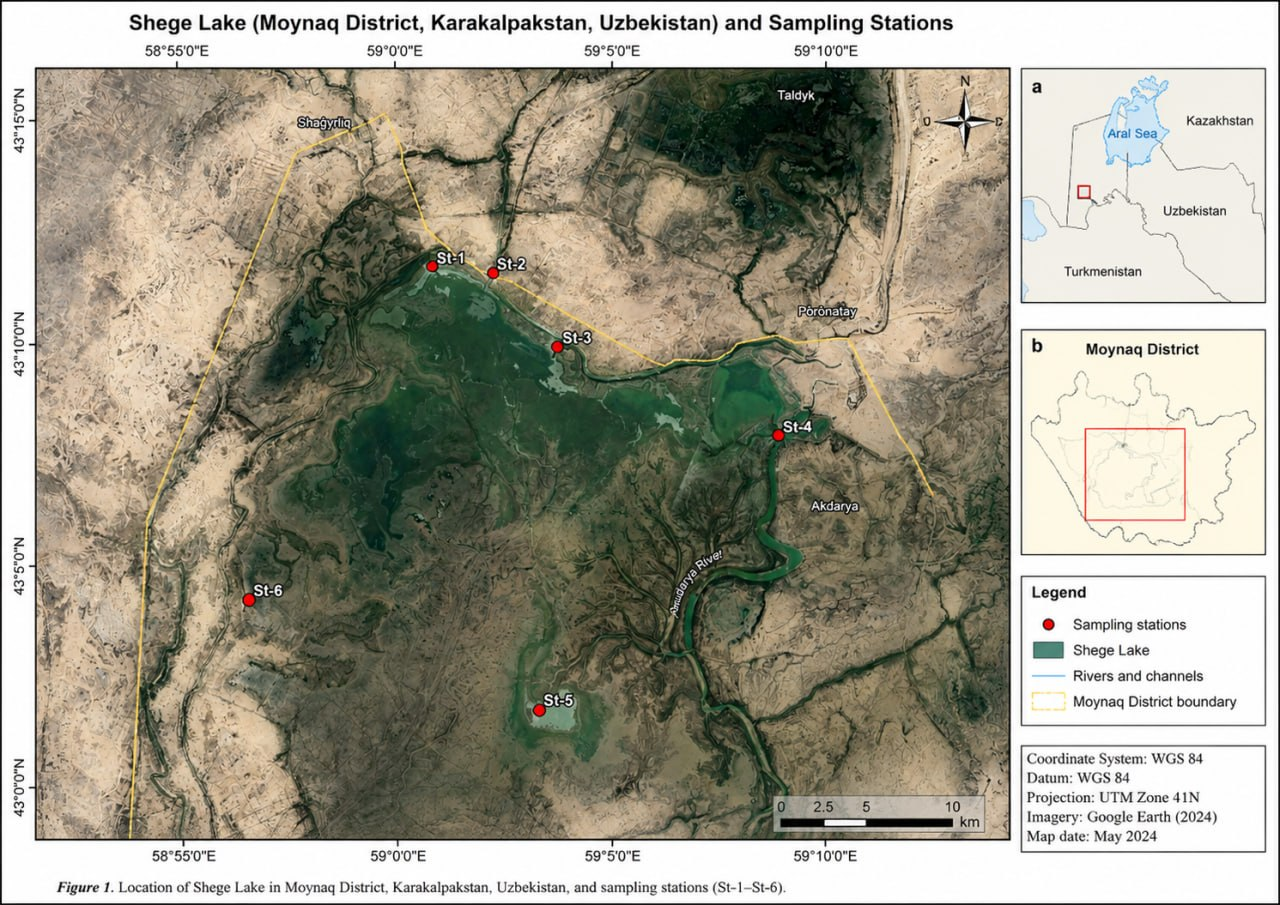 | Figure 1. Location of sampling sites in the Muynak and Shegekul areas within the dried Aral Sea basin |
3. Results and Discussion
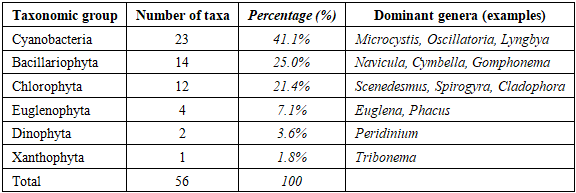
- Species Composition and BiodiversityThe hydrobiological analysis of the studied areas revealed a high diversity of microorganisms in the dried Aral Sea basin, particularly in the Muynak and Shegekul regions. The taxonomic composition included representatives of several major groups, such as Cyanobacteria, Bacillariophyta (diatoms), Chlorophyta (green algae), Euglenophyta, Dinophyta, and Xanthophyta (Table 1).The taxonomic composition of hydrobiological communities identified in the study area is summarized in Table 1. The analysis revealed that the studied ecosystems are dominated by representatives of Cyanobacteria, Bacillariophyta, and Chlorophyta, which together constitute the core of the microbial community structure.
|
4. Conclusions
- The present study provides a comprehensive analysis of the hydrobiological structure and species diversity of microorganisms in the dried Aral Sea bed, focusing on the Muynak and Shegekul areas. Despite the extreme environmental conditions associated with desiccation, including high salinity, aridity, and unstable hydrological regimes, the studied ecosystems support a relatively diverse assemblage of microorganisms.A total of 56 taxa belonging to six major taxonomic groups were identified, with Cyanobacteria (41.1%), Bacillariophyta (25.0%), and Chlorophyta (21.4%) forming the core of the hydrobiological community. The dominance of cyanobacteria reflects their high ecological plasticity and adaptability to stress conditions, while the significant presence of diatoms indicates the persistence of microhabitats capable of supporting benthic and periphytic communities.Comparative analysis revealed spatial differences between the Muynak and Shegekul areas, which are primarily associated with variations in hydrological stability and environmental conditions. The Shegekul region demonstrated relatively higher biodiversity due to more stable water bodies, whereas the Muynak area was characterized by the prevalence of stress-tolerant taxa.The results are consistent with previous studies on the Aral Sea region, which have documented substantial ecological restructuring and increasing dominance of stress-tolerant microorganisms following desiccation processes [1,2]. Microorganisms, particularly cyanobacteria and microalgae, play a crucial role in these processes by contributing to primary production, nutrient cycling, and ecosystem stabilization.Overall, the findings demonstrate that the dried Aral Sea bed represents a dynamic and biologically active system rather than a degraded and lifeless environment. This study contributes to a deeper understanding of biodiversity patterns and adaptive mechanisms in extreme environments and provides a scientific basis for future ecological monitoring and restoration strategies in the Aral Sea basin.Funding: This research was supported by the Ministry of Higher Education, Science and Innovation of the Republic of Uzbekistan under Project No. AL-9424115044.Institutional Review Board Statement: Not applicable.Informed Consent Statement: Not applicable.Data Availability Statement: The data are available upon reasonable request from the corresponding author.Conflicts of Interest: The authors declare no conflict of interest.Author ORCIDsYulduzkhon Tukhtaboeva https://orcid.org/0009-0008-2209-3582Nuriddin Ikramov https://orcid.org/0009-0002-9853-1151