
-
Paper Information
- Paper Submission
-
Journal Information
- About This Journal
- Editorial Board
- Current Issue
- Archive
- Author Guidelines
- Contact Us
International Journal of Virology and Molecular Biology
p-ISSN: 2163-2219 e-ISSN: 2163-2227
2026; 15(3): 74-81
doi:10.5923/j.ijvmb.20261503.03
Received: May 25, 2026; Accepted: Jun. 12, 2026; Published: Jun. 29, 2026

Antiretroviral Resistance Profile in Treatment-Naïve Patients Infected with HIV-1 in the Era of Dolutegravir-Based Triple Therapy in Abidjan, Côte d’Ivoire
 Abstract
 Reference
 Full-Text PDF
 Full-text HTML
Odegue Kpadraux Danielle1, Dechi Jean Jacques Renaud2, Kamo Irie Lou Bohila Emilie3, Diallo Zelica4, Diane Kouao Maxime5, Dosso Mireille6
1Molecular Biology Platform (PFBM), Pasteur Institute of Côte d'Ivoire (IPCI), Abidjan, Côte d'Ivoire
2National Blood Transfusion Centre of Côte d’Ivoire (CNTSCI), Abidjan, Côte d’Ivoire
3Department of Epidemic Viruses (DVE), Pasteur Institute of Côte d'Ivoire (IPCI), Abidjan, Côte d'Ivoire
4Department of Infectious and Tropical Diseases (SMIT), Treichville University Hospital, Abidjan, Côte d'Ivoire
5Biological Resource Centre (CEREB), Pasteur Institute of Côte d'Ivoire (IPCI), Abidjan, Côte d'Ivoire
6Department of Bacteriology and Virology, Pasteur Institute of Côte d'Ivoire (IPCI), Abidjan, Côte d'Ivoire
Correspondence to: Odegue Kpadraux Danielle, Molecular Biology Platform (PFBM), Pasteur Institute of Côte d'Ivoire (IPCI), Abidjan, Côte d'Ivoire.
| Email: |  |
Copyright © 2026 The Author(s). Published by Scientific & Academic Publishing.
This work is licensed under the Creative Commons Attribution International License (CC BY).
http://creativecommons.org/licenses/by/4.0/

HIV-1 resistance to antiretroviral drugs increases the risk of treatment failure in newly infected individuals who have not previously received antiretroviral therapy. In Côte d’Ivoire, data on this category of HIV-1-infected individuals are scarce. The aim of our study was to determine the circulating HIV-1 subtypes and mutations that could compromise treatment success in antiretroviral-naïve individuals in the context of the roll-out of dolutegravir. The identification of mutations and their interpretation were carried out using the techniques and algorithms of the ANRS (www.hivfrenchresistance.org). Sequence analysis showed that 14% of treatment-naïve subjects were resistant to antiretrovirals. Treatment-naïve subjects were resistant to Zidovudine (ZDV), Rilpivirine (RLV), Efavirenz (EFV) (5% each) and ritonavir-boosted Atazanavir (9%). Minor mutations were L10V, L10I (5% each) and G16E (9%). The major mutations were T215I and M230I (5% each). The combination of the three minor mutations L10V, G16E and L10I was responsible for resistance to ritonavir-boosted atazanavir. The major mutation M230I was responsible for resistance to RLV and EFV. The T215I mutation was responsible for resistance to ZDV. No HIV-1 mutations conferring resistance to integrase inhibitors were observed. CRF02_AG was the most commonly identified HIV-1 subtype (90%).
Keywords: HIV-1, Acquired resistance, Dolutegravir, Treatment-naïve patients, Côte d’Ivoire
Cite this paper: Odegue Kpadraux Danielle, Dechi Jean Jacques Renaud, Kamo Irie Lou Bohila Emilie, Diallo Zelica, Diane Kouao Maxime, Dosso Mireille, Antiretroviral Resistance Profile in Treatment-Naïve Patients Infected with HIV-1 in the Era of Dolutegravir-Based Triple Therapy in Abidjan, Côte d’Ivoire, International Journal of Virology and Molecular Biology, Vol. 15 No. 3, 2026, pp. 74-81. doi: 10.5923/j.ijvmb.20261503.03.
Article Outline
1. Introduction
- The HIV-1 pandemic remains a major global health challenge, affecting 39.9 million people worldwide, of whom 630,000 died from an AIDS-related opportunistic infection in 2023 [1]. Côte d’Ivoire is one of the most affected countries in the West African region, with approximately 407,595 people living with HIV and a high prevalence of the condition among key populations (transgender people, men who have sex with men, and people who use drugs). The prevalence rates observed were 1.08%, 2.56%, 2.91%, 6.60%, 10.70% and 24.20% among men, women, people with disabilities, people who use drugs, men who have sex with men and transgender people, respectively [2].In 2023, 73% of identified HIV-positive individuals were on antiretroviral treatment [2]. The roll-out of dolutegravir-based triple-drug regimens has proven to be an effective means of combating HIV-1 resistance to antiretrovirals. A recent study conducted in Côte d’Ivoire demonstrates this through the decline in the rate of circulating HIV-1 resistance to antiretrovirals from 74% in 2019 to 22% in 2023 [3]. However, the increased use of antiretrovirals (ARVs) for treatment has led to more frequent detection of HIV-1 drug resistance mutations in untreated patients, in both high and low-income countries [4,5,6]. Some reports describe an exponential increase in the prevalence of transmitted resistance in resource-limited countries, with many exceeding a rate of 10% [5,7]. For example, recent studies conducted in Ghana, Malawi, Ethiopia and the Republic of Guinea have reported high proportions of transmitted resistance ranging from 6% to 25% [8,9,10,11]. In Côte d’Ivoire, data on HIV-1 drug resistance in untreated patients are very scarce and out of date. Most of the studies carried out concern resistance developed by the virus during antiretroviral treatment. Furthermore, the medical management of people newly diagnosed as HIV-1 positive is carried out without prior assessment of viral load or transmitted resistance; this reinforces the lack of data among untreated patients. To better combat HIV-1 infection in Côte d’Ivoire, a better understanding of the dynamics of the epidemic is urgently needed. More recent data on pre-treatment antiretroviral resistance and genetic diversity are therefore urgently needed. It is against this backdrop that this study is being conducted, with the aim of determining the genetic diversity and the proportion of transmitted resistance mutations among people living with HIV in Côte d’Ivoire.
2. Materials and Methods
2.1. Study Population
- Our study population consisted of adults aged 18 years or older who tested positive for HIV-1 and had not yet started antiretroviral treatment (treatment-naïve subjects). They were recruited from three HIV-1 care centres in the city of Abidjan. The first site was the Cocody University Hospital (CHU), specifically the outpatient, neurology and respiratory medicine departments. The second site was the Treichville University Hospital (CHU), specifically the outpatient and counselling unit, and the third site was the clinical research unit at the Pasteur Institute of Côte d’Ivoire. The study took place from February 2022 to October 2023.
2.2. Ethical Considerations
- The study was approved by the National Ethics Committee for Life Sciences and Health of the Ministry of Health of Côte d’Ivoire (reference number: 197-20/MSHP/CNESVS-kp). All participants provided written informed consent before being recruited into the study.
2.3. Procedure for Data Collection and Blood Sampling
- Informed consent was obtained from each participant included in the study during a face-to-face interview, after which their sociodemographic data were recorded on a questionnaire. A blood sample was then taken from each patient into an EDTA tube and sent to the molecular biology laboratory at the Pasteur Institute of Côte d’Ivoire.
2.4. Pre-Treatment Procedure for Blood Samples
- On arrival at the laboratory, the blood samples were pre-treated by centrifugation at 2,200 rpm for 10 minutes, and the plasma supernatants were collected in aliquots and stored at -80°C for further analysis.
2.5. Genotyping of HIV-1 Drug Resistance Mutations
- Mutations in the reverse transcriptase, protease and integrase genes were identified using the ANRS AC11 reference methods (http://www.hivfrenchresistance.org).
2.5.1. Extraction of viral RNA
- Viral RNA was extracted from the plasma samples using the QIAamp Viral RNA Mini Kit (Qiagen, Germany) in accordance with the manufacturer’s instructions.
2.5.2. RT-PCR
- Amplification of the regions of interest in the HIV-1 pol gene (reverse transcriptase, protease and integrase) was carried out using the Eppendorf VAPO Protect thermal cycler.The RT-PCR technique was used to perform the initial amplification of the genes of interest using the SuperScript III One-Step RT-PCR System with PlatinumTaq DNA (Invitrogen). Briefly, a 50 µL reaction containing 25 µL of master mix (2X), 20 µL of RNA, 0.5 nM of each RT-PCR primer, 1 µL of Platinum Taq-RT Superscript III and 20 µL of extracted RNA was performed.The primer pairs used were MJ3 / MJ4 (AGT AGG ACC TAC ACC TGT CA / CTG TTA GTG CTT TGG TTC CTC T); 5’PROT1 / 3’PROT1 (TAA TTT TTT AGG GAA GAT CTG GCC TTC C / GCA AAT ACT GGA GTA TTG TAT GGA TTT TCA GG) and INPS1 / INPR8 (TAG TAG CCA GCT GTG ATA AAT GTC / TTC CAT GTT CTA ATC CTC ATC CTG) respectively for reverse transcriptase, protease and integrase. The amplification thermal conditions were 55°C for 30 min (activation), 94°C for 2 min (denaturation) for 1 cycle; 94°C for 30 s, 55°C for 30 s, 68°C for 1 min 30 s for 45 cycles, and a final extension at 68°C for 5 min.
2.5.3. NESTED PCR
- The second amplification of the target genes was carried out using the nested PCR technique with the FIREPol Master Mix Ready to Load with 12.5 mM MgCl₂, 5X (SOLIS BIODYNE) kit.This involved performing a 50 µL reaction containing 10 µL of FIREPol Master Mix 5X, 10 µL of PCR products (amplicons), 0.5 nM of each primer, 10 µL of 10× buffer and nuclease-free water. The primer pairs used were A35 / NE135 (TTG GTT GCA CTT TAA ATT TTC CCA TTA GTC CTA TT / CCT ACT AAC TTC TGT ATG TCA TTG ACA GTC CAG CT); 5’PROT2 / 3’PROT2 (TCA GAG CAG ACC AGA GCC AAC AGC CCC A / AAT GCT TTT ATT TTT TCT TCT GTC AAT GGC) and INPS3 / INPR9 (GAA GCC ATG CAT GGA CAA G / ATC CTC ATC CTG TCT ACT TGC C) for reverse transcriptase, protease and integrase, respectively. The amplification conditions were 95°C for 5 min (denaturation) for 1 cycle; 95°C for 30 s, 61°C for 60 s, 72°C for 4 min for 45 cycles, and a final extension at 72°C for 10 min.
2.5.4. Electrophoresis, Purification and Sequencing
- The amplification products obtained following nested PCR were run on a 1% agarose gel, and positive products were visualised using Geldoc. The ChargeSwitch-ProPCR Cleanup kit (Invitrogen) was used to purify the positive amplicons in accordance with the manufacturer’s recommendations. The BigDye Terminator v3.1 kit (Applied Biosystems) was used for the sequencing reaction in accordance with the manufacturer’s recommendations. Ethanol purification using Agencourt CleanSEQ (BECKMAN) was performed to purify the products of the sequencing reaction in accordance with the manufacturer’s recommendations. The 3500 XL Genetic Analyser (Applied Biosystems) was used to sequence the genes of interest.
2.6. Phylogenetic Analyses
- The sequences obtained were aligned with the HIV-1 reference sequence (HIV-1 HXB2, GenBank accession number: K03455). In order to determine the viral subtypes, the consensus sequences obtained were aligned with the reference sequences available in GenBank (http://hiv-web.lanl.gov/). The alignment was performed using the online software HIVGRAD (https://www.hiv-grade.de/cms/grade/). The list of identified mutations is that of the International AIDS Society (IAS, http://www.iasusa.org). Interpretation was carried out using the ANRS algorithm (http://www.hivfrenchresistance.org/, Version No. 34 of November 2023). Phylogenetic trees were constructed using the online sequence alignment programme PHILM. https://www.hiv.Lanl.gov/content/sequence/HIV/HIVTools.html.
2.7. Data Processing and Statistical Analysis
- SPSS Statistics 17.0.1 software was used for the statistical analyses.
3. Results
3.1. Characteristics of the Patients Included in the Study
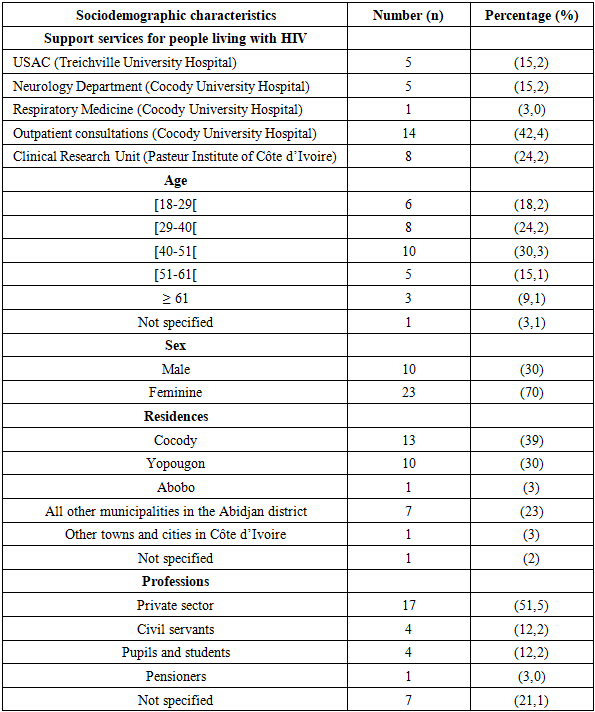
- A total of 33 patients were included in the study. Women accounted for 70% (n = 23/33) of the study population. The median age was 42 years (range 18–61 years). The predominant age group was that of patients aged 40 to 51 years. Participants from the municipality of Cocody were the most numerous (39%), as were those working in the private sector (17%) (Table 1).
|
3.2. Results of the Molecular Analysis of the Samples
- Of the 33 samples analysed, 22 were successfully amplified and sequenced; this represents a positivity rate of 67% (22/33). The protease gene was analysed in 100% (22/22) of cases, compared with 9% (2/22) for reverse transcriptase and 5% (1/22) for integrase.
3.3. Distribution of Viral Subtypes
- A summary of the various phylogenetic analyses showed that the CRF02_AG subtype accounted for 90% (n = 20/22) of the isolated viral subtypes. This was followed by subtype A, which accounted for 5% (1/22) of the isolates. 5% (1/22) of the strains could not be identified by the software (Fig. 1).
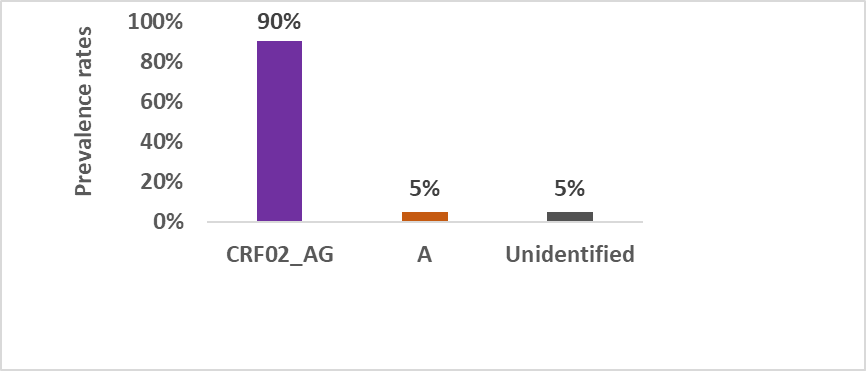 | Figure 1. Distribution of HIV-1 subtypes among treatment-naïve individuals |
3.4. Prevalence of HIV-1 Resistance to Antiretrovirals in Treatment-naïve Subjects
- The prevalence of antiretroviral resistance among treatment-naïve patients was 14% (n = 3/22) (Fig. 2).
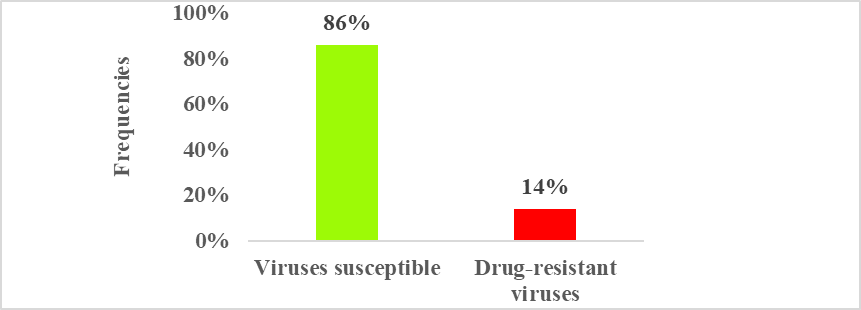 | Figure 2. Prevalence of HIV-1 resistance to antiretrovirals in treatment-naïve individuals |
3.5. Prevalence of HIV-1 Resistance to Different Classes of Antiretrovirals
- The frequency of HIV-1 resistance to protease inhibitors (PIs) is 9%, followed by resistance to nucleoside reverse transcriptase inhibitors (NRTIs) and non-nucleoside reverse transcriptase inhibitors (NNRTIs) (5% each). No HIV-1 resistance has been observed to integrase inhibitors (INIs) (Fig. 3).
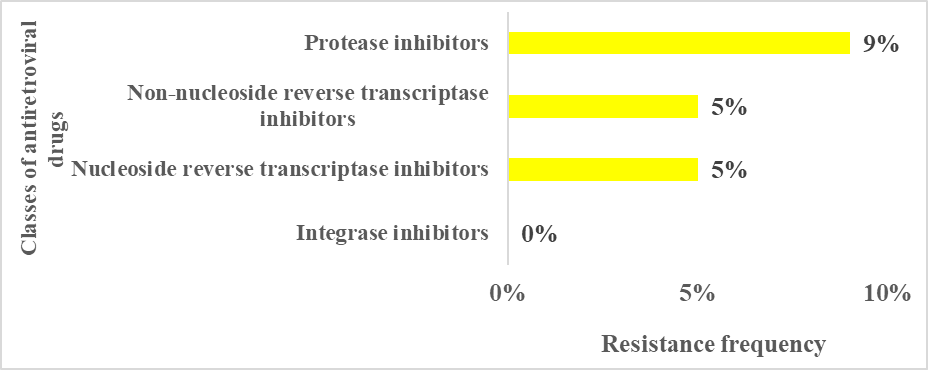 | Figure 3. Prevalence of HIV-1 resistance to different classes of antiretroviral drugs among people who have never received treatment |
3.6. Distribution of Mutations and Resistance Profiles in Antiretroviral-Naïve Subjects
- Analysis of the 22 sequences identified 5 substitutions, of which 60% (n = 3/5) were minor mutations and 40% (n = 2/5) were major mutations. The minor mutations associated with resistance were L10V (substitution of Leucine at position 10 with Valine), G16E (substitution of glycine at position 16 with glutamic acid) and L10I (substitution of leucine at position 10 with isoleucine), with respective frequencies of 5% (n = 1/22), 9% (n = 2/22) and 5% (n = 1/22). The major mutations associated with resistance were T215I (substitution of a threonine at position 215 with an isoleucine) and M230I (substitution of a methionine at position 230 with an isoleucine), with respective frequencies of 5% (n = 1/22). The main resistance mutations and their frequencies are shown in Fig. 4.
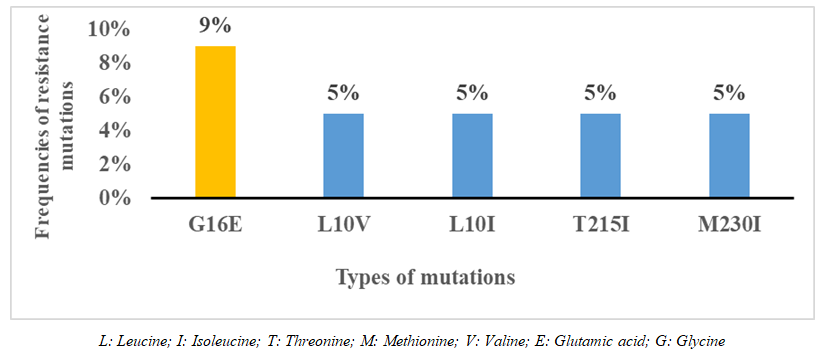 | Figure 4. Major resistance mutations and their frequencies in treatment-naïve patients |
|

4. Discussion
- Phylogenetic analysis of the HIV-1 reverse transcriptase, protease and integrase genes in treatment-naïve individuals revealed a heterogeneous distribution of two non-B strains of HIV-1, among which the circulating recombinant form CRF02_AG was the most prevalent, accounting for 90% of cases. The predominance of this strain is consistent with the results of previous studies conducted in Côte d’Ivoire [3,12]. However, those authors had observed a greater number of HIV-1 subtypes. Indeed, in addition to CRF02_AG and subtype A, Kpadraux and colleagues had also identified subtypes G, A1 and complex recombinant viruses. The same applies to Dechi and colleagues, who identified subtypes B, C, D and complex recombinant viruses in adult subjects. The differences observed compared with our study could be explained by the large sample sizes of their studies, which comprised 139 and 182 patients respectively. Other African researchers have also observed a predominance of CRF02_AG. This is the case for Ouro-Medeli and colleagues in Togo, Appah and colleagues in Ghana, and Meriki and colleagues in Cameroon, who found CRF02_AG to be predominant at frequencies of 64.8% [13], 66% [14] and 69% [15]. The prevalence of this strain in African countries [16] could be explained by its high replication capacity compared to other HIV-1 subtypes [17]. Our study revealed that 14% of treatment-naïve subjects were resistant to antiretrovirals. This prevalence is consistent with the trend of HIV-1 resistance to ARVs observed in many resource-limited countries, where rates of transmitted resistance exceed 10%. This is the case in Ghana (17%) [14], Vietnam (14.7%), Mali (15.4%), Côte d’Ivoire (16.5%), Cameroon (19.3%), Togo (24.6%) [18] and Guinea-Bissau (10.4%) [19]. This phenomenon could be explained by increased access to antiretroviral drugs combined with a lack of systematic monitoring of HIV-1 resistance to antiretrovirals in newly diagnosed patients and in patients experiencing treatment failure. This situation requires public health action through systematic monitoring and resistance testing prior to the initiation of antiretroviral therapy, in accordance with WHO recommendations.Rates of HIV-1 resistance to ARVs in patients on treatment are generally higher than those observed in antiretroviral-naïve patients. Several studies conducted in Côte d’Ivoire, Brazil and Tanzania bear this out, with respective rates of 22% [3]; 84.1% [20]; 41.39% [21]; 57.8% [22] and 96% [23]. The observed differences, with lower rates of transmitted resistance, could be explained by the selection pressure associated with antiretrovirals, which allows pre-existing resistant variants in the environment to be selected. Furthermore, resistance mutations may arise in regions targeted by antiretrovirals, particularly regions of the pol gene [24]. With regard to HIV-1 resistance to different classes of antiretrovirals, our study showed that resistance to PIs is by far the most frequently observed among treatment-naïve individuals, with a prevalence of 9%. Our results differ from those of several authors who have observed very low, or even zero, rates of HIV-1 resistance to PIs. This is the case for Dat and colleagues in Vietnam and Rakotomalala and colleagues in Madagascar, who observed zero resistance to PIs [25,26]. Chen and colleagues in China reported a rate of 0.2% [27]. The differences observed in our study could be explained by the small size of our study sample.The prevalence of HIV-1 resistance to NRTIs and NNRTIs was 5% for each of these classes in our study. This rate is similar to those observed in Zimbabwe [28], China [27] and the United States [29], which were 4%, 3.5% and 6.9% respectively for NRTIs. As for NRTIs, our result is not far removed from those reported in other countries, such as Vietnam (6.3%) [25] and China (3.4%) [27].The absence of resistance to integrase inhibitors justifies the recent adoption of first-line treatment regimens containing dolutegravir in Côte d’Ivoire. This finding is confirmed by several studies which have observed low or zero levels of HIV-1 resistance to integrase inhibitors, notably in Nigeria (0%) [30], Ethiopia (0%) [31], Brazil (0%) [32], Cameroon (1.3%) [33], South Africa (2.2%) [34], in Europe (2.3%) [35] and in the United States, where McClung and colleagues reported a rate of 0.8% HIV-1 resistance to NIs after studying a cohort of 50,747 antiretroviral-naïve subjects [29].With regard to antiretroviral resistance mutations, the T215I mutation in the reverse transcriptase gene conferred resistance to zidovudine at a frequency of 5%, whilst the M230I mutation caused resistance to rilpivirine and efavirenz at a frequency of 5%. The presence of the L10V, G16E and L10I substitutions in the protease gene resulted in 9% of HIV-1 strains being resistant to ritonavir-boosted atazanavir. These transmitted mutations in the reverse transcriptase and protease genes are broadly similar to those found in previous studies conducted in Côte d’Ivoire among patients on ARVs [3,12]. The prevalence levels of transmitted mutations in this study correspond to a moderate level of resistance according to the WHO classification and warrant caution in the selection of treatment regimens. No dolutegravir resistance mutations were identified in the integrase genes, confirming the results of studies conducted in Togo [13], Cape Verde [7] and Madagascar [26]. This finding suggests that treatment regimens containing dolutegravir are likely to be effective in these antiretroviral-naïve patients. Overall, this study has provided baseline data on the potential prevalence of ARV-resistant HIV-1 among antiretroviral-naïve individuals. However, it has limitations, the main one being the small sample size. This highlights the importance of conducting large-scale studies combining phylogenetic, clinical and epidemiological data in Côte d’Ivoire. This study is also limited by the self-reported history of previous ARV use among subjects newly diagnosed as HIV-positive. Indeed, some study participants may have provided inaccurate or even incorrect information regarding their previous use of ARVs.
5. Conclusions
- The CRF02_AG recombinant form is the most common HIV-1 variant found in treatment-naïve individuals. The prevalence of primary HIV-1 resistance to antiretrovirals is moderate in Côte d’Ivoire. No resistance mutations to integrase inhibitors were identified, suggesting that antiretroviral regimens containing dolutegravir may be effective in treatment-naïve patients.
ACKNOWLEDGEMENTS
- We would like to thank the Swiss Centre for Scientific Research in Côte d’Ivoire (CSRS) for funding this work under the Strategic Support Programme for Scientific Research (PASRES) (project number: PASRES/73-22/SY/MA). This project was co-funded by the Pasteur Institute of Côte d’Ivoire (IPCI).
Authors’ Contributions
- Study design and development by Kpadraux Danielle Odegue and Jean-Jacques Renaud Dechi. Preparation of materials, data collection and analysis by Kpadraux Danielle Odegue. Drafting of the first version by Kpadraux Danielle Odegue. Revision and proofreading of subsequent versions by Jean-Jacques Renaud Dechi, Irié Lou Bohila Emilie Kamo, Zelica Diallo, Kouao Maxime Diane and Mireille Dosso.All authors have read and approved the final manuscript. Supervision and securing of funding by Kpadraux Danielle Odegue.
Conflicts of Interest
- The authors declare that they have no conflicts of interest in relation to the content of this article.