
-
Paper Information
- Previous Paper
- Paper Submission
-
Journal Information
- About This Journal
- Editorial Board
- Current Issue
- Archive
- Author Guidelines
- Contact Us
International Journal of Virology and Molecular Biology
p-ISSN: 2163-2219 e-ISSN: 2163-2227
2026; 15(2): 57-61
doi:10.5923/j.ijvmb.20261502.07
Received: Apr. 3, 2026; Accepted: Apr. 25, 2026; Published: Apr. 30, 2026

Taxonomic Analysis of Game Birds Fauna in Bukhara Region
 Abstract
 Reference
 Full-Text PDF
 Full-text HTML
Rayimov Avaz Rustamovich1, Rashit Rakhimovich Rakhmonov1, 2, Jumanov Muratbay Arepbayevich3, Arepbaev Islambek Muratbaevich3, Qoilova Mehriniso Djuraevna1, Yusufaliev Shokhzod Zafar ugli4, Jonibek Rashitovich Raximov5, Xomitova Marjona Ibratovna6
1PhD., Associate Professor, Bukhara State Pedagogical Institute, Bukhara, Uzbekistan
2Independent Researcher, Karakalpak State University, Nukus, Uzbekistan
3Professor, Doctor of Biological Sciences, Karakalpak State University, Nukus, Uzbekistan
4Director, History Museum of Tashkent Medical University, Tashkent, Uzbekistan
5Lecturer, Department, Bukhara State Pedagogical Institute, Bukhara, Uzbekistan
6Master's Degree Student, Bukhara State Pedagogical Institute, Bukhara, Uzbekistan
Correspondence to: Rayimov Avaz Rustamovich, PhD., Associate Professor, Bukhara State Pedagogical Institute, Bukhara, Uzbekistan.
| Email: |  |
Copyright © 2026 The Author(s). Published by Scientific & Academic Publishing.
This work is licensed under the Creative Commons Attribution International License (CC BY).
http://creativecommons.org/licenses/by/4.0/

The article analyzes the species composition, leading order, spectrum of families and taxonomic composition of game birds of Bukhara region and adjacent territories. It has been established that in the territory of the Bukhara region and adjacent territories there are 7 orders, 9 families and 27 species of game birds. Due to the increased interest in bird hunting, in particular hunting tourism, much attention is being paid to improving the system of hunting management, special breeding and protection of game bird species, and the introduction of advanced working methods in this area. In this regard, improvements were made, including in the management of hunting farms, the organization of hunting, maintaining their sustainability through the special breeding of game birds, as well as increasing the economic efficiency of farms through the introduction of hunting tourism.
Keywords: Streptopelia senegalensis, Columba livia, Corvus frugilegus, Desert zone, Biotope, Agrocenosis, Biocenosis, Environmental factor
Cite this paper: Rayimov Avaz Rustamovich, Rashit Rakhimovich Rakhmonov, Jumanov Muratbay Arepbayevich, Arepbaev Islambek Muratbaevich, Qoilova Mehriniso Djuraevna, Yusufaliev Shokhzod Zafar ugli, Jonibek Rashitovich Raximov, Xomitova Marjona Ibratovna, Taxonomic Analysis of Game Birds Fauna in Bukhara Region, International Journal of Virology and Molecular Biology, Vol. 15 No. 2, 2026, pp. 57-61. doi: 10.5923/j.ijvmb.20261502.07.
Article Outline
1. Introduction
- The use of modern methods and technologies in the activities of hunting farms has resulted in the preservation of the number of bird species and the stability of their habitats [4]. It should be noted that, depending on the zoogeographical characteristics of each region and the specifics of the hunting industry there, the type of hunting objects and the volume of hunting differ from each other [5]. Accordingly, a scientific approach to compiling a list of huntable bird species for a particular region, acclimatizing promising bird species, and issuing appropriate permits for hunting is of significant scientific and practical importance in preventing the decline in the number of huntable bird species, developing measures for the implementation of biotechnical measures, and putting them into practice.
2. Materials and Methods
- In order to determine the species composition of the bird fauna of the Bukhara region and adjacent areas, our observations were carried out in different seasons in 2010-2025. In various natural biotopes - deserts, semi-deserts, foothills, natural reservoirs, groves, as well as partially developed areas, stationary and routed, a total of 140 land censuses were conducted in different seasons of the year (spring, summer, autumn and winter) [18,5]. The results of the census of the number of birds of prey in the Bukhara region and adjacent areas were extrapolated to an area of 10 hectares, and the density of the bird community was determined according to the following formula: [16,17]
 where D is the density; n is the number of birds encountered; L is the length of the route; W is the width of the route, or the distance from the route axis to the border of the calculated corridor. To take into account the species composition of the prey bird fauna on the left and right sides of the route axis, a multiplier of 2 was used in the formula, but the results of our calculations were taken from one side of the route axis, due to the specifics of the deserts [6].In addition to visual observations, photographs and video images were used to determine the species and count the number of hunted bird fauna, using a Cinema Res 1200x video camera and Viking 10x50 binoculars. The following methods were used to identify animals and record populations:1. Visual observation: Identification of animals by direct observation in their natural habitat.2. Identification by tracks and remains: Species identification using paw prints, fur, bird remains, and negative tracks.3. Traps and camera traps: Animal activity and species were recorded using special sensor cameras.4. Acoustic monitoring: identification using the vocalizations of birds and some mammals.5. Biological samples: laboratory analysis of soil, bird eggshells, fur, and food samples.Each method was applied in a manner that caused minimal environmental harm to the animals [1,2,4].The percentage of a particular species in the prey population (%) was determined using the following formula:
 Here a is the number of representatives of a specific species; b is the number of representatives of all species counted at the census location [5,15].
3. Literature Review
- Studies on migration, distribution in biotopes, population size, biology, and ecology of passerine birds have been conducted by foreign researchers such as M. Umar et al. [13], S. Laxminarayan et al. [11], Pande Satish et al. [8], Laszlo Bozo and Tibor Csorgo [7], Rahmat Ullah Khan et al. [10], Wafae Squalli et al. [14], Muhammad Zeshan Haider et al. [9], W. Tesfahunegny and A. Assefa [12], and others. Research on bird fauna and their ecological characteristics has also been reported in the works of T. Zohidov, R.N. Meklenburuev, A.K. Sagitov, O.V. Mitropolsky, D.Yu. Kashkarov, E. Shernazarov, A. Mambetjumaev, S. Bakaev, F. Kholboev, M. Jumanov, A. Jabborov, M. To‘raev, R.R. Rakhmonov, A.R. Rayimov, and others [3].
4. Topic Description
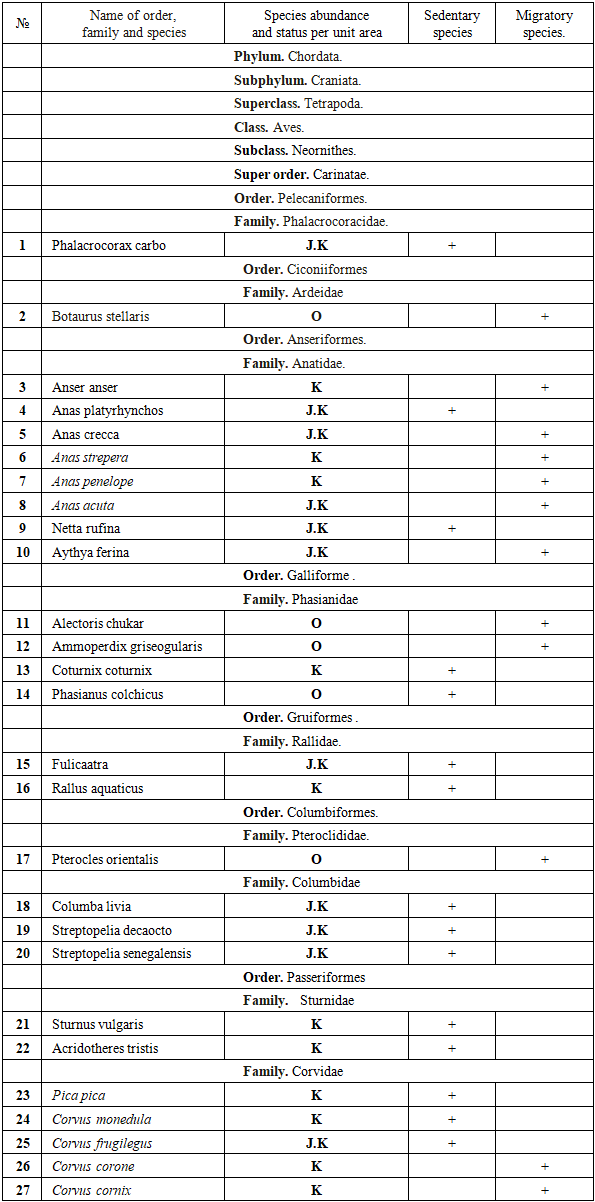
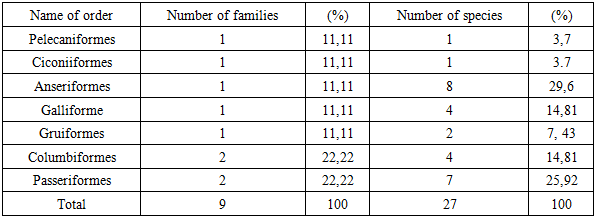
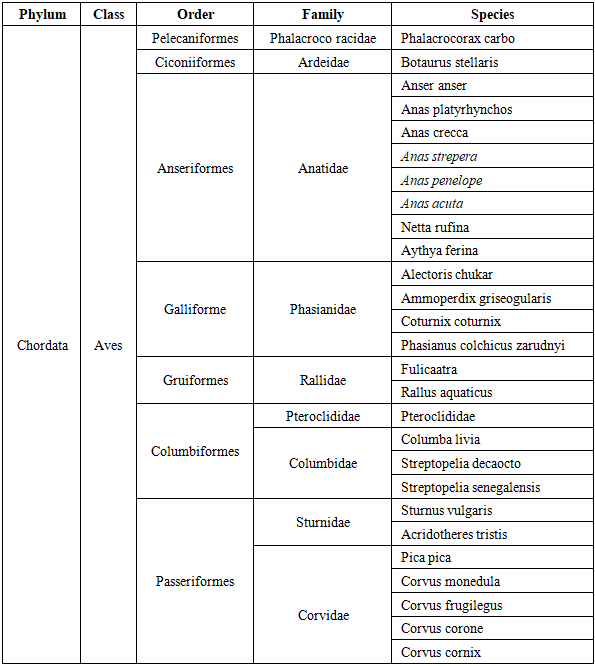
- It was determined that 27 species of birds belonging to 1 subclass (Neornithes), 7 orders (Pelecaniformes, Ciconiiformes, Anseriformes, Galliforme, Gruiformes, Columbiformes, Passeriformes), 9 families (Phalacrocoracidae, Ardeidae, Anatidae, Phasianidae, Rallidae, Pteroclididae, Columbidae, Sturnidae, Corvidae) were found in the Bukhara region and adjacent areas. Birds are hunted for sports and amateur purposes, as well as for scientific, medical and other purposes, and almost all of these hunts are carried out by removing birds from their habitat. (Table 1).
|
|
|
5. Conclusions
- It is necessary to restore the number of rare species of game birds (Pterocles orientalis, Phasianus colchicus zarudnyi, Ammoperdix griseogularis, Alectoris chukar, Botaurus stellaris) in the Bukhara region and adjacent areas, acclimatize promising species, breed them in captivity, implement biotechnical measures, and establish industrial hunting to increase the diversity of hunting objects and the economic efficiency of hunting farms. It is equally vital to preserve the fauna and biodiversity of game birds in the Bukhara region and adjacent areas, to improve their distribution, number, bioecological characteristics, to reduce the impact of anthropogenic factors, to improve measures for the protection and sustainable use of species. Monitoring the state of the game bird population in the Bukhara region and adjacent areas, and to create a cadastral information base should also be considered.