U. T. Azilova
Nukus State pedagogical Institute named after Ajiniyaz Nukus, Uzbekistan
Correspondence to: U. T. Azilova, Nukus State pedagogical Institute named after Ajiniyaz Nukus, Uzbekistan.
| Email: |  |
Copyright © 2026 The Author(s). Published by Scientific & Academic Publishing.
This work is licensed under the Creative Commons Attribution International License (CC BY).
http://creativecommons.org/licenses/by/4.0/

Abstract
In this article, the morphogenesis features of Ziziphus jujuba Mill. were studied for the first time in the conditions of the Republic of Karakalpakstan, during its introduction to the territory. During the study, the morphogenesis periods of plants grown from seeds and their duration were determined. Also, the growth rate, development dynamics of plants, and the main indicators of the success and prospects of the introduction were evaluated. The results obtained serve as a scientific basis for the widespread introduction of this plant in the region, the organization of intensive plantations, as well as the improvement of landscaping and agrotechnical measures.
Keywords:
Morphogenesis, Ziziphus jujuba Mill, Rhamnaceae, Introduction, Relict, Acropetal, Latent
Cite this paper: U. T. Azilova, Study of the Introduction and Morphogenetic Characteristics of Ziziphus jujuba Mill. Under the Conditions of the Republic of Karakalpakstan, International Journal of Virology and Molecular Biology, Vol. 15 No. 2, 2026, pp. 52-56. doi: 10.5923/j.ijvmb.20261502.06.
1. Introduction
Currently, special attention is being paid to the systematic reproduction of ornamental, rare and endangered plants in the world, their use in ecology, and the organization and use of a national green space project. It should be noted that the Z jujube species and varieties, which are widely used in landscaping, are of particular importance. Ziziphus jujuba Mill. is a relict subtropical plant species distributed in Central Asia, its natural range is sharply decreasing. Therefore, this species is included in the Red Book of the Republic of Uzbekistan as a rare and protected plant. In natural conditions, it grows mainly in the regions of the Western Tyanshan, on dry, rocky slopes and along river and stream banks [1]. It has been cultivated as a fruit and medicinal plant since ancient times. It has been cultivated in the Botanical Garden of the Academy of Sciences of the Republic of Uzbekistan since 1958 [2]. It is kept for conservation in the Surkhan State Reserve and the Ugam-Chatkal National Nature Park [3]. By studying their morphogenesis, it was possible to determine the bioecological characteristics of this species, its growth and development, and mechanisms of adaptation to climate change, as well as to develop scientifically based methods of reproduction under introduced conditions. Ziziphus jujuba Mill. is a plant belonging to the Rhamnaceae family. Although there are about 170 species in the genus Ziziphus worldwide, only 58 species are widely used by local populations and traditional medical practitioners in arid and semi-arid regions for the treatment of various diseases and as a functional food [4–5]. The ancient Greeks as the “zizyphon” tree and in Arabic knew the plant by its legendary name “Zizouf” or “Zefzouf” [6]. The genus Ziziphus mainly includes six widely distributed species: Ziziphus sativa, Ziziphus mauritiana, Ziziphus mucronata, Ziziphus lotus, Ziziphus spina-christi, and Ziziphus jujuba [7]. In Karakalpakstan, only one species Ziziphus jujuba Mill. is found. “Determinant of the highest plants of Karakalpakstan” O.N. Bondarenko gave a detailed review of the genus Ziziphus Mill., according to the author, 1 species occurs on the territory of our Republic: Ziziphus jujuba Mill., the main diagnostic signs are the morphological features of the flowers and leaves of the plant [8]. At the same time, we are conducting scientific research aimed at studying the propagation, introduction, growth, and morphogenetic stages of Ziziphus jujuba and its cultivars ‘Ta-yan-szao’, ‘U-sin-xun’, and ‘small-fruited cultivar’.Morphogenesis is the process of the formation of specific spatial structures and shapes in an organism as a result of the differential division, growth, and movement of cells and tissues, as well as the interactions between them. In plants, morphogenesis is characterized by complex feedback mechanisms between growth-regulating signaling systems and the growth processes of the plant organism [9].
2. Materials and Methods
Ziziphus jujuba Mill. is a deciduous tree or shrub, with significant morphological variability within the species. Representatives of this species occur from shrubby forms reaching a height of 1.5–2.0 m to tree-like forms with a trunk diameter of about 30 cm and a height of 10–12 m [13].The object of our research was the species Ziziphus jujuba Mill., introduced to the Republic of Karakalpakstan, and the varieties ‘Ta-yan-szao’, ‘U-sin-xun’, and ‘small-fruited cultivar’ with fruits. Our experiments were mainly conducted at the Aral Sea International Innovation Center under the Ministry of Ecology, Environmental Protection and Climate Change of the Republic of Uzbekistan, in the Amudarya district and the city of Nukus. The research work was carried out during 2023-2025 (Figure 1).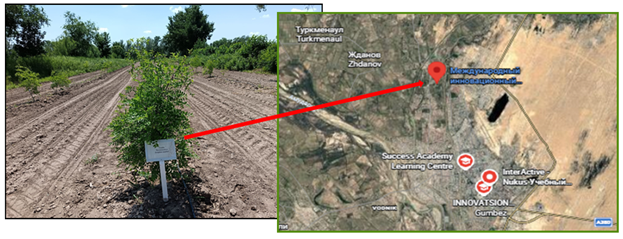 | Figure 1. Experimental field of Ziziphus jujuba Mill. in the Aral Sea International Innovation Center, with geographical location indicated on the map |
The object of this study was Ziziphus jujuba Mill., introduced into the Republic of Karakalpakstan, as well as its cultivars ‘Ta-yan-szao’, ‘U-sin-xun’, and ‘small-fruited cultivar’. The experiments were mainly conducted at the Aral Sea International Innovation Center under the Ministry of Ecology, Environmental Protection and Climate Change of the Republic of Uzbekistan, as well as in the Amudarya district and the city of Nukus. The research was carried out during 2023–2025 (Figure 1).The Republic of Karakalpakstan is located in the northwestern part of Uzbekistan, in the lower reaches of the Amudarya River and along the southern coast of the Aral Sea. The southwestern part of the republic borders the Karakum Desert. The Ustyurt Plateau lies to the northwest, while the Kyzylkum Desert stretches to the northeast [10]. The climate is sharply continental, characterized by hot, dry summers and relatively severe winters, strong winds, low precipitation (70–110 mm per year), unstable snow cover, high evaporation during the day, and significant temperature fluctuations between seasons. The absolute maximum temperature reaches +45.5°C (July), while the minimum drops to −37.0°C (January). The transition of the average daily air temperature above +10°C occurs in the third decade of April. In winter, the soil freezes to a depth of 5–15 cm. The degree of continentally increases from the southern to the northern regions. The annual amplitude of air temperature fluctuations is 32–34°C in the south and up to 36°C in the north. The duration of the frost-free period ranges from 175–187 days in the northern part to 187–215 days in the southern part [11].
3. Results and Discussion
The research is aimed at studying the stages of morphogenesis of Ziziphus jujuba and identifying the differences between them. In this case, the ontogenesis classification proposed by I.G. Serebryakov [14], T.A. Rabotnov [15], and other scientists was determined according to the signs of morphological development of plant organs. Scientific research on the morphogenesis of Z jujuba has not been conducted in Uzbekistan. The life form of Ziziphus jujuba is a perennial tree, and its growth and development were determined: I primary dormancy period was divided into latent (se) dormant seeds, virginal period (v), grass stage (p), juvenile (j), immature (im), generative (g) periods.Latent Period (se).This period is the intermediate period from the moment the plant seeds ripen to germination. The fruits of Ziziphus jujuba are drupes with a hard endocarp. Usually 1, sometimes 2 seeds develop inside the fruit. The seeds are endospermic. The seeds of Ziziphus jujuba are brown, oblong, hard, oval or flat, consisting of 1-2 elliptical seeds, 8-9 mm long and 4.8-5 mm wide. The weight of 1000 seeds of the Z jujuba plant is 204.55 grams. The average weight of one seed was measured in laboratory conditions on an electronic balance (KERN 440-45N). Seed weight is of great importance: large and heavy seeds have high sowing quality [12]. Seed weight is essential for determining planting standards. The latent period is determined by the development of the fertilized egg, embryo formation, and seed maturation. During this period, nutrients necessary for the further development of the plant are accumulated in the seed coat. Seed formation is a complex biological and physiological process that depends on environmental factors and the speed of pollination and fertilization (Figure 2).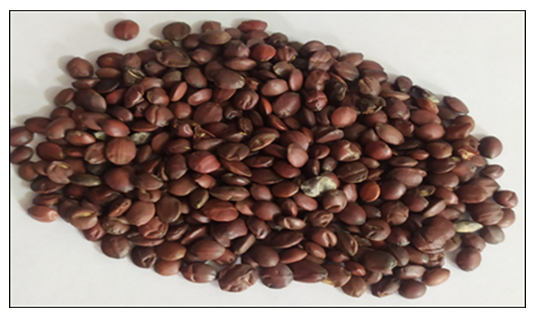 | Figure 2. Latent (se) dormancy period of Ziziphus jujuba Mill. Morphogenesis |
Virginal period (v).The virginal period of Ziziphus jujuba covers the period from the germination of the seed to the appearance of the first generative organs (buds). During this period, the vegetative development of the plant predominates, and the following stages are distinguished: p- grass, j- juvenile, im- immature stage. Each stage is characterized by a gradual complication of the morphological and physiological characteristics of the plant.The grass stage (p).This stage includes the period from seed germination to the formation of the first pair of true leaves. According to the results obtained, it was found that scarified seeds of Z jujube germinate 10-11 days after spring sowing, while stratified seeds germinate 21-26 days, and some even later. When the seed first begins to germinate, the seed coat slightly enlarges and splits. Initially, the hypocotyl emerges from it to the surface. When the seed germinates, the hypocotyl is curled, light green in color, and the cotyledon leaves bring the seed post to the surface. After germination, the cotyledons on the 3rd day are not yet fully opened and are located close to each other. During this period, the hypocotyl is short and curved, and the root is just forming, and the initial growth of the main root is observed. The seedling is generally morphologically thin and poorly developed, and is characterized by small seed pod sizes (Figure 3).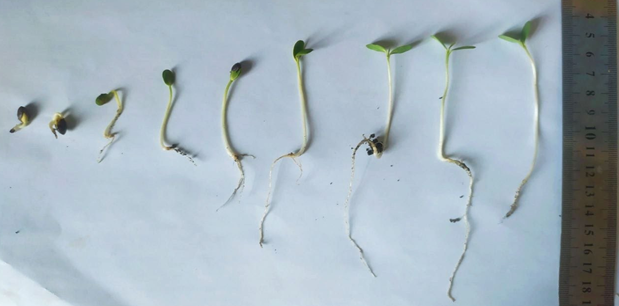 | Figure 3. The grass stage (p) of Ziziphus jujuba morphogenesis |
When the seedlings are 7 days old, the cotyledons are separated from each other. The cotyledon leaves are green, oval-elliptical in shape, smooth on the edges, without teeth, 1-1.2 cm long, 7-8 mm in diameter, and the plant height is 3-3.2 cm. The root system of the seedlings is well developed, the main root is clearly visible. The root length is 3.1-3.2 cm, and lateral roots have not yet formed at this stage. The active development of the root system improves the plant's supply of water and minerals, as a result, the growth of the above-ground part, in particular the epicotyl, accelerates. After 18-20 days, the seedlings begin to transition to the juvenile state.Juvenile stage (j).This stage includes the period from the appearance of the first cotyledons in the plant to the formation of the first order of branches. The cotyledons turn yellow and fall off after 42 days, this process is associated with the transition of the plant to independent nutrition. The first cotyledons are located opposite, the length of the leaf plate is 1.5-1.6 cm, width is 0.9-1 cm. The second cotyledons are formed after 4-5 days, and the leaves are located alternately. At this stage, the plant's spines are also formed, and they are located opposite in 1 pair in each joint. In addition, small toothed leaves are formed on the edge of the leaf blade (Figure 4). At the juvenile stage, the plant has 6-7 pairs of cotyledons, and the length of the main root is 7-8 cm. At this stage, the main root formed secondary and tertiary branches. The average height of the plant reached 9-10 cm. The duration of the juvenile stage was recorded as 24-26 days.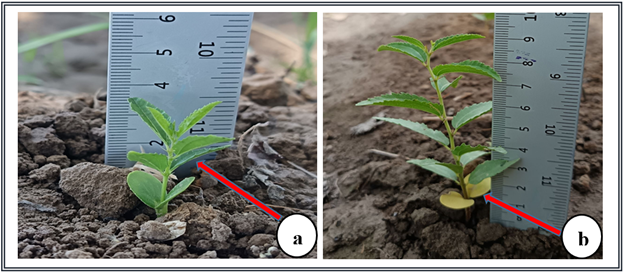 | Figure 4. Juvenile stage of Ziziphus jujuba a- formation of bracts, b- yellowing and shedding of cotyledons |
Immature stage (im).This stage includes the period from the appearance of the first order branches in the plant to the budding stage. In Z jujuba, this stage was observed 46 days after seed germination, in the third decade of May. The first order branches emerged mainly from the 4-5-6 pairs of pinnate leaflets. The height of the plants was 20-23 cm at the end of June. The number of lateral branches was 13-17, the length of the lower ones was 16-18 cm, the branches in the middle part were 19-22 cm, and the length of the upper branches was 11-15 cm. There are fourth-order branches. The length of the leaf plate is 3.1-3.3 cm, width is 2.2-2.4 cm, the spines consist of 1 pair in each leaflet, the length is 0.5-0.9 cm. The root system is well developed, has a fourth-order branching, the main root is 27-32 cm, deep, the most formed roots are 2-3 orders. The immature stage was noted to last 51-56 days (Figure 5).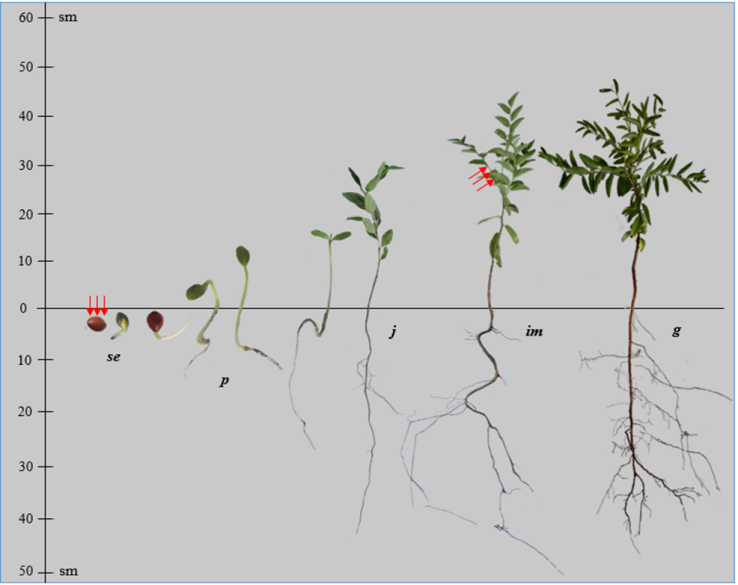 | Figure 5. Se – latent period, p – grass stage, j – juvenile stage, im – immature stage, g – generative period |
Generative period (g).In Ziziphus jujuba, this period is characterized by the formation of flowers and seeds, and falls on the second decade of July. Flower buds are located on special generative branches, the formation of which occurs due to the cells of the third meristem. In determining the reproductive organs of Ziziphus jujuba, the processes of bud formation, inflorescence development, flower location on branches, transition to flowering, opening of sepals, pollination and up to the withering of the flower and the formation of seeds were studied. The arrangement of flower buds is acropetal, located in a row upwards, and on this basis the opening of the flower also occurs. The ripening process of seeds also occurs in the same way. The flowers open slightly later than the leaves. The inflorescence is panicle-shaped, and the number of flowers in it varies depending on the plant variety and environmental conditions. The flowers are small, bisexual, actinomorphic, and green or yellowish in color. The calyx consists of 5 sepals and the corolla consists of 5 petals, which are arranged alternately. There are 5 stamens, which are located opposite the petals. The length of the corolla is on average 5–6 mm. The length of the sepals is 1–1.5 mm, and they are arranged freely.The gynoecium of Ziziphus jujuba flowers is usually formed by the fusion of 2–3 carpels, representing a syncarpous type. The ovary is superior and typically 2-, sometimes 3-locular. Each locule contains one ovule. The ovules are anatropous and attached to the central axis. The style is short or nearly absent, and the stigma is usually 2–3-lobed, corresponding to the number of carpels. The embryo sac develops according to the Polygonum type, which is characteristic of angiosperms. Ziziphus jujuba flowers are insect-pollinated (entomophilous). Bees, wasps, and other pollinating insects play a major role in pollination. The budding stage begins in the second decade of June and continues until early August. During the generative phase, variation in flower number was observed across different orders of lateral branches: 4 flowers on 5th-order branches, 8 on 6th-order, 7 on 7th-order, and 5 on 8th-order branches. The highest flowering intensity was observed on 6th–7th-order branches.
4. Conclusions
In conclusion, the morphogenesis of the species Ziziphus jujuba Mill. was studied for the first time in the conditions of the Republic of Karakalpakstan. During the morphogenesis process, the vegetative and generative periods of the plant are characterized by specific morphological features. In the generative stage, the formation of flowers, their acropetal opening and the formation of a panicle-shaped inflorescence were observed. It was found that the presence of a gynoecium of the senescent type in the flower structure, the high location of the node and the development of 2–3 ovules in it are one of the important diagnostic features of the species. The subsenile and senile (s) stages of the plant were not studied during the research process, since there were no individuals belonging to these ontogenetic stages among the experimental objects. At the same time, it was observed that the course of the morphogenesis stages is closely related to the biological characteristics of the plant and external environmental factors. The results obtained serve as an important scientific basis for a deeper study of the morphological features of the species Ziziphus jujuba and its application in landscaping.
Conflicts of Interest
The authors declare no conflicts of interest regarding the publication of this paper.
References
| [1] | Red Data Book of the Republic of Uzbekistan: Rare and Endangered Species of Plants and Animals (in 2 volumes). Vol. 1: Plants and Fungi. Tashkent: Chinor ENK Publishing House, 2009. |
| [2] | Grubov, V.I. Family Rhamnaceae. In: Trees and Shrubs of the USSR, Vol. 4. Moscow–Leningrad: Academy of Sciences of the USSR, 1958, pp. 526–607. |
| [3] | Red Data Book of the Republic of Uzbekistan. Vol. I: Plants. Ed. by F.O. Khasanov. Tashkent: Chinor ENK, 2019. 356 p. |
| [4] | El Maaiden, Ezzouhra, Youssef El Kharrassi, Nagib AS Qarah, Abdel Khalid Essamadi, Khadija Moustaid, and Boubker Nasser. “Genus Ziziphus: A comprehensive review on ethnopharmacological, phytochemical and pharmacological properties.” Journal of ethnopharmacology 259 (2020): 112950. |
| [5] | Medan, D., and C. Schirarend. “Rhamnaceae.” In Flowering plants· Dicotyledons: Celastrales, Oxalidales, Rosales, Cornales, Ericales, pp. 320-338. Berlin, Heidelberg: Springer Berlin Heidelberg, 2004. |
| [6] | Simpson M.G. 2006. Plat systematics. Elsevier Academic Press. Berlington. pp:477-491. |
| [7] | Touaibia Meriem. A review on Phytopharmacological Properties of Five Jujube Species: Ziziphus Sativa, Z. Mauritiana, Z. Mucronata, Z. Lotus and Z. Spina Christi (Rhamnacées). J. Pharm. Drug. Dev. Vol. 3 Iss. 1. (2024) https://doi.org/10.58489/2836-2322/028. |
| [8] | Bondarenko, O.N. Key to Higher Plants of Karakalpakstan. Tashkent: Nauka, 1964. 304 p. |
| [9] | Sattler, R., & Rutishauser, R. (1997). The fundamental relevance of morphology and morphogenesis to plant research. Annals of Botany, 80, 571–582. |
| [10] | Aimbetov, N.K., Tleumuratova, B.S., Mambetullaeva, S.M., et al. (2017). Dynamics and Potential of the Natural Environment of Karakalpakstan. Nukus: Ilim. 251 p. |
| [11] | Allanazarov, K.Zh., & Satbaev, T. (2005). Climatic conditions and agroclimatic resources of the Amudarya delta and their changes in connection with desertification. In: Study of Environmental Problems of the Aral Sea Region: Proceedings of the Scientific and Practical Conference. Nukus. |
| [12] | Azilova U.T. Assessment of seed germination of jujube (Ziziphus jujuba Mill.) under field conditions // American Journal of Agriculture and Horticulture Innovations. – 2025. – Vol. 5, № 12. – P. 12–15. |
| [13] | Azilova U.T., Ajiev A.B. Introduction of Ziziphus jujuba Mill. in the conditions of the Republic of Karakalpakstan // Journal of International Scientific Research. – 2024. – Vol. 1, Issue 2. – October. – P. 406–412. |
| [14] | Serebryakov, I.G. (1962). Morphology of vegetative organs of higher plants. Moscow: Soviet Science Publishing House. |
| [15] | Rabotnov, T.A. Methods for studying seed reproduction of herbaceous plants in communities. In: Field Geobotany, edited by E.M. Lavrenko and A.A. Korchagin. Moscow–Leningrad: Publishing House of the Academy of Sciences of the USSR, 1960, pp. 20–21. |


 Abstract
 Reference
 Full-Text PDF
 Full-text HTML