
-
Paper Information
- Paper Submission
-
Journal Information
- About This Journal
- Editorial Board
- Current Issue
- Archive
- Author Guidelines
- Contact Us
International Journal of Virology and Molecular Biology
p-ISSN: 2163-2219 e-ISSN: 2163-2227
2026; 15(2): 27-33
doi:10.5923/j.ijvmb.20261502.02
Received: Jan. 18, 2026; Accepted: Feb. 12, 2026; Published: Apr. 10, 2026

Biological Absorption Coefficients, Elemental Uptake, and Biogeochemical Activity of Lycium Barbarum L. in Relation to Plant Molecular Responses
 Abstract
 Reference
 Full-Text PDF
 Full-text HTML
Dilrabo E. Djuraeva1, Murodjon T. Isagaliev2
1Andijan Institute of Agriculture and Agrotechnologies, PhD student, Uzbekistan
2Department of Soil Science, Joint faculty of Agrarian, Fergana State University, Fergana, Uzbekistan
Correspondence to: Murodjon T. Isagaliev, Department of Soil Science, Joint faculty of Agrarian, Fergana State University, Fergana, Uzbekistan.
| Email: |  |
Copyright © 2026 The Author(s). Published by Scientific & Academic Publishing.
This work is licensed under the Creative Commons Attribution International License (CC BY).
http://creativecommons.org/licenses/by/4.0/

This study investigated the biological uptake and organ-specific distribution of macro- and microelements in the medicinal plant Lycium barbarum L. under different mineral fertilization regimes. Elemental concentrations and biological absorption coefficients (Ax) were used to assess accumulation intensity, selectivity, and biogeochemical activity in leaves, stems, and fruits. The results demonstrated that mineral fertilization significantly altered elemental uptake patterns, with the N60P60K40 treatment showing the most pronounced and balanced effects. Potassium exhibited active uptake across all organs, while selenium and chlorine showed strong bioaccumulation in fruits, substantially increasing their functional and medicinal value. In contrast, iron, cobalt, scandium, and other potentially hazardous elements displayed very low Ax values, indicating effective physiological exclusion and ecological safety. Overall, the findings highlight the role of optimized fertilization in regulating selective element uptake and enhancing the biogeochemical and bioactive properties of Lycium barbarum L., providing a scientific basis for its safe cultivation and biofortification.
Keywords: Lycium barbarum L., Biological absorption coefficient, Mineral fertilization, Bioaccumulation, Selenium, Biogeochemical activity
Cite this paper: Dilrabo E. Djuraeva, Murodjon T. Isagaliev, Biological Absorption Coefficients, Elemental Uptake, and Biogeochemical Activity of Lycium Barbarum L. in Relation to Plant Molecular Responses, International Journal of Virology and Molecular Biology, Vol. 15 No. 2, 2026, pp. 27-33. doi: 10.5923/j.ijvmb.20261502.02.
Article Outline
1. Introduction
- Living organisms, particularly medicinal plants, possess the ability to selectively absorb and accumulate chemical elements from the soil within their tissues and organs. At the same time, the investigation of the chemical composition of plants plays a crucial role in the geochemical characterization of the soils in which they grow. Due to the selective uptake capacity of plants, the concentration of chemical elements in plant organs may differ significantly from their levels in the surrounding soil environment [1].Plants represent a key component in the circulation of chemical elements within the soil–plant–atmosphere system. One of their fundamental characteristics is the ability to selectively absorb elements present in the soil solution and distribute them according to physiological and metabolic requirements. In the scientific literature, this process is commonly described as selective uptake or ion selectivity. This property is of considerable importance for plant adaptation to geochemical environments, resistance to environmental stress factors, and overall evolutionary development [2].Selective element uptake enables plants not only to optimize nutrient acquisition but also to protect themselves from the adverse effects of toxic elements, enhance competitive ability, and regulate biogeochemical processes. Numerous scientific studies indicate that ions are actively and selectively absorbed through specialized transport systems located in the membranes of plant root cells. This mechanism allows plants to efficiently acquire essential macro- and microelements even under conditions of low elemental availability in the soil [3]. As a result, plants are capable of sustained growth and development in ecosystems characterized by limited nutrient resources.In addition, selective uptake mechanisms protect plants from the harmful effects of heavy metals and other toxic elements. Certain plant species are capable of retaining elements such as Cd, Pb, and Hg within the root system, thereby limiting their translocation to aboveground organs [4,5]. At the same time, elements such as Ca, Si, and Zn can mitigate the intracellular activity of toxic ions. Selective element uptake also ensures the optimal functioning of enzymatic systems. Microelements are incorporated into enzyme structures only in the required amounts, which reduces antagonistic interactions between elements. As noted by previous studies, this process enhances the efficiency of photosynthesis, respiration, and protein synthesis [6].Moreover, ion selectivity plays a critical role in plant adaptation under salinity, drought, and other abiotic stress conditions. Demonstrated that the restriction of Na⁺ ion uptake and the preferential absorption of K⁺ ions are essential for plant survival in saline soils. In addition, elements such as Si and Ca enhance cell membrane stability, thereby strengthening plant tolerance to stress factors [7].The selective accumulation of elements by plants has been reported to exert a direct influence on landscape geochemistry [8,9]. Certain plant species gain a competitive advantage in environments enriched with specific elements, leading to the formation of ecological groups such as metallophytes and selenophytes. This phenomenon represents one of the key pathways of evolutionary adaptation. A review of the literature indicates that the ability of plants to selectively assimilate chemical elements provides them with extensive ecological and physiological advantages. This characteristic is crucial for survival under conditions of nutrient deficiency and toxic environments, optimization of metabolic processes, enhancement of stress tolerance, and regulation of biogeochemical cycles. Consequently, selective element uptake is considered one of the fundamental mechanisms underlying the stable development of plants in both natural and anthropogenically influenced ecosystems.Goji berry (Lycium barbarum L.) is a perennial medicinal shrub of the Solanaceae family widely cultivated in Central and East Asia. The plant is tolerant to arid and saline soils and is known for its capacity to selectively absorb and accumulate mineral elements from the soil. Its fruits contain biologically active compounds such as polysaccharides, carotenoids, flavonoids, vitamins, and essential trace elements, which contribute to antioxidant and immunomodulatory effects. Due to its selective elemental uptake and bioaccumulation ability, L. barbarum is considered a suitable model species for studies on biological absorption coefficients, plant–soil interactions, and biogeochemical activity.
2. Materials and Methods
- The study was conducted on the introduced medicinal plant goji (Lycium barbarum L.) cultivated under open-field conditions in the southern part of the Fergana Valley, Uzbekistan. Two contrasting soil environments were selected: irrigated typical sierozems located on foothill sloping plains and irrigated meadow saline soils situated in the desert plain zone. The region has a sharply continental climate characterized by hot, dry summers and low annual precipitation (180-220 mm).One-year-old uniform seedlings were planted in spring 2023. Sampling was performed during the peak vegetation and fruiting stage (July–August 2024). Plants grown on typical sierozems were considered the control group, while plants cultivated on meadow saline soils represented the treatment group exposed to natural soil salinity conditions. Each site included three replicated plots, with 20 plants per plot.Irrigation was applied using a drip system at 7–10 day intervals throughout the growing season using local irrigation water of low mineralization. No mineral fertilizers were applied during the experimental period in order to evaluate natural soil–plant elemental interactions.Soil samples were collected from the root zone (0–30 cm depth) adjacent to sampled plants. Plant samples included leaves and mature fruits collected from randomly selected individuals within each replicate. Plant material was washed with distilled water, oven-dried at 60°C to constant weight, and ground to a fine powder. Soil samples were air-dried, homogenized, and sieved through a 1-mm mesh.The physicochemical properties of the soils were determined using standard methods. Typical sierozems had light loamy texture, pH 7.6–7.8, low salinity (0.2–0.3% soluble salts), and humus content of 1.0–1.2%. Meadow saline soils were characterized by heavier texture, alkaline pH (8.1–8.4), and elevated soluble salt content (0.8–1.2%), dominated by chlorides and sulfates.Elemental composition of soil and plant samples was determined by neutron activation analysis (NAA) at the Activation Analysis Laboratory of the Institute of Nuclear Physics, Academy of Sciences of the Republic of Uzbekistan. Approximately 0.3–0.5 g of dried samples were sealed in polyethylene capsules and irradiated in a research reactor under a neutron flux of 5 × 10¹³ neutrons/cm²·s. After appropriate decay periods, gamma-ray spectra were measured, and elemental concentrations were calculated based on characteristic half-lives and gamma energies of radionuclides. Certified reference materials were used for quality control.The following elements were quantified (mg/kg dry weight): Fe, Mn, Zn, Cu, Co, Ni, Cr, Sr, Ba, Rb, Cs, Ca, K, and Na. Biological absorption coefficients (BAC) were calculated as the ratio of element concentration in plant tissues to that in the corresponding soil. All measurements were performed in triplicate and expressed as mean ± standard deviation. Statistical comparisons between control and saline soil conditions were evaluated using Student’s t-test with significance accepted at p < 0.05.
3. Results
- The precise quantitative determination of macro- and microelements in medicinal plants, as well as the identification of hazardous or toxic concentrations of heavy metals, represents a critical step in assessing safety for both plants and consumers. In addition, obtaining detailed information on hyper accumulator plants and the distribution of elements within their organs is of significant importance for biogeochemical and ecological research. Hyper accumulator plants are capable of absorbing exceptionally high concentrations of heavy metals from soils, accumulating metals at levels approximately 50–100 times higher than those observed in non-accumulating plant species [10,11]. Currently, approximately 500 plant species worldwide have been recognized as hyper accumulators, representing only about 0.2% of all angiosperm species [12].The mobile fractions of macro- and microelements in soils play a crucial role in their uptake by medicinal plants, with their primary function being the retention and regulation of elemental circulation within the biosphere. To evaluate the ability of living organisms to absorb and accumulate chemical elements, an index of element uptake intensity (Ax) was proposed, which was later termed the biological absorption coefficient by A.I. Perelman (1971) [13,14]. This coefficient serves as an important scientific and practical tool for analyzing the biogeochemical behavior of elements in medicinal plants, as well as for assessing plant material quality. When Ax > 1, elements are considered to be accumulated by plants, whereas when Ax < 1, they are regarded as retained or excluded [13,14].Element biophilicity (B) is calculated as the ratio of the elemental Clarke value in living organisms to that in the lithosphere or soil, and its relative magnitude should be taken into account in biogeochemical assessments [13]. Thus, the investigation of the quantitative and qualitative elemental composition of medicinal plants under diverse soil and climatic conditions enables the assessment of their biogeochemical characteristics through the biological absorption coefficient. This methodology is important not only for determining the physiological and bioactive properties of plants but also for understanding the migration of macro- and microelements under conditions of soil degradation.The figure 1 illustrates the distribution of macro- and microelements (Fe, Ca, Na, K, Mo, Mn, Ba, Sr, and Zn) in different organs of Lycium barbarum L., including old leaves, young leaves, one-year-old stems, and two-year-old stems, under control (non-fertilized) conditions. Elemental concentrations demonstrate pronounced organ-specific accumulation patterns, with higher levels generally observed in leaf tissues compared to stems.
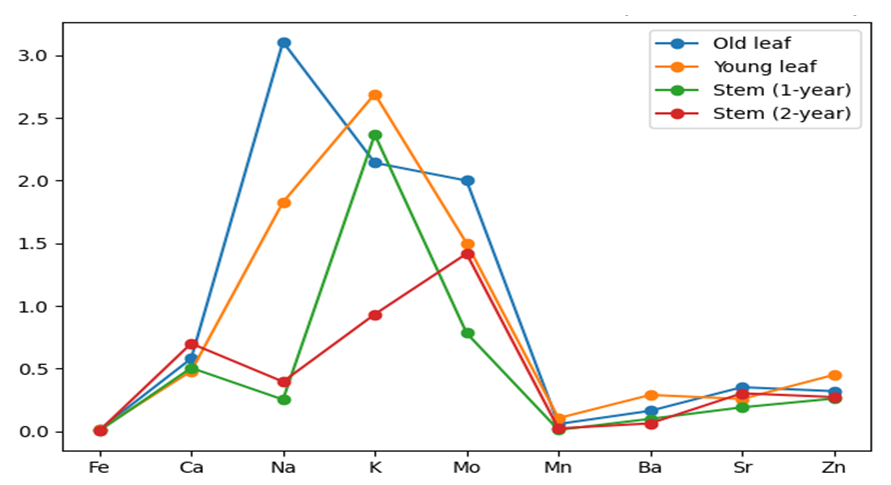 | Figure 1. Elemental distribution in different organs of Lycium barbarum L. under control conditions (no fertilizer) |
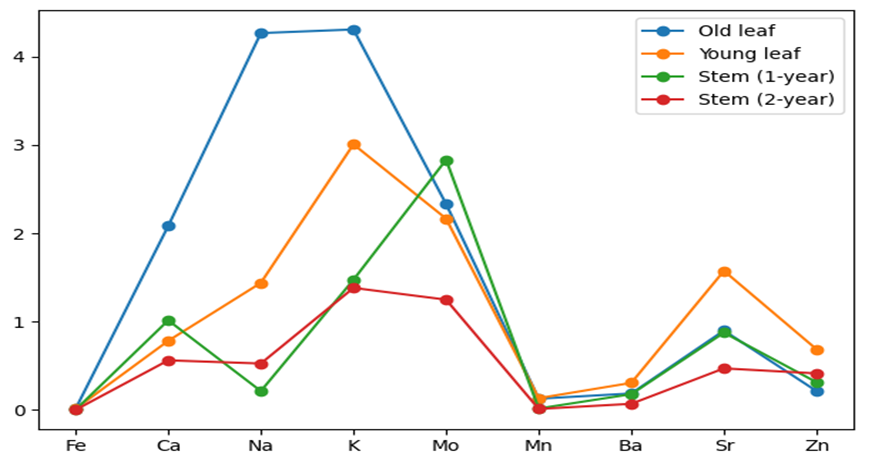 | Figure 2. Elemental distribution in different organs of Lycium barbarum L. under N30P60K40 fertilizer treatment |
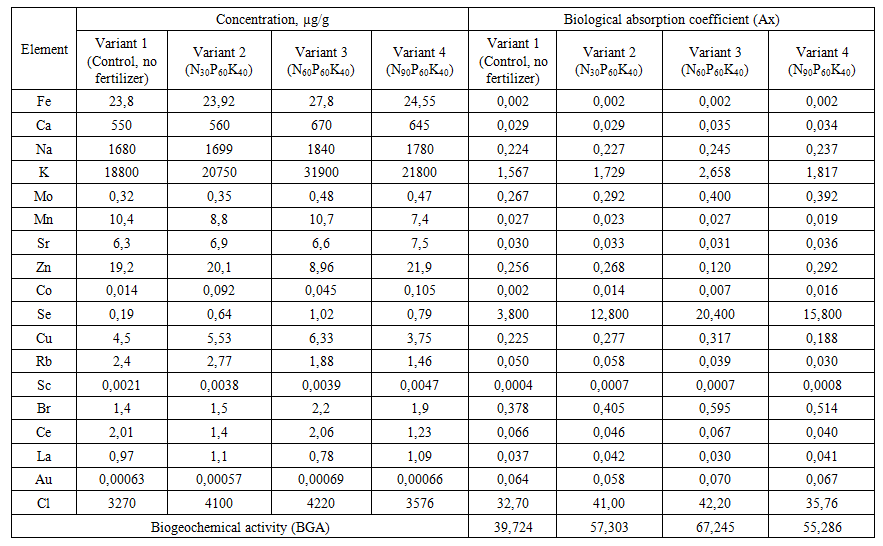 | Table 1. Changes in the biological absorption coefficient and biogeochemical activity of fruits of the medicinal goji plant (Lycium barbarum L., Ningxia Cultivar) under mineral fertilization |
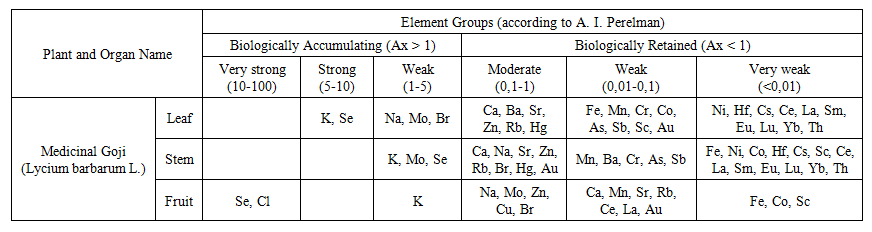 | Table 2. Biological uptake intensity of chemical elements in medicinal goji (Lycium barbarum L.) (third treatment variant) |
4. Conclusions
- The present study demonstrates that mineral fertilization significantly influences the biological uptake, accumulation patterns, and biogeochemical activity of macro- and microelements in the medicinal goji plant (Lycium barbarum L.). The obtained results confirm that the biological absorption coefficient (Ax) is a sensitive and informative indicator for assessing element mobility, selectivity, and physiological relevance within different plant organs under varying fertilization regimes.Among the tested treatments, the N60P60K40 variant proved to be the most effective in stimulating selective bioaccumulation of essential elements. This treatment enhanced the uptake of potassium (K) across all organs, reflecting its fundamental role in osmotic regulation, metabolite transport, and cellular division. Notably, selenium (Se) and chlorine (Cl) exhibited pronounced accumulation in fruits, with Se showing very strong bioaccumulation (Ax > 10), thereby substantially increasing the nutritional and medicinal value of goji fruits as a natural selenium source. Such targeted enrichment highlights the potential of controlled fertilization strategies for biofortification of medicinal plants.The organ-specific distribution of elements followed clear physiological patterns. Leaves showed selective accumulation of K and Se, while most other elements were either moderately retained or weakly absorbed, indicating strict regulatory mechanisms that prevent excessive accumulation. Stem tissues displayed comparatively stable uptake behavior, functioning primarily as transport pathways rather than accumulation sites. Fruits demonstrated the highest biogeochemical activity, particularly under optimal fertilization, emphasizing their role as final sinks for biologically significant elements.Conversely, elements such as Fe, Co, Sc, and several rare or potentially toxic metals consistently exhibited very low Ax values (Ax < 0.01), indicating effective physiological barriers against their accumulation in edible organs. This finding is of particular importance for ensuring the ecological safety and pharmacological quality of medicinal plant raw materials.Overall, the study confirms that elemental uptake in goji plant (Lycium barbarum L.) is governed by complex, non-linear interactions between soil availability, fertilization level, and plant physiological selectivity. The results underscore the importance of optimized mineral nutrition in regulating biogeochemical activity, enhancing bioactive potential, and maintaining elemental safety in medicinal plants. These findings provide a scientifically grounded basis for developing sustainable fertilization strategies aimed at improving the quality, safety, and functional value of goji berries, which is of direct relevance to biogeochemistry, plant physiology, and molecular biology-oriented research fields.
ACKNOWLEDGEMENTS
- The authors sincerely acknowledge the Department of Soil Science and the Department of Public Health at as well as Fergana State University, for providing laboratory facilities, instrumentation, and technical support essential for this research. Special thanks are extended to colleagues and research staff for their assistance in soil and plant sample collection, analytical procedures, and constructive discussions that significantly contributed to the completion of this study. The authors also appreciate the contributions of laboratory technicians and collaborators who facilitated molecular assays and data interpretation.
Conflict of Interest
- The authors declare that there is no conflict of interest regarding the publication of this paper.
Funding
- This research did not receive any specific grant from funding agencies in the public, commercial, or not-for-profit sectors. The study was conducted with institutional support from the Department of Soil Science and the Department of Public Health at Fergana State University.