
-
Paper Information
- Paper Submission
-
Journal Information
- About This Journal
- Editorial Board
- Current Issue
- Archive
- Author Guidelines
- Contact Us
International Journal of Virology and Molecular Biology
p-ISSN: 2163-2219 e-ISSN: 2163-2227
2026; 15(1): 7-10
doi:10.5923/j.ijvmb.20261501.02
Received: Nov. 23, 2025; Accepted: Dec. 20, 2025; Published: Jan. 31, 2026

The Impact of Biochemical and Hematological Blood Parameters on Aerobic Oxygen Delivery Capacity in Young Athletes
 Abstract
 Reference
 Full-Text PDF
 Full-text HTML
Rakhimov G'ulom1, Kaxorov Bolta2
1Associate Professor, Department of Pedagogy and Social Sciences, University of Economics and Pedagogy
2National University of Uzbekistan named after Mirzo Ulugbek, Tashkent, Uzbekistan
Correspondence to: Rakhimov G'ulom, Associate Professor, Department of Pedagogy and Social Sciences, University of Economics and Pedagogy.
| Email: |  |
Copyright © 2026 The Author(s). Published by Scientific & Academic Publishing.
This work is licensed under the Creative Commons Attribution International License (CC BY).
http://creativecommons.org/licenses/by/4.0/

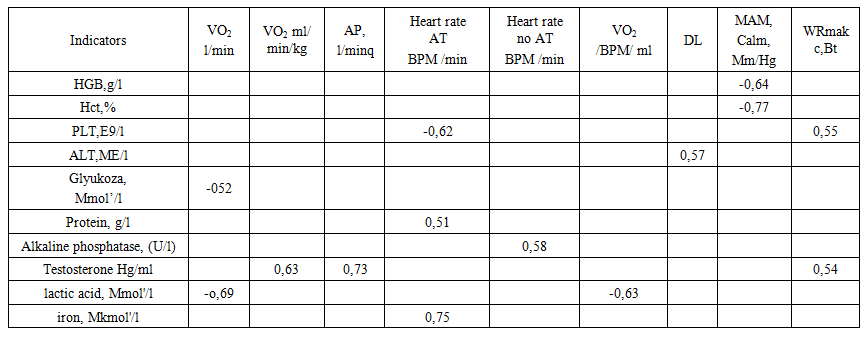
This study investigated the relationship between hematological and biochemical blood parameters and aerobic capacity in young male and female athletes. The findings revealed a significant correlation between red blood cell parameters (RBC, hemoglobin [HGB], and hematocrit [HCT]) and key indicators of aerobic capacity, including VO2max, anaerobic threshold (AP), and oxygen utilization efficiency (VO2/YYQ). Additionally, it was observed that lower levels of urea, total bilirubin, and iron in the blood were associated with a higher heart rate at the anaerobic metabolism threshold. The study underscores the importance of monitoring hematological and biochemical parameters to better understand and enhance athletic performance in young athletes, while also highlighting the need for gender-specific approaches in training and physiological assessment.
Keywords: Hematological and biochemical parameters, Aerobic capacity, Anaerobic metabolism, Blood glucose and lactate, Exercise intensity
Cite this paper: Rakhimov G'ulom, Kaxorov Bolta, The Impact of Biochemical and Hematological Blood Parameters on Aerobic Oxygen Delivery Capacity in Young Athletes, International Journal of Virology and Molecular Biology, Vol. 15 No. 1, 2026, pp. 7-10. doi: 10.5923/j.ijvmb.20261501.02.
Article Outline
1. Introduction
- Evaluating the functional state of the body and its adaptive reserves is a critical focus in sports and youth physiology. A high functional level serves as the foundation for enhancing physical performance and the body's ability to effectively adapt to the demands of training and competition [1,2,5,7]. However, physical loads that exceed the age-specific capacities of children and adolescents can lead to functional disruptions and stress-related conditions, underscoring the need for careful monitoring.Blood, as a vital physiological system, undergoes significant changes in response to sustained physical exertion. These changes are reflected in elevated hematological indicators, which gradually align with those observed in adult athletes [2,4,6]. Hematological and biochemical tests, alongside other medical and biological metrics, provide valuable insights into an athlete's adaptation to training loads. These tests also help assess metabolic processes, fatigue levels, and the body's response to physical stress, including the risks of overtraining [3,4,6,8].Given the growing emphasis on youth sports and the importance of safeguarding the health of young athletes, studying the interplay between biochemical, hematological, and physical performance indicators is crucial. This research aims to contribute to a deeper understanding of these relationships, providing a foundation for optimizing training programs and ensuring the well-being of young athletes [5,6].
2. Purpose of the Research
- The primary aim of this research was to investigate the relationship between hematological and biochemical blood parameters and aerobic capacity in young athletes, encompassing both boys and girls. Specifically, the study sought to explore how red blood cell parameters (RBC, hemoglobin [HGB], and hematocrit [HCT]) and biochemical markers (such as urea, total bilirubin, iron, glucose, and lactate) influence key metrics of aerobic capacity, including VO2max, anaerobic threshold (AP), and oxygen utilization efficiency (VO2/YYQ).The research aimed to determine whether these hematological and biochemical factors could serve as reliable indicators of aerobic performance in young athletes. Additionally, the study aimed to identify potential gender-specific differences in these relationships, particularly focusing on whether young female athletes exhibit distinct patterns in the correlation between hematological parameters and aerobic capacity compared to their male counterparts.
3. Materials and Methods
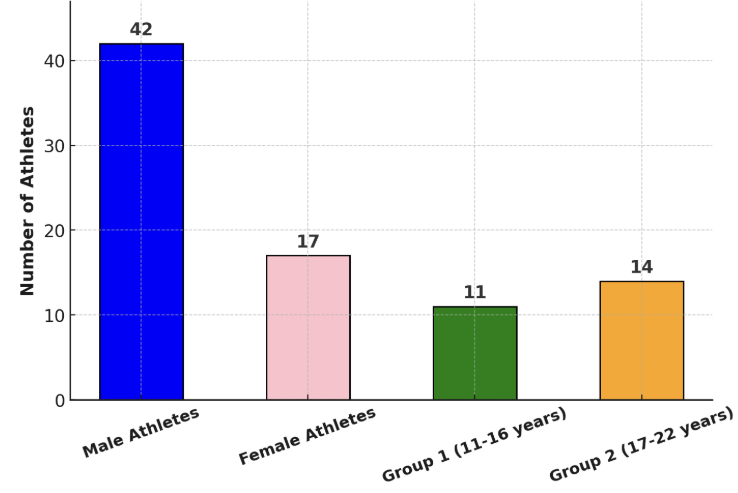
- To assess the impact of biochemical and hematological blood parameters on aerobic capacity in young athletes, taking into account gender characteristics.The study involved 42 male athletes (16.6±2.8 years) and 17 female athletes (14.07±2.01 years). They specialized in cyclic sports and their sports qualifications ranged from the second junior level to the Master of Sports of Uzbekistan. All participants had been training regularly for at least 3 years, were healthy, and had no restrictions on sports. The first group (n=11) included athletes aged 11 to 16 (cycling, rowing), and the second group (n=14) included athletes aged 17 to 22 (swimming, athletics) (Fig. 1).
 | Figure 1. Distribution of athletes by gender and age groups |
4. Results and Discussion
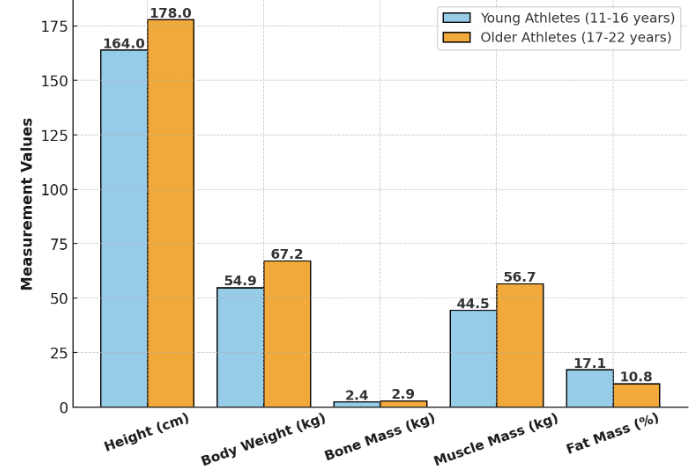
- Achievements in each sport are provided by a number of physical and physiological variables that depend on age and maturity in youth sports of boys and girls, which affect sports performance in specific sports methods. In addition, a significant increase in muscle strength is manifested in adolescence. Comparison of anatomical and morphological parameters made it possible to identify statistically significant differences in some parameters. Thus, in young athletes (11-16 years) height was lower (164 (155); 176) cm) compared to older athletes (178 (171; 182) cm) (p=0.006), body weight (54.9 (45; 59) kg 67.2 (61; 70) kg, p=0.003), bone (2.4 (1.8; 2.6) kg, 2.9 (2.8; 3.1) kg, p=0.002) and muscle mass (44.5 (32.3; 48.7)) kg, compared to 56.7 (51.8; 59.3) kg, p=0.001), butthis was higher in the percentage of fat mass (17.1 (12.3); 17.6%), 10.8 (9.3; 12.0)%, p=0.01) (Fig. 2).
 | Figure 2. Comparison of physical characteristics between young and older athletes |
 | Table 1. The correlation of biochemical and hematological parameters with aerobic capacity in young athletes |
5. Conclusions
- Using water sports as a model, this study examined the dynamics of biochemical indicators in response to various types of training loads. Significant differences in clinical laboratory test results were observed depending on the nature of the training load. Aerobic exercise induced the most pronounced changes in the concentration of several chemical substances, while strength-oriented training led to significantly higher increases in creatine phosphokinase (CPK) activity. The post-exercise differences in biochemical indicators primarily reflect the energy supply mechanisms specific to the type of load performed.This study presents findings from clinical and laboratory investigations involving highly qualified athletes in kayaking, canoeing, diving, slalom rowing, and swimming, ranging from test events to major international competitions. The adaptation of athletes to competitive demands is driven by complex biochemical reactions, which provide insights into the metabolic response to high-intensity physical exertion. Competitive activities place maximal demands on the functional systems of the body, requiring them to operate at the limits of physical capacity.
ACKNOWLEDGEMENTS
- We extend our sincere gratitude to all the young athletes who participated in this study, as well as their coaches and families, for their cooperation and support throughout the research process. Their dedication and commitment were invaluable in ensuring the successful completion of this study.We would like to thank the medical and laboratory staff who assisted in the collection and analysis of hematological and biochemical data. Their expertise and attention to detail were crucial in maintaining the accuracy and reliability of the results.Special thanks go to the institutions and organizations that provided access to facilities and resources necessary for conducting this research. Their support enabled us to carry out the study under optimal conditions.We are also deeply grateful to our colleagues and research team members for their contributions, insightful discussions, and collaborative efforts. Their hard work and dedication were instrumental in bringing this project to fruition.