
-
Paper Information
- Paper Submission
-
Journal Information
- About This Journal
- Editorial Board
- Current Issue
- Archive
- Author Guidelines
- Contact Us
International Journal of Virology and Molecular Biology
p-ISSN: 2163-2219 e-ISSN: 2163-2227
2025; 14(6): 139-145
doi:10.5923/j.ijvmb.20251406.10
Received: Oct. 8, 2025; Accepted: Nov. 11, 2025; Published: Nov. 17, 2025

Soil Nematodes of Saline Irrigated Sierozem-Meadway Soils
 Abstract
 Reference
 Full-Text PDF
 Full-text HTML
Pakhradinova Nargiza Saifutdinovna1, Gafurova Lazizakhon Akramovna2, Khurramov Alisher Shukurovich3, Jumaniyozova Dilnoza Komilovna4, Makhkamova Dilafruz Yuldashevna5, Ergasheva Olimakhon Khalikjonovna5, Abdujalilova Oygul Khamidovna6
1Doctoral Candidate, Department of Soil Science, National University of Uzbekistan named after Mirzo Ulugbek, Tashkent, Uzbekistan
2Professor, Department of Soil Science, National University of Uzbekistan named after Mirzo Ulugbek, Tashkent, Uzbekistan
3Professor, Department of Soil Science, Termez State University, Termez, Uzbekistan
4Central Phytosanitary Laboratory, Agency for Quarantine and Plant Protection of the Republic of Uzbekistan
5Associate Professor, Department of Soil Science, National University of Uzbekistan named after Mirzo Ulugbek, Tashkent, Uzbekistan
6Doctoral Candidate, Department of Soil Science, Gulistan State University, Gulistan, Uzbekistan
Copyright © 2025 The Author(s). Published by Scientific & Academic Publishing.
This work is licensed under the Creative Commons Attribution International License (CC BY).
http://creativecommons.org/licenses/by/4.0/

Using informative indicators, the current state of sierozem-meadow soils was analyzed, diagnostic indicators, key fertility elements, and salinity types and degrees were determined, and the species diversity and faunal assemblages of nematodes in the root soil of plants under salinized conditions were identified. The phytonematode fauna was determined: 33 species and 1.173 individuals of phytonematodes belonging to 2 subclasses, 7 genera, 16 families, and 21 genera were identified in irrigated sierozem-meadow soils. It was shown that the composition of their species and ecotrophic groups depends on soil diversity, their agrochemical composition, humus and nutrient content, mechanical composition, and the degree of salinity. In slightly and moderately saline soils, nematodes were widely distributed in the 10-20 and 0-10 cm layers. In highly saline soils, nematode abundance was lower, with the highest numbers observed in the 10-20 and 20-30 cm layers. This article examines the diversity, ecological groups, and abundance of nematodes common in the root system and root zone of agricultural crops (wheat, mung bean and alfalfa) in specific soil types. It was found that the highest nematode abundance was observed in the root system and root zone of mung bean on light loamy soils, fewer species were observed in wheat than in mung bean on medium loamy soils, and the fewest species were found in alfalfa on heavy soils. This is explained by the use of agrotechnical measures in the cultivation of agricultural crops, the long period of cultivation of the same crops, soil characteristics and other reasons.
Keywords: Sierozem-meadow soils, Salinization, Soil nematodes, Ecological-trophic groups
Cite this paper: Pakhradinova Nargiza Saifutdinovna, Gafurova Lazizakhon Akramovna, Khurramov Alisher Shukurovich, Jumaniyozova Dilnoza Komilovna, Makhkamova Dilafruz Yuldashevna, Ergasheva Olimakhon Khalikjonovna, Abdujalilova Oygul Khamidovna, Soil Nematodes of Saline Irrigated Sierozem-Meadway Soils, International Journal of Virology and Molecular Biology, Vol. 14 No. 6, 2025, pp. 139-145. doi: 10.5923/j.ijvmb.20251406.10.
Article Outline
1. Introduction
- It is known that the soil fauna is the most important part of the soil biota, it is numerous and diverse. Including nematodes, which make up its largest part - about 90% of the pedofauna of the biogeocenosis, and their biomass is up to 22 g / m2, the species diversity can reach up to 140 species [1; 159 p.]. Nematodes, with the participation of microflora, participate in the processes of soil humification, in the decomposition and transformation of organic matter [2; 446 p., 3; 173-179 p., 4; 211 p., 5; 281-283 p., 6; 16-32 p.]. They regulate the number of bacteria and fungi, suppressing or stimulating their development [7; 93-98 pp., 8; 41-57 pp., 9; 75-87 pp.]. Soil nematodes participate in soil gas exchange [10; 131 p.]. Phytoparasitic nematodes play a major role in the development and condition of plants and the creation of their biomass [11; 160 p., 12; 227 p., 13; 376 p., 14; 109-115 p., 15; 66 p., 16; 65 p.].Despite the abundance of soil nematodes and their significant role in soil formation, evolution, and transformation, the characteristics of their ecotrophic groups in arid conditions, particularly under salinized conditions, remain poorly understood. Therefore, the aim of this study was to investigate the distribution and population dynamics of soil nematodes in the widespread saline sierozem-meadow soils of the Golodnaya Steppe.
2. Object and Methods of Research
- The studies were carried out in 2020-2024 in the apron zone of the Khavast inclined plain. There are very few works in the literature containing a detailed and comprehensive description of the soil cover of the Khavast inclined plain. Some information is available in the works [17; 77-159 p., 18; 336 p., 19; 116-129 p., 20; 34-56 p., 21; 69-95 p., 22; 87 p., 23; 59-62 p.]. This area is very unique in its natural and meliorative features and the boundaries run along the inter-cone Obruchev depression in the west, along the mouth of the Fergana Valley in the east, along the slope of the Turkestan ridge in the south, and along the Jizzakh depression in the north. The upper part of the sloping plain is located in Tajikistan, while the Khavast Plain's arid zone is located within Uzbekistan, within the Golodnaya Steppe and the New Irrigation Zone of the Golodnaya Steppe [24; 264 p.]. The object of our study is the territory located primarily in the Golodnaya Steppe within the Khavast fog.The climate of the Khavast district is characterized by increased aridity compared to other areas of the piedmont plain. Annual precipitation is 312 mm, evaporation is 1691 mm, and the moisture deficit is 1379 mm. The average air temperature is 15.6°C.The increased aridity of the climate is associated not only with low precipitation but also with higher temperatures. Analysis of long-term hydrometeorological data (from 1938 to 2024) indicates changing climatic conditions and increasing aridity in the region. Over 86 years, an increase in the average annual temperature of 2.5°C has been recorded, with a particularly pronounced upward trend in average monthly temperature observed in the last 10-15 years. The area of the Khavast sloping plain apron is characterized by a deluvial-proluvial genesis associated with the removal of material from the eastern part of the foothills of the Turkestan Range by temporary streams and is formed by deposits of merged alluvial fans of these streams and deluvial aprons of the foothills, which are leveled out within the apron zone itself [18; 116-129 p., 23; 264 p.]. Gradually, to the north, the surface of the Khavast plain apron flattens out, and at the northern boundary, the Dzhetysay depression cuts off the apron of the Khavast deluvial-proluvial plain. Groundwater mineralization varies from 3-5 to 50-100 g/l and is found primarily at depths of 2-3 to 3-5 m. The mineralization type is sulfate-magnesium-sodium or sulfate-sodium, less commonly sulfate-chloride or chloride-sulfate. Due to the shallow occurrence of groundwater in the apron zone of the Khavast Plain, the region primarily develops semi-hydromorphic, semi-automorphic, and hydromorphic soils of varying textures and salinity levels, creating complex conditions in terms of soil meliorative properties and susceptibility to degradation processes.Ten key sites in the Yangiyer massif of the Khavast fog with sierozem-meadow soils of varying salinity levels were selected for the study.Soil samples were collected from the soil profiles of the key sites to characterize the morphological, agrochemical, and agrophysical properties of the genetic horizons. To study soil nematodes, samples were collected at depths of 0-10, 10-20, 20-30 cm in triplicate; samples were collected in spring, summer, and winter. In the field, undisturbed soil samples were collected with a Kachinsky auger to determine soil density. In laboratory conditions, the following were determined in the soil samples: humus content using the Tyurin method [25; 273 p.], mobile forms of NPK – nitrate nitrogen using the disulfophenol method, phosphorus using the Machigin method, and exchangeable potassium using the flame photometric method [26; 656 p., 27; 488 p.]. Soil moisture was determined using the thermogravimetric method [26; 656 p.]. The ion-salt composition of saline soils was determined using the standard water extract method [27; 488 p.]. When establishing the chemistry and degree of soil salinity, the classifications of N.I. Bazilevich and E.N. Pankova, as well as V.A. Kovda and V.V. Egorov were used [27; 488 p., 28; 47-51 p.].In key areas, the horizontal distribution of nematodes in sierozem-meadow soils was determined using the methods [29; 24-25 p., 30; 20-24 p.]. The average soil sample in the 0-30 cm layer was obtained by mixing the samples. Soil nematodes were isolated using the Berman method, followed by fixation of the nematodes in 5% formalin at a temperature of 60°C. The nematodes were counted, gradually transferred to glycerol and into preparations using the standard method [31; 320 p.]. The isolated nematode species were divided according to trophic preference [32; 123-132 p., 33; 315-331 p.]. In total, the following trophic groups of nematodes are distinguished: bacteriotrophs, mycotrophs, polytrophs and their predators, phytotrophs. According to the ecological structure, the following are distinguished: pararhizobionts, eusaprobes, deisaprobes, non-specialized phytonematodes, specialized phytonematodes [2; 446 p.].
3. Results and Discussions
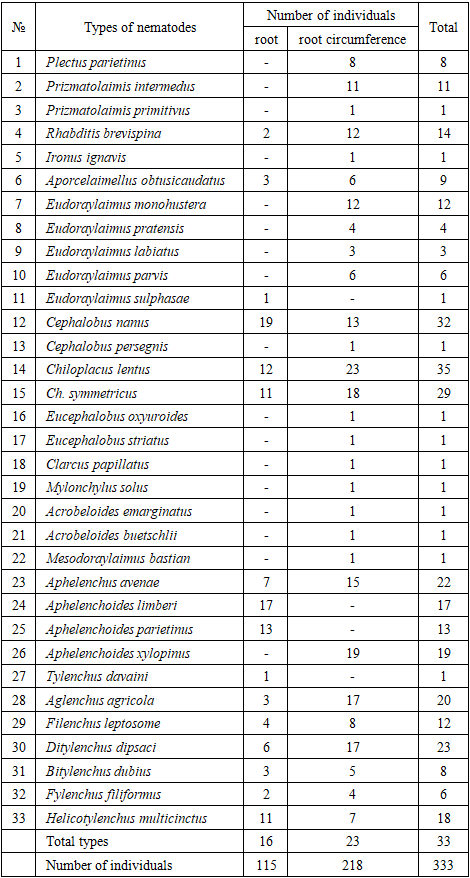
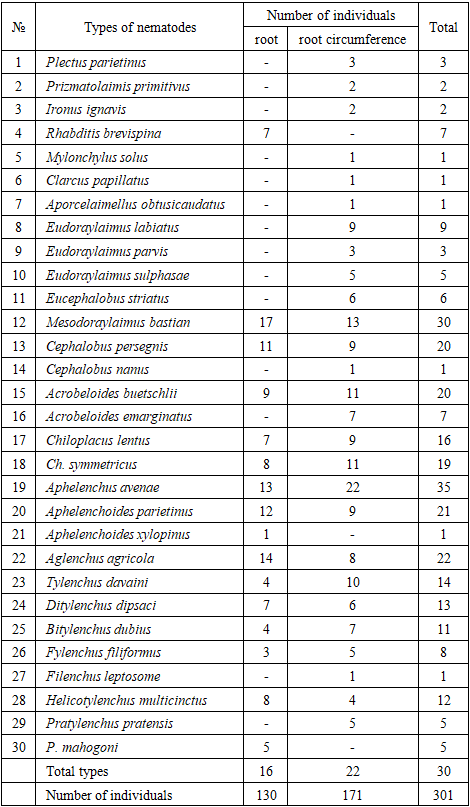
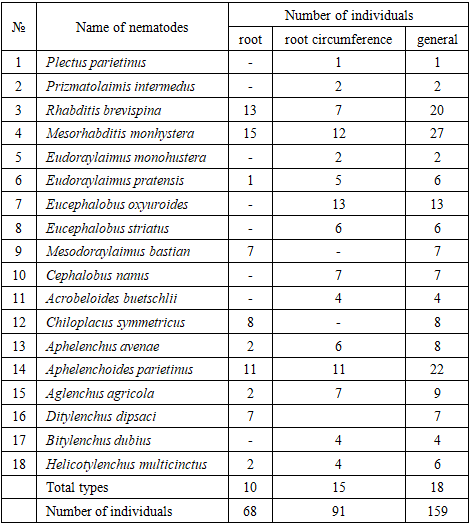
- Soils of key areas. Serozem-meadow soils are semi-hydromorphic soils, and their morphological description is similar to meadow-serozem soils. However, unlike meadow-serozem soils, their profile morphology is more pronounced, with regenerative processes occurring from a depth of 1.00-1.50 m and intense solonchak processes.The grain size distribution of the studied soils varies across the profile and is primarily composed of light and medium loams, with occasional heavy loams and sandy loams. Total physical clay (<0.01 mm) ranges from 30 to 45%, with soils containing 10-20% and, rarely, 45-60% physical clay.Humus content in the studied soil profiles is characterized by an increase in the upper horizons (0.7 to 1.2%) and varies depending on the degree of soil salinity. The values gradually decrease toward the lower horizons of the profile (to 0.2-0.3%). Overall, the soils are classified as low- and, in places, moderate-rich in humus content. The distribution of total nitrogen across the profile follows the same pattern as humus. The highest value was found in the surface layers, reaching 0.12-0.20%, decreasing towards the lower layers to 0.05-0.08%.Mobile forms of phosphorus, due to soil formation conditions – carbonate content, locally high values of physical clay, slightly alkaline environment, low biological activity, etc. – were determined in small values (9.0-18 mg/kg of soil), and in terms of availability, they are mainly classified as low-availability. Low values of availability of saline sierozem-meadow soils with mobile phosphorus may also be due to the presence of magnesium sulfate in solutions, which contributes to the transition of soluble forms of phosphates to poorly soluble ones due to their precipitation as magnesium phosphates.In sierozem-meadow soils, the total potassium content varies depending on the texture, humus content, and profile structure, and ranges from 1.12-2.00%. Exchangeable soils are classified as having medium and low potassium content, with values ranging from 110-144.0 to 192.0-279.3 mg/kg of soil.In terms of general physical properties, the studied soils are characterized by some compaction: in the upper horizons, the soil density is 1.28-1.35 g/cm³, increasing toward the illuvial horizon and parent material to 1.46-1.55 g/cm³. Accordingly, soil porosity also varies from 38 to 50%. All soils are characterized by an increase in moisture content from the upper to the lower horizons, which is related to the texture, profile structure, density, humus content, salt composition, and groundwater depth. Soil salinity levels are generally classified as slightly and moderately saline, with some highly saline soils also identified. The total salt content averages 0.66-1.25%, reaching 2.10-2.70% in some places. Salinity types include sulfate, chloride-sulfate, and, in some places, sulfate-chloride. The soils contain 6.3-11.5% CO2 carbonates. Gypsum SO4 can be found in relatively high quantities in the soils-from 7.2 to 18.0%, and in some places up to 45.1%-which are observed in the middle soil horizons. Thus, the conditions of soil formation, in particular climatic conditions and the proximity of mineralized groundwater determine the salinity of sierozem-meadow soils, which serves as the basis for including them in the group of degraded soils that require regular monitoring, taking into account their agrochemical, agrophysical, chemical and biological indicators (as the most sensitive indicators of degradation), which is necessary to restore and increase their fertility, and carry out complex agro-reclamation and agrotechnical measures.Ecological analysis of identified nematodesThe study of the fauna of soil nematodes is of great importance in many respects. Faunal studies not only provide material for the study of ecological, physiological, and biochemical characteristics, but also contribute to the establishment of phylogenetic relationships between individual taxonomic and ecological groups of nematodes. Analysis of the nematode fauna is essential for predicting the harmfulness of plant-parasitic species, developing methods for controlling parasitic species, and also as a bioindicator of environmental health.Nematodes are plant-feeding animals distinguished by the diversity and abundance of their species among soil-dwelling organisms. All nematode species are associated with plants to some extent, but their relationships with plants vary. Therefore, when studying the fauna, it is necessary to determine the relationship of individual nematode groups to their host plants. Identifying changes in the properties and fauna of soil nematodes under the influence of salinization processes, taking into account the unique soil and climatic conditions of the region, revealed that nematode species identified in the region's agricultural crops (mungbean, wheat, alfalfa) were divided into two subclasses: Adenophorea and Secernenta.As a result of the research, 40 nematode species belonging to 2 subclasses, 7 orders, 20 families, and 25 genera were identified in agricultural crops. According to the ordinal analysis, the Rhabditida family, consisting of 12 species, accounted for 30% of all identified nematode species. The Tylenchida family included 10 species (10%), the Dorylaimida family 7 species (17.5%), and the Mononchida family 5 species (12.5%). The remaining families were rare: Aphelenchida – 4 species (10%), Plectida – 1 species (2.5%) and Enoplida – 1 species (2.5%). The most numerous nematode family was Rhabditida (513 specimens, 38.7%), followed by Tylenchida (325 specimens, 24.5%), Aphelenchida (260 specimens, 19.6%) and Dorylaimida (160 specimens, 12.1%). The numbers of representatives of the orders Mononchida (51 specimens, 3.9%), Plectida (12 specimens, 1%) and Enoplida (2 specimens, 0.2%) were somewhat lower, and in some cases they were found as single specimens. To demonstrate the differences between nematode communities in the soils of the region, the species were combined into ecotrophic groups. Phytonematodes found in the soil of roots and the root zone of agricultural crops were distributed among ecological groups as follows: pararhizobionts – 13 species 221 (17% of all detected nematodes), devisaprobionts – 11 species 420 (31%), eusaprobes – 2 species 109 (8%), specialized phytohelminths – 6 species 184 (14%), non-specialized phytohelminths – 403 (30%) of 8 species (Fig. 1).
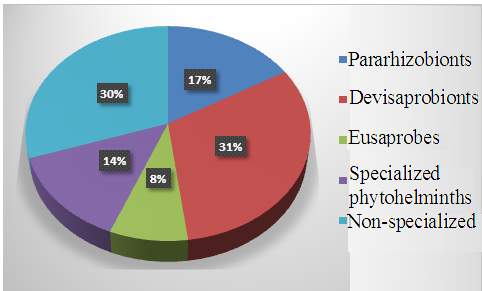 | Figure 1. Distribution of nematodes detected by ecological groups |
|
|
|
4. Conclusions
- A comparative study of the nematode fauna of agricultural crops revealed that 11 nematode species make up the majority of the fauna. Among the nematodes, Cephalobus persegnis, Chiloplacus symmetricus, Aphelenchus avenae, and Aphelenhoides helophilus were widespread across all studied crops. Rare nematode species, found only in small numbers on individual plants, were identified: Acrobeloides tricornu, Acrobeles ciliatus, Pratylenchus mahogoni, and Paratylenchus amblycephalus.It was noted that different soils also differ significantly in the composition of their nematode communities based on their mechanical composition: Acrobeloides tricornu and Acrobeles ciliatus are typical of light loamy soils; For medium loamy soils, the following species are present: Prismatolaimis primitivus, Ironus ignavis, Mylonchylis solus, Eudoraylaimus sulphasae, Eudoraylaimus parvis, Cephalobus persegnis, Aphelenchoides xylopinus, Filenchus leptosoma, Pratylenchus mahogoni, and Paratylenchus amblycephalus.Thus, the species composition and ecotrophic groups of nematodes in sierozem-meadow soils depend on their degree of salinity, humus status, mechanical composition, and agrochemical and agrophysical properties. A study of the nematode fauna of various agricultural crops in the Khavast district revealed that the highest nematode abundance was observed in the root and root systems of mung bean on light loam soils, the lowest number of species was observed on wheat on medium loam soils, and the lowest number of species was observed on alfalfa on heavy loam soils. This is explained by the use of agricultural practices during crop cultivation, long-term cultivation of the same crops, soil characteristics, and other factors.