
-
Paper Information
- Next Paper
- Previous Paper
- Paper Submission
-
Journal Information
- About This Journal
- Editorial Board
- Current Issue
- Archive
- Author Guidelines
- Contact Us
International Journal of Traffic and Transportation Engineering
p-ISSN: 2325-0062 e-ISSN: 2325-0070
2013; 2(3): 42-50
doi:10.5923/j.ijtte.20130203.04
Analysis of Vehicle Crash Fatality Due to Pavement Edge Drop-off
 Abstract
 Reference
 Full-Text PDF
 Full-text HTML
Tamara Chowdhury, Eric Brandon
Department of Engineering, Construction Management and Industrial Technology, Alabama A&M University, AL 35762, USA
Correspondence to: Tamara Chowdhury, Department of Engineering, Construction Management and Industrial Technology, Alabama A&M University, AL 35762, USA.
| Email: |  |
Copyright © 2012 Scientific & Academic Publishing. All Rights Reserved.
Unsafe roadway edge drop-offs cause vehicle crashes. Many run-off-road collisions are the result of pavement edge drop-offs which causes 4,000 fatalities and costs $40 Billion annually in USA. The true extent of the problem is difficult to assess because the role of the hazardous pavement edge drop-off leading to a crash often is not documented. In addition, tort liability claims resulting from pavement edge drop-offs cost highway agencies millions each year. Pavement edge drop-offs are potential safety hazards as they can reduce vehicle stability and impede a driver’s ability to handle a vehicle. Drop-offs can occur between a paved travel way and an unpaved shoulder, between two paved travel lanes, or between a paved shoulder and an adjacent surface. Pavement edge drop-off on highways has been linked to many serious crashes especially in rural roadways. Number of all rural crashes, rural fatalities, edge drop-off crashes and fatalities for the state of Alabama has been analyzed and quantified in this paper. Fatality due to pavement edge drop-off is significantly high and safety measures should be taken to prevent these fatal crashes.
Keywords: Unsafe Roadway, Rural Road Edge Drop-off, Crash Fatality, Pavement Safety Edge
Cite this paper: Tamara Chowdhury, Eric Brandon, Analysis of Vehicle Crash Fatality Due to Pavement Edge Drop-off, International Journal of Traffic and Transportation Engineering, Vol. 2 No. 3, 2013, pp. 42-50. doi: 10.5923/j.ijtte.20130203.04.
Article Outline
1. Introduction
- Drop-offs occur when there are height differences between a paved road and the adjacent graded material. Conventional paving techniques result in vertical or nearly vertical pavement edges, which can cause safety concerns when they are exposed due to erosion of the adjacent shoulder material. Unsafe edge drop-offs cause crashes. An estimated 11,000 Americans suffer injuries and 160 die each year in crashes related to unsafe pavement edges, at a cost of $1.2 billion only in the state of California[1]. The true extent of the problem is difficult to assess because the role of the hazardous pavement edge in the sequence of events leading to a crash often is not documented. In addition, tort liability claims resulting from pavement edge drop-offs cost highway agencies millions of dollars each year. In one case, the court awarded $6 million for injuries caused by a low, defective shoulder drop-off[1].When a vehicle strays from the travel lane onto the shoulder or roadside, the normal reaction of a driver is to return to the safe haven of the travel lane. The driver's urgency to make this return is usually heightened by the sudden drop when the shoulder or roadside elevation is significantly lower than the travel lane. Pavement edge drops can cause drivers to have unexpected collisions, particularly when they are surprised at night by the sudden drop of a wheel. Most commonly, the vehicle will be affected in one of three ways: (i) move abruptly across the travel lanes and either collides with opposing vehicles or roadside hazards off the far edge of the roadway, (ii) overturn on the roadway or roadside, or (iii) collide with roadside hazards beyond the edge drop. Many researches[2-4] has shown that the ability of a driver to recover from a pavement edge-drop excursion is a function of edge-drop height and shape, vehicle speed and path angle, and the width of lane available for recovery. Moreover, certain vehicles such as motorcycles, sub-compact automobiles, and tractor-trailer trucks have a much greater sensitivity to edge drops than do the full-size automobiles that have normally been tested.Pavement edge drop-off crashes are more severe and fatal in rural two-lane roadways compared to urban highways. In 2010, rural areas accounted for 54 percent of the fatal crashes and 55 percent of the fatalities as compared to urban areas[5]. As a result many researchers[2-4],[6-11] investigated causes of rural roadway crashes.Without sufficient information about the frequency of edge drop-off-related crashes, agencies are not fully able to measure the economic benefits of investment decisions, evaluate the effectiveness of different treatments to mitigate edge drop-off, or focus maintenance resources. To address these issues, this paper details research to quantify the contribution of pavement edge drop-off to crash frequency and fatality in the state of Alabama. Although there is some National guidance and recommendations for addressing pavement edge drop-off for highway design, construction, and maintenance, no national standards exist that indicate the level at which pavement edge drop-off should be addressed. Numerous studies list a threshold drop-off height where some action should be taken; however, none of the national guidance discusses edge drop-off shape nor agrees on a specific level of drop-off that constitutes a potential hazard. The United States Department of Transportation (DOT) suggests that a drop-off with a vertical differential of 3 inch or more is considered unsafe[12]. The American Association of State Highway and Transportation Officials (AASHTO) suggest that no vertical differential greater than 2 inch should occur between lanes[13]. The Federal Highway Administration (FHWA) has instituted its Safety Edge program to address edge drop-off[14]. The program encourages agencies to use a 30 – 35° asphalt fillet along each side of the roadway in all resurfacing projects.
2. Safety Edge and Pavement Edge Drop-off
2.1. Definition of Pavement Edge Drop-off
- A pavement edge drop off is created by a difference in elevation between two surfaces of the roadway. An edge drop-off is road geometry defect where the vertical distance from the edge of seal to the adjacent shoulder exceeds acceptable limits. Edge drop-offs generally occur when the road shoulder is worn, or there is inadequate strength of the pavement at the edge of the roadway, as shown in Figure 1. A significant edge drop-off can make the transition between the road and its shoulder challenging particularly for smaller vehicles, and this may result in a loss of control for the vehicle[15]. Conventional paving techniques result in vertical or nearly vertical pavement edges, which can cause safety concerns when the adjacent shoulder materials are eroded. Pavement edge drop-off on highways has been linked to many serious crashes, including fatal collisions[5].
 | Figure 1. Pavement Edge Drop-Off of Rural Road-Ways |
2.2. Definition of Safety Edge
- The Safety Edge is a simple but highly effective solution to reduce crashes on rural two-lane highways. Shaping the edge of the pavement to 30 degrees minimizes the problem of vertical drop-off, as shown in Figure 2. This angle provides a safer roadway edge that allows drivers to re-enter the paved road safely. Compared with the conventional hot-mix asphalt paving process, the Safety Edge improves pavement density, makes the edge durable, and increases driver safety. The shoe that makes the Safety Edge can be installed on new or existing asphalt resurfacing equipment. The attachment acts as a screed extension and extrudes the asphalt, forming a compacted pavement edge in the desired 30-degree shape[14],[16]. Using the Safety Edge adds very little to the construction costs.
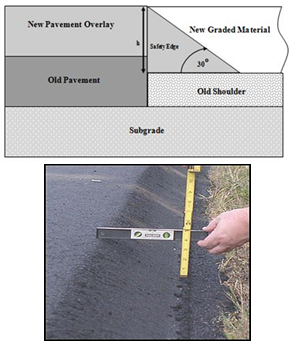 | Figure 2. Schematic diagram & implemented Pavement Safety Edge |
2.3. Crashes Due to Unsafe Pavement Edges
- A vehicle may leave its travel lane for a number of reasons, such as driver error or distraction, poor surface condition, or avoidance of a collision with another vehicle in the travel lane. When a vehicle leaves the travel lane, pavement edge drop-off may cause a potential safety problem. Drivers who slip off a resurfaced road onto an unimproved shoulder are likely to lose control as they attempt to climb onto the roadway. When the right wheel or wheels drop off the edge of the roadway, the driver may be surprised by the abrupt change in elevation and attempt to return to the travel lane immediately[15],[17]. The pavement edge creates a scrubbing condition that must be overcome through over-steering. Scrubbing is a condition in which the tire sidewall is forced into the pavement edge, resulting in friction between the tire and pavement. Some drivers compensate for scrubbing by increasing the steering angle. As drivers over steer to re-enter the roadway, they are prone to lose control of the vehicle. Compounding the danger, the rear wheel may catch the edge of the shoulder, swinging the car around. When the right front tire finally remounts the pavement, a sudden loss in friction between the tire and the surface of the pavement edge occurs. The vehicle then turns to the left and the driver may enter the adjacent or opposite lane where it may collide or sideswipe oncoming cars, overturn, or run off the road and crash[18]. It should be noted that on a divided roadway a vehicle may leave the travel lane to the left as well. As a result, drop- offs of three or more inches are considered unsafe if the roadway edge is at a 90-degree angle to the shoulder surface.In addition to the typical pavement edge drop-off-related crash, which causes running off the road to the right, over-correction, and then crossing the centerline, Glennon and Hill[19] suggested that several other outcomes are also possible when a driver leaves the roadway and encounters drop-off. Possible outcomes and different causes of drop-off between a paved roadway and an unpaved shoulder are shown in Figure 3.
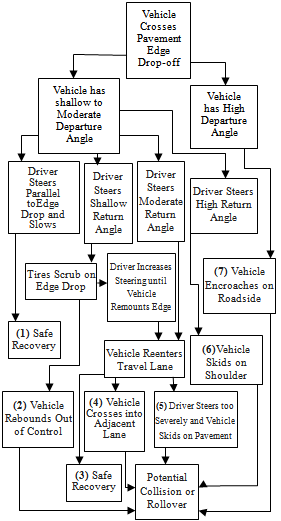 | Figure 3. Possible Outcomes when a vehicle encounters pavement edge drop-off |
3. Consequences of Pavement Edge Drop-off
- Pavement edge drop-offs may occur during highway work such as resurfacing or shoulder work as shown in Figure 4. When not properly addressed, drop-offs may lead to an errant vehicle losing control with a high potential for a serious accident. Desirably, no vertical differential should occur between adjacent lanes or at the edge of pavement. However, when a vertical differential does occur, mitigating measures should be taken. The extent of the measures depends upon:• amount of vertical differential• longitudinal length of differential• location of differential (centerline, lane line and/or edge of pavement)• duration• traffic volume and speed• geometrics• relative location of on-coming traffic.Difference in height between paved road surface and shoulder or adjacent surface can be caused by:• Inadequate maintenance• Erosion• Broken pavement• Resurfacing road but not shoulder.If a vehicle leaves the road, edge drop-off makes it difficult to drive back on, increases crash risk. Crashes related to pavement edge drop-off are a major source of tort liability claims filed against highway agencies. Therefore research-based guidance is needed to prevent drop-off and crashes. Crashes related to drop off are more severe than other crashes on similar roads, more than twice as likely to be fatal. Density of crashes on segments increases with drop-off prevalence.
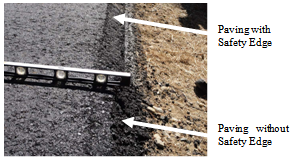 | Figure 4. Pavement with and without Safety Edge |
3.1. Comparison of Rural and Urban Motor Vehicle Crashes
- Rural roadways are more susceptible to pavement edge drop-off crashes compared to urban highways. In addition, fatalities in rural crashes are higher than those of urban crashes. The rural and urban fatality in USA due to motor vehicle crashes during the years 2001 to 2010 are shown in Table 1 and Figure 5 for comparison[5]. In 2001 there were 25,150 rural fatalities out of 42,138 total fatalities in USA, which is about 60%. In 2010 there were 18,026 rural fatalities out of 32,572 total fatalities, which is about 55%. The overall rural motor vehicle crash fatalities are found to be approximately 55-60% of the total fatalities. From previous studies[20] it has been found that, edge drop-off fatalities are the major contributor of rural fatalities.
|

 | Figure 5. Motor Vehicle Traffic Fatalities for USA during the Year 2001-2010 |
4. Scope of Work
- Numerous studies have been performed to evaluate test drivers’ ability to return to and recover within their own travel lane after leaving the roadway and encountering drop-off under various conditions, including speed, vehicle type, drop-off height and shape, and scrubbing versus non-scrubbing conditions. Actual impact of pavement edge drop-off and series of events occurring as drivers encounter drop-off under regular driving conditions is not well understood, and little information is available that quantifies the number or severity of crashes in which pavement edge drop-off may have been a contributing factor. Without sufficient information about the actual frequency of edge drop-off related crashes, agencies are not able to measure fully the economic benefits of investment decisions, evaluate the effectiveness of different treatments to mitigate edge drop-off, or focus maintenance resources. With limited budgets and numerous competing demands for maintenance resources, agencies may have limited interest in addressing problems where only speculative evidence exists. The percentage of rural motor vehicle crashes has been found to be significantly large compared to urban highway crashes. Moreover, the fatalities of rural crashes are higher than those of urban crashes. Consequently, the rural crash fatality is found to be about 50% more compared to urban fatality. The present study attempts to analyse the extent to which pavement edge drop-off contributes to crash frequency and severity for the state of Alabama. This paper is generally focused on analysing the vehicle fatality due to pavement edge drop-off on rural two-lane paved roadways, which make up a significant portion of a state’s roadway inventory. Pavement edge drop-off can be particularly problematic on two-lane paved rural roadways, since they are often high-speed facilities (55 mph or more), have varying levels of maintenance, and are likely to be characterized by adverse roadway conditions such as narrow lanes or no shoulders. It is planned to analyse the total fatality data for the State of Alabama published in Traffic Safety Fact for Alabama 2006-2010 by the National Highway Traffic Safety Administration[21], and estimate the edge drop-off crashes, edge drop-off related fatality, and other impacts.
5. Results and Discussion
- The intent of this paper is to analyze the vehicle crash fatality due to pavement edge drop-off in the rural roads of Alabama. Rural crash fatalities are found to be 55-60% of total crash fatalities in the nation. Edge drop-off related crashes are more prone to rural two-lane paved roadway with unpaved shoulder. Previous studies at the State of Iowa have shown that edge drop-off related fatalities are about four times larger than all other fatalities. Generating data for edge drop-off related crashes are not straight forward. In this paper, the results obtained from North Carolina, Illinois, Iowa and Missouri road study[22], have been used to analyze the data for Alabama.Since determining the exact number of edge drop-off-related crashes that occur is difficult, the methodology adopted by Patel and Council[22] has been used to estimate the edge drop-off-related crashes and fatality for Alabama. They identified the following five categories of crash types that may indicate pavement edge drop-off contributed to the crash. • Category A: Run-off-road right, cross centerline/median, hit vehicle in opposite direction (head-on or sideswipe).• Category B: Run-off-road right, sideswipe vehicle in the same direction.• Category C: Run-off-road right, rollover. No control on where the rollover occurs. It could be in-road or out-of-road.• Category D: Run-off-road right, then run-off-road left.• Category E: Single vehicle run-off-road right.The five categories are mutually exclusive. Since the roll over or roadway departure crashes are not clearly specified, rural roadway crashes and fatality for Alabama has been calculated based on the previous study results obtained for North Carolina, Illinois, Iowa and Missouri[22].In Table 2 the percentage of fatality due to all rural crashes for the state of North Carolina, Illinois, Iowa and Missouri as reported by Hallmark et al[22] have been shown. The average of these four state’s data has been used to estimate the rural fatality for the state of Alabama. Similarly average percentage of probable and possible crashes for Category A-E and average percentage of edge drop-off fatality for the above mentioned states has also been used to estimate the roadway edge drop-off crashes and fatality for the state of Alabama.
|

|

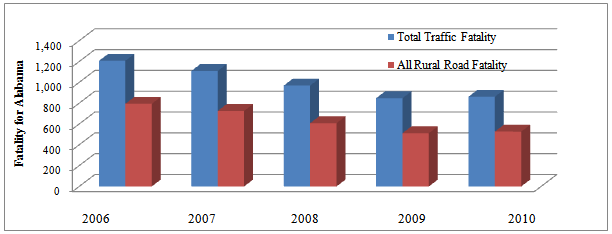 | Figure 6. Bar Chart Comparing Total Fatality and All Rural Road Fatality for Alabama from 2006-2010 |
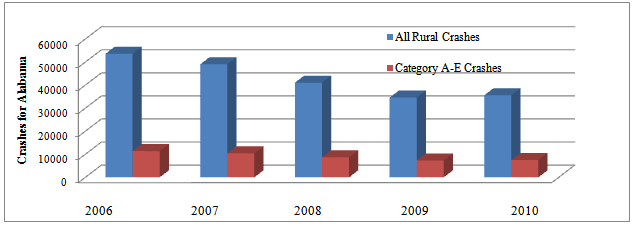 | Figure 7. Bar Chart Comparing All Rural Road Crashes and Category A-E Crashes for Alabama from 2006-2010 |
 | Figure 8. Bar Chart Comparing Total Edge Drop-Off Crashes and Fatalities for Alabama from 2006-2010 |
|
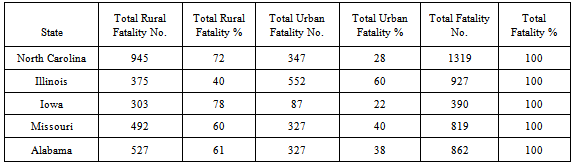
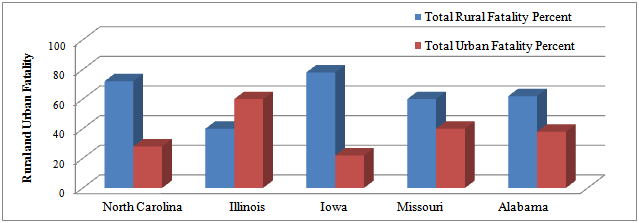 | Figure 9. Bar Chart Comparing 2010 Total Rural Fatality and Total Urban Fatality Percent for five States |
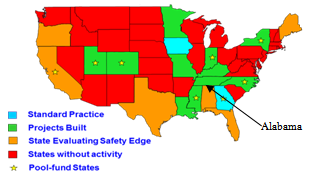 | Figure 10. Safety Edge Implementation by States in USA |
6. Conclusions and Recommendations
- This paper analyzes frequency and severity of vehicle crash fatality due to pavement edge drop-off. In this analysis rural two-lane paved roadways are considered for various run-off-road crashes. These roadways are more vulnerable to edge drop-off, often are high-speed facilities (55+ mph), have varying levels of maintenance, and are likely to be characterized by adverse roadway conditions, such as narrow lanes or no shoulders. The paper is focused to study the crash and fatality data for the State of Alabama for various years. It has been found that the edge drop-off crashes are about 20% of run-off-road crashes, category A-E crashes. The fatality due to edge drop-off crashes is about three times the fatality of all rural crashes. It may be mentioned that rural crash fatalities are about 60% of all (rural and urban) crash fatalities. Edge drop-off crashes usually results in vehicle rollover, causes fatality or severe injury with total loss of vehicle. The cost of safety edge to prevent edge drop-off crashes is insignificant compared to the total road construction cost, repair and maintenance. Priority should be given to inspect the rural roadways in the state of Alabama and implement pavement safety edge to minimize the loss of life and property.