Friedhelm Manfred Jöge
Georg Simon Ohm University of Applied Sciences, Nuernberg Germany
Correspondence to: Friedhelm Manfred Jöge, Georg Simon Ohm University of Applied Sciences, Nuernberg Germany.
| Email: |  |
Copyright © 2025 The Author(s). Published by Scientific & Academic Publishing.
This work is licensed under the Creative Commons Attribution International License (CC BY).
http://creativecommons.org/licenses/by/4.0/

Abstract
The rudiments of a dark energy theory are provides that appears to have been developed in two complementary ways. On the one hand, this theory is based on physics and mathematics and, on the other hand, it is developed on the basis of available data. This correspondends to the discovery of the laws of planetary motion in elliptical planetary orbits by JOHANNES KEPLER in the past. He developed his laws from a large dataset. Later it was theoretically substantiated more thoroughly by ISAAK NEWTON. The focus is on deriving a formula for the equivalence of energy and time or equivalence of dark energy and the age of the universe. This derivation provides new theoretical insights and applications in theoreticsl terms and leads to the discovery of a new law of nature. The theoretical result is confronted with the numerical value calculated from the available data from the MAX PLANCK Institute for Radio Astronomy. Excellent matching of numerical values of dark energy resulting in three independent paths makes the approach plausible. THOMAS GÖRNITZ [1] provides a theoretical basis for the equation of the equivalence of dark energy and the age of the universe. The empirical BALMER formula for the frequencies of the spectral lines in the arc spectrum of hydrogen was also theoretically justified by NIELS BOHR, who calculated the energy levels of the hydrogen atom and the fequencies of spectral lines. The derivation of a formula for calculation dark energy is described. Further formulas are deducted. The dark matter of the cosmos is calculated. A balance sheet is drawn up. Conclusions are drawn.
Keywords:
Dark energy, Dark matter, PLANCK time, Age of the universe, Cosmic information
Cite this paper: Friedhelm Manfred Jöge, Advances in Exploration of the Dark Universe - Dark Energy & Dark Matter, International Journal of Theoretical and Mathematical Physics, Vol. 15 No. 3, 2025, pp. 57-62. doi: 10.5923/j.ijtmp.20251503.01.
1. Introduction
Dark energy is a mysterious energy. Nobody knows what dark energy actually is. Dark energy and dark matter cannot be observed directly. It is thought to be responsible for the Dark energy is accelerated expansion of the universe. Dark energy is, by this nature, a low-energy phenomen that is dispersed. It is not found in galaxies or galaxy clusters and is unlikely to be found in laboratory studies. The repulsive dark energy that accelerated the expansion of the universe could be explained if the cosmological constant is the vacuum energy of space. Some considerations have been made; however they have not yet produced fruitful results to date. In particular, it was not possible to carry out an exact calculation of dark energy. This goal was achieved in the present article.Applications of formula (1.2) for the equivalence of dark energy and the age of the universe could be made to answer open questions in theoretical physics, such as:dark energy is relative, dark energy is not constant, time is quantized, universe – an open system and equivalence of information and squered energy. Furthermore an possible application consists in that what Prof. Dr. Alexandre Tkatchenko from the University of Luxemburg says:„Accurate calculation the value of dark energy could be helps to bring together two of the largest fields in physics: Quantum Field Theory (QFT) and General Relativity Theory (GRT) developed by ALBERT EINSTEIN. Research into possible interdisciplinary applications of formula (1.2) could, for example, be applied in areas outside of physics, such as in cosmology or in interdisciplinary modeling of physical systems, in future research.Expanding the possible scope of application could up exciting avenues for further research.It was found a new law of nature.
2. Derivation of a Formula for Calculating Dark Energy
The quotient h/tp represent an energy that leads to the derivation of a formula for calculating dark energy. This requires only the assumptions that the PLANCK time tp is an oscillation period τ and dark energy satisfies the PLANCK/EINSTEIN formula | (1.1) |
Oscillations are fundamental oscillations of the cosmic space [1, pg. 15]. THOMAS GÖRNITZ says: „Structural quanta emerge from a quantum-theoretical description of „oscillation states“ of a system around its ground state. They produce many effects. The AQIs of protyposis are also structural quanta and not particles. One can interpret them as the „fundamental oscillations of the cosmic space“.For dark energy Ed this then leads to:pEd = h / tp = 1.229×10¹⁰ J in PLANCK time1Ed = h / tp2 = 2.28×1053 J in 1 sEd = (h/tp2) · tu = 0.994×1071 J in 13.8 billion years for the age of the universe tu = 4.358×10¹⁷ s The following formula for calculating the dark energy in the universe is then derived from these calculation steps: | (1.2) |
Physical-Mathematical and theoretical derivation of formula (1.2):With ν = 1/τ, you getE = h/τWith τ = tp, you getpE = h/tp for energy in PLANCK time1E = (h/tp2) for energy in 1 sE = (h/tp2) · t (1.1) Equivalence of Energy and TimeFor the age of the universe tu, you getEd = (h/tp2) · tu (1.2) Equivalence of Dark Energy and age of the universeTHOMAS GÖRNITZ [1] provided in a more in-depht manner the same result in very well-matched numerical values. A connection to the empirical is thus achieved. Data shows us the nature of things as well as theories.
3. Verification of the Result
In order to show the good concordance of the value calculated according to the formula of dark energy with the value calculated from the existing data, the data from the MAX PLANCK Institute for Radio Astronomy are used as a basis. Accordingly, the mass/energy of the universe is composed as follows:70% dark energy25% dark matter4-5% visible baryonic matter0.3% neutrinosIn Grenzgebiete der Wissenschaft [2, pg. 218] the enegy equivalent for the visible matter in the universe is deducted as follows:For the theoretical calculation, the universe is considered to be a single black hole, just as one imagines, according to a popular theory, the final stage of the universe. THOMAS GöRNITZ has also expressed the idea of the cosmos as a single black hole [1, pg. 30 at the end of 7.2]. He writes: “From this point of view, it makes perfect sense to think about whether our cosmos can be interpreted under certain aspects as the interior of a gigantic black hole.”Then, with the black hole entropy (BEKENSTEIN-HAWKING entropy) [9] SH = kc3 AH / (4ħG) and HAWKING temperature TH = ħc3 / (8πkGM), one obtains the formula THSHM / AH = (2/G)2 (c/2)6 / (2π). If one setsTHSH = QH = E = Mc2 and for the area of the black hole event horizon AH = 4πR2, which measures the information potentially contained in it, one obtains for the visible mass M of the universe M2c2 / (4πR2) = 4c6 / (26 G2 2π) and M = 81/2 c2 R/(23 G). With the HUBBLE relation R = c/H0 yields M = 81/2 c3 / (23 GH0). M = E/c2 is given by | (2.1) |
- a numerical value that STEPHEN HAWKING calculated for the entire current visible mass energy equivalent of the universe [3, pg. 1355]. This theoretically calculated value, which corresponds to 1080 proton masses, and which makes up the major part of the cosmic energy of the matter, can be compared with the value calculated from the volume and density of the universe [4]. This value agrees well with the theoretically calculated value.Based on the available data of the MAX PLANCK Institute for Radio Astronomy and with H0 = 2.285×10⁻¹⁸ s-1 this results in the dark energy: 5.61×1069 J ・ 70 / 4 = 0.982×1071 J.H0 = 70.5 km s-1 Mpc-1 according to WMAP5Whilst the matching of numeric values cannot replace a theory, a good theory must nevertheless be measured according to the concordance of numerical values. In this respect, the calculation supports the assumptions (theory) made for the formula (1.2).A further possibility of validation is given through the application of the equation (4) from Grenzgebiete der Wissenschaft [2, pg. 226]. Accordingly, the energy is equivalent to the information flow H/t with H = SHANNON information entropy and t = time: | (2.2) |
HARTMUT ISING [5] and LIENHARD PAGEL [6] also developed a corresponding formula. The formula (2.2) should be deducted exactly here from the DE BROGLIE's' formula [7]:The DE BROGLIE's formula is: A/h = S/k; with the well-known formulaS = k · ln2 · H you get A/h = (k · ln2 · H) / k = ln2 · H and A = h · ln2 · H →E · t = A; E = h · ln2 · H/t.It is identical to ISING's or PAGEL's formula except for the factor ln2. Thus, dark energy can also be understood as information flow.The cosmic information HK is given in THOMAS GORNITZ [8] as approx. 10122 bit for tu = 15 billion years. From this, formula (3.2) calculates the cosmic information HK = 0.943×10122 bit for tu = 13.8 billion years. HK = 0.943×10122 bit for the cosmic information and tu = 4.358×10¹⁷ s yields Ed = 0.994×1071 J for dark energy. So here too, very good concordance is evident.
4. Derived Formulas
Using the equations (1.2) and (2.1) leads to the ratio of the energy equivalent of dark energy and visible matter | (3.1) |
For the area of astrophysics, it might be relevant to theoretically calculate this relationship.The following relationship for cosmic information HK can be derived from the formulas (1.2) and (2.2) | (3.2) |
This formula (3.2) was also derived by THOMAS GöRNITZ in a comparable form [1, pg. 30].The maximum possible information content Hmax, which can encode the surface of a spherical universe and which corresponds to this surface in PLANCK units, is given by Au = 4πR2 = 4π(R/lp)2. (see [9]).With the HUBBLE relation R = c/H0 and H0 = 1/ tu, Au = 4π (c tu/lp)2. With lp = (ħG/c3)1/2 you get | (3.3) |
This value is in good agreement with the one identified by R. PENROSE [10]. For comparison, the BEKENSTEIN-HAWKING entropy is cited: SH = kc3 AH/(4ħG); with SH = k・ln2・HH follows  | (3.4) |
5. Calculation of Dark Matter
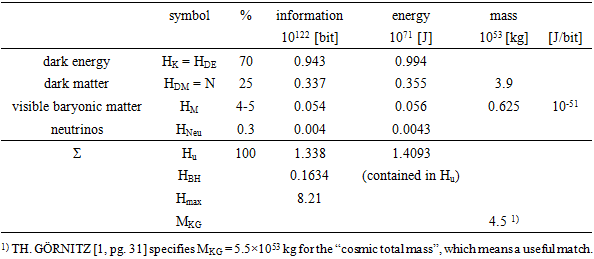
According to THOMAS GöRNITZ, the number of AQIs (abstract quantum information) in the cosmos is N = tcosmos2 / 2 = (tu/tp)2 /2 = 0.32×10122 [1, pg. 30]. This value corresponds to the value of dark matter in Table 1, where HDM = 0.33×10122 is given. That`s a remarkable match!With formula (3.2) it follows: | (4.1) |
By comparing in Table 1 the informational equivalents of the dark energy HDE = HK and the total mass energy of the universe Hu, one obtains the relation | (4.2) |
and Ed = (ln2)2 ・ h ・ Hu / tu. ln2 ・ HDE = (tu / tp)2 ~ AkThe formulas (3.2), (4.1) and (4.9) lead to | (4.3) |
By combining the different informational equivalents of the energies in Table 1, a number of formulas of the ratios of the informational equivalents can be derived. Here are examples: | (4.4) |
 | (4.5) |
The formulas (3.2) and (4.3) lead to | (4.6) |
HDE / ln2 ~ Ak ~ (tu / tp)2Formula (4.2) results in | (4.7) |
and | (4.8) |
According to THOMAS GöRNITZ, the informational equivalent of the total black holes in the universe is | (4.9) |
[1, pg. 28, formula (7.3)]The number of AQIs that make up all black holes in the universe is therefore:N/2 = 0.3268×10122 /2 = 0.1634×10122. The entropy for black holes as objects in the cosmos is always smaller than the number of AQIs that form the black hole (THOMAS GöRNITZ).
6. Preparation of the Balance Sheet
If you enter the values found in a table, you get the following picture:Table 1. Mass energy and information balance of the universe
 |
| |
|
7. Compilation of the Formulas
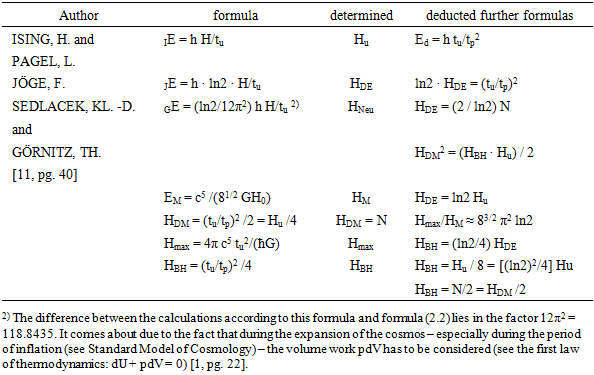
There are three formulas in literature for the equivalence of information flow and energy. They are listed in Table 2.Table 2. Compilation of the most important formulas
 |
| |
|
8. Applications
There are ongoing and future large-scale sky surveys and experiments specifically designet to explore the nature of dark energy and measure its properties. However, a direct, laboratory-detected particle has not yet been found.Several „experiments“ are essentially astronomical observation projects that study the universe as a whole to measure the impact of dark energy on cosmic evolution. They are not pursuing direct proof on a laboratory scale, but are collecting data to test cosmological models and gain a better understanding of this mysterious force.Current and planned experiments include:Dark Energy Spectroscopic Instrument (DESI):Tis Instrument at the Kitt Deale National Observatory in Arizona maps thousends of galaxies to measure the large-scale structure of the universe. Recent data suggest that dark energy may change over time, which could call into question EINSTEIN's theory of the cosmological constant, but more data is needed.Euclid – ESA Mission:The Euclid wide-field telescope was launched to explore the „dark universe“. It is designet to make highly precise measurements of the shape and distribution of galaxies across billions of light-years in order to better understand the expansion of the universe and the role of dark energy.Nancy Grace Roman Space Telescope (formerly NASA's WFIRST):This planned space telescope is also idented to conduct sky surveys to collect data on dark energy using supernovae and gravitational lensing effects.The Dark Energy Survey (DES):Although the main observation phase is complete, the DES data will continue to be analyzed the properties of dark energy.Laboratory experiments:There are also attempts to measure the effects of dark energy or related hypothetical fields (such as quintessence) in controlled laboratory environments, often using neutron rays or searching for axions, although these often target dark matter.The physical interpretation of dark energy remains largely unclear.Current experiments aim to collect more data on the effects on the expansion of the universe in order to determine whether it is a constant form of energy (cosmological constant) or whether its strength changes over time.Vera c. Rubin Observatory:These observatory in Chile will servey the entire southern sky over several years (Logistics Survey of Space and Time) to collect huge amounts of data, which will also be used for research into dark energy.The application of the formula (2.1) as natural law for experimental research or practical applications has already been carried out and will continue to be carried out in the future. However, implementation is difficult. The reason for this is that dark energy is not yet experimentally accessible. In addition, dark energy cannot be observed directly and is diffusely distributed throughout the universe and is therefore not easy to detected.However, the following applications of formula (1.2) could be made answer open questions in theoretical physics and give concrete examples of such applications.In addition to the four applications previously described in the article „Time is quantized“ [11], „The Universe – an Open System“ [12], „Dark Energy is not constant“ over time [13], Energy is relative [14], Equivalence of Information and Squared Energy [15] the article „Theory of Dark Energy“ [16] also contains an application of formula (1.2). The statement of Prof. Dr. Alexandre Tkatchenko from the University of Luxemburg also contains a possible application of formula (1.2). The application in the article „Theory of Dark Energy“ should be highlighted.The possible application in this case consits in that what Prof. Dr. Alexandre Tkatchenko says: „Accurate calculating the value of Dark Energy could be helps bring together two of the largest fields in physics: Quantum Field Theory (QFT) and General Relativity Theory (GRT) developed by ALBERT EINSTEIN.Since the energy is relative [14] and dark energy is not constant [13], the energy on Earth is different than the energy at the edge of the universe. What this means for the development of the universe from Big Bang ti today must be researched. That doesn't matter for the Earth, but whether the linear function of dark energy depending on the age of the universe (see diagram [13] is still valid and the exact calculating of dark energy is still correct must be reconsidered.Research into possible interdisciplinary applications of formula (1.2) could, for example, be applied in areas outside of physics, such as in cosmology or in the interdisciplinary modeling of physical systems, in future research.Expanfing the possible scope of application could open up exciting avenues for further researc.
9. Conclusions
PLANCK time can be understood as the oscillation period τ. Oscillations are fundamental oscillations of the cosmic space [1, pg. 15]. The dark energy satisfies the PLANCK/EINSTEIN formula E = h ν. Dark energy can be interpreted as information flow.According to formula (3.2), the cosmic information multiplied by ln2 is nothing more than the age of the universe in PLANCK time units squared. The approximately fivefold amount of the currently known total information content of the universe would still have space on the surface of a spherical universe.Dark matter corresponds to the number of AQIs in the cosmos. The informational equivalents of dark matter and the total mass energy of the cosmos are in a ratio 1/4. Dark energy and dark matter are in a ratio 2/ln2. The ratio of dark energy to the total mass energy of the cosmos is ln2.According to the formula (4.5) the ratio Hmax / HM is equal to 83/2 · π2 · ln2. The informational equivalent of the black holes in the cosmos is equal to HDM / 2 = Hu /8 = [(ln2)2/4] Hu. Half of the hypothetical particles of dark matter are distributed over the black holes in the universe and can be made accessible after the experimental production of small black holes in a particle accelerator.These statements can serve only as the beginnings of a theory on dark energy and give cause for further research.
Definition of Symbols Used in Formulas
A = effect, actionAH = area of the black hole event horizon measures the information potentially contained in itAu = surface of the spherical universe, corresponding to HuAk = surface of the spherical universe, corresponding to HkAQI = abstract quantum information (protyposis)R = cosmic radiusc = speed of lightν = frequencyE = energyG = constant of gravitationH0 = HUBBLE constantH = SHANNON information entropyHBH = informational equivalent of the total mass energy of the number of black holes in the cosmosHDE = informational equivalent of dark energyHDM = informational equivalent of dark matterHK = cosmic information, HK = HDEHNeu = informational equivalent of neutrinosHu = informational equivalent of the total mass energy of the universeh = PLANCK quantum of action, ħ = h/(2π)k = BOLTZMANN constantM = massMDM = mass of dark matterMKG = cosmic total massMM = mass of visible baryonic matterN = number of AQIs in the cosmosnBH = number of AQIs for a black holeS = thermodynamic entropySH = BEKENSTEIN HAWKING entropyT = absolute temperatureτ = period of oscillationt = timetu = age of the universetp = PLANCK timelp = PLANCK lengthU = internal energyV = volumezBH = nummer of black holes in the cosmos (THOMAS GÖRNITZ [1])
Statements
Conflict of interest:no conflict interestInformed consent:I agree to the journal's guidelines.Funding information:I will initially pay all publication costs myself, but will endeavor to find sponsors.Data available:This is already stated in „Section 2. Verification of the result“:Data from the MAX PLANCK Institute for Radio Astronomy.
References
| [1] | GÖRNITZ, TH.: Quantum cosmology https://viXra.org/pdf/1701.0544v1.pdf. |
| [2] | JÖGE, F.: Information und Wirkung. Zur Einfuhrung des Immanenzbegriffs als physikalische Größe. Grenzgebiete der Wissenschaft (GW) 64 (2015) 3, 215-228. http://viXra.org/abs/1807.0230?ref=10041418. |
| [3] | EIGEN, M.: Von der Entropie zur Information-die physikalische Chemie der belebten Materie. Bunsentagung Berlin. Ber. Bunsenges. Phys. Chem. (1994) 11, 1351-1364. |
| [4] | TIPLER, P.A. / LLEWELLYN, R.A.: Moderne Physik. München / Wien: Oldenbourg Wissenschaftsverlag, 2003. |
| [5] | ISING, H.: Information and energy https://dx.doi.org/10.6084/m9.figshare.2115400.v1. |
| [6] | PAGEL, L.: Information ist Energie. Definition eines physikalisch begrundeten Informationsbegriffs. Wiesbaden: Springer Vieweg/ Springer Fachmedien, 2013, pg.27. |
| [7] | DE BROGLIE, L.: La Themodynamique de la particule isolée (ou Thermodynamique cachée des particules). Paris: Gauthier-Villars, 1964, p.88/89; ders.: The Reinterpretation of wave mechanics. Foundations of Physics 1 (1970) 1, 5-15, pg.10. |
| [8] | GÖRNITZ, TH.: Der kreative Kosmos: Geist und Materie aus Information. Heidelberg/ Berlin: Spektrum, Akademie Verlag, 2002, pg. 388. Wiesbaden: Springer Vieweg/ Springer Fachmedien, 2013, pg. 27. |
| [9] | BEKENSTEIN, J.: Information in the holographic universe. Sci. Am. 289 (2) (2003), 58-65. |
| [10] | PENROSE, R.: The Emperor`s New Mind. Oxford University Press, 1989, pp. 480. |
| [11] | Jöge, F.M.: Time is quantized. International Journal of Physics and Astronomy, December 2023, Volume 11, pg. 2. |
| [12] | Jöge, F.M.: The Universe – an Open System. International Journal of Physics and Astronomy, December 2023, Volume 11, pg. 1. |
| [13] | Jöge, F. M.: Dark Energy is not constant. Applied Sciences Research Periodicals (ASRP), June 2024, Vol. 2, No. 6, pp. 1-2. |
| [14] | Jöge, F. M.: Energy is relative. Advances in Theoretical & Computational Physics, 09-Dec-2024, Volume 7, Issue 4, pg.1. |
| [15] | Jöge, F. M.: Equivalence of Information and Squared Energy. Advances in Theoretical & Computational Physics, 09-Dec-2024, Volume 7, Issue 4, pg. 1. |
| [16] | Jöge, F. M.: Theory of Dark Energy. London Journal of Research in Science: Natural & Formal | Volume 25 | Issue 1 | Compilation 1.0, pp. 1-4. |
| [17] | Jöge, F.M.: Quantum Gravity – To Unification of Quantum Field Theory (QFT) and General Relativity Theory (GRT). Advances in Theoretical & Computational Physics | Volume 8 | Issue 2 | pp. 1-3. |
| [18] | TRIBUS, M.; MC IRVINE, E.C.: Energy and Information. Sci. Am. 225 (3) (1971) 179-188. |
| [19] | SEDLACEK, KL.-D.: Aquivalenz von Information und Energie. Norderstedt: Books on Demand GmbH Verlag, 2nd ed. 2010, pg. 40. |
| [20] | VÖLZ, H.: Das ist Information. Aachen: Shaker Verlag, 2017, p. 372. |
| [21] | VÖLZ, H.: Wie wir wissend wurden: Nicht Alles ist Information. Aachen: Shaker Verlag, 2018, p. 54. |


 Abstract
 Reference
 Full-Text PDF
 Full-text HTML