Branko Mišković
Independent, Novi Sad, Serbia
Correspondence to: Branko Mišković, Independent, Novi Sad, Serbia.
| Email: |  |
Copyright © 2016 Scientific & Academic Publishing. All Rights Reserved.
This work is licensed under the Creative Commons Attribution International License (CC BY).
http://creativecommons.org/licenses/by/4.0/

Abstract
A consistent methodology is applied to physics, in the aim of its reexamination. Possible uncertainties of the objective scientific sources are here made up by the subjective criteria. Instead of further multiplication of some formal concepts and their relations, the classical laws are mutually compared and related, generalized and reduced to a unique general law. The exposition is supported by EM theory, as the central physical discipline already elaborate. Its results are here introduced intuitively and applied widely. By a consistent cosmology, time is strictly interpreted and included into 4D space, as the natural formal frame. Instead of arbitrary new axes, a structural dimension is introduced by the media stratification, in the ambient concerning matter, as the third natural category. In thus obtained solid scientific system, the known physical forces are explained, mutually compared and related. With reinterpretation of the known empirical facts, the number of the distinct natural phenomena is reduced. After elaboration of classical physics, the majority of the modern theories is bypassed or called in question.
Keywords:
Field theory, General laws, Natural categories, Scientific criteria
Cite this paper: Branko Mišković, Reexamination of Physics, International Journal of Theoretical and Mathematical Physics, Vol. 6 No. 2, 2016, pp. 59-74. doi: 10.5923/j.ijtmp.20160602.01.
1. Introduction
The successful and reliable formulation of a natural law or scientific theory may origin from various, explicit or implicit, sources of cognition. The convincing distinction of at least conditional truths from the scientific fallacies – or even full delusions – understands very clear and convincing scientific criteria. Each of the sources also plays the role of respective criterion. Irrespective of its originating source, the scientific knowledge must not contradict to any criterion. Only as such, it may be accepted and applied in further investigations. If some criteria are uncertain or difficult to apply, all the others must be as much as convincingly satisfied.
1.1. Objective Sources or Criteria
Physical processes manifest in the surrounding space, thus affecting some of the human senses. Respective, thus formed mental images represent the empirical bases of any cognition. Owing to usually very complex natural relations, the same phenomena are usually provoked artificially, in the reduced technical conditions, with a minimal number of the possible final interpretations. At longer causal sequences between the processes and their effects, the conclusions more depend on their interpretations. Their confirmation by the other criteria increases the reliability, but a conflict with only one of them calls in question the obtained conclusions. The initial formulation of a physical law, in the verbal or mathematical form, mutually relates physical quantities, as the basic notions. Such laws are obtained by interpolation of the empirical data, or by the direct logic of development of the physical processes. Due to various technical restrictions, mathematical functions are not ever equivalent with effective physical laws. Therefore, the domains of their validities must be strictly taken into account. Moreover, some laws can be expressed in the algebraic or differential forms. These two forms are usually not fully equivalent, but their domains of validities are more or less distinct.Similar formal relations are also expressed by the similar mathematical equations. However, their formal symmetries are restricted by physical distinctions of the related quantities. The scientific essences just consist in the strict estimation of physical senses of all the noticed similarities and distinctions. Excessive such features of the physical quantities or their mutual relations, expressed by respective generalizations, reductions or simplifications, as a rule follow into insolvable logical contradictions and respective scientific dead ends. Arisen already in the classical, some of such inconsistencies culminated in the modern physics.
1.2. Subjective Criteria or Sources
Starting from the inherited scientific tradition, the further development consists in its profound reexamination and/or possible elaboration, outstrip or even legitimate revision. A successful elaboration is vitally preceded by profound study of the inherited knowledge. Already in education, it must be undergone to all scientific criteria. Not only that the future investigators thus exercise effective application of scientific methodology, but the tradition itself is best prepared to the improvement, with possible accommodation of the former criteria. Scientific crises demand the radical reexamination of the former tradition or methodology.The rational interpretations of natural phenomena demand clear vision of physical processes, developing in space and time. Instead of mere mathematical calculations, the rational control of each formal procedure is needed, from the starting premises – up to the final conclusions. This control is very difficult at the complex formal or technical procedures. Such visions are best supported by the mathematical field theory. The considerations restricted to 3D space also rely on the experience. Though some new dimensions can be formally added, the experience supports only the visions restricted to 3D strait and 2D curve spaces.Some hypotheses, introduced in advance intuitively, must be thoroughly checked by the other scientific criteria. Apart being the separate source, intuition also controls all the other cognitive processes. Moreover, in its role of the source it also understands, more or less strictly, all other criteria. Implicit principal views – founded on the experience or tradition – do not essentially distinguish from the explicit hypotheses. And finally, physical laws can be formulated in the causal or final forms. The former laws, expressed in the terms of forces, are turned by integration into the latter, in the terms of energies, as such frequently introduced intuitively.
2. Scientific Tradition
2.1 Classical Bases
In the classical mechanics originally founded, Newtonian laws treat the motions and balances of solid bodies, reduced to respective material points in their centers. This set may be supplemented by the law of gravitation, expressing the static interaction of two massive bodies. The attempts for similar foundation of electrodynamics may be reduced to Coulomb’s law for the static interaction of two electric charges. Similar kinetic central law, formulated by Ampere, does not express the complete interaction of two elementary currents, as the moving charges. Its general form demands the clear insight into EM fields and their motion in space.For description of developing physical processes in space during time, the mathematical field theory is elaborated and successfully applied to the mechanics of the fluids and solid bodies. However, it could not be extended in the same form to the invisible EM fields and their uncertain motion. Thus sensory inaccessible, these motions have not been clearly imagined, let alone – formally treated. EM theory was thus founded on electric circuits and their interactions. Instead of their motion, the field variations are observed. The algebraic field relations are thus bypassed, with the ready differential notions taken from the fluid mechanics.Although thus unilateral and/or incomplete, the classical physics is applied in practice, and its incompleteness has not been even noticed. Respective faults are manifest attempting its application to the micro-phenomena. Instead of its further elaboration, this physics is pronounced as incompetent for such purposes, and substituted by a number of the particular, much more inconsistent, modern theories. Instead of further reduction of physical quantities and relating laws, they are multiplied and/or complicated. In the absence of clear vision of physical processes, the quantities and their relations are subordinated to the ideal formal principles.
2.2. Scientific Wander
Various types of formal symmetries represent the mostly used and respected formal principle. In opposition to needed restrictions of external symmetries of technical devices and living bodies – in the aims of their functionalities, the ideal symmetries of physical objects and the laws relating them follow into contradictions. There is special relativity (SRT), as the typical example. Under assumption of the equality of various reference frames, the manifold physical quantities of the same objects are obtained. These useless data just follow from the assumed symmetry. On the other hand, the frame hierarchy gives the better results.The invariance of physical quantities and covariance of the equations relating them are usually in mutual conflicts. For a simple example, the covariance of Einstein’s relation understands the variable mass against its own motion. On the other hand, if the mass were reduced to its resting value, the equation should be respectively corrected. The invariances of various mutually related quantities are also in such mutual conflicts. Thus, space and time invariant to the frame motion understand the variable speed of light, and vice versa. In the last case, the two natural categories would be subjugated to a particular speed, derived from them.The quantum principle expresses intuitive expectations of the smallest values or fractions of various physical quantities, including physical fields. In fact, electric charge is the only certainly quantized quantity, expressed as the product of the mass and radius of a free particle, the two inversely related quantities. Mass is disturbed at its motion or being built into the complex structures. As being emitted from the atoms, light photons seem to be quantized. As the product of the continual frequency and Plank constant, the photon energy is also a continual quantity. The expectation of the quantum gravitation is especially unfounded.The probability principle is somehow causally inverted. At observation of very complex relations in the sets of plenty objects, the laws of the great numbers are manifest. Such laws ensure the reliable functioning of the semiconducting elements in the electronic devices. However, such the laws are as less reliable as the smaller number of the objects is observed. Their application to particular elementary particles tries to substitute respective unknown deterministic physical laws. In the final instance, the probability maybe concerns the multiplicity of unknown foreign conditions influencing the observed particular particles. Though not being explicitly emphasized, the materialistic principle is commonly implicitly understood. It relies on the phenomenal matter, with further continuation of its dividing into expected constituent parts. Though variable and apt to defects or even annihilation, mass is considered as the main material quantity. This course just culminated by the hunt and recent alleged registration of elementary masses. In fact, the experimental results are accommodated to the former expectations. On the other hand, in spite of widely accepted energy conservation, this invisible and impalpable quantity is persistently treated rather formally.On the bases of the above mentioned and similar formal principles, a number of modern physical theories, weakly – or even anyhow not – founded in reality, are introduced. Not only that these theories are not sufficiently convincing and reliable, but they collide with some of the general scientific criteria. Though initially introduced conditionally, by some assumptions never confirmed so far, they are extended in the meantime by imposing elaborations, giving the impressions of the significant theories. Though disobeying one or more of scientific criteria, their reexamination is not allowed at all, irrespective of the convincing arguments.
2.3. Possible Reorientation
The recent essential deductive exposition of the elaborate electrodynamics [1] – as the central physical discipline – radically changes the scientific relations in complete physics. The resolution of some internal problems of EM theory, by consistent follow of the field motions, influences also the other theories. Not only that EM processes convincingly explain the mechanical laws, but they are also related with the known micro and cosmic empirical facts. At least a few of the modern physical theories are thus restricted, surpassed or fully called in question. In the final instance, they hardly deserve a serious scientific attention.In reverse to the former gradual inductive elaboration of EM theory [2], its results are the support and orientation of this systematic foundation of a general field theory. EM laws are extended and applied to the other physical disciplines. In accordance with the summary force diagram of R. Bošković (1711-87), all material structures, including vacuum medium, are stratified along a structural dimension, as the fifth axis. Newtonian balance of the forces acting from various strata is generalized into the general law of energy homogeneity – in 4D space. It also understands electrical neutrality of each 3D location, as the consequent general law.These two general laws applied to a supposed substructure of the medium follow into a united theory of all the physical forces. Instead of the usual formal unity of the two EM fields, electric field is initially resolved into its static and dynamic components, whereas the magnetic field concerns the kinetic forces. The inertia is thus reduced to electric, and centrifugal forces – to magnetic fields around elementary particles. Thus being mutually distinct and separated from gravitation, these forces are related with the two general laws at least via EM phenomena. However, gravitation and nuclear forces can be directly explained by the general laws.
3. Foundation of Physics
3.1. Reliable Formulation
With scientific tradition, as its indispensable basis, each a science usually starts with certain empirical facts and finally terminates with practical application of obtained results. The rational interpretations of physical relations, usually inspired by intuition, are supported by the formal procedures: of the arrangement, comparison and correlation of empirical data with mathematical functions. On one hand, the interpretation and intuition, as the subjective scientific criteria, rely on the experience and formal relations, as the objective sources. On the other hand, the two objective sources should be under continuous control of the subjective criteria. The firm reliance on the former tradition was predominant in some regressive antique cultures. Excluding the modern science, nearer to the antique regard of its own theories, the tradition of physics is only the starting basis, being liable to reconsideration up to outstrip. Sensory experience, usually supported by certain technical equipment, is predominant in this science. After initial formal arrangement of established empirical facts, the rational criterion enables interpretation of natural phenomena. The spiritual experience, restricted to intuition, is further reduced in modern physics – to arbitrary guess, irrespective of other criteria.
3.2. Development & Exposition
The philosophical procedure thesis-antithesis-synthesis is also convenient in the inductive scientific development. Two confronted theses may be thus substituted by a more general interpretation, obeying all the scientific criteria. The modern wave-particle dualism is thus here substituted by the vortical models, better explaining all empirical facts. The final results from the hard inductive developments represent the starting bases for the final clear deductive expositions, deriving the particular effects from the more general laws. The former inductive elaboration enables the deductive exposition and practical application of the theory. Though the particular phases or procedures of derivation may be inductive or deductive, a complete theory consists of the balanced alternating approaches. One of them is usually predominant in the global exposition of the theory, and the other – in the particular procedures. Though being inevitably inductive, from a known and particular – towards unknown and general, the development of the complete physics just consists of some deductive jumps, especially – in the critical scientific phases. On the other hand, the educative deductive exposition cannot avoid the inductive procedures, needed for the conviction and scientific training.Gradual inductive development of the classical physics enabled its reliable results, obtained by the numerous steps forward into the unknown, their possible reexamination and redirection. The grueling ascent up the scientific stairs just demands the continuous accommodation of the full scientific methodology and the occasional substitution of the inherited formal concepts. Persistently avoiding such accommodation, the contemporary physics resorts to very risky deductive procedures, directed by doubtful formal principles. In the aim of deductive exposition of a consideration, the number of the initial relations must be reduced.
3.3. Formal Constitution
A consistent physical theory operates by some basic and derived physical quantities, as the needed formal concepts. The basic quantities are introduced intuitively, on the bases of the direct experience, and as such mutually related by the basic physical laws, in the verbal or mathematical form. By separate definitions, the remaining quantities are defined by the given basic set, with respective combinations of physical dimensions. Unlike these formal definitions, as the rational mathematical relations, the quantities and their expressions related by the basic laws cannot be directly equaled, but are accommodated by physical constants.For a systematic relation of n basic notions, n – 1 formal relations are necessary and sufficient. Therefore, in a fully reduced physical theory, the set of its basic laws must be smaller for one from that of the basic quantities. In the case of more laws, their mutual equivalences or collisions must be examined. At the more quantities, the remaining laws are looking for, including that from the other theories. Rational explanation of a basic law would turn it to the definition of a quantity, thus transferred into the derived set of quantities. Such the explanation of the complete set of basic laws would reduce the theory to only one quantity.Geometry is a simple example of fully reduced scientific theory in 3D space, with three identical dimensions of length, and the angles, as the ratios of the lengths. By introduction of time, as the forth dimension – distinct from the lengths, the kinematics is founded on the two physical quantities. As the derivatives of the length per time, speed and acceleration are introduced. On the other hand, the statics is founded by the force, instead of time, with the torque as a derived quantity. The mechanics is nothing else but a synthesis of these two theories, with a sequence of derived quantities defined by the algebraic combination of the basic ones.
3.4. Scientific Synthesis
Let us start with the original Newtonian mechanics. The law of the force symmetry, as the rational relation, directly postulates the dimensional equality of all the physical forces. The law of inertia appears as the special case of force action law, at the zero force, and as such is excessive in the basic set. Though introduced empirically, without any interpretation, the force action law is formulated in the rational form, as the force definition, via the three basic quantities: length, time and mass. Though manifests only by the forces, the concept of mass suggests matter, as the third natural category, in the given formal frame of space and time.The law of gravitation seemed to be independent of thus founded mechanics. The labor performance law represents the definition of energy, as the force integral along the path covered. If the force action law were treated as the force definition, the complete relation of the three basic quantities would demand two new laws. The inclusion of gravitation into the mechanics demands the correction of an obvious methodical inconsistency: though accommodated with three basic quantities, the force is related with two of them by a physical constant. In fact, with the unit constant in one, the two laws relate the four basic quantities.With these four mechanical quantities, electrodynamics can be founded by the Coulomb’s – static, and Ampere’s – kinetic laws. These laws introduce electricity and current, as the new quantities, directly mutually related by the current definition. In thus extended physical theory, four basic laws relate the five basic quantities. Well, electrodynamics and mechanics – also including gravitation – form the consistent scientific system, as such deserving the status of a united physical theory. The predictive elimination of all constants follows into the natural system (NS) of the quantities and units, with only one basic quantity.Instead of the presented systematic approach, this quantity reduction was performed gradually. The known Maxwell’s relation links the two EM constants with the speed of light, and thus – electric and magnetic charges, in respective two static laws. Adopting the unit values of both EM constants, time is reduced to length via the speed of light propagation, and so, energy and linear momentum – to mass. And finally, by the unit value of Plank constant, dimensionally equal to the action or linear momentum, mass is reduced to inverse length, and thus electric charge – obtained from their product – losses its physical dimensions.
4. Space & Time
4.1. Phenomenal Notions
Even before foundation of physics, and especially during its last development, space, time and matter represented the three natural categories. 3D space is understood as a formal frame of mechanical events. At homogeneous and isotropic media, all directions are equivalent, but the perpendicular position of the three spatial axes expresses their mutual independence. Some formal reference frames, with the linear or angular axes, may be directed arbitrarily. The visible or invisible matter, in the forms of the bodies or medium, is contained in space. A motion is the object displacing, with respect to the medium or reference frame.The image of material world is continuously chaining by the visible motion of various present bodies. The sequence of these images may be arranged along temporal axis. As if the observers, implicitly moving along the temporal axis, are successively passing through these images. With respect to the light propagation, just restricted to the moving frame, the observations of the past and future are excluded. A speed is defined as the derivative of the path covered per time taken. However, the orientation in space and time is problematic. Alike the measuring etalons, the reliable references of these two quantities must be precisely defined.Spatial distance of two points at the invisible medium can be determined only with respect to the visible matter. If we connect the reference frame beginning to a massive body, the positions of other points amongst variously moving bodies cannot be fixed. In practice, Earth is used as the rigid referent body, at least – for the smaller spatial domains. The stable constellation of the Galactic stars takes over this role in the wider cosmic space. However, such the orientation is very difficult inside the Solar system, between respective planets moving on their independent orbits, even related to Sun, as the convenient frame beginning. On the other hand, the lapse of time is compared with the development of various physical processes, from the free mechanical oscillations – up to the noticed rotations and/or revolutions of celestial bodies. In fact, all these processes are finite, and therefore, more or less approximate. The universal cosmic expansion may be the best temporal etalon. Though referring a time beginning to the assumed cosmic origin, the cosmologists do not dare to relate the lapse of time with the cosmic process. Namely, the absolute time calls in question SRT, as the sacred scientific taboo. Let us now present the main aspects of this speculative theory.
4.2. Speculative Orientation
Lorentz’ transformations of one spatial and the temporal axes are historically ascribed to a few scientists. Irrespective of their inventor, they were introduced hypothetically, and then tried to affirm by a sequence of formal inconsistencies. We here present possible pretexts for their introduction, with the inconsistencies thus made. At first, there are the relations of the measurable and wanted 4D coordinates of a moving celestial object. Irrespective of the measuring procedure, the path covered by the object during this procedure must be also taken into account. The equations (1) thus relate the wanted with accessible kinematical quantities. | (1) |
With respect to the object speed (v) – somehow known in advance, its present position (r') and time (t) of its passage through the obtained former position (r) can be calculated. Owing to the finite speed of light, the former object position is visible merely at the present instant (t'). The delay (r/c) is determined by the measured distance (r) and the speed (c). Though – on the pretext of the insolvable difficulties – SRT negates any possibility of the temporal comparison of two distant events, this procedure is habitual in the astronomy. On the other hand, the pair (1) formally reminds an attempt for mutual relation of space and time (2). | (2) |
The classical transformation of the spatial object position (2a) is similar to the relation (1a). The position (r) – in the moving frame, added to displacement (vt) of the same frame from the common start, gives the position (r') – in the resting frame. Instead of the invariant time (t' = t) already understood, its analogous transformation (2b) is somehow assumed. As if, the fraction from (1b) is here multiplied by v/c. Apart from the mutual motion, the temporal difference between the two frames thus depends on the common orientation and starting position of the two formal frames. However, these two latter functions have been ignored so far.The mathematical inversion of the pair (2) gives the pair (3), with the common set determinant, g2 = 1 – (v/c)2, as such expressing the physical asymmetry of the two frames. Apart from the quantity differences in (2), their ratios are now also disturbed. For the sake of their symmetry, the determinant is arbitrarily divided between the two sets, by 1/g – in each of them. The mutual formal inversion is thus saved. Not only that the same factor (1/g) in the mass function (11a) does not support, but just disproves the assumed frame equivalence. Namely, according to this function, mass is minimal when rests in a preferential reference frame. | (3) |
Though overlooked or neglected, the time dependences on the – arbitrarily adopted – frame orientation and position still remain. Only that against the speed modulus is explicitly understood, but without mere announcement of any possible physical interpretation. The cosmic time would be thus given in the multiple values, and so practically undetermined and inapplicable. Moreover, time dependent on speed – as the ratio of length and time, would thus relate the kinematical quantities in the implausible causal loop. And finally, such formal relation disables any interpretation of time, as is its possible relation with cosmic process.The direct ratio of the two relativistic transformations – of position and time – gives respective speed transformation. Being applied to light propagation, it gives the identity: c' = c. As the direct consequence of the assumed frame symmetry – instead of the unique time, this particular speed appears as invariant. This result disables any interpretation of light and the medium of its propagation. Michelson-Morley’s result was referred to Earth, as a predominant mass, and cannot be generalized to the formal frames. Moreover, with respect to the rotation and revolution of Earth, the restriction to inertial frames would call in question this result.With respect to the starting premises, the latter corrected pair may be taken as the direct set, thus being in accord with the known complementary transformations of the transverse components of two EM fields [1]. Though the use of two EM constants in the set determinant avoids the fraction, the speed of light hides the vacuum medium and EM origins of SRT. Moreover, the vector form avoidance in these two equations hides the time dependence on the angular frame orientation. Apart being a wrong physical theory, SRT appears as an intentional multilateral delusion, if not being aimed as the stimulating scientific provocation.In fact, SRT was founded on the bases of incomplete EM theory, inherited from Maxwell. Apart from EM theory itself, its former gradual elaboration [2] was also inspired by the fantastic relativistic views somehow referred to it. However, all the attempts to place SRT on the solid scientific bases completely failed. By all appearances, this is just the typical contemporary speculation, based on the apparent empirical and inconsistent formal relations. The unrestricted scientific courage may be the main its feature. Without needed critical distance, its followers took it at the face value, much more seriously than its inventor himself.
4.3. Physical Orientation
With respect to known physical forces, usually dependent on the kinematical quantities, there arises the question of the relevant reference frame for their determination. They must be defined uniquely, in one – strictly determined – frame. In everyday life and technical practice, this frame is connected to Earth. Owing to Earth’s rotation and revolution, each body is moving along a cycloid path – of variable curvature, but respective variations of centrifugal forces are not significant. Moreover, above mentioned MM experiment also points to nearly the same speeds of light in all directions, irrespective of the known orbital Earth’s motion. Of course, the same results must be expected on the other planets. Therefore, in the first approximation – at least, the reference frame of all physical events on a celestial body and in its surroundings may be connected only to its gravitational phenomena, as the palpable physical facts. The gravitational field (G) and potential (X), as the specific force or energy per the unit object, are expressed in the central forms (4), derived from respective law. The negative field sign expresses the attractive force course. The determined field integral – along the radius, from the observed object – up to infinity, gives respective potential, as the scalar field. | (4) |
The constant of integration (X0) represents the potential at infinity, or in a cosmic location enough distant from this one and all the other celestial bodies. The full diagram of the potential is presented on Fig. 1. With respect to the formal relations, the potential dimensionally equals to the square of speed. Therefore, there is the equality X0 = co2, as the referent potential at infinity. By its extrapolation, the same diagram would determine the speed of propagation through the given potential: X = c2. From its maximal value – at the distant cosmic location, the speed of light declines approaching a celestial body, along the field of gravitation.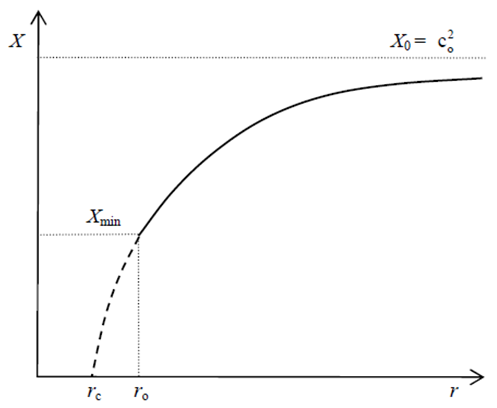 | Figure 1. Gravitational potential |
The diagram is practically broken in the point ro, on the body surface. Assuming a possible compression of the body volume, the diagram approaches r-axis, cutting it at the zero values of the speed and potential. From the zero potential (4b) the critical ratio (m/rc) is obtainable, similar – but different – from the mass density. The negative potentials just point to the imaginary speeds, expressing the inability of the light propagation. The greater values from the critical ratio m/r may be expected around so called black holes. The numerical accordance of the two real diagrams might be questionable, but can be checked empirically. However, some obvious phenomena point to the relevant references, wider from that connected to Earth. The frame of light propagation still slightly falls behind the orbital Earth’s motion. Though being at rest in the Earth’s frame, stationary satellites are affected and thus maintained by the centrifugal forces determined with respect to the wider surroundings. Moreover, with motion around Earth, they follow its motion along the solar orbit. Instead of the ‘revolutionary’ exchange of the two reference frames, the above facts point to their successive hierarchy: from planetary, via stellar and galactic, up to the biggest – cosmic reference.The light propagating along the gravitational field, as the gradient of respective potential, practically comes across the variable medium density. In common with the speed of their propagation, the photon radii are also variable, manifest by the apparent frequencies and real energies. These variations are similar to the kinetic energy variations of the massive bodies moving in the same radial direction. The light emitted from a star is losing a fraction of its energy, which cannot be fully made up in the Earth’s field much weaker. This shift towards the red spectrum should be distinguished from the cosmic red shift, being presented soon.
4.4. Consistent Cosmology
The famous Kant’s antinomy of space found the finite or infinite strait spatial axes equally unacceptable. This old dilemma is successfully surpassed by Riemannian model of the curve space, with the finite, circularly closed axes. With radial temporal axis, this model enables a clear interpretation of the curved cosmos. Closed into itself, without boundary surfaces in 3D, it may be reduced to a thin hyper-spherical wave, as the cosmic cunami propagating along temporal axis. Not only that the global spatial curvature would be clear, but the cosmic process, manifest in 3D – as the expansion, is thus strictly related with the lapse of time.Surface field of height just expresses the ground relief. Its negative gradient, directed down the slopes, is proportional to the surface components of the gravitational forces, acting from the hills – towards the valleys. His attempt to generalize SRT Einstein founded just on this analogy, substituting the gravitation around the celestial bodies by the radial spatial funnels – on the cosmic cunami. Some implicit radial force field, acting from the cosmic beginning and so ineffective in the regular cosmic locations, would be thus manifest on the funnel slopes. The local times would be thus radially delayed – behind the standard cosmic time. The global cosmic cunami points to the uniform cosmic process, developing at the speed c, directed along temporal axis. Namely, this speed value is clearly and convincingly indicated in EM theory [1]. The linear extrapolation of this process points to the cosmic center, as the beginning of the cosmic expansion and lapse of time. Arc distance (d) of two celestial bodies is thus determined by (5a), where  is the central angle, r – cosmic radius, and t – cosmic age or the absolute time. Temporal derivative of (5a) gives the speed of the mutual moving away (5b). The Hobble’s constant is thus reciprocal to the cosmic age: v/d = 1/t.
  | (5) |
In the process of the cosmic expansion, cosmic age – as the absolute time or Hobble’s constant – is the same for all celestial bodies, at a given instant. The special and general relativities are superseded systematically. In accord with the billions of years of the cosmic age, it is relatively the same during usual physical observations. With the constant speed of the cosmic process, the speed of the moving away (5b) depends on the angular distance of an object and its observer. This known speed would determine the angular distance, and vice versa. The cosmic radius (r = ct) and absolute time are thus related with the accessible data.In order to avoid the unrestricted cosmic inflation, various physical reasons were looking for slowing down and U-turn of the cosmic process. The only hope which might contribute to this reversal was expected from the gravitation between celestial bodies. With some estimation of insufficiency of the existent visible matter, some dark matter, of the vague sense and location, was predicted and looking for. On the other hand, gravitation itself may be ascribed to the kinetic effect of mutual attraction of the matter in the parallel cosmic flows. Therefore, instead of a factor influencing the cosmic process, it may be only one of its consequences.In the final instance, even without this intuitive idea, the slowing is renounced and shortly forgot under impression of a new empirical fact and its provisory interpretation. Namely, after explosion of a star, it turns into the super-nova state of the great surface and the flux of light radiation visible at vast distances, with respective red shift and its variations. Thus increasing red shift is very rashly ascribed to the accelerated cosmic expansion, difficult to be rationally explained. As the pandanus of the dark matter, some opposite factor – as the dark energy, of the more secrete sense and spatial location, is predicted at least very conditionally.The simplest strait form of the temporal axis just follows into Kant’s temporal antinomy. Alike the three spatial axes, this antinomy can be surpassed by the similar cyclic closing of the forth axis. At the uniform lapse of time, the cosmos would oscillate between the two singularities in 4D space, via a maximal cosmic radius – in between. Thus expected – decelerated expansion would be turned into the accelerated contraction, unlike the accelerated expansion – explaining the increasing red shift. Instead of Riemannian, this effect may be ascribed to the inverse spatial model of Lobachevski, possibly applied to the temporal axis. Even without just mentioned mathematical alternative, there are also a number of possible physical reasons for the increasing red shift. As the first, the reversal collapse of the already exploded star – as the source of the light radiation, understands the local Doppler’s effect, also manifest by the diminished frequency of the emitted light. Moreover, it may be superimposed to the gravitational red shift expressing the diminution of the photon energy and frequency, by influence of the opposite gravitation. With respect to the accelerated collapse of the star in its own gravitational field, both these effects are also progressively growing.
4.5. Cosmic Red Shift
The speed of a star effectively moving away from Earth is determined by the red shift of the light arriving from it. This effect is expressible by the ratio of the received  and emitted
  frequencies. The most habituated its description (6a) has been used so far. However, unlike the local wave effects, at motion of particular details of technical equipment, this shift is caused by the medium extension, thus distributed along the whole path of light, from its source – up to detector [4, 5]. The frequency ratio, as the function of the speed of mutual moving away, must be in the exponential form (6b), similar to that of the radioactive decay.
 | (6) |
These two functions are presented and compared on Fig. 2. The former of them cuts the abscissa – at v = c, with the vertical asymptote – at v = – c. The former fact points to the horizon of cosmic events at the expansion, and latter one – to wave wall, at possible cosmic contraction. Each of these two effects is in some sense unacceptable. The latter function has no vertical, but the horizontal asymptote, thus avoiding both these effects. Apart from the mentioned physical logic, these boundary conditions also speak in favor of the function (6b). Though cutting each other – at zero, the two functions are considerably different for greater speeds.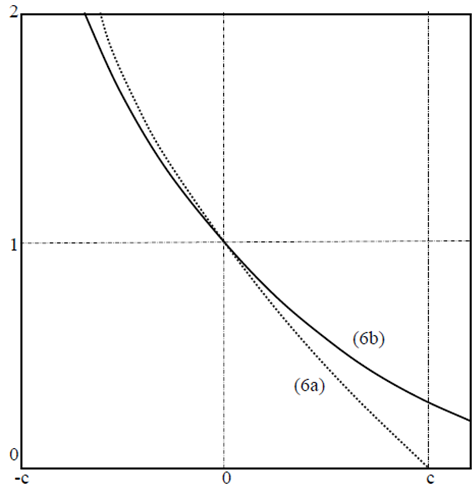 | Figure 2. Red shift diagrams |
The exponential function also accords with an additional fact. Namely, the light propagates at the same speeds with respect to its source – on one, and detector – on the other celestial body, both of them at rest in the surrounding, though expanding medium. This fact might be an additional pretext for respective relativistic postulate. However, it is valid for the cosmic red shift only, and cannot be anyhow applied to the local wave effects [5,6], caused by the motion of some technical devices in relation to the indispensable medium, as the substratum of all physical events and – at least fractional – reference of the light propagation.With respect to the maximal angular distance of the two celestial bodies, equal to  the speed of their moving away (5b) is limited by the value
  a few times greater from the speed of light. This limit would be double for the detour light beam, via the opposite side of the cosmic hyper-sphere. In any case, the arrived photons would be shifted far out of the visible spectrum, with respective diminution of energies. Moreover, owing to their angular dispersion, the number of photons would be also diminished, up to small probabilities of their any detection. At least technically, a horizon of the cosmic events is thus still imposed.
5. Elementary Interactions
5.1. Static Forces
The static electric forces between two electric charges, directed along their distance, are expressed by Coulomb’s law (7), in the causal formal sense. The factor n simplifies the equations and enables their easier comparison. The static force integrated along the radius gives the energy, in the form of Einstein’s equation (8), as the final law. The kinetic (n) is thus turned into dynamic factors: m = nr. As the factor of induction or self-induction, known from electric circuits, it represents the mutual or proper mass. In the latter cases, r denotes the particle radius, as the distance of the surface electric charge from its own center.  | (7) |
 | (8) |
Already empirically known, the mass and charge would determine the particle radius. This radius was tried to verify by passing of free electrons through some fissures. However, not only that the surfaces of these very elastic particles were accommodated to the much narrower fissures, but the same electron passed through two near fissures, without noticed destruction of its own identity. Even smeared electrons about electronic shells were not sufficient for physicists to surpass a solid particle body, firmly established in their minds. The conditional equivalence of the above fundamental relations has not been even noticed so far. With respect to the mass function (8b), the product of – inversely related – mass and radius of an elementary particle is proportional to the square of its charge. This value is the same for a proton or electron, in accord with their inverse radii and masses. This fact points to possible direct relation of all the known physical constants, including the speed of propagation (c), as the function of the elasticity and density, the two typical medium features:  The mathematical relations between the other physical constants are probably not as formally complex as they are difficult to be intuitively predicted or rationally comprehended.
5.2. Neutral Structures
The neutral particles, as the atoms or neutrons are, do not manifest their electric and magnetic features by themselves, out of foreign fields. However, the foreign EM fields disturb their internal constitutions, thus turning them into respective dipoles. These effects announce their constitutive elements, displaced along the structural depths, coexistent irrespective of the external mutually annulled fields. Though obeying the external electric neutrality and energetic homogeneity, the two charges and structural strata form respective capacitors, with the energies referred to the internal (stronger) EM, or external (weaker) gravitational forces.In the final instance, the bipolar structure of the medium, even undisturbed by the fields of present material particles, consists of the two similar – at least statistically – evenly distributed polarities, irrespective of their mutual links and spatial arrangement of respective sub-elementary particles. Therefore, the medium is also expected to manifest its own inertia and gravitation, irrespective of its aggregate states and respective structural forms. In the surroundings of spiral galaxies and particular bodies, the complementary medium reactions may be expected, explaining possible disturbances or non-homogeneities of invisible matter.
5.3. Uniform Motion
The extended Ampere’s law (9) expresses the asymmetric sum of transverse kinetic and longitudinal dynamic forces between two charges in parallel motion [1]. The carrier itself, as its own object (V = v), is affected by the central force – in the continuation, as the even pressure upon its surface. All the surrounding electricity – resting in the local medium – suffers the sum of the static and dynamic electric forces. The radial former, diminished by axial – latter field, thus turns into the ellipsoidal form. The integration of the combined force (9) gives the mutual kinetic energy (10), also expressed in the respective asymmetric form.  | (9) |
 | (10) |
In the moving frame  the energy is expressed by the last result. Though being mutually equal, the two speeds further play their particular roles. Temporal derivative of the result at right – via the linear momentum
  gives the power of the energy transfer, also equal to the product of the object speed and reactive dynamic force:
  The same force is thus expressed in the known form of force action law:
 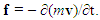 Therefore, this Newtonian law is here finally reduced to the two EM inductions. Instead of the assumed elementary mass, this quantity is thus ascribed to the electric energy around the elementary particles.
5.4. Variable Motion
The full combined central force (9) – subtracted from the opposite static force (7), disturbs the former balance with the radial medium reaction. The new balance is established on a smaller radius of thus compressed particle. With respect to the inverse function of the radius (8b), this fact points to the mass proportionally increased. The force comparison at rest and in the motion gives the known mass function (11a), estimated by H. A. Lorentz from Kaufmann’s results. The mass is minimal when resting in the frame connected to the medium, tending into infinity approaching the speed c with zero value of the particle radius. | (11) |
The gradual particle compression nearly to its zero radius value confirms the absence of any internal material contents of the particles. With respect to the inverse mass function (8b), the particle mass must be contained in its external field. There is unbelievable the existence of some other physical causes of the inertial mass, in the form of elementary bosons. Their apparent registration can be briefly expressed: Some effects similar to that expected from the hypothetical bosons are conditionally noticed in probability of 50 %. Even if such particles were found, the essential question would remain: What is a reason making them massive?
5.5. Mass Types
Temporal derivative of the linear momentum – expressed as the product of the three factors – is also resolved into the three respective terms (12). Substitution of the mass function (11a) and its derivative per the speed (11b), explicates the two force components – in the force action law. The two former terms of (12) turn into longitudinal – dynamic (13), and the third – into the transverse – kinetic (14) reactions, against variable motion. In the latter force s denotes the path covered, and r = rro – the radius of the same curve path. In the case of the assumed fixed mass (with g = 1), these values turn into the known classical forms. | (12) |
 | (13) |
 | (14) |
The three mass types are understood as introduced from respective three mechanical forces: apart from gravitational, the longitudinal and transverse inertial masses. Unlike the first, possibly independent of motion, the second manifests at linear acceleration, and third – on the curve paths. The two latter values are also not mutually proportional, but distinctly depend on the speed. With respect to their classical forms, the resting mass (mo) plays the role of the gravitational, mo/g – of transverse, and mo/g3 – of longitudinal inertial masses. With the common resting value mo, the three forces may be considered as the three distinct functions.The three types of EM and mechanical forces presented above are: radial static, transverse kinetic and longitudinal dynamic, with some essential distinctions. Bipolar electricity interacts by EM forces in the course dependent on the parity of interacting polarities, but gravitation between two masses is ever attractive. On the other hand, kinetic and dynamic EM forces, apart from the present objects, affect in return also their own carriers. Unlike the interactive gravitation, the transverse and longitudinal inertial forces, restricted to the space between the particles, affect the moving bodies only, as the carriers of the internal EM fields.
5.6. Mass or Energy
The full kinetic energy of a moving charge particle equals to the energy difference of (8a) – in the motion and at rest. With respect to the inverse function (8b), this energy amount is finally obtained (15). It may be interpreted as the energy of electric field around the moving particle compressed by the negative combined force (9). Under the condition of the two saved radii of proton and electron in a hydrogen atom (Fig. 6a), the same expression – as the simple difference – would determine the energy of this atom. With respect to the great ratio of the two components, the atomic mass would be thus a little smaller from that of a free proton. | (15) |
After its convincing reduction to respective energy, the notion of mass is finally superseded, as the apparent material feature [3]. In parallel with Einstein’s relation, expressing the energy of charged – and thus massive – particles, Plank’s equation expresses the energy of a photon – dependent on the apparent frequency or respective wave length. In fact, a half of this wave length just accords to the photon diameter, thus reminding of the mass function of a particle. By its linear momentum, the light exerts some pressure upon irradiated surfaces. It also diffracts – in the transverse, and changes its energy – in the longitudinal gravitation.
6. Structural Essence
6.1. Structural Forces
Chemical bonds of two or more atoms are realized by their peripheral EM fields. Expecting similar, but much stronger interactions of the nuclear particles and their possible parts, respective forces were also predicted. Further going in the same direction, similar strata of a vacuum medium and their forces may be also expected. With such a vision, Bošković predicted the summary force acting between the structural elements, from the finest up to the crudest structures. A little advanced his diagram is given on Fig. 3. As such, it at least indicates the successive weaken of each external force and such extension of its radial domain. 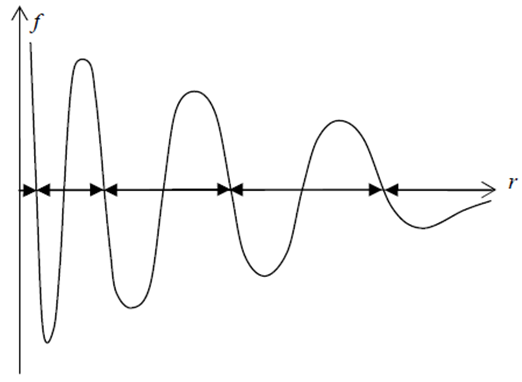 | Figure 3. Structural forces |
The alternating sum of these radial forces, here taken into account, is projected on the abscissa presenting the distances (r) between the centers of the structural particles. The points of the confronted forces represent stable distances between the particles of the observed structural strata. These distances are regulated automatically, thus providing the stability of respective structures. The points in between, with drifting apart forces, represent the empty structural levels. The stable structures are thus arranged into successive levels along the structural depths. The structure zooming thus represents the motion of observation along fifth axis.This diagram presents the four structural strata, with the opposite forces around them. By the zooming through these structures – contrary to the r-axis, from the cruder into finer structural strata, much stronger forces interact between the smaller particles – at respective distances. Owing to the large quantitative jumps between two successive strata, for more than a few decimal places, there is justifiable approximation to the final punctual particles densely packed each to other, interacting by the infinite forces. The dilemma between the smallest material particles or the infinite – asymptotical – divisibility of matter is thus set aside.In the frames of particular strata, the domains on the fifth axis are limited from bottom by the physical points (∂v), as the minimal relevant volumes. Logarithm of their radii just represents the new axis, with the opposite infinite legs: one striving into structural depths, and the other – into cosmic widths. On the other hand – in the function (8b) – mass is inversely proportional to the particle radius, thus indicating the material essence of the fifth axis thus introduced. In the frame of space and time, this dimension represents all matter, as the third natural category, also including vacuum medium, as the finer invisible (or dark) matter.The former idea of the fifth dimension of T. Kaluza was not supported by any interpretation. Its hypothetical closing into itself on some elementary levels – by O. Klein – merely enabled unrestricted formal speculations. Bošković lacked in enough empirical arguments, only for a step of its convincing introduction. With respect to the separate energetic levels of the particles, the fifth dimension is of the energetic sense. With time already included into 4D space, energy substitutes matter in the role of other natural category. There remains a direct relation of these two metaphysical notions, by one – unique, most general natural law.
6.2. General Laws
Irrespective of the observed material structures, each their particle is affected by the zero sum of various force fields. The multiplication of this sum by differential displacements points to the same energy density at all locations in 3D space (16a). The causal force balance thus accords with the final energy homogeneity. Though the energies of particular strata may be inhomogeneous, their summary gradient is reduced to zero. This full equality divided by the temporal differential further turns into the zero powers of the closed technical compositions. The homogeneity is thus extended to temporal axis, as the remaining 4D direction. | (16) |
As a special case of this general law, Bernoulli’s equation expresses the homogeneous sum of three energy densities: static – gravitational, kinetic energy – of the fluid flow, and thermal energy – of internal molecules, just equal to the fluid pressure: P = NkT. The homogeneity refers to these three manifest strata, but without any transfer between the other – finer or cruder – structural strata. The three types of energy can be transformed each into the other, but their full sum stays homogeneous. Mechanical fluid flows are followed by diminution of the transverse pressures. This phenomenon is already mentioned as the kinetic effect.The medium tendency to the local homogeneity of each its stratum is expressed by (16b). The energetic density is the potential of respective force field. Tending to the general or local homogeneities, the force fields convey the particles into the minimal potentials. By all appearances, the material particles themselves are nothing else but also the energetic disturbances of the medium [3, 6]. As such, they form all the structural strata. Their possible smooth would mean the final eradication of the phenomenal world. All structures would be thus dissolved into the absolutely homogeneous substance, consisting of the punctual particles.With respect to the hypothetical senses of quarks & strings, the dipper material structures are still unknown. At least the three stable elementary particles are undoubtedly certain: electron, proton and neutron. If the last one were understood as an expected composition of the former two, the complete matter would be reduced to the electrical bipolarity, as the opposite energetic disturbances of a structural stratum. In the sense of the general neutrality, the other strata react by the opposite disturbances and strains of their structures, with the regular force balances. The tendency to the local neutrality is expressed by the known static laws. As the condition of energetic homogeneity, the general neutrality is confirmed by a classical Faraday’s experiment, and as such here promoted into the most general electrostatic law. Namely, a charge inserted into metallic sphere attracts opposite, and repels the same medium polarities, including the metallic spherical wall. The external surface thus obtains the same polarity of the inserted charge. Discharging this electricity, Faraday established its strict equality with the charge inserted into the center (or any other internal point) of the closed metallic sphere. The opposite disturbances of the various strata compensate each other.
6.3. Elementary Particles
Judging on the bases of sensory experience, phenomenal reality consists of various material bodies, hiding their own deeper material essences. Looking for these deeper essences, by dividing the cruder into finer structures, their features and mutual relations are examined, more or less distinct from the noticed phenomenal impressions. The new interpretations are also expressed by the new formal concepts, thus possibly surpassing the former experience. With respect to the human minds, inevitably based on the experience, the interpretations are finally reduced to the new combinations of the features of the cruder structures already known.With respect to the mentioned unresolved antinomy of the infinite divisibility of the matter or its final smallest elements, these two views were alternated during the scientific history. The new particles are considered as smallest up to a noted possibility of their own divisibility. The particles of chemical elements, known as atoms, are later divided into elementary particles. Without sufficient insight into their essences, these particles are tried to divide into the hypothetical quarks and abstract strings. Contrary to this trend, all physical forces are expected to be reduced to the finite final quanta. These two opposite trends are enforced in parallel.Irrespective of possible results of these two tendencies, they are followed by some methodological inconsistencies. In order to divide the actual particles, their known features must be explained in comparison with the cruder, already well-known material structures. We already mention the dual nature of all elementary particles, as the typical unresolved scientific antinomy. Namely, these particles manifest some contradictory features of the two distinct cruder phenomena, and therefore should be reduced to a third, more general interpretation. Instead, the already contradictory statements are further complicated and mystified.In spite of its soft manifestation – alike a wave, a particle behaves as a compact body, fully preserved at its own motion, even – at the very vast cosmic distances. With respect to the inadequate results of the electron radius – in relation to that expected from the equation (8b), the spatial accommodation of the elastic particle may be certainly supposed. Moreover, the expected solid structural electrons would not be anyhow convenient for their smearing about atomic shells, somehow estimated on the empirical bases. Instead of a solid body, a particle more reminds a blown balloon, and instead a wave – the medium vortex of Descartes. The CPT symmetry (circulation, polarity, time), obvious from algebraic or differential equations of electrodynamics, successfully reconciles the two lastly mentioned concepts. Particle polarities depend on the courses of internal vortical circulations in tr-planes, with respect to temporal axis. The hyper-toroidal fluidic vortex (Fig. 4) convincingly obeys this condition. Its own internal flows diverge at the future side, closing into themselves – in the past, and vice versa – for the negative particle. The transverse radius expresses all the directions in 3D. The circular central line of the full vortex represents the spherical particle surface.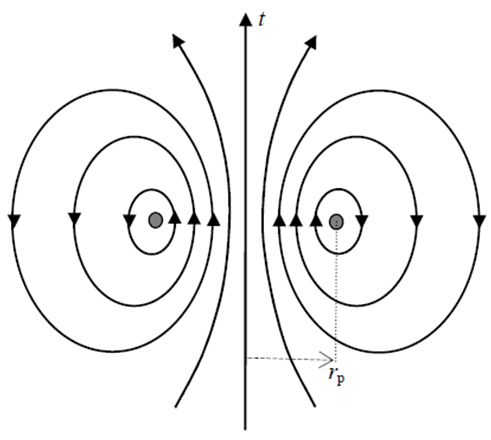 | Figure 4. Toroidal particle model |
Not only that this spherical balloon does not have any internal material contents, but its surface represents the set of the centers of circulations of some medium components. The electric field in 3D space appears as the consequence of this circulation, and behaves as the rigid structure. The apparent particle may be considered as the field carrier, but not as its source or radiator. Instead of being built of countable smaller parts, the particle is a statistical image in the medium of the much finer substructure. This elementary model may be the basis for explanation of the atoms of all chemical elements, as well as of the known complex particles.
6.4. Cosmic Process
The usual concept of electricity concerns assumed bipolar substance, characteristic by mutual repulsion of the similar, and attraction of the opposite polarities. In this case, both boundary surfaces would be affected by the positive radial pressures, without their quantitative differences mentioned above. The two different surface pressures are here necessary, manifest in 3D as the static potentials. The balances with the medium reaction are obtained at the smaller proton – than of electron radii. With the radius over a thousand times smaller, the proton mass and energy are greater in the same ratio, in relation to respective electron features. The implicit motion of the complete cosmic matter along temporal axis can be interpreted only by the abreast common propagation of the all its particles. The internal particle flow is thus added to, and external – subtracted from the cosmic cunami. According to the kinetic effects, their results thus cause the opposite variations of the two medium pressures: negative inside, and positive outside a positive charge. They are manifest as the static potentials, Fig. 5. Their difference exerts the negative pressure about the proton surface, and vice versa about electron, with the mentioned explanation of the known quantitative differences.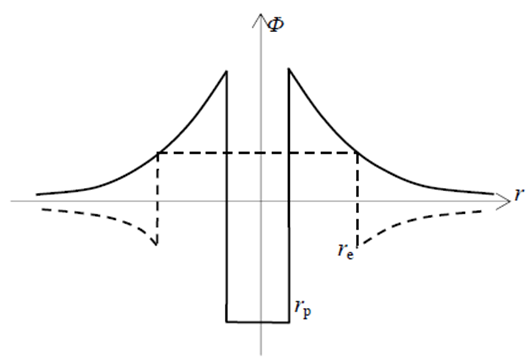 | Figure 5. Elementary potentials |
Apart from the surface pressure balances, the particle radii also depend on some resonant frequencies of the complete particle constitutions. The same frequencies of the opposite charges point to respective antiparticles, as the alternatives. Owing to the pressure unbalance on their own surfaces, the antiparticles are less stable, and therefore – also less probable. This is the reason of the inequality of antimatter with matter. In the final instance, with respect to their registered mutual annihilation, the two forms cannot coexist in the same space during a longer time. The predominant matter would finally consume the inferior antimatter.With respect to the apparent particle surface, it cannot be affected by the usual mechanical forces, as the atmospheric pressure – on a blown balloon. The only possibility is the dielectric reaction of the polarized medium. In analogy with just presented bipolar crude matter, similar features may be expected from the vacuum medium, though consisting of its much finer substructures. In accord with general neutrality, the mentioned positive pressure disturbance would suppress and displace radially positive structural electricity, and vice versa. This process is well known as the medium polarization, including the material and vacuum strata.This consistent solution just points to the dielectric flows in the particle model. At the dielectric medium, the needed displacement currents are opposed by medium strains. The permanent particle existence thus demands the continual its own axial propagation along the temporal axis, within the framework of the expanding cosmic wave. Alike in 3D, the speed of this propagation is determined by the two medium features:  As EM constants, the two Greek symbols denote elasticity of the medium structure and mass density of the displaceable bound electricity. These two constants are thus finally convincingly interpreted.
6.5. Various Radiations
The general wave equation, obtained from Maxwell’s set, convincingly pointed to some EM waves and the speed of their propagation, equal to the cosmic speed (c). The same registered speed of light announces the similar natures of these two phenomena. However, there are some essential distinctions between them. EM waves are ever polarized by crosswise EM fields, thus determining the perpendicular direction of propagation and power independent of the wave frequency. Unlike the waves, the particular photons need not be polarized, and their energies are strictly related with their (at least apparent) frequencies:  EM waves, alike mechanical or sound ones, also expand in the space, in the frames of more or less strictly limited solid angles. Although a light beam is also similarly expanding, each particular photon is propagating at the straight line, alike a solid body. Unlike the massive particles, of their strict dimensions dependent on their own types, the photons are continually changing their frequencies and energies, e. g. – along their paths of propagation (6). Even if the apparent frequency be explained by the photon radius, its variations are related with expanding medium, distinctly from similar results of the local wave effects.The impossible wave packet, as the modern concept of a photon, only expresses the wide admission of its unknown nature. Who has ever packed a wave of any nature, and by which ties would be it achieved? The standing waves – in a resonant cavity – are just limited by the reflexive walls. The propagating waves on the conducting cables are determined in accord with the variable currents and voltage. A toroidal vortex of the displacement current – in 3D, with circular magnetic field, is a model explaining the photon behavior. The model persistence at dielectric media also demands its uniform continuous axial propagation.A particular photon is by the rule axially symmetric. If its vortex be somehow predominant at a longitudinal plane, this asymmetry is manifest as the light polarization. The photon model also answers the implicit, so far unasked question. With respect to greater frequencies of the photons than that of EM waves, which is the boundary frequency between their two domains? Not only that such a frequency has not been theoretically determined nor empirically noticed so far, but it does not exist at all. The two domains are conditioned by the dimensions of their respective generators, as the structural particles or technical macro-oscillators. The concept of a wave associated to a mowing particle is also very problematic. With respect to the strict wave speed (c) and continually variable particle motion below this speed, the wave would depart particle, spending its kinetic energy – up the full particle stoppage. Therefore, instead of any wave, there are only the stable EM fields associated to the moving particles. Passing by the resting instruments, these fields play the role of the wave half-period. The same effect is produced by a free photon, propagating at the known its own speed. These obvious contradictions of the former formal concepts have not at all been considered so far.By formal analogy of EM waves and their propagation, the similar gravitational phenomenon is predicted and allegedly confirmed. This result is of the same kind as the elementary mass bosons or accelerated cosmic expansion. The technique is so developed that sooner or later must register each idea, even in the form of a mere thought. The speculative thought is so conceited that pretend to distinguish each particular pulse amongst the noisy forest of similar greater pulses. The assumed rare event – happened far away a long time ago – is noticed just now on the infinitely small Earth just at the short instant of our intensive looking for it. As the culmination of the modern speculative thinking, all physical interactions are tried to reduce to some exchange of the assumed energetic quanta, photons or even – gravitons, thus also supporting the assumed quantization of all physical interactions. The energy balances are explained by the same bidirectional numbers of the exchanged quanta. Not only that all the particles would thus glow, but their own shine would depend on surrounding particles taking part in the bilateral interactions. In the final instance, nobody tried to explain the causal process of these interactions. The forces causing the attraction are especially problematic.
6.6. Compound Structures
The particle model in the form of a hyper-toroidal vortex is projected into 3D as a spherical balloon. The central line of the vortex from tr-planes forms the spherical surface in 3D space. The opposite pressures inside and outside are manifest as the static potentials. Apparent smearing of the electrons about atomic shells can be explained by successive wear of the nucleus by electrons, which constitute the atomic cover. At a hydrogen atom, much smaller proton is dressed by the bigger electron, Fig. 6a. Their opposite roles demand some accommodations of their two radii, so that the force balance determines the neutron radius, Fig. 6b.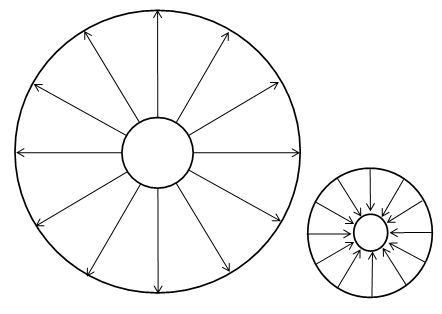 | Figure 6. Hydrogen atom and neutron |
Both boundary spheres of the neutron are displaced from their balanced radii, thus each of them is tending to its own free-state radius. With these two opposite radial tendencies, a free neutron is relatively unstable particle. Though the two simple compositions obey the external electrical neutrality, their internal domains are disturbed by the opposite fields between their two structural spheres. Each of the next atoms, starting by deuterium, is formed by successive addition of the neutrons or hydrogen atoms. Apart from their external neutralities, the internal neutralities of the next compositions are thus also gradually approached. With respect to the quantitative ratio of the two neutral components, the central nucleus would be thus successively dressed by a number of electronic shells. Mutual influences of neighboring shells disturb their central symmetries, thus determining magnetic moments or angular quantum numbers. With respect to the same such numbers on the shells and in nucleus, similar concentric mutual wear of the nucleons may be expected. The cluster model, as the molecular analogy, is superseded. The disturbances of two general laws substitute the assumed weak nuclear forces. The strong forces between non-existent quarks can be excluded.
6.7. Nuclear Processes
By alternating addition of the two neutral particles, the disturbances of internal EM states alternate as the extreme values of the force given on Fig. 3. The disturbance caused by a new hydrogen atom, changing the chemical element, is compensated or even superseded by one or more neutrons, producing respective isotopes. Thus the tritium, obtained by a new neutron attracted magnetically by disturbed nucleus of deuterium, suffers the opposite electric disturbance. The next atom – of helium, in fact containing two of deuterium atoms probably connected magnetically, better compensates former electric and magnetic disturbances.Of course, the oppositely alternative disturbance gradually decreases alike the summary force (Fig. 3). This fact points to decreasing energetic jumps of the internal EM disturbance – against increasing atomic weights. However, the energetic disturbance of homogeneity, manifest in the surroundings as the gravitation, is increasing in the same direction, with their common minimum at the iron atom. The greater atoms are apt to the radiation and fission into the simpler atoms, with some nuclear energy released into the space. However, this one is much weaker from the thermo-nuclear energy, at the mentioned fusion of the smaller atoms.Very long lives of free protons and electrons just confirm their elementary natures. The stable atoms of majority of the chemical elements are also long-living. The smaller of them are more stable, and the greater contain proportionally more energy. The other registered short living particles probably comprise the photons, enabling the greater numbers of the possible combinations. In fact, all these particles appear and exist at the speeds very close to the speed of light. Though very small, the speed difference conditions the soon photon departure from such the structures. Thus ruined remainders continue their further dissolution.Irrespective of the unique lapse of their times, related to the cosmic process, the more rapid particles are more stable, and therefore, live longer. Comparing the main features of the noticed particles, the formal quark theory is composed. Instead of thus predicted division of elementary charge in the thirds, it is effectively diminished nearly to 2/3 of its value, by the longitudinal dynamic field component (9), subtracted from the central static field (7). The presences of structural photons probably can explain the additional quark features. These temporary compositions are incidental, and cannot be expected in the usual stable matter.Unlike the spherical symmetry of the particles, projected along temporal axis, photons are axially symmetric – in 3D space. As such, they do not manifest their electric charges or respective inertial masses. According to their energies, some equivalent masses may be ascribed to them. Really, photons and EM waves exert some pressure upon irradiated surfaces, and curve their paths in the course of transverse gravitational fields. Though the right-screw and left-screw photons do not effectively distinguish in the experience, their mutual wears probably form neutrinos, with the same speed of propagation and the tiny equivalent masses.
7. Summary
With the explicit or implicit scientific criteria, the known theories of the classical physics were successfully founded, more or less consistently and/or completely. At least two of them are reduced to respective sets of the basic laws. In spite of the mentioned systematic inconsistency of mechanics, it is successfully treated by mathematical field theory. Owing to sensory inaccessible essences of EM phenomena, respective theory is founded on the differential notions, taken from fluid mechanics. Though not fully completed, these theories were followed by free scientific communications, thus enabling at least their successful applications. In the shadow of these applications, their inconsistencies or incompleteness were lost from view. For this reason, they could not be successfully applied to the boundary questions of micro-structure and/or cosmology. Without elaboration of the inherited classical bases, the continuity of the scientific development was broken. This lack is tried to make up by the experimental perfection and formal speculation. Apart from the classical tradition, its implicit methodology is reduced. The modern science just prefers the two objective sources (empirical and formal), on account of the – less reliable – subjective criteria (rational and intuitive).However, without the needed subjective verification and control, the objective results of the complex experimental or mathematical procedures are uncertain and called in question. The arbitrary ideal formal principles, usually incompatible with some scientific criteria, thus follow into the doubtful interpretations, even – of the valid objective results. By its speculative character, the modern physics thus exceeds even the classical philosophy. After their long-lasting repetition, the initial provisory theories are gradually accepted as the absolute truths. The rigorous scientific censorship excludes any critique of thus founded ideology.The final elaboration of EM theory [1, 2] enables a strict reconsideration of the main aspects of the inherited modern theories. As the typical example, let us cite SRT. One by one pretext for its introduction is uprooted in [1, 4, 5] and this text. In its essence, SRT may be reduced to the imposition of the artificial symmetries to the physical relations, thus calling in question space and time, as the two natural categories and the formal frame of each consideration. All the attempts of its application follow into the insolvable contradictions. All its ideas have the convincing alternatives. Therefore, it can be tolerated as a scientific provocation.After exclusion of the two relativities, there remain no much reasons even for the diminished Einstein’s fame. Not only that his famous relation was obtained accidentally, but he (or anybody else) did not notice its more or less direct equivalences with Maxwell’s relation and/or Coulomb’s law. Though emphasized by him, the forth dimension is averted by his SRT to be related with the cosmic process. Similar is his declarative affirmation of the curve space, without any due interpretation. The explanation of photo-electric effect is also incomplete. The general field theory is merely here founded, at least in the first approach. In the frames of this theory, the majority of the modern empirical results are successfully incorporated into the new system, and some of quantum antinomies are convincingly resolved. The nature of mass, its dependence on speed and its defects in the compound structures are explained as EM effects. The longitudinal inertia is referred to the electric, and transverse – to magnetic fields around particles. The former rather mystical dual natures of the photons and particles are also substituted by respective vortical models – in the spatial or temporal domains, essentially distinct from EM waves, though somehow similar to them.In accord with the summary structural force (Fig. 3), via stratification of matter and vacuum medium, a structural axis is introduced, as the fifth physical dimension, also supported by Poynting’s theorem [1]. By all appearances, fifth is the sufficient number of the axes for explanation of the known natural phenomena. The string theory, founded on the more dimensions, may be thus excessive. Although founded on the noticed particle features, the quark theory arbitrarily and artificially combined them. Among the others, electricity and mass, as the two angles of view on the same particles, cannot be separated by mechanical splitting. In the final instance, the well-known – very expensive – experiments thus also appear as nearly useless. Directed to the apparent matter, they persistently try its infinite division. The particles – already elementary – cannot be divided by the collision, but the addition of the vast kinetic energies enable the formation of some compound, unstable and short living structures. In the attempts of their explanation, each of the noticed their features is ascribed to a separate structural part. However, these features represent the various angles of view onto the same natural entities. Modern theory thus calls in question even the perfect experiments.The mentioned summary structural force presents a few successive material structural strata. The particular strata are conditioned by the forms of respective structures and the force balances of all the present force fields. This structural principle is extended to a vacuum medium, with a qualitative distinction. The various material forms, as the images in this medium, are enabled by its – at least statistical – continuity along the fifth axis. This fact is announced by the continual variations of the particles or photons in their motion. As the temporal projections from 4D space, the particles are strictly quantized and energetically arranged. By the gradual generalization of Newtonian force balance or the equivalent law of energy conservation, the principle of energetic homogeneity, as the most general physical law, is here introduced. The specific and opposite variations of the energy densities are manifest as the electrical bipolarity. The general neutrality thus appears as the particular case of the general homogeneity. Though satisfied along the fifth axis, these principles are disturbed at particular structural strata. Respective physical forces, as the energy gradients, tend to obey these principles at each stratum separately. In any case, their general senses are obligatory. By concentric mutual dressing of protons and electrons, as the apparent particles, with the opposite distributions of their potentials, two neutral structures are formed: hydrogen atom and neutron. The space around these two forms is generally neutral. By their alternative and/or successive superposition, various atoms and their isotopes are obtained. With respect to the structural stratification of matter, this process may be understood as their succession along the structural axis. The projection into 3D space appears as the concentric successive dressing. Such compositions, as the wholes, also tend to their own minimal energetic disturbances.EM phenomena are already based on general neutrality and its opposite disturbances in various structural strata [2]. As the implicit pivot of this exposition, EM fundaments are transparently presented in [1], and as such understood in this consideration. The readers of this text are also expected to be aware of the former scientific development, its unresolved problems and the ideas for their resolutions. The long lists of the former references are thus fully excessive. Such relevant details are here directly mentioned in the needed convenient forms, and convincingly compared with respective, further offered alternative interpretations.
8. Conclusions
The most famous scientific revolution, well-known as the Copernican U-turn, only substituted one spatial reference by the other, for a step higher in the hierarchical sequence of such spatial references. Irrespective of the planetary orbits being simpler in the frame connected to the Sun, the satellite orbits further refer to their native planets. As the latter fact was overlooked, the former one gave the impression of the great scientific revolution. This impression was additionally reinforced by the crude resistance of some contemporaries, firmly conditioned by the sensory experience and respective Ptolemaic cosmology already established.This situation is somehow comparable with our relation of Thomson’s algebraic, with Maxwell’s differential equations of electrodynamics [1]. Not only that the new set is much simpler, equivalent and/or complementary – in application, but it is the best bases for derivation of the old set. Owing to its implicit form, Maxwell’s set demands respective mental sacrifice to be accepted, under the force of the authority or empirical facts, without the clear interpretations. We cannot expect easy renunciation of this sacrifice already invested. All attempts to affirm the new set stay without any success, irrespective of the strong arguments. Unfortunately, this one is just the minimal sacrifice that this our exposition expects from the contemporary physicists. Apart from the convincing elaboration and extension of EM theory, the main pretexts for former foundation of SRT are here finally unmasked, with the convincing arguments and systematic alternatives. The minimal sacrifice needed for the acceptance of Maxwell’s theory cannot be even compared with that needed to believe into this fully absurd speculative creation. In relation to Maxwell and his equations, mainly known by the specialists, Einstein and his theory are the general synonyms of human genialness.The remaining needed sacrifices are also not restricted to the scientists. The popularization just underlines the mostly problematic scientific theories. Who can accept a collective resolution of all the habituated antinomies of the quantum theory and/or modern cosmology? By perpetual repetition, these antinomies took the mystical status of the supernatural phenomena, comparable only with God’s will. The partial considerations of the phenomena, as time, cosmic expansion and gravitation, must be substituted by their convincing relation. Psychical structures of the scientists would be thus rearranged and considerably advanced.The sooner sequence of Nobel Prizes obtained for physics just points to a methodological crisis of this natural science. Not only that some of these contributions are theoretically problematic or just here fully surpassed, but each of them is a minor doddle with respect to this text. Being confident in its own general orientation, this science is preoccupied by the petty details, neglecting the whole as if being inexistent. The partial results only exchange the old by new concepts, with the further complication of their formal relations. Ascribing gravitation to spatial curvatures, and mass – to some bosons, only mystify these two phenomena.Directed contrariwise, this exposition treats physics as the whole. The comparison and mutual relation of its laws and theories follows into the convincing synthesis. As the central physical discipline, electrodynamics already explained the known laws of mechanics as well as some of structural facts established empirically. The cognitive loop is finally closed by the consistent cosmology. With the time included into 4D space, the apparent matter is finally substituted by the more universal energy. The two remaining natural categories, as the two metaphysical notions, are mutually related by the sufficient number of one general law.
References
| [1] | B. Mišković, Elaboration of Electrodynamics, SAP, I. J. of Theoretical and Mathematical Physics, 6(1), 2016. |
| [2] | B. Mišković, Fundamentals of Electrodynamics, SAP, I. J. of Electromagnetics and Applications, 5(1), 2015. |
| [3] | B. Mišković, Final Essence of Material Existence, SAP, I. J. of Theoretical and Mathematical Physics 5(1), 2015. |
| [4] | B. Mišković, Space, Time and Motion, SAP, I. J. of Theoretical and Mathematical Physics, 5(2), 2015. |
| [5] | B. Mišković, Relativity and/or Symmetry, SAP, I. J. of Theoretical and Mathematical Physics, 4(5), 2014. |
| [6] | B. Mišković, Medium of Natural Phenomena, SAP, I. J. of Theoretical and Mathematical Physics, 4(4), 2014. |


 Abstract
 Reference
 Full-Text PDF
 Full-text HTML