
-
Paper Information
- Next Paper
- Previous Paper
- Paper Submission
-
Journal Information
- About This Journal
- Editorial Board
- Current Issue
- Archive
- Author Guidelines
- Contact Us
International Journal of Theoretical and Mathematical Physics
p-ISSN: 2167-6844 e-ISSN: 2167-6852
2012; 2(6): 211-214
doi: 10.5923/j.ijtmp.20120206.06
Diffraction of Impulse Sound Signals on Spheroidal Body, Put in Plane Waveguide
 Abstract
 Reference
 Full-Text PDF
 Full-Text HTML
A. A. Kleshchev , E. I. Kuznetsova
Saint , Petersburg State Navy Technical University, Saint , Petersburg, Lotsmanskaya st., 3, 190008, Russia
Correspondence to: A. A. Kleshchev , Saint , Petersburg State Navy Technical University, Saint , Petersburg, Lotsmanskaya st., 3, 190008, Russia.
| Email: |  |
Copyright © 2012 Scientific & Academic Publishing. All Rights Reserved.
With the help of the Fourier transform and characteristics of the stationary (continuos) sound signal are calculated the impulses, scattered by the ideal spheroid, placed in the waveguide. In the first part of the paper is presented the method of the imaginary sources and imaginary scatterers from the solution of the problem of the sound diffraction on the spheroidal body, put in the plane waveguide. In the second part of the paper are calculated the impulse signals with different filling, scattered by the the ideal soft spheroid, placed in the plane waveguide.
Keywords: Diffraction, Waveguide, Impuls, Spheroidal Body, Source, Scatterer, Imaginary
Cite this paper: A. A. Kleshchev , E. I. Kuznetsova , "Diffraction of Impulse Sound Signals on Spheroidal Body, Put in Plane Waveguide", International Journal of Theoretical and Mathematical Physics, Vol. 2 No. 6, 2012, pp. 211-214. doi: 10.5923/j.ijtmp.20120206.06.
Article Outline
1. Introduction
- At the basis of the method of the imaginary sources and imaginary scatterers is calculated the pulse sequence, got from the spheroidal scatterer, accommodated in the plane waveguide with the ideal boundary conditions. The impulse signals put the energy, therefore they are propagating with the group velocity (as and the energy), which lie in the principles of the method of the imaginary sources and imaginary scatterers.
2. The Method of the Imaginary Sources and Imaginary Scatterers for the Spheroidal Body, Put in the Plane Waveguide
- The scattering of sound by the bodies, placed in the waveguide, are investigated in the papers[1] –[9]. In thepaper[1] were calculated the spectral characteristics of the idial spheroid, placed in the sound channel, by the impulse irradiation; in the papers[8] and[9] with the help of the method of the imaginary sources and scatterers are found the vertical distributions of the scattered sound field of the ideal soft spheroid, placed in the plane waveguide, at the irradiation his by the harmonic signal. In the present paper are investigated and calculated the impulse signals with the different filling.Let's put the ideal soft spheroid into the liquid layer with the thickness
 and the constant sound velocity. At the upper boundary of the waveguide is fulfilled Dirichlet condition, at the lower boundary – Neimann condition. The axis of the rotation of the prolate spheroid will be orientated parallel to the boundaries of the waveguide and perpendicular to the plane of the figure 1. The dimensions of the scatterer, distance from it to the boundaries and the thickness of the waveguide H are supposed to be such that we can do without taking into consideration the scattering of the second order of the waves reflected from the boundaries of waveguide are not taken into account in the further process of the diffraction.The centre of the scatterer is fixed on axis X at the distance 200 m. from the bottom, at the horizontal distance L from it and on the axis X (Figure 1) is placed the point-source 01 of the impulse sound signal. Using the method of the imaginary sources and scatterers[8. 9], are found the scattered impulse signal in the point 0. The sound impulse signals were the two appearance: with the harmonic and frequency-modulated filling. In the point 0 arrive the signals from everybody scat-terers and everybody sources.The spectrum
 of the sound impulse of the source
 with the harmonic filling has the appearance[10] :
 | (1) |
 – the frequency of the filling of the impulse;
 – the number of the oscillation periods of the harmonic signal in the impulse;
 – the circular frequency.The normalized impulse
 and the modulus of his spectrum
 are presented at Figure 2.
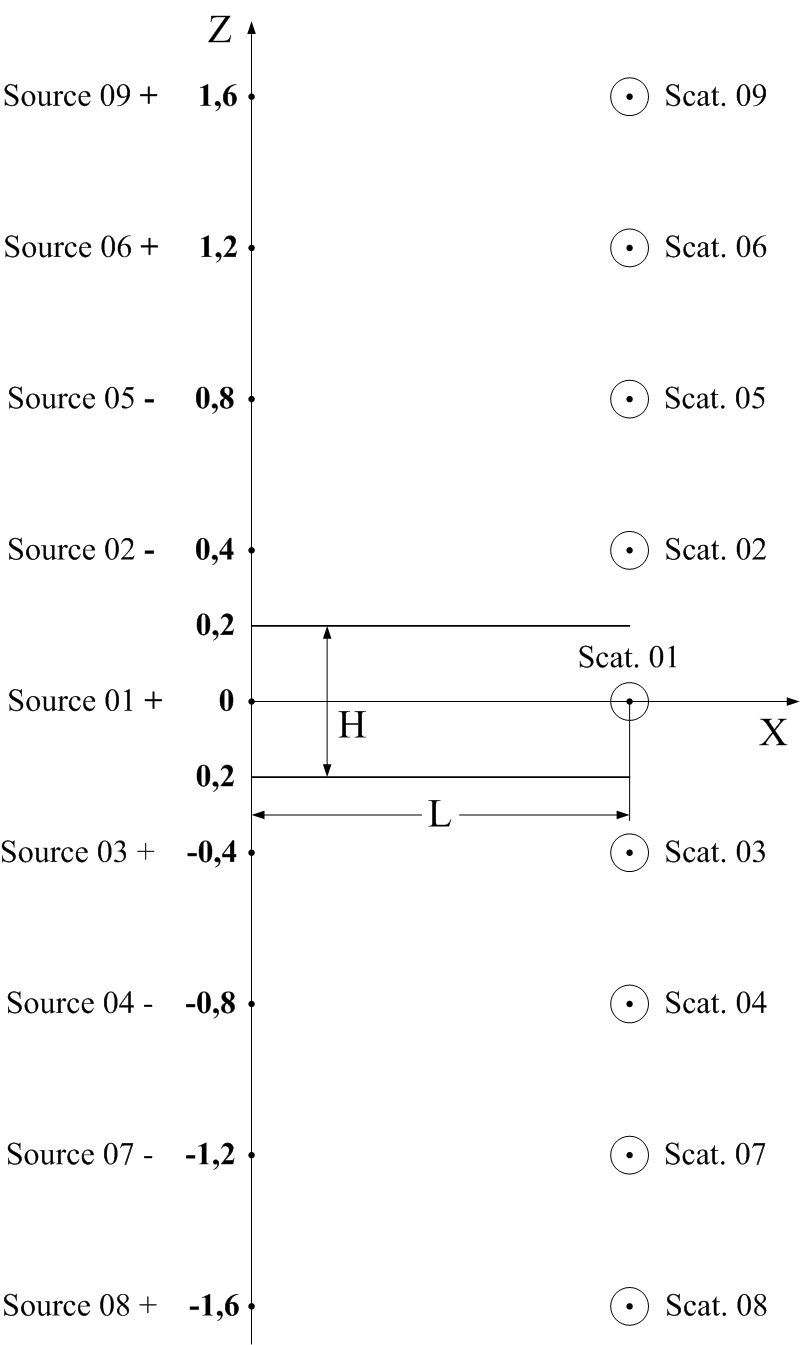 | Figure 1. The mutual disposition of the impulse point-soirces and scatterers in the plane waveguide |
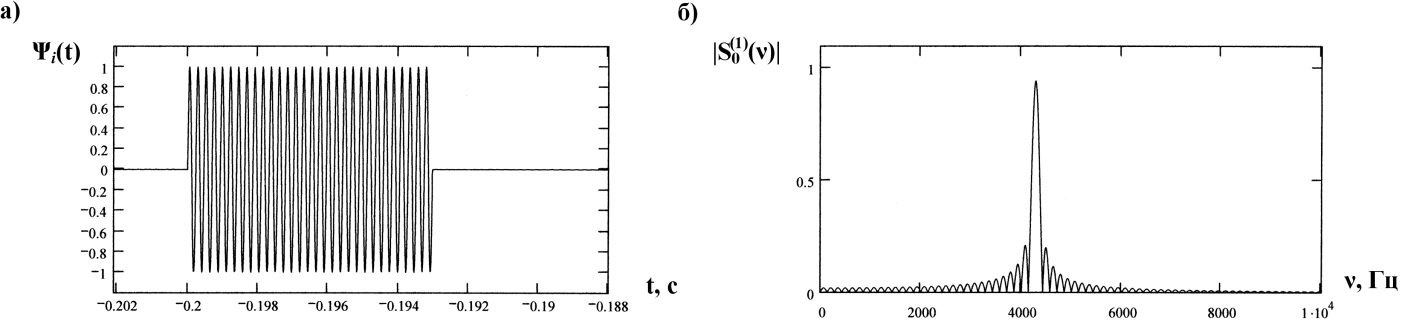 | Figure 2. a) the falling impulse  with the harmonic filling; b) the modulus of the spectrum  of the impulse  |
 | Figure 3. a) the falling frequency-modulated impulse  ; b) the modulus of the spectrum  of the impulse  |
 is connected with
 by the return Fourier transform:
 | (2) |
 is by the product of the spectrum
 at the corresponding meanings of the angular characteristic of the scattering of the soft spheroid
 (
 and
 – the angular coordinates of the point of the observation).The angular characteristic of soft spheroid
 had calculated by the formula[8]:
 | (3) |
 the wave dimension,
 the wave number in liquid,
 the half – focal distance;
 the normalized angular spheroidal function;
 and
 the radial spheroidal functions of the first and third forms correspondingly;

 the radial coordinate of the scatterer;
 the angular coordinate of the source.The falling impulse with the frequency-modulated filling
 has the appearance[10]:
 | (4) |
 of the falling impulse with the frequency-modulated filling is found with the help of the Fourier transform for the function
 [10]:
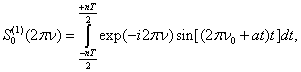 | (5) |
 in the impulse.The impulse
 and the modulus of his spectrum
 are presented at Figure 3.
3. Calculation of the Pulse Sequence, Got from Spheroidal Scatterer
- By the chosen orientation of the scatterer his angular characteristic
 is found oneself by “isotropic” in the correlation from the angle
 in the chosen range of the wave dimensions of the spheroid
 (
 where
 - the half – focal distance of the spheroid,
 - the length of the sound wave in the liquid )[1, 8]. We map into the source 01 and the scatterer 01 relatively of the boundaries of the waveguide like this, in order that we had 9 the imaginary sources and 9 the imaginary scatterers. The formulas for the calculation of the angular characteristics of the spheroid
 are given in[11 – 15, 1, 8]. For the chosen system of the sources and scatterers we will calculate the series of the reflected impulses in the point 0. The distance L between the source 01 and the scatterer 01 we accept equal 1000 m., – 400 m., the correlation of the half-axises of the spheroid is equally 10, but his half-focal distance is equally 0,2777 m. At Figure 4 and 5 are presented the normalized series of first three reflected impulses with the harmonic filling
 (Figure 4) and the frequency-modulated impulses
 (Figure 5). Number of the imaginary sources and scatterers are appeared the another impulses, coming in the point 0 noticeable latest.
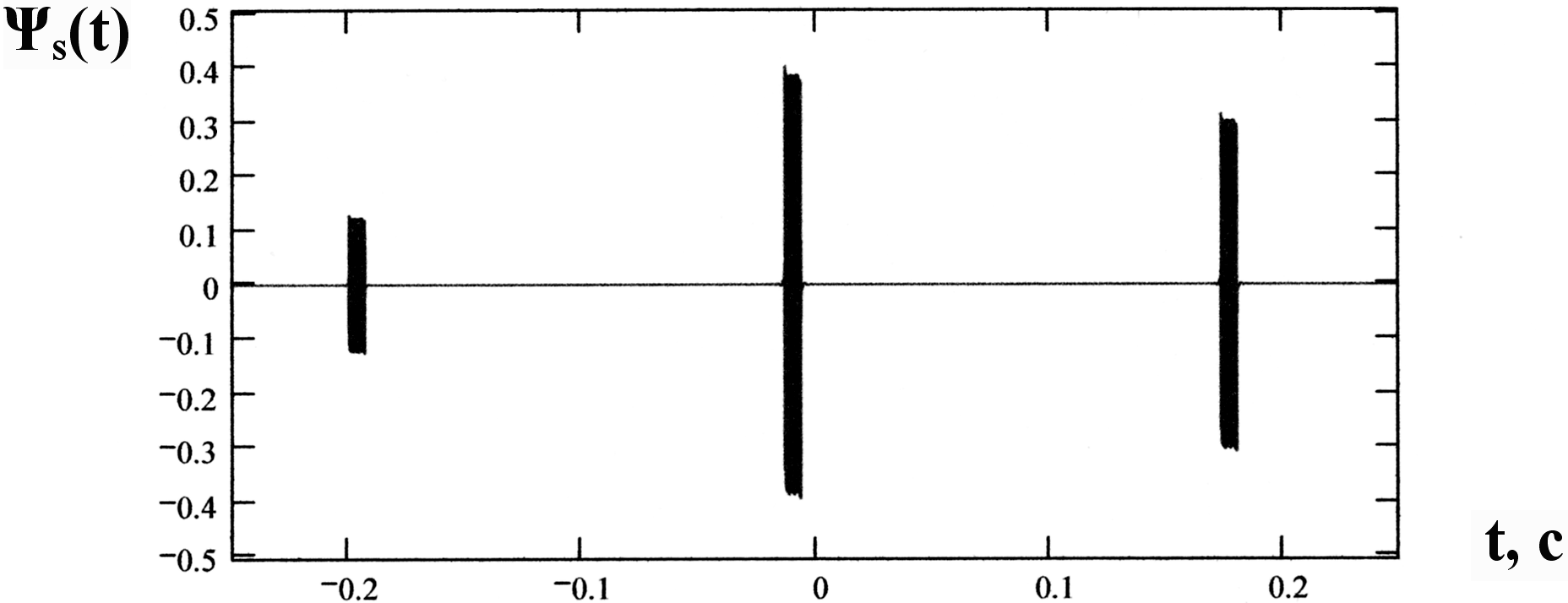 | Figure 4. The normalized series of first three reflected impulses with the harmonic filling in the point 0 |
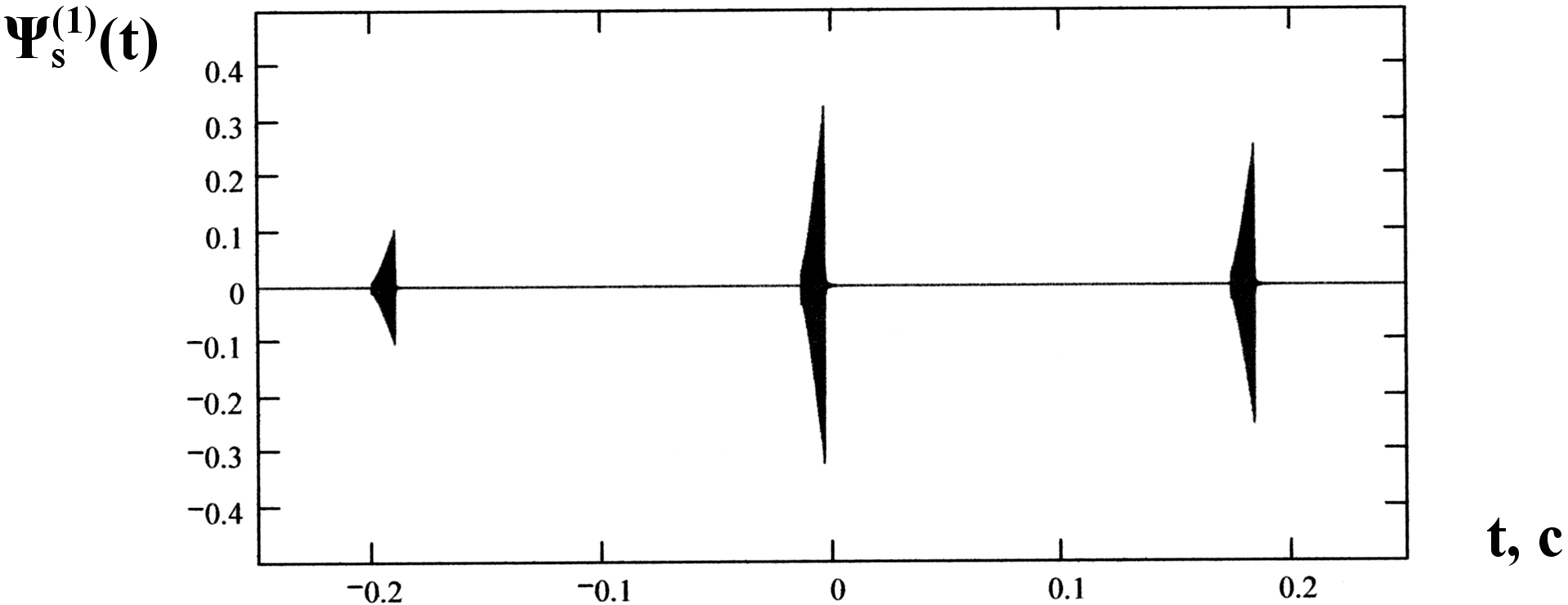 | Figure 5. The normalized series of first three reflected frequency-modulated impulses in the point 0 |
4. Conclusions
- In the paper is shown the effectiveness of the method of the imaginary sources and imaginary scatterers for the pulse sequence, got from spheroidal body and based at the use of the group velocity of the sound. The calculations of the scattered impulse signals with the different filling were done with the help of the Fourier transform and the characteristics of the scattering of the stationary (continuos) sound signal.The applied interest is concluding in the detection of theunderwater object in the small sea.
ACKNOWLEDGMENTS
- This worc supported as part of research under State Contract no P242 of April 21, 2010, within the Federal Target Program “Scientific and scientific – pedagogical personnel of innovative Russia for the years 2009 – 2013”.