
-
Paper Information
- Paper Submission
-
Journal Information
- About This Journal
- Editorial Board
- Current Issue
- Archive
- Author Guidelines
- Contact Us
International Journal of Prevention and Treatment
p-ISSN: 2167-728X e-ISSN: 2167-7298
2013; 2(3): 32-37
doi:10.5923/j.ijpt.20130203.02
Significance of Teaching Basic Physiotherapy Techniques to Non-Medical Workers in Rehabilitation Home or Center
 Abstract
 Reference
 Full-Text PDF
 Full-text HTML
Senthilkumar Thiyagarajan , Johnson Dhilip Christopher
Department of Physiotherapy, Faculty of Therapeutic Sciences, Asia Metropolitan University, Malaysia
Correspondence to: Senthilkumar Thiyagarajan , Department of Physiotherapy, Faculty of Therapeutic Sciences, Asia Metropolitan University, Malaysia.
| Email: |  |
Copyright © 2012 Scientific & Academic Publishing. All Rights Reserved.
Prevention of disability and related complications are the challenge faced by rehabilitation care worker in the community. Currently around 10 per cent of the total world's population, or roughly 650 million people, live with disability. A disability may be present from birth, or acquired during a person's lifetime. Role of physiotherapist as rehabilitation team member is to help the disabled person to achieve better quality of life and do functional activities independently. The need of qualified physiotherapists in the rehabilitation home is increasing day by day whereas number of physiotherapists who works in such rehabilitation set up is less. This demand and supply gap could be met by organizing well planned hands on training of non-medical care givers who spend most of the time with patients in a care centre or old age home. These trainings will give confidence to the care giver to handle the patient in the absence of a physiotherapist and assist the physiotherapist during the treatment sessions. These training sessions must be focused to improve the quality of life and functional capacities of residents in the homes or centers. By understanding and performing the basic physiotherapy techniques a caregiver can effectively prevent and reduce the disability related complications in the rehabilitation home or centre. The aim of this paper encourages the physiotherapist to share knowledge to non medical workers for enhance the rehabilitation process to achieve the better quality of life to physically disabled.
Keywords: Physiotherapy, Rehabilitation, Disability, World Health Organization (WHO)
Cite this paper: Senthilkumar Thiyagarajan , Johnson Dhilip Christopher , Significance of Teaching Basic Physiotherapy Techniques to Non-Medical Workers in Rehabilitation Home or Center, International Journal of Prevention and Treatment, Vol. 2 No. 3, 2013, pp. 32-37. doi: 10.5923/j.ijpt.20130203.02.
Article Outline
1. Introduction
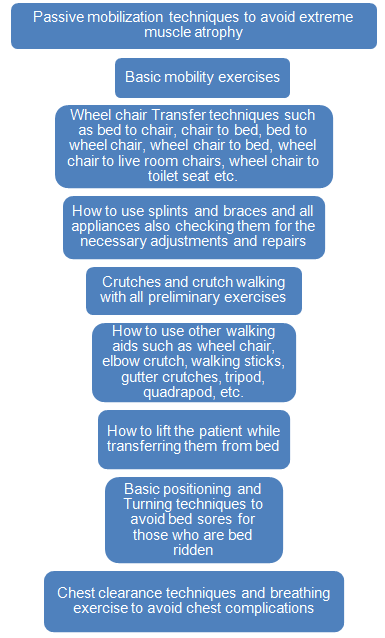
- The World Health Organization estimates that there are about one billion persons with disabilities worldwide (1). Most of the disabled persons are rehabilitated in the community level rehabilitation home, where there is unavailability of specialist professionals at all time. In most cases, a non-medical person is taking care of the disabled person. A community level rehabilitation center accommodates persons with various disabilities. Disabilities fall into two groups such as acute short-term conditions and chronic long term disabilities. Second group are paraplegic, hemiplegics, quadriplegics, amputees, miscellaneous disabilities resulting from arthritis, poliomyelitis, cerebral palsy, multiple sclerosis or Parkinson’s disease. During rehabilitation sessions disabled clients may be classified as Bed ridden patients, Wheel chair bound patients and Ambulatory patients (8). Though the caregivers are trained in basic nursing of these patients they are not adequately exposed or trained to assist or handle patients during a physiotherapy session. This lack of knowledge and practical skill may put disabled person at higher risk in getting disability related complications. Over a billion people are estimated to live with some form of disability. This corresponds to about 15% of the world's population. Between 110 million (2.2%) and 190 million (3.8%) people 15 years and older have significant difficulties in functioning. When most of us think of the word "disability" we immediately picture someone in a wheelchair. There are many other disabilities listed by medical professional such as people who are blind or partially sighted, learning or intellectual disabilities, who are deaf or hearing impaired, people with a physical disability, people with long term illnesses, people with mental health or psychological difficulties, people with an acquired brain injury and spinal cord injuries(5).From my experience with the rehabilitation homes in Malaysia, there is a felt need to train non-medical workers in basic physiotherapy techniques such as transferring, passive mobilization, bed care, bed mobility and bed hygiene. Basic physiotherapy skills should be delivered to the care givers by planned and well-structured workshops. Care givers should be trained in assisting a physiotherapist during treatment session and in caring the patient independently in the absence of a physiotherapist.
1.1. Current Global Scenario of Disability
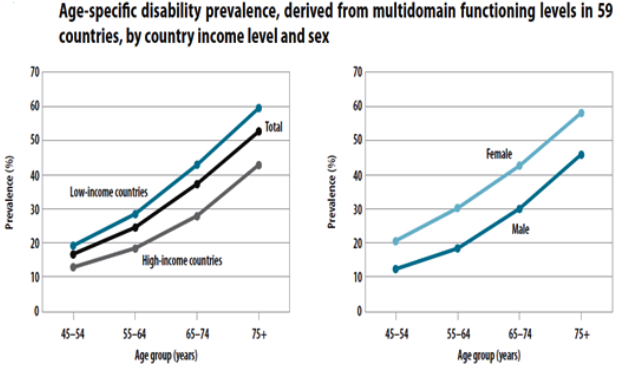 | Figure 1. Age specific disability prevalence, derived from multidomain functioning levels in 59 countries, by country income level and sex (WORLD REPORT ON DISABILITY- WHO) |
- The World Health Organization (WHO) estimates about 15 percent of the world's population or 1 in every 6 persons has a significant physical or mental disability(9). The GBD (Global burden of disease) uses the term disability to refer to loss of health, where health is conceptualized in terms of functioning capacity in a set of health domains such as mobility, cognition, hearing and vision. In 2004, the World Health organization estimated world populations of 6.5 billion people, of those nearly 100 million people were estimated to be moderately or severely disabled (10). In the United States, Americans with disabilities constitute the third-largest minority (after persons of Hispanic origin and African Americans); all three of those minority groups number in the 30-some millions in America (11). According to the U.S Bureau of the Census, as of 2004, there were some 32 million disabled adults (aged 18 or over) in the United States, plus another 5 million children and youth (under age 18). If one were to add impairments—or limitations that fall short of being disabilities—Census estimates put the figure at 51 million(12). Nearly eight million men in Europe returned from the World War I permanently disabled by injury or disease. (13) About 150,000 Vietnam veterans came home wounded, and at least 21,000 were permanently disabled. (14) Global ageing has a major influence on disability trends. There is higher risk of disability at older ages and national populations are ageing at unprecedented rates. GBD estimates children aged 0-14 years experiences moderate or severe disability at 93 million (5.1%). With 13 million experiences severe disabilities (0.7%). UNICEP estimated the number of children with disabilities under age 18 at 150 million. (15)
1.2. Scope and Role of Physical Therapist in Rehabilitation Home
- Physical therapists are health care professionals who are skilled in the promotion of optimal mobility and function (2). The management of dysfunction within the major body systems (musculoskeletal, neuromuscular, cardiopulmonary, and integumentary) represents the major scope of practice for the profession of physical therapy. Disablement model says, Physical therapists focus on the management of impairments, functional limitations, and disabilities in these four body systems (3). Physiotherapists use their extensive knowledge and skills to promote improved public health. Furthermore, physical therapists, which are recognized as experts in rehabilitation, are becoming increasingly involved in the development of health care policy. In this regard, physical therapists promote health and wellness in community through involvement in activities that encourage the public to adopt healthy behaviors, especially as they relate to fitness and mobility (16). These activities may include the performance of screening and the provision of recommendations to prevent disease and disability, including modification of life style risk factors for heart disease, diabetes, and obesity (17) and the development and implementation of programs to reduce fall risk in the elderly(18).Physiotherapy is the skilled use of physiologically-based movement techniques, supplemented when necessary by massage, electrotherapy and other physical means for the prevention and treatment of injury and disease. It is used to assist the process of rehabilitation and restoration of function, including the achievement of personal independence. The work of the Physiotherapist is therefore essential to ensure a good quality of life of individuals ranging from children to the elderly with various disabilities (physical, neurological, psychosocial, sensory and other…) and rehabilitation needs and their integration in the community. (2) Physiotherapists are therefore of paramount importance in the effective operation of the health care, social welfare and education systems. According to American Physical Therapy Association, Physical therapy is defined as the care and services provided by or under the direction and supervision of a physical therapist. Thus, only a physical therapist can supervise, direct, and provide physical therapy services (4). In countries where there is scarcity of qualified and licensed physiotherapist, it is not possible to give good quality life to the residents unless and until non-medical workers are trained and involved in the process of providing physiotherapy care and rehabilitation.Care givers should be given training in handling the patient in the absence of a physiotherapist and assist the physiotherapist during the treatment sessions performed by therapists. These training sessions should be planned primarily to improve the quality of life and functional capacities of residents in the disabled homes.
2. Training Model
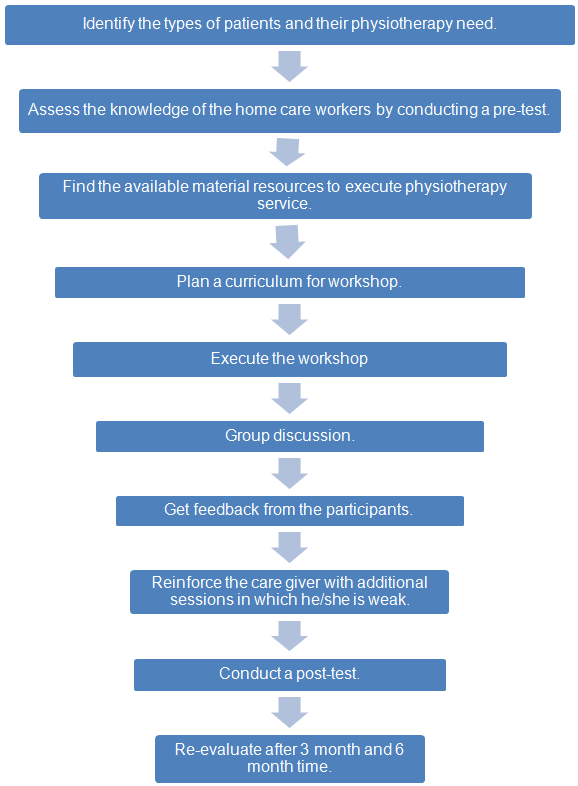
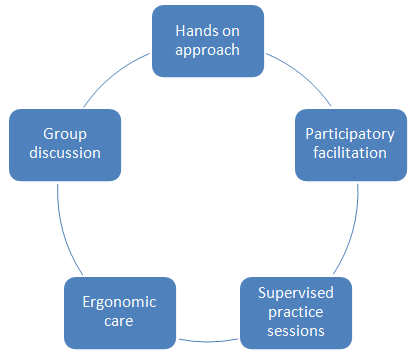
- Well planned and structured workshops with greater proportion of practical components tailored to address the needs of the specific rehabilitation home / home workers.
2.1. Transferrable Basic Skills Identified
2.2. Step-By-Step Approach in Training Home Care Workers
2.3. Components of Training
2.4. Expected Benefits of Training
3. Conclusions
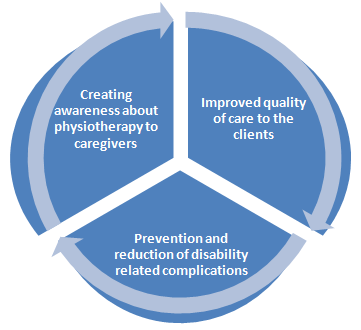
- There is a lack of trained professionals in community rehabilitation set up such as rehabilitation home or center. The available non-medical workers are not adequately trained in giving basic physiotherapy service to the patients in need. Hence, training of non-medical workers in basic physiotherapy techniques will create awareness about the beneficial effects of physiotherapy in the management of the disabled person. It will also help the worker to give improved quality care to the person in need. By understanding and performing the basic physiotherapy techniques a caregiver can effectively prevent and reduce the disability related complications. These types of trainings will help in bridging the gap of unavailability of manpower in rehabilitation sector and will provide quality care of patients at the community level.