
-
Paper Information
- Paper Submission
-
Journal Information
- About This Journal
- Editorial Board
- Current Issue
- Archive
- Author Guidelines
- Contact Us
International Journal of Probability and Statistics
p-ISSN: 2168-4871 e-ISSN: 2168-4863
2020; 9(2): 42-44
doi:10.5923/j.ijps.20200902.03
Received: Aug. 21, 2020; Accepted: Sep. 9, 2020; Published: Sep. 17, 2020

Characterizations of the New Two-Parameter Poisson-Sujatha Distribution
 Abstract
 Reference
 Full-Text PDF
 Full-text HTML
G. G. Hamedani
Department of Mathematical and Statistical Sciences, Marquette University, Milwaukee, WI, USA
Correspondence to: G. G. Hamedani, Department of Mathematical and Statistical Sciences, Marquette University, Milwaukee, WI, USA.
| Email: |  |
Copyright © 2020 The Author(s). Published by Scientific & Academic Publishing.
This work is licensed under the Creative Commons Attribution International License (CC BY).
http://creativecommons.org/licenses/by/4.0/

The problem of characterizing a distribution is an important problem in applied sciences, where an investigator is vitally interested to know if their model follows the right distribution. To this end the investigator relies on conditions under which their model would follow specifically the chosen distribution. In this work, we present certain characterizations of the new two-parameter Poisson-Sujatha distribution introduced by Shanker et al. (2020) with the intention of completing, in some way, their work. These characterizations are based on the conditional expectation of certain function of the random variable and in terms of the inverse hazard function.
Keywords: Poisson, Sujatha
Cite this paper: G. G. Hamedani, Characterizations of the New Two-Parameter Poisson-Sujatha Distribution, International Journal of Probability and Statistics , Vol. 9 No. 2, 2020, pp. 42-44. doi: 10.5923/j.ijps.20200902.03.
1. Introduction
- Characterizations of distributions is an important part of the distribution theory which has attracted the attention of a good number of researchers in applied sciences, where an investigator is interested to know if their data follows the appropriate distribution. To this end, the investigator relies on the conditions under which their data would follow specifically the chosen distribution.Shanker et al. (2020) introduced a new discrete probability model called New Two-Parameter Poisson-Sujatha (NTPPS) distribution which includes Poisson-Sujatha and Poisson Akash distributions. They argued that such a distribution is needed in the case of over-dispersed count data sets. In this very short note, we present certain characterizations of the NTPPS distribution, for simplicity, with parameters
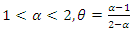 , based on: (i) the conditional expectation of certain function of the random variable and (ii) in terms of the reverse hazard function. The main goal here is to complete, in some way, the work of Shanker et al. (2020).The cumulative distribution function (cdf),
  the corresponding probability mass function (pmf),
  and the reversed hazard function,
  of the NTPPS distribution are given, respectively, by
  | (1) |
 | (2) |
 | (3) |
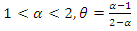 are parameters,
  is the normalizing constant and, for simplicity,
2. Characterization Results
- Proposition 1. Let
 be a random variable. The pmf of
  is (2) if and only if
  | (4) |
 has pmf (2), then the left-hand side of (4), using the formula for the finite geometric series, will be
  Conversely, if (4) holds, then
 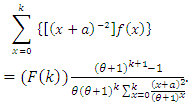 | (5) |
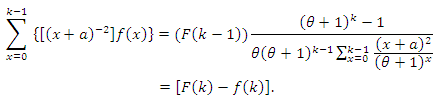 | (6) |
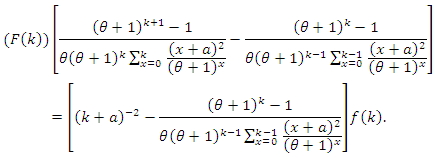 or
or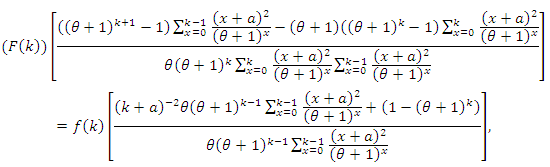 or
or 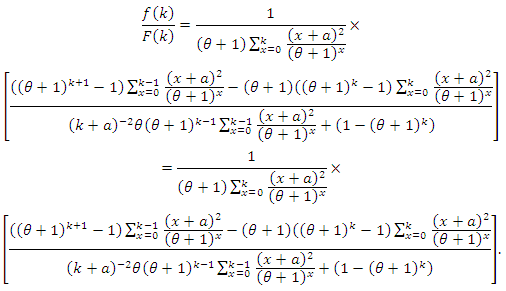 After some rearranging the terms and simplifying, we arrive at
 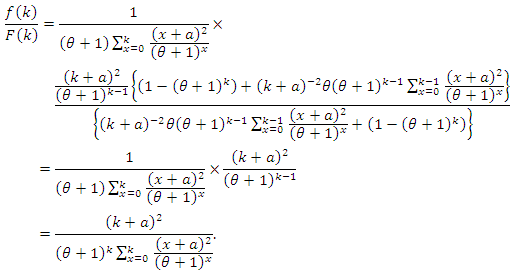 From the last equality, we have
 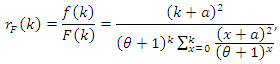 which, in view of (3), implies that
  has pmf (2).Proposition 2. Let
  be a random variable. The pmf of
  is (2) if and only if its reverse hazard function,
  satisfies the following difference equation
 | (7) |
 Proof. Clearly, if
  has pmf (2), then (7) holds. Now, if (7) holds, then
  or
or or, in view of the initial condition
  we have
  which is the reverse hazard function corresponding to the pmf (2).