
-
Paper Information
- Paper Submission
-
Journal Information
- About This Journal
- Editorial Board
- Current Issue
- Archive
- Author Guidelines
- Contact Us
International Journal of Psychology and Behavioral Sciences
p-ISSN: 2163-1948 e-ISSN: 2163-1956
2026; 16(2): 54-60
doi:10.5923/j.ijpbs.20261602.02
Received: Oct. 7; Accepted: Oct. 28, 2026; Published: Nov. 13, 2026

How Happy are You, Why Should You Know, and How Can You Tell
 Abstract
 Reference
 Full-Text PDF
 Full-text HTML
Alphonsus Obayuwana
M.D., Ph.D., CPC, Triple-H Project, LLC., USA
Correspondence to: Alphonsus Obayuwana, M.D., Ph.D., CPC, Triple-H Project, LLC., USA.
| Email: |  |
Copyright © 2026 The Author(s). Published by Scientific & Academic Publishing.
This work is licensed under the Creative Commons Attribution International License (CC BY).
http://creativecommons.org/licenses/by/4.0/

This article reports on a self-assessment tool called the Edo Questionnaire that has made it possible, for the first time, to measure and quantify the happiness of a human individual and report it in a universal unit of measure called “PHI”. This questionnaire is a 12-item self-assessment tool that can accurately differentiate and identify happy, unhappy, very happy, very unhappy, flourishing or languishing individuals, in any cohort — regardless of culture and ethnicity. Scores are reported in a universal unit of measure termed ‘Personal Happiness Index’ (or PHI). This questionnaire, also known as Personal Instant Self-Assessment Scale, was inspired by the Triple-H Equation, and has been heavily tested in the US and Canada, Costa Rica in Central America, Guyana in South America, Nigeria and Ghana in Africa, Caribbean islands of Jamaica and Bahamas, and Thailand in Asia. Emerging data as well as two case reports are presented to encourage interest in the concept of PHI and invite other investigators to evaluate the Triple-H Equation and the Edo Questionnaire.
Keywords: Equation, Happiness, Hope, Hunger, Questionnaire
Cite this paper: Alphonsus Obayuwana, How Happy are You, Why Should You Know, and How Can You Tell, International Journal of Psychology and Behavioral Sciences, Vol. 16 No. 2, 2026, pp. 54-60. doi: 10.5923/j.ijpbs.20261602.02.
Article Outline
1. Introduction
- During the thirty-five years of research on human hope and happiness, three major scientific findings and one incidental discovery were made by this author. This article narrates what led to the unexpected discovery of a simple but very consequential equation that eventually inspired the Edo Questionnaire, the main purpose of this paper. To begin, the three original findings that preceded the moment of eureka are presented.
2. The Three Original Findings
- Finding No. 1 revealed that each of us has five essential human assets which are: 1. Intrinsic Assets; 2. Human Family Assets; 3. Economic Assets; Educational Assets; 5. Spiritual Assets. These assets (real or potential) are the FIVE SOURCES OF HUMAN HOPE—as was originally reported in [1], [2], and [3].Finding No. 2 suggested that there are five compelling human desires (referred to as hungers). These hungers are inborn and are the motives (or drives) behind every action we take in life. These INBORN HUNGERS are: 1. Hunger for inclusion and acknowledgement; 2. Hunger for intimacy and trusted companion; 3. Hunger for food and comfort; 4. Hunger for information and answers; 5. Hunger for continuity and certainty. These hungers were originally reported in [4] and [5].Finding No. 3 affirmed that five common life situations typically evoke happiness in people. These FIVE TRIGGERS OF HAPPINESS are: 1. Personal achievements, victories, and accomplishments; 2. Advancement or enhancement in personal relationships, human family connection, or connectedness; 3. Increase in income, material possessions, and personal comfort; 4. Acquired new knowledge, new skill, expertise, or capability; 5. Pleasant spiritual experience, event, or occurrence. These impressions were affirmed following a series of interviews and surveys conducted in US, Canada, Nigeria, Jamaica, and Central America, during which individuals told their personal stories of happiness. For example: Allen, a 17-year-old American, a senior in high school, got a perfect score on the SAT, and he was “very happy”.Zelda, a 28-year-old Nigerian teacher, got an engagement ring from Ben, her boyfriend of three years, and she became “happier”.Marcus, a 45-year-old supervisor in Costa Rica, got promoted to the position of vice president with a substantial salary increase; Marcus was “grateful and happy”.Helen, a 36-year-old Canadian attorney, who had been taking flying lessons, and finally became licensed to fly without supervision. She became “happy”.Virginia, a 54-year-old American nurse, got baptized by a pastor in the biblical river Jordan while on a pilgrimage to Israel. She became “so happy”.These international surveys and interviews were conducted between 2010 and 2015 and are reported in [6].
3. The Incidental Discovery
- When the above three separate and independent findings, made several years apart, were eventually juxtaposed (side by side) and reviewed together, interesting and striking relationships were noted between and among HOPE, HUNGER, and HAPPINESS: 1. The five triggers of happiness and the five sources of human hope were very similar contextually and highly suggestive of positive correlation. 2. The five triggers of happiness, in essence, seemed to be the desired answers (or solutions) to the five inborn human hungers. 3. The five sources of human hope (or assets) and the five inborn human hungers were basically opposite sides of same coin. The most accurate phrase or language that could best precisely express these fascinating relationships was a mathematical one—in the form of a very simple equation that says,
 This equation, which was dubbed the Triple-H Equation, was essentially claiming and predicting that:A. Happiness is assured when Hope is high, and Hunger is low. B. Happiness will increase when Hope gets higher, and/or Hunger gets lower.C. Happiness is not possible at all, in the absence of Hope. When the implications, applications, and practical utility of this simple but profound equation were considered, it was an exciting moment of eureka.
4. Discussion
- If we define happiness as a feeling of joy or satisfaction, the face validity of this equation is very strong since hunger should decrease happiness while hope is expected to increase happiness. Beyond face validity, literature overview and empirical analysis [7] show a strong positive relationship between Hope and Happiness. Also, it has been demonstrated [8] that more hopeful people are indeed happier and healthier than the less hopeful. Additionally, the Desire-Fulfillment Theory [9] which holds that the fulfillment of a desire results in happiness—strongly corroborates the Triple-H Equation. Experientially, we all know that a hopeful disposition usually makes one feel happier, and a happy feeling strengthens our hope for the future, whereas unfulfilled desires (or hunger) make us unhappy. Considering the face validity, support from literature, and the experiential evidence cited above, the Triple-H Equation seems very scientifically authentic and convincing.
5. Deconstruction and Analysis
- When the Triple-H Equation was deconstructed and its three variables, HOPE, HUNGER, and HAPPINESS were defined, broken down to their elements, and juxtaposed, as shown in Fig. 1, the “what”, the “why”, and “how” of happiness became easier to discern and appreciate: What make people happy are clearly shown in column III, e.g., Allen, the 17-year-old, who got a perfect score on SAT, and became “happy” because of that achievement; Zelda, who became “happier” because of an advancement in human relationship; Marcus, who was “grateful and happy” because of a rise in income; Helen, who was “happy” because of a new skill; and Virginia, who was “so happy” because of a pleasant spiritual experience. Everyone cited had a specific trigger for his or her episode of happiness and these five triggers are the known principal situations or occasions (in everyday life) that make people happy in every culture—across the globe.Why these triggers ultimately resulted in happiness is explained by a rise in HOPE and a fall in HUNGER—as the Triple-H Equation asserts.How HOPE rose, and HUNGER fell in each case becomes clarified when the Mega Chart is fully analyzed: • In the case of Allen, his achievement made him proud of himself, which means a rise in self-esteem. Consequently, his HOPE rose because self-esteem is a source of HOPE (see Column I). Simultaneously, Allen’s HUNGER for inclusion and acknowledgment decreased proportionately in intensity (see Column II). The increase in HOPE • and the decrease in HUNGER resulted in HAPPINESS. • In the case of Zelda, the engagement ring meant an enhanced relationship (see Column III). This boosted her human family assets and consequently HOPE (see Column I). Proportionately, a decrease in the intensity of her HUNGER for intimacy and trusted companionship occurred (see Column II). The increase in HOPE and the accompanying decrease in HUNGER resulted in HAPPINESS.• In the case of Marcus, the rise in income boosted his economic assets and therefore a rise in HOPE (see Column I) with a simultaneous and proportionate decrease in the intensity of HUNGER for food and personal comfort (see Column II). The increase in HOPE and the simultaneous decrease in HUNGER resulted in HAPPINESS.
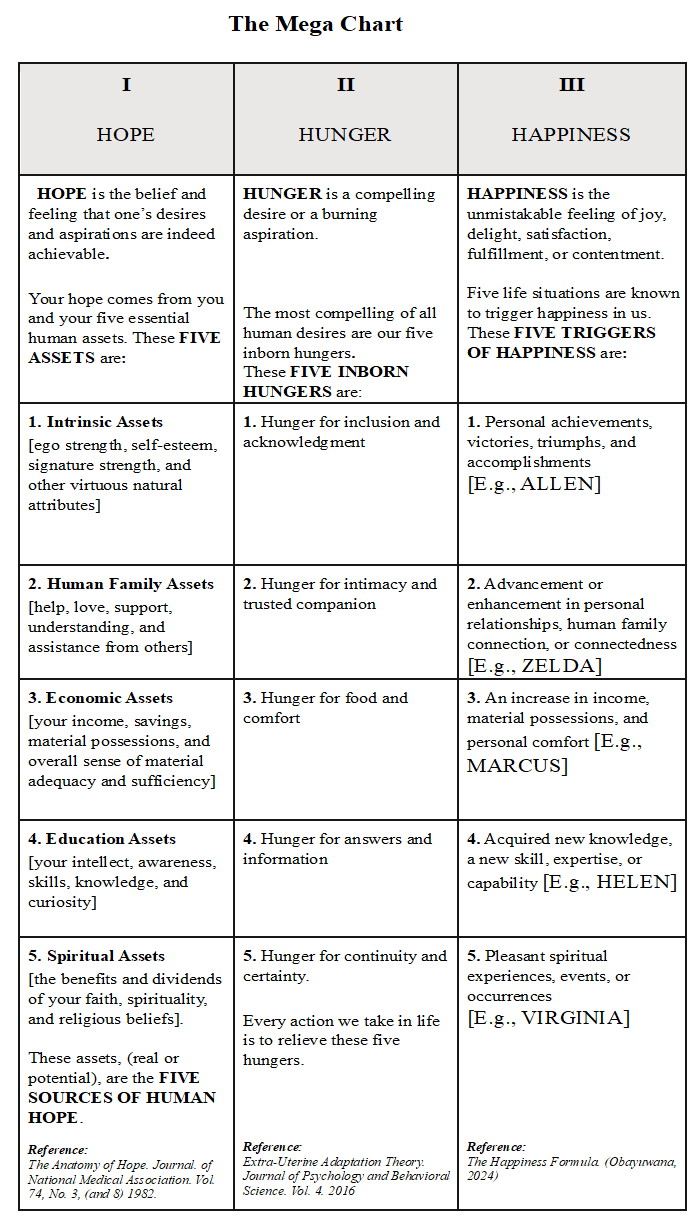 | Figure 1. Represents the Triple-H Equation, fully deconstructed to show the fundamental elements and basic components of HOPE, HUNGER, and the five triggers of HAPPINESS, juxtaposed |
6. Implications and Applications
- The Triple-H Equation has several implications, claims, and possible applications. Most fundamentally, it implies that:1. As individuals, we become happier when our HOPE is increased and our HUNGER is decreased.2. If we can accurately measure HOPE and HUNGER, HAPPINESS becomes quantifiable and reportable as an authentic happiness score (NOT the score of satisfaction with life).3. Consequently, those who are happy, or very happy, unhappy, very unhappy, flourishing, or languishing, can be accurately identified in any cohort—by their numerical happiness scores. Inspired by these implications, Edo Questionnaire, (aka Personal Instant Self-Assessment Scale or PISA Scale), a twelve-item self-assessment tool, was developed. Six items were constructed to measure HOPE and six to measure HUNGER. Ten of the twelve items were very meticulously constructed to assess the five essential human assets (or HOPE) and the five compelling human desires (or HUNGERS) of the respondent on a Likert scale of 1 to 8 with 1 or 2 representing not true at all and 7 or 8 signifying very true in response to the twelve statements made about the respondent’s daily life experiences. There are no questions asked about annual income, marital status, level of education, national GDP, or system of governance. The scale measures each respondent’s level of hope and intensity of hunger—two universally applicable human issues in every culture.Because HOPE generates positive emotions (e.g., the feelings of excitement, joy, anticipation, enthusiasm, interest, exhilaration etc.), whereas HUNGER generates negative emotions (e.g., feelings of sadness, fear, anxiety, anger, annoyance, guilt, despair, etc.), the final score is in essence the ratio of positive emotions to negative emotions of the respondent—a true measure of HAPPINESS. The questionnaire takes five minutes or less to administer, score, and interpret. It has none of the flaws of other happiness tools regarding length or brevity, assumptions and imaginations, difficulty in administration, translation, scoring, interpretation. Eurocentricity and other social desirability biases that plague many tools are minimal. It measures happiness NOT the correlations of happiness.The content validity ratio (or CVR) of the Edo Questionnaire is 0.85, its internal consistency has an alpha value of 0.88, and test-retest reliability is 0.95. Thus, the PISA Scale is a valid and authentic instrument for measuring HAPPINESS. The questionnaire takes approximately five minutes to administer, score, and interpret. Happiness scores range from 1.0 to 8.0 with PHI (or Personal Happiness Index) used as the unit of measure. Individuals with PHI of 1.0 or above are regarded as “happy”; PHI of 2.0 or above is classified as “very happy”; PHI of 4.0 or above is classified as “flourishing”. PHI of less than 1.0 means “unhappy”, PHI of 0.5 means “very unhappy”, PHI score of 0.25 or less means “languishing”. See Fig. 2.
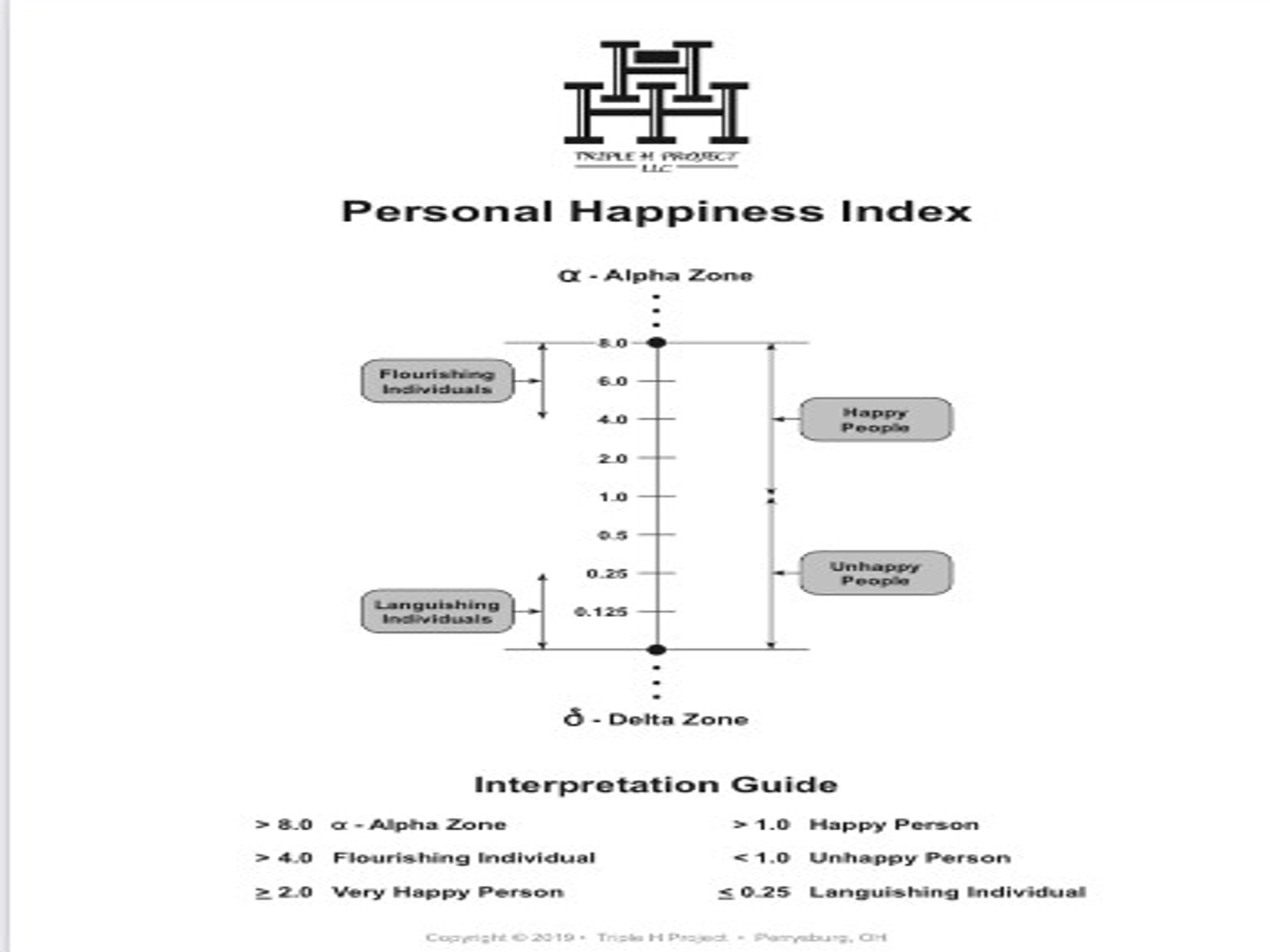 | Figure 2. Personal Happiness Indices and Interpretation Guide |
7. Emerging Data and Findings
- When testing with the PISA Scale was carried out in the United States, Canada, Nigeria, Costa Rica, Bahamas, and Jamaica, emerging results suggest and confirm that there are essentially three types of individuals to be found in every nation, community, or cohort: 1. Those who have high HOPE and low HUNGER scores 2. Those who have average HOPE and moderate HUNGER scores 3. Those who have low HOPE and high HUNGER scoresRespectively, they were named Zone A individuals, Zone B individuals, and Zone C individuals, as shown in Fig. 3.
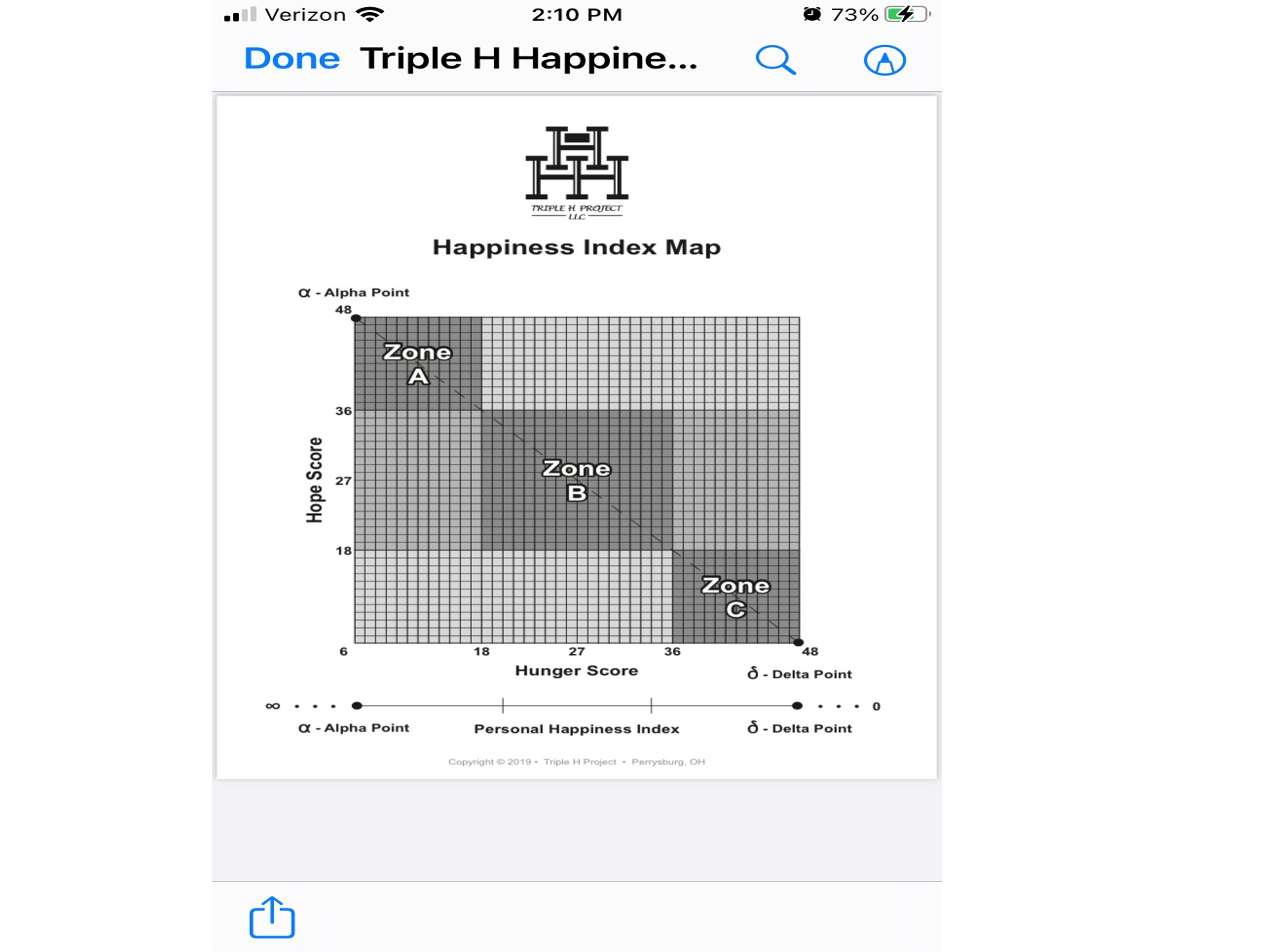 | Figure 3. Happiness Index Map & Graph showing the respective locations of Zone A, B, and C individuals |
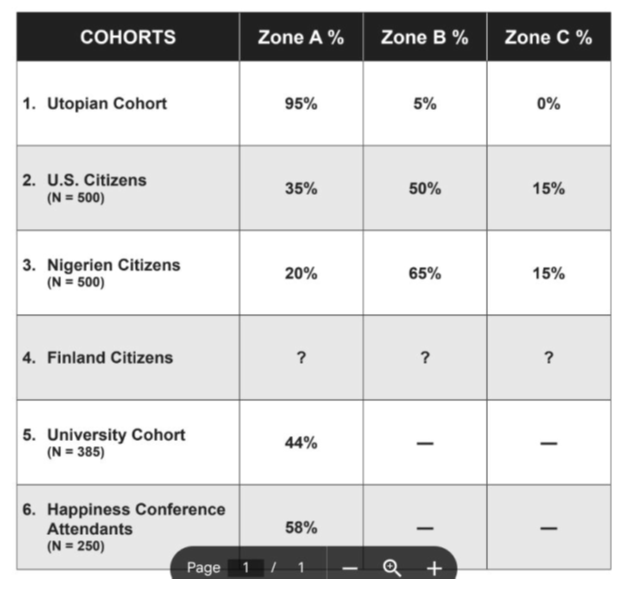 | Figure 4. Represents the ranking of cohorts—according to percentages of citizens in Zone A, B, or C |
8. Summary
- This article reports an incidental discovery of a simple but very consequential equation, that has been determined to be well-corroborated in literature, and has made it possible, for the first time, to calculate the happiness scores of individuals, based on their hopes, assets, hungers, and unfulfilled desires—with scores reported in a universal unit of measure called Personal Happiness Index (or PHI). Consequently, it is now possible to accurately differentiate, and identify happy people, unhappy people, very happy, very unhappy, flourishing or languishing individuals in any given cohort—based on their numeric happiness scores. Since HOPE and HUNGER are universal determinants of HAPPINESS in every culture, scientific researchers, clinicians, and life coach working in different parts of the globe or in culturally diverse settings, may now be able to collaborate, compare, and exchange results directly, using PHI as a common unit of measure. Like blood pressure readings, body weight in lbs., height in feet, and body mass index (BMI), there are many reasons for everyone to know his or her personal happiness index (PHI). The following two case reports are instructive: The Case of AJo AJ was a forty-three-year-old female who was the assistant principal in a middle school. She attended one of my presentations and subsequently asked privately for my happiness coaching services. During our one-on-one happiness coaching, her PHI was 0.932, which is in the “unhappy” zone.o After the necessary analyses were completed, a customized personal daily routine (or PDR) that was unique to her circumstances was designed and given to her for actualization. AJ was to return after six weeks of performing and actualizing her PDR.o Instead, she showed up after three months with copious apologies for her tardiness. At post-testing, she had a PHI of 2.314 — a very impressive progress. She had moved from Zone C to Zone A—bypassing Zone B. This was unusual but very welcome. o As the coach was marveling about what an effective happiness coaching and PDR actualization had occurred, AJ smiled broadly and said she had some good news to share: “I have been promoted to the rank of a full principal, and guess what? I also have a wedding engagement” as she flashed a diamond ring on her finger. o At that moment, it became evident why JR had taken three months instead of six weeks to return for her coaching sessions. With tearing eyes of joy, her last words were, “I was 0.9, now I’m 2.3, and I am not going to stop until I get to 4.0 and continue to flourish.” This case, like many others, heightens confidence in the Edo Questionnaire, as a tool that can capture significant life events and have them reflected in numerical happiness scores. JR knowing her PHI scores certainly gave her a sense of purpose and determination.The Case of LM o As a physician, it is routine in my clinic that the PHI of every patient is required—just like pulse, blood pressure, and temperature—called vital signs. And whenever a vital sign is abnormal, the underlying reason must be determined and attended to as a priority—regardless of the actual reason for a visit to the clinic.o When I was reviewing the chart of LM—a nineteen-year-old patient, the vital signs were all normal except that her PHI was 0.127—the lowest I had ever seen. Just as I would have done in the case of a very high fever or extremely elevated blood pressure, I sent LM to the nearest hospital emergency room for admission—with a handwritten note to the ER lead physician— explaining the need for immediate admission and a prompt psychiatric consult, within twenty-four hours. o Despite my handwritten note followed by a telephone call from me, the ER physician was not impressed given LM’s very normal blood pressure of 116/72, pulse of 78, and temperature of 98.7. The ER physician sent LM home against my advice. She was given an appointment to the outpatient psychiatric clinic for the next day. The patient, as I had feared, did not show up for her appointment and all subsequent phone calls from my nurse and me to the troubled teenager were unanswered. o We later learned that she had taken her own life—by overdosing on a bottle full of unknown pills. The very poignant case of LM makes routine determination of PHI hugely advisable. For both AJ and LM, their PHI scores were accurately diagnostic, prognostic, informative, and truly confirmatory of their wellbeing and outcomes. PHI is an authentic well-being index, a truly “vital information”. Personal Happiness Index of greater than 1.0 is a reassuring baseline score that is good to know and confirm—for oneself, or for a patient, a client, students, and employees.
9. Conclusions
- Based on the discussion, findings, results, data, and the case reports presented, it is reasonable to conclude that:1. Achievements, relationships, resources, knowledge, and spirituality make us happy (or happier) by increasing our HOPE and diminishing our HUNGER. Since the former generates positive emotions while the latter generates negative emotions, the ensuing outcome is happiness.2. The Triple-H Equation,
 needs further evaluation by other investigators because of its significant promise in the science of positive psychology and wellbeing.3. The Edo Questionnaire is a valid tool for measuring HAPPINESS, and it is available to coaches, counsellors, HR directors, other scientists, and investigators—upon requests.
ACKNOWLEDGEMENTS
- Most profound gratitude goes to those hundreds of medical and nursing students, resident physicians and fellows, as well as attending physician colleagues, particularly Drs. James Collins, Robert Barnett Jr., Georgia Dunston, John Allotey, and Ramu Perni—for their enduring support. As all the helpful individuals are too many to mention by name, much gratitude goes to institutions such as Howard University College of Medicine, Johns Hopkins School of Medicine, and Eastern Virginia Medical School for their excellent resources and highly supportive staff that made this work possible.
AWARD
- Originally, this paper was presented (orally) at the International Research Conference on Mental Health and Wellness organized by the World Academy of Science, Engineering and Technology, in London, United Kingdom, on May 18, 2026, where it won the Certificate of Best Presentation Award.